Easter IV Sunday homily- May 8, 2022

Easter IV [C] [May 8] Good Shepherd Sunday (World Day of Prayer for Vocations) (Eight minute-homily in one-page)

Introduction: The fourth Sunday of Easter, known as Good Shepherd Sunday, is also the “World Day of Prayer for Vocations.” Each year on this Sunday, we reflect on the image of Jesus as the Good Shepherd who devotedly and kindly takes care of his flock. The title “pastor” means shepherd. A shepherd leads, feeds, nurtures, comforts, corrects, and protects his flock—responsibilities that belong to all Church leaders, parents, civil leaders, and all who are in charge of others.

Scripture lessons summarized: Today’s first reading describes how Paul and Barnabas opted to listen to the voice of Jesus, the Good Shepherd, and follow him, and how, like their Master, they were rebuffed and rejected when they tried to share the good news of salvation. It also suggests that the sympathy of the early Christians for the Gentiles caused a rupture with Judaism. The second reading, taken from the book of Revelation, depicts Jesus as both the glorified Lamb and the Shepherd. John’s vision encourages his readers with the assurance that every person who has ever followed Christ and led others to him will share everlasting life with him. The Gospel text offers us both comfort and a great challenge. The comforting message is that no one can snatch the sheep out of his Father’s hands. The challenge is that pastors should be good shepherds to those entrusted to their care, while their flock of lay people should respond by being good sheep.

Shepherds in the Bible: In the Old Testament, the image of the Shepherd is often applied to God as well as to the leaders of the people. The book of Exodus represents Yahweh several times as a Shepherd. The prophets Isaiah and Ezekiel compare Yahweh’s care and protection of His people to that of a shepherd. Ezekiel represents God as a loving Shepherd who searches diligently for the lost sheep. Psalm 23 is David’s famous picture of God as The Good Shepherd: “The Lord is my shepherd; I shall not want.” In the New Testament: Introducing himself as the Good Shepherd of his flock, Jesus makes three claims in today’s Gospel. 1) He knows his sheep and his sheep hear his voice: 2) He gives eternal life to us, his sheep (by giving us Faith in him through Baptism, and then by strengthening that Faith through Confirmation, by nourishing our souls with the Holy Eucharist and the Holy Bible, and by making our society holy through the Sacraments of Matrimony and the priesthood (Holy Orders). 3) He protects his sheep by placing them in the loving hands of his Almighty Father. St. John’s Gospel adds two more claims: 4) He goes in search of stray lambs and heals the sick ones (through the Sacraments of Reconciliation and Anointing of the sick). 5) Jesus died for his sheep to free us from our sins, giving us life.

Life Messages: Let us become good shepherds and good sheep, good leaders and good followers. (1) Let us become good shepherds: Everyone who is entrusted with the care of others is a shepherd. Hence pastors, parents, teachers, doctors, nurses, government officials, etc. are all shepherds. We become good shepherds by loving those entrusted to us, praying for them, spending our time and talents for their welfare, and guarding them from physical and spiritual dangers.

(2) Let us be good sheep in the fold of Jesus, the Good Shepherd: Our local parish is our sheepfold, and our pastors are our shepherds. Hence, as the good sheep of the parish, parishioners are expected to a) hear and follow the voice of their shepherds through their homilies, Bible classes, counseling, and advice; b) receive the spiritual food their pastors provide by regular participation in the Holy Mass, by frequenting the Sacraments, and by attending prayer services, renewal programs, and missions; c) cooperate with their pastors by giving them positive suggestions for the welfare of the parish, by encouraging them in their duties, by lovingly offering them constructive criticism when they are found misbehaving or failing in their duties and by praying for them always and forgiving them at need; and d) cooperate in the activities of various councils, ministries, and parish associations. (3) Let us pray for vocations to priestly and religious life so that we may have more good shepherds to lead, feed, and protect the Catholic community.

Synopsis of Mother’s Day homily: Today we thank our mothers, pray for them and honor them by celebrating Mother’s Day and by offering our mothers on the altar of God and by praying for them. This is a day to admit gratefully the fact that none of us can return, in the same measure, all the love that our mothers have given us. Our mothers are the good shepherds we all experienced. They gave us life, nursed us, fed us, taught us, disciplined us and showed Christ’s self-sacrificing agape love for us, their children, practicing Christ’s commandment of love, “love others as I have loved you.” Let us remember that we have two mothers. Hence, let us entrust our mothers to our Heavenly Mother, Mary, the mother of Jesus who gave her as our mother, as his last gift to us from the cross, before his death.

EASTER IV [C] (May 8): Acts 13:14, 43-52; Rv 7:9, 14b-17; Jn 10:27-30

Homily starter anecdotes #I: “I know the Psalm, but he knows the Shepherd:” Years ago the great actor Richard Burton was given a grand reception in his childhood parish. While replying to the complimentary speeches in the parish auditorium he asked if there was anything, they specially wanted to hear from him. After a minute’s pause his old pastor asked him if he could recite the Good Shepherd Psalm (Psalm 23), which he had taught Burton in his Sunday school. A strange look came over the actor’s face. He paused for a moment, and then said, “I will, on one condition—that after I have recited it, you, my pastor and teacher, will do the same.” “I,” said the old, retired pastor, “am not an actor, but, if you wish it, I shall do so.” Impressively the actor began the Psalm. His voice and intonation were perfect. He held his audience spellbound, and, as he finished, a great burst of applause broke from the audience. As it died away, the old pastor rose from his wheelchair and began to recite the same Psalm. His voice was feeble and shivering and his tone was not faultless. But, when he finished, there was not a dry eye in the room. The actor rose and his voice quivered as he said, ‘”Ladies and gentlemen, I reached your eyes and ears, but my old pastor has reached your hearts. The difference is just this: I know the Psalm, but he knows the Shepherd.” — This Good Shepherd Sunday, Jesus wants us to know him by experiencing him and to become good shepherds to those entrusted to our care. (https://frtonyshomilies.com/)

#2: “Who’s running the Church, you or the Holy Spirit?” Here is an anecdote that perfectly conveys the humble spirit of Pope St. John XXIII as a good shepherd. On the evening when he announced the opening of the Second Vatican Council — the first one since 1870 — he couldn’t sleep. Finally, he called himself to order: “Angelo, why aren’t you sleeping? Who’s running the Church, you or the Holy Spirit? So sleep.” And he did. Prior to his being elected Pope, Angelo Roncalli had served as a clerical diplomat in Bulgaria, Turkey, and Greece; as Papal Nuncio in Paris; and as Patriarch of Venice. All this training helped him deal with social problems in society and in the Church. While still an Archbishop, he noted: “Wherever I go, I pay more attention to what we have in common than to what separates us.” Pope St. John XXIII began his mission by promising to be “a good shepherd.” He brought a real revolution to the Apostolic Palace by getting rid of the three prescribed genuflections in private audiences and by his impromptu conversations with workers and gardeners on the streets of Vatican City. He was the first Pope in history “to pay tribute to the part played by women in public life and to the growing awareness of their human dignity.” Best of all, by convening the Second Vatican Council, Pope St. John XXIII, led by the Holy Spirit, set in motion a spirit of reform that continues to our day. — In September of 2000, this son of Italian peasants was beatified by Pope St. John Paul II; he was canonized by Pope Francis on April 27, 2014. (https://frtonyshomilies.com/)

# 3: “LEAD, FOLLOW OR GET OUT OF THE WAY.” On a recent highway trip, one bumper sticker in particular grabbed my eye and caused me to consider its frank command: “LEAD, FOLLOW, OR GET OUT OF THE WAY.” — In a sense, the Scripture readings for today, Good Shepherd Sunday, proffer the same challenge to believers. Christianity admits of no mediocrity; the decision of Faith which discipleship demands requires a daily deliberateness and a constantly renewed certainty. Either Jesus and his way of life are accepted and followed, or they are rejected. There is no middle path; to live otherwise is to become an obstacle in the way of others. As Christians, each of us is called to be both a leader and a follower. Ultimately, as John points out in the Gospel, our leader is Jesus, the loving shepherd who calls us away from sin and self to union with him and one another. (Sanchez Files) (https://frtonyshomilies.com/)

Introduction: The fourth Sunday of Easter, known as Good Shepherd Sunday, is also the “World Day of Prayer for Vocations.” The Scripture lessons for this day concern the role of the shepherds of God’s flock in the Church. Each year on this Sunday, we reflect on the image of Jesus as the Good Shepherd who devotedly and kindly takes care of his flock. One pastor recently made the joking remark that some people think that their pastor works only on Sundays! This is obviously untrue. Exactly what responsibilities does God give a pastor and what does God expect of him besides saying Mass and preaching? The answer to the question lies in the title “pastor,” which means shepherd. A shepherd leads, feeds, nurtures, comforts, corrects, and protects his flock—responsibilities that belong to every Church leader. The earliest Christians saw Jesus as the fulfillment of the ancient Jewish dream of the Good Shepherd, Who also wished to include the Gentiles as part of God’s flock. Today’s first reading describes how Paul and Barnabas opted to listen to the voice of Jesus the Good Shepherd and follow him, and how, like their Master, they were rebuffed and rejected when they tried to share the Good News of salvation. It also suggests that the sympathy of the early Christians for the Gentiles caused a rupture with Judaism. Today’s Responsorial Psalm (Ps 100) reminds us that “…the Lord is God: He made us, His we are – His people, the flock He tends.” The second reading, taken from the book of Revelation, depicts Jesus as both the glorified Lamb and the Shepherd. John’s vision encourages his readers with the assurance that every person who has ever followed Christ and led others to him and who has suffered rejection and persecution will also know the unending joy of victory and have a share in everlasting life. The Gospel text offers us both great comfort and a great challenge. The comforting message is that no one can snatch the sheep out of Jesus’ Father’s hands. The challenge is that pastors should be good shepherds to those entrusted to their care., and their flock, the laity, should be good sheep, obedient and helpful to their shepherds.

The first reading: Acts 13:14, 43-52, explained: Paul and Barnabas were on their first missionary journey to Asia Minor (present day Turkey). On the Sabbath, Paul and Barnabas entered the synagogue at Antioch in Pisidia where they were invited to give a word of exhortation to the people. They explained that since Christ had been rejected by the Jews, Christians were obliged to preach the Gospel to all the nations, thus emphasizing the universal mission of Christianity. In other words, since the Jews had rejected the word of God, it was being offered to the Gentiles. But those Jews in Antioch who opposed the idea of preaching to the Gentiles gathered enough support to expel the apostles from their territory. Nevertheless, Paul and Barnabas remained faithful to the Gospel that Jesus had revealed. They “were filled with joy and the Holy Spirit” and continued to preach to the Gentiles who welcomed them with delight (v. 48). The mission of the Church is indeed a continuation of the ministry of salvation begun by Jesus. Is the seed of the Gospel still being sown to the ends of the earth? Are the poor, the blind, the deaf, the lame, the hungry, the thirsty, the lost, and the imprisoned still the primary focus of our service?

The second reading: Rv 7:9, 14-17, explained:

The book of Revelation, the vision Jesus gave to St. John the Evangelist,  to be written down, was meant to instruct and  encourage persecuted Christians, not only of the First Century but of all centuries. The Vision presents Jesus as both the slain and glorified Lamb and the Good Shepherd.  In the latter role, he protects and refreshes his flock when they suffer persecution.  John has a vision of all the sheep, representing the universal Church — people “from every nation, race, people, and tongue”  —  rescued by the Good Shepherd.  The Lamb will shepherd and shelter those who, with his help, win through. He will feed them well and will wipe “away every tear from their eyes.”  The essence of the vision is that Christ, the Son of the Living God Incarnate, now risen from the dead, glorified, will, in his glorified humanity, have the chief place in Heaven, and that all rational creatures will sing his praises forever.  John’s visions promised his readers that Jesus, the Passover Lamb, would shepherd them, providing them with shelter, protection, and safe passage to the life-giving waters of eternity (Ps 23; 80; 35:10; Is 40:11; Ez 34:23; Jer 2:13).

Gospel exegesis: The context: It was December, wintertime, probably the time of the Jewish Hanukkah festival (the Feast of Dedication), which commemorated the triumph of the Jewish commander Judas Maccabaeus over the Syrian leader Antiochus IV Epiphanes in 165 BC).  Jesus was walking in the Temple on the east side, which offered protection against the cold winds from the desert.  The Jews had gathered around him.  They were not sure whether or not he was the promised Messiah because there were many such wandering preachers and healers in those days.  Hence, they asked him directly whether he was the Christ. Instead of giving them an equally direct answer, Jesus claimed that he was the Good Shepherd and explained to them his role.

Shepherds in the Old Testament: In the Old Testament, the image of the Shepherd is often applied to God as well as to the leaders of the people.  The book of Exodus represents Yahweh several times as a Shepherd.  The prophets Isaiah and Ezekiel compare Yahweh’s care and protection of His people to that of a shepherd.  “He is like a shepherd feeding his flock, gathering lambs in his arms, holding them against His breast and leading the mother ewes to their rest” (Is 40:11).  Ezekiel represents God as a loving Shepherd who searches diligently for the lost sheep.  Psalm 23 is David’s famous picture of God as The Good Shepherd: “The Lord is my shepherd; I shall not want. He makes me lie down in green pastures. He leads me beside still waters; He restores my soul” (RSV, 2nd Catholic Edition).   The prophets often used harsh words to scold the selfish and insincere shepherds (or leaders) of their day.  Jer 23:1: “Doom for the shepherds who allow the flock of My pasture to be destroyed and scattered.”  Ez 34:2: “Trouble for the shepherds of Israel who feed themselves!  Shepherds ought to feed their flock.”

The Good Shepherd in the New Testament: Introducing himself as the Good Shepherd of his flock, Jesus makes three claims in today’s Gospel.

1) He knows his sheep and his sheep hear his voice: Just as the Palestinian shepherds knew each sheep of their flock by name, and the sheep knew their shepherd and his voice, so Jesus knows each one of us, our needs, our merits, and our faults.  He loves us as we are, with all our limitations, and he expects us to return his love by keeping his words.  He speaks to us at every Mass, through the Bible, through our pastors, through our parents, through our friends, and through the events of our lives.  “God whispers to us in our pleasures, He speaks to us in our consciences, and He shouts to us in our pain!” (C.S. Lewis).  2) He gives eternal life to us, his sheep by receiving us into his sheepfold and giving us Faith through Baptism, and then he strengthens that Faith in Confirmation.  He supplies food for our souls in the Holy Eucharist and in the Divine words of the Holy Bible.  He makes our society holy by the Sacraments of Matrimony and the priesthood (Holy Orders.  3) He protects his sheep by placing them in the loving hands of his Almighty Father.  Without him to guide us and protect us, we are an easy prey for the spiritual wolves of this world, including Satan and his minions.

In chapter ten of John’s Gospel, Jesus adds two more roles to those of the Good Shepherd.  He goes in search of stray lambs and heals the sick ones.  Jesus heals the wounds of our souls through the Sacrament of Reconciliation and strengthens us in illness and old age with the Sacrament of the Anointing of the Sick.  Jesus dies for his sheep:  Just as the shepherds of ancient days protected their sheep from wild animals and thieves by risking their own lives, so Jesus died in expiation for the sins of all people.

Through today’s Gospel, Jesus teaches one of the central aspects of the ministerial priesthood: the priest as shepherd.  It means that a priest is one who, by his consecration, lives for others.  The title, “Father”, like the title, “Shepherd,” expresses a relation of loving service to others in everything, from the most sacred ministries to the most trivial chores.

World Day of Prayer for Vocations. ” Today is also “World Day of Prayer for Vocations.” It is a day when Christians are invited to reflect on the meaning of God’s call and to pray that they may answer the call to dedicate their lives to serve the Church in a special way, i.e. to shepherd the Church communities, particularly as pastors in their parishes and as superiors in their religious orders or congregations. The Church presents to us in today’s Gospel the figure of Jesus the Good Shepherd that we may reflect on the meaning of the  religious vocation to priesthood, diaconate, and consecrated life.  Last Sunday we reflected on  Our Lord’s commission and charge to Peter, saying once, “Feed my lambs,” and twice, Feed my sheep.” In that way he made Peter a shepherd, a pastor. Our Lord continues his work of shepherding his people through Peter and his co-workers: the apostles and disciples, and through their successors: the Pope, the bishops, priests, deacons, catechists, and committed lay people. The first thing we need to remember is that every single person here has a vocation!  Each person here, whatever one’s state in life, has been, and is being, called by God through the Holy Spirit to offer one’s special gifts to benefit  the rest of the community.  Therefore, “Vocations Sunday” is not just for a few selected for directly religious vocations, it is for all of us here. On the one hand, each one needs to reflect on what one’s particular calling is and how one can respond to it for the well-being of the whole parish community. Secondly, one needs to help others,  and not be an obstacle to them as they respond  to the particular calling and graces that God through his Spirit is giving one. If we will all actively respond to that call what a wonderful community, we  will be! For, We are his people, the sheep of his flock.”

 Life Messages: Let us become good shepherds and good sheep, good leaders and good followers.

1) Let us become good shepherds:  Everyone who is entrusted with the care of others is a shepherd.  Hence, pastors, parents, teachers, doctors, nurses, government officials, etc. are all shepherds.  We become good shepherds by loving those entrusted to us, praying for them, spending our time and talents for their welfare, and guarding them from physical and spiritual dangers.  Parents must be especially careful of their duties, thus giving their children good example through the way they live their Christian lives as husband and wife and as parents.

2) Let us be good sheep in the fold of Jesus, the Good Shepherd: Our local parish is our sheepfold, and our pastors are our shepherds.   Jesus is the High Priest, the bishops are the successors of the apostles, the pastors, assisted by their Deacons,  are their helpers and the parishioners are the sheep.  Hence, as the good sheep of the parish, parishioners are expected to a) hear and follow the voice of their shepherds through their homilies, Bible classes, counseling, and advice; b) receive the spiritual food our pastors provide by regular participation in the Holy Mass, by frequenting the Sacraments, and by attending prayer services, renewal programs, and missions; c) cooperate with our pastors by giving them positive suggestions for the welfare of the parish, by encouraging them in their duties, by lovingly offering them constructive criticism when they are found misbehaving or failing in their duties, by praying for them always and forgiving them at need; and d) cooperate with our fellow-parishioners in the activities of various councils, ministries, and parish associations.

3) Let us pray for  generous responses to all the vocations God offers men  to enter the priesthood, the diaconate, the mission fields, and all the vocations God offers   both men and women  to enter the consecrated  life, so that we may have more good shepherds to lead, feed, and protect the Catholic community here an abroad. Let us remember that the duty of fostering vocations is the concern of the whole believing community, and we discharge that responsibility primarily by living exemplary Christian lives. Parents foster vocations by creating a God-centered climate in homes based on solid Christian values. They should pray with their children for vocations during the family prayer time and speak encouraging words about their pastors, the missionaries, and the religious, instead of criticizing these servants of God. Such an atmosphere in the family will definitely foster vocations from such families. Financial support of seminarians is also a positive contribution to promoting vocations.

JOKE OF THE WEEK

#1: The young pastor was teaching the 23rd Psalm to the Sunday school children. He told them that they were sheep who needed guidance.  Then the priest asked, “If you are the sheep, then who is the shepherd?”– obviously indicating himself.  A silence of a few seconds followed.  Then a young boy said, “Jesus. Jesus is the Shepherd.”  The young priest, obviously caught by surprise, said to the boy, “Well then, who am I?”  The boy frowned thoughtfully and then said, “I guess you must be a sheep dog.”

#2: A man in an Armani suit, Ferragamo shoes, the latest Polarized sunglasses and a tightly knotted power tie emerges from his shiny silver BMW, approaches a shepherd guarding his flock, and proposes a wager: “Will you give me one of your sheep, if I can tell you the exact number in this flock?”  The shepherd accepts.  “973,” says the man.  The shepherd, astonished at the accuracy, says, “I’m a man of my word; take the sheep you have won.”  The man picks a sheep and begins to walk away.  “Wait,” cries the shepherd, “Let me have a chance to get even.  Will you return my animal if I tell what your job is?”  “Sure,” replies the man.  “You are an economist for a government think-tank,” says the shepherd.  “Amazing!” responds the man, “How did you deduce that?”  “Well,” says the shepherd,you drove into my field uninvited.  You asked me to pay you for information I already know, answered questions I haven’t asked, and you know nothing about my business.  Now put down MY DOG!”

Note: (Pictures are available only in my emailed homilies because permission from the publishers is necessary for legally uploading pictures in a website. You may get pictures  from Google images, by typing the subject John 10: 27-30 or Easter IV Sunday (C) under Google images).

USEFUL WEBSITES OF THE WEEK

1) Fr. Don’ collection of video homilies & blogs: https://sundayprep.org 

2) Video Sunday-Scripture study by Fr. Geoffrey Plant:

https://www.youtube.com/user/GeoffreyPlant2066

3) Dr. Brant Pitre’s commentary on Cycle C Sunday Scripture for Bible Class: https://catholicproductions.com/blogs/mass-readings-explained-year-c

 4)      Catholic questions& answers: Once Catholic.org,

5)      Catholic answers for teenagers: EveryStudent.com,

6)      The Catholic News Service:http://www.catholicnews.com

7)      Doctrinal Concordance: http://www.infpage.com/concordance/

8) USCCB gospel video reflections: http://www.usccb.org/bible/reflections/

23 Additional anecdotes

1) St. Teresa of Calcutta (Mother Teresa)’s Good Shepherd prayer: During her visit to the United Nations several years ago, Mother Theresa was approached by a diplomat who said, “I am not a Catholic, Mother.  But I want to know: how should I pray.”  The frail little nun took his burly hands in hers and spread out five of his fingers on one hand.  “When you pray,” she said, “Think about the many blessings you have received; then, at the end of the day, count out on each finger the words spoken to you by Jesus: ‘You.. did.. this.. for.. Me.’”  The diplomat left holding up his hand as though it were a trophy and saying: “You did this for me.” — In this simple prayer, Mother Theresa let us see the Resurrection as real.  What she meant was that the love and peace of the Good Shepherd is present to us in the many moments of compassion that bless our lives:  in kind words, in the listening ear, in generous actions.  Jesus is also present in the blessings we extend to others.  The Good Shepherd of today’s Gospel guides us every day in our journey to eternal life. (Sanchez Files) https://frtonyshomilies.com/)

2) “Whatever happens, don’t let go.”  There is a wonderful scene towards the end of the movie, Titanic.   As the ship is preparing to take its final plunge into the cold waters of the Atlantic, Jack Dawson and Rose are hanging straight onto the edge of the ship.  Jack turns to Rose and tells her: “Don’t let go. Whatever happens, don’t let go.” —  There is something profound in knowing that there is someone who wants us to hold on, no matter how difficult the situation.  As children, we held onto our parents for guidance and protection.  When we are adults, we hope to find a spouse or close friend who will hold us when we are hurt and carry us when we stumble.  In today’s Gospel, we hear the profound revelation from Jesus that God intends to “hold us” through every storm and every difficulty of life.  Jesus, as our Good Shepherd, offers us double protection.   He assures us that we are in his hands and nothing will ever take us from him.  He further assures us that we are also in the Father’s hands.   Nothing can ultimately hurt us. https://frtonyshomilies.com/)

3)   “I have a dream:” https://youtu.be/_IB0i6bJIjw   During the Civil Rights struggles of the 1960s, Martin Luther King Jr. kept alive the hopes of victims of race discrimination by sharing his dreams. On August 28, 1963, standing on the steps of the Lincoln Memorial in Washington DC, he told the audience of nearly 250,000  those who had joined the March on Washington for Jobs and Freedom, (Wikipedia) “I have a dream . . . a dream that one day the sons of former slaves and the sons of former slave owners will be able to sit down together at the table of brotherhood. . . that this desert state sweltering with the heat of injustice and oppression will be transformed into an oasis of freedom and justice.” King’s dream awakened a nation and challenged its people and its legislators to face the inequities being perpetrated against some of its citizens. King’s dream offered consolation, inspired courage and strengthened the committed. Twenty centuries before King, the seer, John, similarly served his contemporaries with his visions. Like King, John shared his visions with the struggling. During the reign of the Roman emperor Domitian (AD 81-96), Christians were being persecuted for their Faith. Denied the right to worship as they wished, they were judged guilty of treason for refusing to venerate Domitian as god. So condemned, they became the prey of one of the fiercest persecutions ever launched against the Church. A contemporary of John’s, Clement of Rome, described the injustices suffered by those early followers of Christ as “sudden and repeated misfortunes and calamities.” Nevertheless, the Church was not without hope. John’s vision of a glorious future in the eternal presence of God and the victorious Lamb of God (Jesus) strengthened his contemporaries in their resolve to remain firm in their Faith, undeterred in their baptismal commitment. https://frtonyshomilies.com/)

4)  A sergeant’s good shepherd’s story:  There was a sergeant in the Marines who was the senior enlisted man in his platoon.  One day his outfit was ambushed and pinned down by enemy fire.  The lieutenant in command was badly wounded as were many of the men.  The sergeant took over and extricated the men from the trap, though he himself was wounded twice.  He went back by himself to carry out the wounded commanding officer.  Miraculously every man in the platoon survived, even the wounded lieutenant.  Later the men said that if it were not for the incredible bravery of the sergeant, they all would have been killed.  “He was like a father to us,” they said.  He was recommended for the Medal of Honor but did not receive it.  However, he did receive the DFC.  — He never wore the medal because he said the lives of his men were more important than any medal.  Later when he had children of his own, he loved them devotedly.   His wife said that during the war he had learned to be tender. https://frtonyshomilies.com/)

5) Jesus knows his sheep by name: There have always been people with a good memory for names: Napoleon, “who knew thousands of his soldiers by name . . .” or James A. Farley, “who claimed he knew 50,000 people by their first name . . .” or Charles Schwab, “who knew the names of all 8,000 of his employees at Homestead Mill . . .” or Charles W. Eliot, “who, during his forty years as president of Harvard, earned the reputation of knowing all the students by name each year . . .” or Harry Lorayne, “who used to amaze his audiences by being introduced to hundreds of people, one after another, then giving the name of any person who stood up and requested it.”– But can you imagine Christ knowing all his sheep by name? That’s millions and millions of people over 2,000 years. No wonder we call him Master, Lord, Savior – watching over his flock, calling each by name! https://frtonyshomilies.com/)

6) “I only know them by name.” Tony Campolo loves to tell the story of a particular census taker who went to the home of a rather poor family in the mountains of West Virginia to gather information. He asked the mother how many dependents she had. She began, “Well, there is Rosie, and Billy, and Lewella, Susie, Harry, and Jeffrey. There’s Johnny, and Harvey, and our dog, Willie.” It was then that the census taker interrupted her aid said: “No, ma’am, that’s not necessary. I only need the humans.”                                                “Ah,” she said. “Well, there is Rosie, and Billy, and Lewella, Susie, Harry, and Jeffrey, Johnny, and Harvey, and….” But there once again, the census taker interrupted her. Slightly exasperated, he said, “No, ma’am, you don’t seem to understand. I don’t need their names; I just need the numbers.” To which the old woman replied, “But I don’t know them by numbers. I only know them by name.” — In today’s Gospel Jesus the Good Shepherd says that he knows his sheep by name. https://frtonyshomilies.com/)

7) “I’d like to preserve my integrity and credibility.” About 4 years ago, Mark Cuban, owner of the NBA’s Dallas Mavericks, offered WGN Chicago Radio sports-talk host David Kaplan $50,000 to change his name legally to “Dallas Maverick.” When Kaplan politely declined, Cuban sweetened the offer. Cuban would pay Kaplan $100,000 and donate $100,000 to Kaplan’s favorite charity if he took the name for one year. After some soul searching and being bombarded by e-mails from listeners who said he was crazy to turn down the money, Kaplan held firm and told Cuban no. Kaplan explained: “I’d be saying I’d do anything for money, and that bothers me. My name is my birthright. I’d like to preserve my integrity and credibility.” [Skip Bayless, Chicago Tribune (1/10/01), Leadership Summer 2001)] — The name “Christian” is our birthright. From the moment of our Baptism and our birth into the Kingdom of God, we are the sheep of the Good Shepherd who promises to lead us to green pastures and beside the still waters. The Voice of the Shepherd protects us. https://frtonyshomilies.com/)

8) “May I see your driver’s license?” Everyone, it seems, is interested in my numbers. I go to the grocery store to buy some groceries. After the checkout woman rings up my bill, I pull out my checkbook and write out the check. She takes it from me. She looks at the information. Numbers tell her where I live. Numbers tell her how to reach me on the telephone. “Is this information correct?” she asks. “Yes, it is,” I reply. “May I see your driver’s license?” she asks. She looks at my driver’s license and writes some more numbers on my check. Finally, I am approved. The numbers are all there. I can eat for another week. One could wish it were a bit more human and personal. So the IRS knows me by my tax number. My state knows me by my driver’s license number. My bank knows me by my bank account number. My employer knows me by my social security number. On and on it goes for you, for me, for everybody. Everybody knows my numbers. I am not sure that anyone knows me! — The numbers game that is played in our culture is one symptom of loneliness and alienation that surrounds us today. “All the lonely people, where do they all come from?” That is a line from the song Eleanor Rigby by the Beatles. Loneliness. Isolation. Alienation. These are the realities of contemporary civilized life. “I am the Good Shepherd.” These are Jesus’ words in our reading from John’s Gospel text for this sermon. “I am the Good Shepherd; I know my own and my own know me …” Today’s Gospel tells us that Jesus knows us personally and loves us. https://frtonyshomilies.com/)

9)  His Master’s Voice: Have you ever seen the painting done in the 1930s of a dog, looking with a cocked head, at an old gramophone? The name of the painting is His Master’s Voice. This serves us today as a symbol of what Jesus is saying to us: “The sheep listen to his voice. He calls his own sheep by name and leads them out.” https://frtonyshomilies.com/)

10) “Then we FLEECE them!” Two television evangelists were talking. One was explaining how he was seeking to be the ideal shepherd to his television flock. “There are three ways I seek to do that,” he said. “What three ways do you mean?” asked the other evangelist. “Well” he explained, “First, we FIND them. Every year we find new stations to carry our ministry. Then we FEED them. I give them the plain unvarnished word of God.” “But what’s the third thing?” asked the second evangelist. “Well,” he answered, “Once we’ve found them and fed them, then we FLEECE them!” –Some TV evangelists have become quite proficient at fleecing their flock. I hope you understand that nothing could be farther from the example of Christ. Jesus said, “I am the Good Shepherd. The Good Shepherd lays down his life for the sheep . . .” Fleecing the flock is a long way from laying down your life for them. https://frtonyshomilies.com/)

11) “But I never jumped.” A paratrooper who had recently resigned from the military was asked how many times he had jumped out of an airplane. He said, “None.” A friend of his asked, “What do you mean, ‘none,’ I thought you were a paratrooper?” He said, “I was, but I never jumped. I was pushed several times . . . but I never jumped.” — The hired hand never jumps. He has to be pushed. Churches often have hired hands in them. Not our Church, of course! But other Churches are full of people who have to be pushed to do what they know they ought to do. Jesus did not have to be pushed. https://frtonyshomilies.com/)

12) “I give my life for my sheep”: We applaud when a man or woman gives his or her life for another. Such instances do come along from time to time. Murfreesboro, Tennessee. May 28, 1989: “Former NFL football player Jerry Anderson,” read the newspaper account, “died Saturday after pulling two young boys out of a rain-swollen river about 40 miles southeast of Nashville. Witnesses said Anderson saw two boys, thought to be 11 or 12 years old, attempting to cross a dam spanning the river. One or both boys fell into the water. According to Officer Bill Todd, ‘Mr. Anderson jumped in the water and managed to get the little boys out, but witnesses said he went under two or three times and about the fourth time, he didn’t come back up.’” He gave his life to rescue two small boys. https://frtonyshomilies.com/)

Of course, you don’t have to be an American or a football player for such heroic actions. In a Middle school in the Ukrainian village of Ivanichi, a young teacher died sometime back. He absorbed the blast of a hand grenade to protect his pupils. What was a grenade doing in a middle school? According to the London Times, the teacher, a graduate of the KGB border guard college, had been delivering the military instruction that is a compulsory part of the curriculum for Soviet children. He was teaching them how to handle what should have been an unarmed grenade. When he pulled the pin a wisp of smoke showed that a live grenade had become mixed in with demonstration grenades, and he fell on the grenade, giving his life to save the children. https://frtonyshomilies.com/)

And you don’t have to be a man to perform such heroics. Many years ago a woman carrying a baby through the hills of South Wales, England, was overtaken by a blizzard. Searchers found her later frozen to death in the snow. Amazed that she had on no outer garments, they searched further and found her baby. She had wrapped them around the child, who was still alive and well. He grew up to be David Lloyd George, the Prime Minister of Great Britain in World War I. https://frtonyshomilies.com/)

13) Big Brother is watching us: Ever since George Orwell’s 1984 hit the bookstores, people concerned about individual privacy and freedom have looked for signs that Big Brother is becoming a reality in our society. And it is true that more and more of our urban landscape is being observed by security cameras. But that is only one way our privacy is being invaded. There was a news report several years ago that Israeli scientists are now marketing a microchip that, implanted under the skin, will protect film stars and millionaires from kidnappers. The chip emits a signal detectable by satellite to help rescuers determine a victim’s approximate location. Originally the chip was developed to track Israeli secret-service agents abroad. The $5,000 chip doesn’t even require batteries. It runs solely on the neurophysiological energy generated within the human body. The firm which developed it, Gen-Etics, won’t reveal where the chip is inserted but said that, at that time, 43 people had had it implanted. Since this report was published there has been an explosion of interest in this technology. Farmers keep tabs on the health and safety of their cows and other livestock with such chips. But the use of such devices to monitor human beings is almost limitless. Already there is a monitoring bracelet for Alzheimer patients, so that families can use GPS systems to help find loved ones who might have wandered off. Would it be inconceivable that loving parents might want to monitor the whereabouts of their children via satellite? Why not have a chip implanted? Pet owners are already using such technology. Some cynics have suggested that some wives might want to monitor their husbands. Soon we will see signs, “Big Brother is watching.” — Here’s what’s amusing to me. There are people who have no difficulty believing that one day the government will keep track of us all, but who cannot conceive that an all-knowing God can take a personal interest in each of His children, hear each of our prayers, and be responsive to each of our individual needs! https://frtonyshomilies.com/)

14) Images are highly influential. They become emblazoned on the wall of our minds, and they evoke a wide range of responses. Millions of people will remember the fireman carrying the baby out of the ruins of the Murrah Federal Building in Oklahoma City. World War II veterans, particularly the ones who served in the South Pacific, will always remember Mount Surabachi and the Marines who raised an American flag at its summit, as well as the image of General MacArthur returning to the Philippines. Neil Armstrong taking that first step on the moon in the early ’70s is frozen in many memories, too. If you were old enough to watch and understand television in l963, you probably remember young John F. Kennedy, Jr., at the casket of his father Jack. Much closer to our own time, many of us will long retain the image of students running out of Columbine High School with their hands over their heads. — Some images are immensely powerful and have a tenacity that is tireless and timeless.  If there is one image associated with the Christian Faith which, more than any other, has found an enduring place within the collective life of the Christian church, it is the image of Jesus as the Good Shepherd. https://frtonyshomilies.com/)

15)  Hannah and her Sisters: A movie by Woody Allen, titled, Hannah and Her Sisters, deals precisely with that theme. It is about Hannah and her sisters and how family life gives some sense of stability to life in a fractured world. The part played by Woody Allen in the movie is that of a man who is constantly afraid that he will get some terrible disease. He is what we call a hypochondriac. As he comes into the movie, we see him on his way to the doctor. The doctor assures him that nothing seems to be terribly wrong, though some additional tests need to be made. Woody cannot calm himself over these additional tests. He is sure they will find something terrible. “What are you afraid of,” one of his friends asks him, “cancer?” “Don’t say that,” Woody responds with a look of terror. More tests are performed. A CAT scan is prescribed for his head. He is sure they will find a brain tumor. But his fears are unfounded. The doctor announces to him that all is well. In the next scene we see Woody coming out of the hospital, kicking up his heels, and running joyfully down the street. He is celebrating. But suddenly he stops. We know instinctively why he stops. He tells us in the next scene. “All this means,” he says, “is that I am all right this time. Next time it will probably be serious.” —  Our lives are lived in constant danger. Woody Allen’s character overplays the danger. But the danger is there. There are all kinds of realities that imperil our lives nearly every day. Accidents might befall us. Natural disasters strike. Oppressive structures of life weigh us down. Disease stalks us and death awaits. That is the way life is. We live our lives in constant peril. Woody Allen might have exaggerated a bit, but he is right. Human beings belong to an endangered species. Death calls a halt to every human life.  “I am the Good Shepherd,” Jesus says. “The Good Shepherd lays down his life for the sheep.” https://frtonyshomilies.com/)

16)  The Bismarck: In the beginning of World War II, the Nazis commissioned a massive battleship named the Bismarck.  It was the biggest fighting vessel the world had seen up to that time.  With the Bismarck, the Germans had the opportunity to dominate the seas.  Very soon after it was commissioned, the Bismarck sank tons of Allied shipping and allied aircraft.  Its massive armor plating resulted in the boast that the Bismarck was unsinkable.  But the Bismarck was sunk.  And it was sunk due to one lone torpedo.  A torpedo hit the Bismarck in the rudder.  As a result, the battleship zig-zagged through the sea, unable to reach harbor.  It was only a short while before the British navy was able to overtake and destroy it.  No matter how large the battleship may be, it is doomed without a rudder to direct it. — Floundering on the waters of chaos without a rudder, the Bismarck is a modern-day image of a world without the direction of Jesus the Good Shepherd.  Without the Lord, the world is headed toward chaos.  But with the Lord there is guidance, direction and purpose in life. https://frtonyshomilies.com/)

17) Alexander, the shepherd of soldiers.  When the emperor Alexander the Great was crossing the Makran Desert on his way to Persia, his army ran out of water.  The soldiers were dying of thirst as they advanced under the burning sun.  A couple of Alexander’s lieutenants managed to capture some water from a passing caravan. They brought some to him in a helmet.  He asked, “Is there enough for both me and my men?” “Only you, sir,” they replied.  Alexander then lifted up the helmet as the soldiers watched.  Instead of drinking, he tipped it over and poured the water on the ground. The men let up a great shout of admiration. —  They knew their general would not allow them to suffer anything he was unwilling to suffer himself. https://frtonyshomilies.com/)

18) “It will kill you if you move.” A soldier dying on a Korean battlefield asked for a priest. The Medic could not find one. A wounded man lying nearby heard the request and said, “I am a priest.” The Medic turned to the speaker and saw his condition, which was as bad as that of the other. “It will kill you if you move,” he warned. — But the wounded chaplain replied. “The life of a man’s soul is worth more than a few hours of my life.” He then crawled to the dying soldier, heard his confession, gave him absolution and the two died hand in hand. https://frtonyshomilies.com/)

19) Four clergymen, taking a short break from their heavy schedules, were on a park bench, chatting and enjoying an early spring day. “You know, since all of us are such good friends,” said one, “this might be a good time to discuss personal problems.” They all agreed. “Well, I would like to share with you the fact that I drink to excess,” said one. There was a gasp from the other three. Then another spoke up. “Since you were so honest, I’d like to say that my big problem is gambling. It’s terrible, I know, but I can’t quit. I’ve even been tempted to take money from the collection plate.” Another gasp was heard, and the third clergyman spoke. “I’m really troubled, brothers, because I’m growing fond of a woman in my church — a married woman.” More gasps. But the fourth remained silent. After a few minutes the others coaxed him to open up. “The fact is,” he said, “I just don’t know how to tell you about my problem.” “It’s all right, brother. Your secret is safe with us,” said the others. “Well, it’s this way,” he said. “You see, I’m an incurable gossip.- — Jokes like this have shaped our views of priests as if there is no difference between the life and work of a priest and that of other Christians. Today’s Gospel tells us that priests are expected to be Good Shepherds as the picture given by Jesus. (Fr. Munacci). https://frtonyshomilies.com/)

20) WHO IS YOUR SHEPHERD?

The TV is my shepherd; I shall not want.
It makes me to lie down on the sofa.
It leads me away from the Faith.
It destroys my soul.
It leads me to the path of sex and violence for the advertiser’s sake.
Even though I walk in the shadow of Christian responsibilities,
There will be no interruption, for the TV is with me.
Its cable and remote control, they comfort me.
It prepares a commercial for me in the midst of my worldliness
And anoints my head with secular humanism and consumerism.
My covetousness runs over.
Surely ignorance and laziness shall follow me all the days of my life,
And I shall dwell in the house of wretchedness watching TV forever.                                (Broadcast on EWTN on March 18, 2002) https://frtonyshomilies.com/)

21) “I prayed and prayed, and I thought you were going to save me!” A Christian humorist once told a story about a man who had climbed onto the roof of his home to escape rising flood waters from torrential rains. He prayed to God to act quickly to save him. After a short while, a search and rescue team came and shouted for the man to jump and swim to their boat. He refused, saying that God would take care of him. Later, a helicopter pilot lowered a ladder and beckoned to him to climb up to safety. Again, he refused, affirming his reliance on God. Hours passed and, as the sky grew dark and the air cold, the man cried out his distress to God, “I prayed and prayed, and I thought you were going to save me!” After a moment of silence, the rooftop refugee heard a voice, “I sent you a team with a boat and a pilot with a helicopter. . . what more do you want?” — Because aid did not come in the manner he expected, the man didn’t recognize his divine rescuer. Many of Jesus’ contemporaries appear to have had a similar experience. He was not the type of Savior they had anticipated; therefore, they did not recognize him as such, nor did they respond to his voice by following him. However, as the fourth evangelist points out in today’s Gospel, those who did hear his voice were promised the gift of eternal life. (Sanchez Files). https://frtonyshomilies.com/)

22) Jewish dream for a new Judas Maccabeus:  An eight-day festival of lights held each Chislev (December), Hanukkah memorialized the successful Maccabaean revolt against the Seleucids (a Greek dynasty) in 164 B.C.E. Three years earlier, in 167 B.C., Antiochus IV Epiphanes had desecrated the Lord God’s Temple in Jerusalem by placing a statue and altar of Zeus on the altar of burnt offerings, Daniel’s “the abomination of desolation in the Holy Place” (Dn 8:13).  Antiochus ordered the people to worship the  idol and to sacrifice swine on Zeus’s altar to worship that god. [(Josephus, The Jewish War). (See www. Penelope.uchicago.edu —Encyclopaedia Romana, Notae, Miscellanea, Trivia Questions, Question #11: Which three kings of Orient old were like no man’s adversary?) After routing their oppressors and destroying their idols, the Jews, led by Judas Maccabeus built a new altar and reconsecrated the Temple. Thereafter Hanukkah became a feast which celebrated not only the restoration of the Temple and its liturgy but also the national heroes of Judah. There is little wonder that this feast also occasioned public excitement and desire for a new Judas Maccabeus to rise up from among them and lead them to victory over the Romans.  — Jesus, however, was a hero of another ilk. He would, indeed, lead a revolt and emerge victorious, but it would be a revolt against the forces of evil and a victory over death. Those wishing a share in his victory need only listen to Jesus’ voice and follow his lead. https://frtonyshomilies.com/)

23) My sheep…I know them:” In his book “Everyday Life of the Mayas,” Ralph Whitlock tells us of the delicate respect that these Central American Indians had for animals in pre-Christian days. “Every animal in the forest,” he writes, “had a soul, which was protected by the gods of the earth. A man could kill an animal if he needed to, but before or immediately afterwards he had to offer an apology.” —   When Christ spoke of the almost “family” relationship between the Good Shepherd and his sheep, he was speaking in terms that his Palestinian listeners, largely shepherds, well understood. Even today in the Middle East, there is close, almost familial, rapport between a shepherd and each of his flock. The sheep know his voice and follow him like children. He in turn knows them as individuals and treats them as a loving father. He will protect them at all costs against anybody who will try to “snatch them out of his hand” (Today’s Gospel). If one of them should stray, he leaves the rest in a safe place and goes off through brush and briar in search of the wanderer. Even when he finds the maverick sheep, he will not scold it (it is already sufficiently frightened and humbled); but simply put it over his shoulders and bring it back joyfully to the sheepfold.

St. Maximus the Confessor, an abbot of the seventh century, pointed out the close parallel between the forgiving shepherd and the forgiving Christ. Of Jesus he said, “When He found wandering in the mountains and hills the one sheep that had strayed from God’s flock of a hundred, he brought it back into the fold, but He did not exhaust it by driving it. Instead He placed it on His shoulders and so compassionately, He restored it safely to the flock.” — Jesus, our good shepherd, calls on us, the sheep of his fold, to return to Him, whether we have wandered far or near. He asks us to confess our sins and change our hearts. We need not fear to say, “I am sorry”. He who calls will treat us gently. He not only loves us; He respects us. (Father Robert F. McNamara). https://frtonyshomilies.com/)

 “Scriptural Homilies” Cycle C (No. 30) by Fr. Tony: akadavil@gmail.com

Visit my website by clicking on https://frtonyshomilies.com/ for missed or previous Cycle C homilies, 141 Year of FaithAdult Faith Formation Lessons” (useful for RCIA classes too) & 197 “Question of the Week.” Contact me only at akadavil@gmail.com. Visit also https://www.catholicsermons.com/homilies/sunday_homilies  under Fr. Tony’s homilies and  under Resources in the CBCI website:  https://www.cbci.in  for other website versions.  (Vatican Radio website: http://www.vaticannews.va/en/church.html uploaded my Cycle A, B and C homilies in from 2018-2020)  Fr. Anthony Kadavil, Chaplain, Sacred Heart Residence of the Little Sisters of the Poor, 1655 McGill Ave, Mobile, AL 36604


May 2-7 weekday homilies

May 2-7:Kindly click on http://frtonyshomilies.com/ for missed Sunday and weekday homilies, RCIA & Faith formation classes: May 2 Monday: (St. Athanesius, Bisop, Doctor of the Church) https://www.franciscanmedia.org/saint-of-the-day/saint-athanasiusJn 6:22-29: 22 On the next day the people who remained on the other side of the sea saw that there had been only one boat there, and that Jesus had not entered the boat with his disciples, but that his disciples had gone away alone. 23 However, boats from Tiberias came near the place where they ate the bread after the Lord had given thanks. 24 So when the people saw that Jesus was not there, nor his disciples, they themselves got into the boats and went to Capernaum, seeking Jesus. 25 When they found him on the other side of the sea, they said to him, “Rabbi, when did you come here?” 26 Jesus answered them, “Truly, truly, I say to you, you seek me, not because you saw signs, but because you ate your fill of the loaves. 27 Do not labor for the food which perishes, but for the food which endures to eternal life, which the Son of man will give to you; for on him has God the Father set his seal.” 28 Then they said to him, “What must we do, to be doing the works of God?” 29 Jesus answered them, “This is the work of God, that you believe in him whom he has sent.” Additional reflections: Click on https://bible.usccb.org/podcasts/video; https://catholic-daily-reflections.com/daily-reflections/; https://www.epriest.com/reflections .

The context: Today’s Gospel introduces Jesus’ famous discourse on the Holy Eucharist which emerged within a dialogue between Jesus and the Jews who had gone around the Lake and come to Capernaum searching for him. In answer to their question about his arrival, Jesus challenged them, saying that they were looking for him so they could get another free meal and that such meals would not satisfy them. He also instructed them to labor for food that would give them Eternal Life.

Naturally, the Jews asked Jesus what they should do to get such a food. Since the Jews believed that the Torah was the “bread of life,” many may have thought that Jesus was instructing them to keep the Torah to attain Eternal Life. So, Jesus clarified that they had to do the work of God to attain eternal life; he told them that the “work of God” was not to work miracles for their own sakes but to believe in Him as the Son of God, sent to give Eternal Life to those who believed in him. While regular food helps us to stay alive in this world, spiritual food sustains and develops our supernatural life, which will last forever in Heaven. This food, which only God can give us, consists mainly in the gift of Faith in Jesus and in the grace God gives us to live according to Jesus’ teaching. Through God’s infinite love, we are given in the Blessed Eucharist the very Author of these gifts, Jesus Christ, as nourishment for our souls.

Life message: 1) Most of the time, we work for food which only nourishes the body. Jesus teaches that he is the Heavenly food, who nourishes the soul and gives us eternal life in union with God in Heaven. Hence, let us receive this Life-giving food both in the Holy Eucharist and in the Holy Scripture with proper preparation and reverence while repenting of our sins. Fr. Tony (https://frtonyshomilies.com/) L/22

May 3 Tuesday: (Saints Philip & James the Lesser, Apostles) https://www.franciscanmedia.org/saint-of-the-day/saints-philip-and-james :Jn 14: 6-14: 7 If you had known me, you would have known my Father also; henceforth you know him and have seen him.” 8 Philip said to him, “Lord, show us the Father, and we shall be satisfied.” 9 Jesus said to him, “Have I been with you so long, and yet you do not know me, Philip? He who has seen me has seen the Father; how can you say, `Show us the Father’? 10 Do you not believe that I am in the Father and the Father in me? The words that I say to you I do not speak on my own authority; but the Father who dwells in me does his works. 11 Believe me that I am in the Father and the Father in me; or else believe me for the sake of the works themselves. 12 “Truly, truly, I say to you, he who believes in me will also do the works that I do; and greater works than these will he do, because I go to the Father. 14 Additional reflections: Click on https://bible.usccb.org/podcasts/video; https://catholic-daily-reflections.com/daily-reflections/; https://www.epriest.com/reflections

James, son of Alphaeus, called James the Lesser wrote the epistle that bears his name and became the bishop of Jerusalem. He is the brother of Jude, and they are cousins of Jesus because their mother Mary, who was married to Alphaeus or Clophas, is the sister or cousin of Jesus’ mother. (This James is different from James the Greater, the son of Zebedee who was married to another sister or cousin of Mary; hence, James and his brother John were also cousins of Jesus). James the Lesser is also known by the title of James the Just on account of his eminent sanctity. James and his brother Jude were called to the apostleship in the second year of Christ’s preaching, soon after the Pasch, probably in the year 31. James, son of Alphaeus, only appears four times in the New Testament, each time in a list of the twelve apostles as number 9. In Christian art he is depicted holding a fuller’s club because he was believed to have been martyred, beaten to death with a fuller’s club, at Ostrakine in Lower Egypt, where he was preaching the Gospel.

Philip: John describes Philip as a fisherman from Bethsaida in Galilee, the same town as Andrew and Peter. It is possible that Philip was originally a follower or disciple of John the Baptist because John depicts Jesus calling Philip out of a crowd attending John’s baptisms. Immediately after his call as an apostle by Jesus, Philip introduced Jesus to his friend Nathaniel as the “one about whom Moses wrote” (Jn 1:45). On one occasion, when Jesus saw the great multitude following him and wanted to give them food, he asked Philip where they should buy bread for the people to eat. Philip expressed his surprise declaring “two hundred days’ wages worth of food would not be enoughfor each of them to have a little bit” (Jn 6:7). It was in answer to Philip’s question, “Master, show us the Father, and that will be enough for us” (Jn 14:8) that Jesus answered, “Have I been with you for so long a time and you still do not know me, Philip? Whoever has seen me has seen the Father” (Jn 14:9). Since Philip had a Greek name, some Greek Gentile proselytes once approached him with a request to introduce them to Jesus. Eusebius records that Polycrates, 2nd century Bishop of Ephesus, wrote that Philip was crucified in Phrygia and later buried in Hierapolis, in Turkey. Tradition has it that his death was around AD 54. We celebrate his feast day on May 3rd.

Life message: Let us ask the intercession of Sts. James and Philip so that we too may bear witness of Jesus by our lives to those around us. (Fr. Tony) (http://frtonyshomilies.com/) 22.

May 4 Wednesday: Jn 6:35-40: 35 Jesus said to them, “I am the bread of life; he who comes to me shall not hunger, and he who believes in me shall never thirst. 36 But I said to you that you have seen me and yet do not believe. 37 All that the Father gives me will come to me; and him who comes to me I will not cast out. 38 For I have come down from heaven, not to do my own will, but the will of him who sent me; 39 and this is the will of him who sent me, that I should lose nothing of all that he has given me, but raise it up at the last day. 40 For this is the will of my Father, that everyone who sees the Son and believes in him should have eternal life; and I will raise him up at the last day.” Additional reflections: Click on https://bible.usccb.org/podcasts/video; https://catholic-daily-reflections.com/daily-reflections/; https://www.epriest.com/reflections

The context: In today’s Gospel passage, Jesus repeats his claim that he is “the Bread of Life.” He means that, just as God sent manna from heaven to sustain the physical life of his people in the desert, so He has sent His Son Jesus to sustain the spiritual lives of His people. Spiritual life is actually Sanctifying Grace, our living relationship with God the Father, through His Son Jesus and the Holy Spirit.

Jesus makes three claims: 1) He claims to be our spiritual Food and offers himself in order to produce God’s life within us. 2) He promises to those who believe in him unbroken friendship with God. 3) Jesus also promises to those who believe in him a share in his own Resurrection at the end of this world and share of Eternal Life with him in Heaven.

Life messages: 1) We need to live dynamic spiritual lives, sharing in God’s Life, Sanctifying Grace, through the Holy Eucharist. 2) We can keep the friendship of Jesus only by leading holy lives free from sin. 3) We can enjoy and share the joy of Jesus’ Resurrection only by realizing and appreciating his presence within us and all around us. 4) Only God can satisfy our deepest needs. Fr. Tony: (https://frtonyshomilies.com/)22

May 5 Thursday: Jn 6:44-51: 44 No one can come to me unless the Father who sent me draws him; and I will raise him up at the last day. 45 It is written in the prophets, `And they shall all be taught by God.’ Everyone who has heard and learned from the Father comes to me. 46 Not that anyone has seen the Father except him who is from God; he has seen the Father. 47 Truly, truly, I say to you, he who believes has eternal life. 48 I am the bread of life. 49 Your fathers ate the manna in the wilderness, and they died. 50 This is the bread which comes down from heaven, that a man may eat of it and not die. 51 I am the living bread which came down from heaven; if any one eats of this bread, he will live forever; and the bread which I shall give for the life of the world is my flesh.” Additional reflections: Click on https://bible.usccb.org/podcasts/video; https://catholic-daily-reflections.com/daily-reflections/; https://www.epriest.com/reflections

The context: Today’s Gospel passage is the continuation of Jesus’ teaching on the Bread of Life. Jesus declares that he has seen God his Father because he has come from Heaven. Jesus also states that we hear God the Father’s Voice through him and through the Holy Spirit because the Father draws us to Jesus through the Holy Spirit.

Jesus reminds the Jews that they cannot be his disciples unless God his Father draws them to him and teaches them. The Magisterium of the Church has repeated this teaching in Vatican II: “Before this Faith can be exercised, man must have the grace of God to move and assist him; he must have the interior help of the Holy Spirit, Who moves the heart and converts it to God, Who opens the eyes of the mind and makes it easy for all to accept and believe the truth” (Vatican II, Dei Verbum, 5). Once they become his disciples, Jesus will feed their souls with the Bread from Heaven, and this Heavenly Bread is his own Body, Blood, Soul, and Divinity. Eternal Life is reserved for such disciples. This Eternal Life is a Life of love, fellowship, communion, and union with God.

Life messagew: 1) Holy Communion is the wonderful banquet at which Christ gives himself to us: “The Bread which I shall give for the life of the world is My Flesh.) 2) Hence, let us receive the glorified Body and Blood of the Risen Lord Jesus in the Holy Eucharist with a repentant heart, proper preparation, reverential fear, and grateful joy. Fr. Tony (https://frtonyshomilies.com/) L/22

May 6 Friday: Jn 6: 52-59: 52 The Jews then disputed among themselves, saying, “How can this man give us his flesh to eat?” 53 So Jesus said to them, “Truly, truly, I say to you, unless you eat the flesh of the Son of man and drink his blood, you have no life in you; 54 he who eats my flesh and drinks my blood has eternal life, and I will raise him up at the last day. 55 For my flesh is food indeed, and my blood is drink indeed. 56 He who eats my flesh and drinks my blood abides in me, and I in him. 57 As the living Father sent me, and I live because of the Father, so he who eats me will live because of me. Additional reflections: Click on https://bible.usccb.org/podcasts/video; https://catholic-daily-reflections.com/daily-reflections/; https://www.epriest.com/reflections (

The context: The Jewish audience for Jesus’ teaching on the Bread of Life were scandalized at his statement that he was going to give them his Flesh to eat, for it suggested to them cannibalism, forbidden in the Jewish Scriptures. Hence, they wanted to know how Jesus could give his Flesh to eat as a means to gain Eternal Life. Jesus asserted that it was a must for them to eat his Body and drink his Blood if they were to receive Divine Life, Eternal Life, and resurrection from the dead. There is no way to interpret Jesus’ words as “simply symbolic,” which would mean that receiving Communion is only a metaphor, and not really eating and drinking the Body and Blood of Christ. Jesus stresses very forcefully that it is necessary for us to receive him in the Blessed Eucharist in order to share in Divine Life and to develop the life of grace we have received in Baptism. “We receive Jesus Christ in Holy Communion to nourish our souls and to give us an increase of grace and the gift of eternal life” (St. Pius X Catechism, # 289). “Really sharing in the body of the Lord in the breaking of the Eucharistic bread, we are taken up into communion with him and with one another.” (Vatican II, Lumen Gentium, 7). Jesus adds that eating his Body and drinking his Blood are essential for abiding in him, which is, on this earth, the beginning of the Eternal Life of Heaven. Communion with Jesus enables us to start enjoying Eternal Life with God here on earth, while resurrection gives us eternal life with God forever. St. Thomas Aquinas gives this explanation: “The Word gives life to our souls, but the Word made Flesh nourishes our souls.” (“Commentary on St. John, in loc.”).

Life message: 1) We need to receive Holy Communion with the full awareness that we are abiding in Jesus, carrying him wherever we go. Hence, we are expected to radiate to all around us the love, the mercy, the spirit of service, and the forgiveness of Jesus. Fr. Toy; (https://frtonyshomilies.com/)22

May 7 Saturday: Jn 6:60-69: 60 Many of his disciples, when they heard it, said, “This is a hard saying; who can listen to it?” 61 But Jesus, knowing in himself that his disciples murmured at it, said to them, “Do you take offense at this? 62 Then what if you were to see the Son of man ascending where he was before? 63 It is the spirit that gives life, the flesh is of no avail; the words that I have spoken to you are spirit and life. 64 But there are some of you that do not believe.” For Jesus knew from the first who those were that did not believe, and who it was that would betray him. 65 And he said, “This is why I told you that no one can come to me unless it is granted him by the Father.” 66 After this many of his disciples drew back and no longer went about with him. 67 Jesus said to the twelve, “Do you also wish to go away?” 68 Simon Peter answered him, “Lord, to whom shall we go? You have the words of eternal life; 69 and we have believed, and have come to know, that you are the Holy One of God.” Additional reflections: Click on https://bible.usccb.org/podcasts/video; https://catholic-daily-reflections.com/daily-reflections/; https://www.epriest.com/reflections

The context: Today’s Gospel passage explains the reaction of Jesus’ listeners when he unequivocally offered eating and drinking of his Body and Blood as an essential condition for Eternal Life which would thus begin on earth. Many Jews in the crowd stopped listening to Jesus. Even some of his disciples started murmuring.

Jesus challenged them, asking how they would they react when they saw his Ascension to Heaven, if they found it difficult to accept this doctrine. He clarified that only someone who listened to His words and received them as God’s Revelation, which is “Spirit and Life,” would be in a position to accept them. Jesus Christ requires his disciples to accept his words because it is He Who has spoken them. That is what the supernatural act of Faith involves–that act “whereby, inspired and assisted by the grace of God, we believe that the things which He has revealed are true; not because of the intrinsic truth of the things, viewed by the natural light of reason, but because of the authority of God Himself Who reveals them, and Who can neither be deceived nor deceive” (Vatican I, Dei Filius, Chapter 3). But the Apostles were not scandalized by our Lord’s words. They said that they already had a deep-rooted confidence in Jesus, and hence, they did not want to leave him. What St. Peter says (v 68), is not just a statement of human solidarity but an expression of genuine supernatural Faith which is the result of the influence of Divine Grace on his soul.

Life message: 1) The mystery of the Eucharist does call for a special act of Faith from us believers. We believe in the Real Presence of Jesus in the consecrated Host and Wine because we believe that Jesus is God, and nothing is impossible for God. Even though we cannot explain the “how” of this mystery we accept it as a doctrine of Catholicism based on the authority and veracity of the Gospels as Divine Revelation. (Fr. Tony) (http://frtonyshomilies.com/)22

Easter III Sunday (May 1, 2022) homily

Easter III [C] (May 1) Sunday Homily- One-page summary 

Introduction: Today’s Gospel narrative shows us the rehabilitation of Peter, who denied Jesus three times in the courtyard of Caiaphas, repented, and then received Primacy in the Church from Jesus. The Gospel also shows us God in search of man, even when man tries to evade Him.

Scripture lessons: The first reading, taken from the Acts of the Apostles, tells us how the Holy Spirit transformed Peter, whom Jesus had appointed head of his Church, from a man fearful of powerful men into a brave witness to the Resurrection. Peter stands before the Jewish Supreme Court – the Sanhedrin — boldly announcing that he and the others must obey God rather than men. The second reading, taken from Revelation (the Apocalypse), presents John’s vision of the Risen Lord as the glorified “Lamb of God,” enthroned in Heaven. The whole of Revelation is an expression of Christian hope in the Risen Lord. Today’s Gospel tells the post-Resurrection story of our merciful Savior Who goes in search of His band of disappointed and dejected disciples. The incident proves that Jesus’ post-Resurrection appearances were not mere hallucinations. In the first part of today’s Gospel, the risen Jesus appears to His disciples and gives them a symbol of their mission in a miraculous catch of fish followed by a grilled fish breakfast prepared by Jesus himself. The second part is a dialogue between Jesus and Simon where Simon is asked three times whether he loves Jesus, and he answers that he does, as if in reparation for his triple denial of Jesus. The two metaphors used in the story, namely fishing and shepherding, are the duties of the Church in her missionary work. Peter, as a forgiven sinner, is chosen for the quality of his love to serve as leader in a community of brothers and sisters. As his primary mission, Peter is given the care of the vulnerable lambs and sheep, and he is told that fidelity to this mission will lead him to martyrdom.

Life messages: We need to open our eyes, ears and hearts wide to see, hear, and experience the Risen Lord coming into our lives in various forms, circumstances, and events: 1) The Risen Lord blesses us with success and achievements. We often fail to acknowledge the presence of the Risen Lord behind our unexpected successes, great achievements, promotions at work, miraculous healings, and success in relationships. He is right there in our parties, celebrations, and occasions of rejoicing. 2) The Risen Lord is present in our pains and suffering: Acts 9:1-13 tells us how the Risen Lord transformed the life of Saul by pushing him down onto the Damascus Road and making him temporarily blind. The same Jesus often visits us in the form of accidents, illnesses, the loss of dear ones, pain, suffering, and problems in relationships. 3) The Risen Lord visits us through our friends and well-wishers: He is present in those who visit us and encourage us in our sad and desperate moments. The Risen Lord visits us in the form of unexpected help from the least expected persons in our dire needs.

4) The Risen Lord is present in our Christian worship: He is present on our altars during the Holy Mass to share His life with us; He is present in the words of Holy Scripture; He is there in the Sacraments, and He is there where two or three are gathered in his name (Mt 18: 20).

EASTER III [C] (Acts 5:27-32, 40b-41; Rv 5:11-14; Jn 21:1-19)

Homily starter anecdotes # 1: Do you love me? Fiddler on the Roof is a musical by Sheldon Harnick which had 3000 Broadway performances. It is based on the book Tevye and his Daughters by Joseph Stein, set in Tsarist Russia in 1905. The story centers on Tevye, the father of five daughters who owned a milk business, and his attempts to maintain his family and Jewish religious traditions while outside influences encroach upon their lives. Finally, he had to move out of his village because of the edict of the reigning Tsar who evicted the Jews from their village. There is a very tender and moving scene in the play, Fiddler on the Roof. Tevye and his wife Golda are being forced to move from their home in Russia. One day Tevye comes into the house and asks his wife, “Golda, do you love me?” “Do I what?” “Do you love me?” Golda looks at him and then responds: “Do I love you? With our daughters getting married and this trouble in the town, you’re upset, you’re worn out, go inside, go lie down, maybe it’s indigestion.” Tevye interrupts and asks the question, “Golda, do you love me?” Golda sighs as she looked at him and says, “Do I love you? For 25 years I’ve washed your clothes, cooked your meals, cleaned your house, given you children, milked the cows. After 25 years, why talk of love right now?” Tevye answers by saying, “Golda, the first time I met you was on our wedding day. I was scared, I was shy, I was nervous.” “So was I,” said Golda. “But my father and my mother said we’d learn to love each other,” Tevye continued, “and now I’m asking, Golda, do you love me?” “Do I love him?” Golda sighs. “For 25 years I’ve lived with him, fought with him, 25 years my bed is his! If that’s not love, what is?” “Then you love me?” Tevye asks. “I suppose I do!” she says. “And I suppose I love you too!” he says. “It doesn’t change a thing, but after 25 years it’s nice to know.” — “Do you love me?” is the same question Jesus is asking Peter in the closing scene of the Gospel of John. Jesus knows that Peter and the other disciples love him because they show him. They bear public witness in the face of opposition and persecution they accept martyrdom out of love for him. “If you love me” Jesus had said “keep my commandments.” Show me by loving other “as I have loved you.” (https://frtonyshomilies.com/)

# 2: Interview for telegraph operator: Fr. Mark Link S.J. once told an incident that happened during the great depression (AD 1929-1939). Jobs were scarce, and when an opening was announced, dozens of applicants applied. On this particular occasion, they crowded into a waiting room, eager to be interviewed for the position of telegraph operator. But the noise of their conversation competed against a steady background of dots and dashes. Suddenly, the door opened and yet another applicant entered the room. After standing there quietly for a moment listening attentively to the dots and dashes, he walked to a door marked “Private” and knocked. The personnel director opened the door and announced to the others, “You may all go now; this applicant has the job.” Furious and frustrated, the others demanded an explanation. At that, the director said, “Listen!” When the room became quiet, all heard the dots and dashes, repeating over and over the same message, “If you hear this, come in; the job is yours.”  This story reminds us that God is constantly speaking to us, but, like the crowd of applicants, we are not always listening. Today’s Gospel describes how the Risen Lord reveals himself to his listening and observant apostles through a miraculous catch of fish and then confers on Peter Primacy in the Church. (https://frtonyshomilies.com/)

# 3:  The value of a $20 bill:  A well-known speaker began a seminar by holding up a $20 bill.  He asked the audience, “Who would like to have this $20 bill?”   Hands started going up.   He then said, “I am going to give this $20 to one of you, but first, let me do this.” He proceeded to crumple the dollar bill up. He then asked, “Who still wants it?”   The hands remained in the air.  “Well,” he added, “What if I do this?”  He dropped it to the floor and proceeded to grind it with his shoe.  He picked it up, crumpled and dirty.  “Now who still wants it?” Still a few hands were raised because the bill had not decreased in value.  It was still worth $20.  —   Many times in our lives, we feel crumpled and ground into the dirt by the decisions we make and the circumstances that come our way.  We feel as though we are worthless.   No matter what has happened to us, however, we never lose our value in God’s eyes.   The worth of our lives comes not in what we do or who we are, but from Him to whom we belong!  We are special – let us never forget it!  This is the lesson of today’s Gospel, which tells us how Jesus chose the repentant Peter to be the leader of his Church, even though Peter had denied him three times. (https://frtonyshomilies.com/

Introduction: Today’s Gospel narrative shows us the rehabilitation of Peter, who denied Jesus three times in the courtyard of Caiaphas, repented, and then received Primacy in the Church from Jesus. The Gospel also shows us God in search of man, even when man tries to evade Him.    This theme prompted   Francis Thompson to write his famous mystic poem, “The Hound of Heaven.”    The first reading, taken from the Acts of the Apostles, tells us how the Holy Spirit transformed Peter, whom Jesus had appointed head of his Church, from a man fearful of powerful men into a brave witness to the Resurrection. Today’s Responsorial Psalm, (Ps 30) reminds us that it is God Who rescues us from our troubles and that it is because of Him that, for us as well as for our Risen Lord, “at nightfall weeping enters in, but with the dawn, rejoicing.”   The second reading, taken from Revelation (the Apocalypse), presents John’s vision of the Risen Lord as the glorified “Lamb of God” enthroned in heaven.  Using rich imagery, John explains that Jesus has done something unprecedented and has given us more than we deserve.  Hence, the angels sing praises around God’s throne. The book of Revelation is an expression of Christian hope in the Risen Lord. The Gospel tells the post-Resurrection story of our merciful Savior who goes in search of His band of disappointed and dejected disciples.  John presents this as the third of Jesus’ post-Resurrection apparitions.   The incident proves that Jesus’ post-Resurrection appearances were not mere hallucinations.  In the first part of today’s Gospel, the risen Jesus appears to His disciples and gives them a symbol of their mission in a miraculous catch of fish followed by a grilled fish breakfast prepared by Jesus. The second part is a dialogue between Jesus and Simon. Three times, Jesus asks Simon Peter, “Do you love Me?” and Peter responds that he does, as if in reparation for his triple denial of Jesus.  The two metaphors used in the story, namely fishing and shepherding, are duties of the Church referring to her missionary work. Peter, as a forgiven sinner, is chosen as a leader in a community of brothers and sisters for the quality of his love. As his primary mission, he is given the care of the vulnerable lambs and sheep, and he is told that his fidelity to this mission will lead him to martyrdom.

First reading (Acts 5:27-32, 40-41), explained: This reading describes how the post-Pentecost Apostles reacted when the Jewish leaders tried to stop them from preaching about Jesus.  The Apostles were brought before the Sanhedrin and ordered to stop teaching in the name of Jesus.   This was the second time they had been arrested by the Sanhedrin — the Jewish Supreme Court.   When the High Priest demanded that Peter and his companions listen to him and obey his orders, Peter replied, “We must obey God rather than men.”  Then they testified to God’s raising of Jesus as Savior “to grant Israel repentance and forgiveness of sins.” Although they were flogged and given strict order not to repeat the “crime,” the Apostles went away “rejoicing that they had been found worthy to suffer for the sake of Jesus’ name.”

Second reading (Rv 5:11-14) explained: This is John’s description of the vision given him of the praise offered to the risen Jesus by all those in Heaven, on earth, under the earth, and in the sea.  In Heaven, angels and other spiritual beings sing praises around God’s throne. In God’s hand is a sealed scroll. A Voice asks, “Who is worthy to receive the scroll and open its seals?”   Then the risen Jesus is pictured as a slain Lamb who stands before the throne of God in Heaven.  Those in Heaven praise him by saying, “Worthy is the Lamb that was slain to receive power and riches, wisdom and strength, honor and glory and blessing.”  Like the suffering, innocent lamb of Isaiah, Jesus is vindicated by God. This passage gave the early Christians the message that the only lord worthy of worship is the risen “Lord Jesus Christ” (and not the Roman emperor). Jesus’ once-and-for-all-sacrifice as the ultimate Passover Lamb has made it possible for every forgiven sinner and faithful believer to pass from death to life. At every Eucharistic celebration, the worthy and victorious Lamb of God is invoked three times as the gathered assembly admits its need for forgiveness: “Lamb of God, you take away the sins of the world, have mercy on us. . . grant us peace.”

Gospel exegesis: The risen Jesus in Galilee: The primary purposes in recounting this appearance of the Risen Christ to his Apostles were to rehabilitate Peter who had denied Jesus three times, but then had repented, and to stress the actual conferring of Primacy in the Church on Peter. In Matthew’s Gospel, Jesus appears to the women saying, “Go tell my brethren that they must leave for Galilee; they will see me there.”  It seems that the risen Christ had a specific purpose in seeing his apostles in Galilee.  It was there that he had begun his own mission and recruited his apostles. It was his purpose to confer the Apostolic mission on Peter and the apostles in Galilee.   We realize that the risen Jesus was the One who planned and directed the missionary activities of the early Church.  We can be certain that the Risen Lord Himself leads and directs his Church today, through the encouragement, guidance and protection of the Holy Spirit, as He did for the Apostles and has done for their successors, down through the ages in their missionary endeavors. [Scholars disagree on whether the author responsible for the first twenty chapters of John also wrote Chapter 21. The fourth Gospel may have originally ended with chapter 20.  If so, Chapter 21 may  have been added later to clear up some ambiguities about the roles that Peter and John were to exercise in their first-century Christian communities.]

Back to the sea for fishing: Chapter 21 of John’s Gospel shows Peter returning to his old way of life, trying, perhaps, to forget the disastrous events of the crucifixion of his master. Six other apostles join him:  Thomas the former doubter, the two hotheaded sons of Zebedee, the faithful and loyal Nathaniel, and two others who are not named.  Although John mentions that “it was now the third time that Jesus appeared to the disciples after he was raised from the dead” (v. 14), this is actually the fourth appearance.  The first was to Mary of Magdala (20:11-17).  The second was to the disciples without Thomas (20:19-23).  The third was to Thomas and the disciples (20:26-29).  This post-Resurrection appearance of Jesus reminds us of an earlier incident in his ministry, namely the call of Peter and the other disciples after their night of fishing in the Sea of Galilee.  (Fishermen often worked at night in order to be able to sell the freshest possible fish at the market in the morning). In both instances, Jesus asks the disciples to cast their nets into the sea a second time.   In both cases they catch a large number of fish, and in both incidents   Jesus invites Peter to follow him. “The Fathers and Doctors of the Church have often dwelt on the mystical meaning of this episode: the boat is the Church, whose unity is symbolized by the net which is not torn; the sea is the world, Peter in the boat stands for supreme authority of the Church, and the number of fish signifies the number of the elect (The Navarre Bible: Text and Commentaries).

Eucharistic meal with the Risen Lord: The return of the apostles to their old occupation sets up the next stage of their conversion.  Eventually, they come to understand that the stranger on the shore directing them to a tremendous catch of fish actually is “the Lord.”  They recognize him while they are doing what they have always done. Immediately afterwards, the disciples eat a meal with Jesus.  Though later followers of Jesus narrowed the Eucharist into a formal ritual in which everyone shares a small piece of consecrated Bread and a sip of consecrated Wine, his first disciples celebrated his resurrected presence with a complete meal. Jesus authenticated their work by adding to the meal some of the fish they had caught.  It was at this point that they realized that their “Lord” was among them, imparting to them the experience of his glorified presence.  In John’s Gospel, Jesus opens his ministry with a miracle of abundance at Cana (2:1-11), and closes his ministry with another miracle of abundance on the Sea of Tiberius (21:4-6). “Jesus came and took the bread and gave it to them and did the same with the fish” (21: 13).  This wording has Eucharistic overtones, but there is no mention of the blessing or breaking of bread, both of which are part of the usual Eucharistic formula.  This is also reminiscent of the earlier feeding of the five thousand on the shores of this same sea (6:1-15).  Jesus is sensitive both to people’s physical and to their spiritual needs.   Since then, the Church has followed Jesus’ example by feeding, clothing, housing, and educating people.  Our concern for people’s physical needs not only relieves human suffering, but also constitutes a powerful spiritual witness.

The triple confession and commissioning of Peter: “One of the features of the stories about the appearances of Jesus after his Resurrection is that they nearly always end up with Jesus commissioning someone.  Jesus appears for a purpose.  The presence of Jesus is strongly linked with the sense of calling.  Peter denied Jesus three times on the night of Jesus’ arrest (18:17, 25, 27), and repented; now, Jesus is offering him three chances to redeem himself.  Jesus first dealt with Peter’s sin and then commissioned him to work on His behalf.  Jesus asks twice if Peter loves him with the deeper, stronger, and more sacrificial kind of agape love and not mere phileo love involving brotherly love or friendship.  In any event, “the one thing about which Jesus questioned Peter prior to commissioning him to tend the flock, was love.  This is the basic qualification for Christian service.  Other qualities may be desirable, but love is completely indispensable (cf. 1 Cor. 13:1-3).” (Paul Avent, Study John’s Gospel, Volume II). By this triple confession, Peter is restored to the leadership position from which he had fallen by his triple denial.  Furthermore, it is proclaimed that Peter is indeed a pastor, who is to show his love for Christ in feeding Christ’s sheep, a recycling of denial into affirmation.  Peter’s rehabilitation is a celebration of Divine Grace.  As the shepherd appointed by the True Shepherd, to do as He did, to care for the sheep, Peter also symbolizes leadership.   “Feed My lambs,” will continue to be the agenda of the post-Resurrection Church until the risen Lord appears in glory.

Peter’s martyrdom foretold: Finally, Jesus says that Peter will glorify God by his death just as Jesus has glorified God by his (v. 19; see also 7:39; 12:16; 13:31-32; 14:13; 17:1-5).  “Stretch out your hands” sounds like crucifixion, and by the time of the writing of this Gospel Peter had been martyred, probably by crucifixion in Rome.  Legend has it that he asked to be crucified upside down because he felt unworthy to emulate his Lord, although evidence for this legend is weak.

Apostles’ experience and our experience:  Just as Peter recognizes the risen Lord and leaps into the waters, so Christians profess their Faith in the risen Jesus and are baptized in water and the Spirit. Just as the first disciples share a meal with the risen Jesus, so we now regularly share the Eucharist with Him. And just as the risen Jesus commissions Peter to undertake a pastoral mission on his behalf, so the natural consequence of Baptism and the Eucharist for us is to share ourselves and our Faith with others.

 Life messages: 1) We need to open our eyes, ears and hearts wide to see, hear and experience the Risen Lord coming to our life in various forms, circumstances and events. A) The Risen Lord gives us success and achievements: We often fail to acknowledge the presence of the risen Jesus behind our unexpected victories, great achievements, job promotions, miraculous healings, and success in relationships.  Let us not foolishly attribute a success in our career only to hard work; our good health only to daily exercise coupled with moderation in food and drink; and our sound financial position only to frugal spending habits and good management of money.  Let us remember the Divine warnings, “Without Me you can do nothing” (Jn 15:5); and “If the Lord does not build the house, the work of the builders is useless” (Ps.127: 1). B) The Risen Lord is present in our pain and suffering:  Acts 9:1-13 tells us how the Risen Lord transformed the life of Saul by pushing him down onto the Damascus road and making him temporarily blind.  The same Jesus often visits us in the form of accidents, illnesses, the loss of dear ones, pain,  suffering, and problems in relationships.  When Cardinal Bernadine was hospitalized for the surgical removal of his gall bladder and one of his kidneys to arrest the growth of pancreatic cancer, he said: “Cancer augmented my Faith in the presence of the Risen Jesus as actively involved in my life.  I could experience Him in the hospital room more than any time in my busy pastoral life” Bishop Desmond Tutu who was losing the battle against prostate cancer, spoke of how the disease had given him new ears and new eyes to see things and hear things he had so taken for granted – the love of one’s spouse, the Beethoven symphony, the dew on the rose, the laughter on the face of a grandchild. C) The Risen Lord is visiting us in our friends and well-wishers: He is present in those who visit us and encourage us in our sad and desperate moments.  The Risen Lord visits us in the form of unexpected help from the least expected persons in our dire needs.  He is right there in our parties, celebrations, and occasions of rejoicing. D) The Risen Lord is present in our Christian worship. He is present on our altars during the Holy Mass to share his life with us; he is present in the words of Holy Scripture; he is there in the Sacraments and he is there where two or three are gathered in his name (Mt 18:20).2) We need to work with the Risen Lord and plan all our activities with his blessing, after consulting him in prayer and receiving his instruction.  Let us pray that we may be a Church that continues in that Gospel lifestyle of fishing for people, of tending the sheep and feeding them with the word of life.

3) Let us compensate for our moments of weakness by genuine acts of love, compassion, and service.  Peter was called upon to prove   his love:  “If you love me, feed my sheep.” The same Risen Lord reminds us: “If you love me, you will keep my commandments” (Jn 14:15). What do our present actions and activities say about our love for Christ?  The Risen Jesus accepts our apology, dismisses the charges against us, exonerates us of guilt, and forgives all our weaknesses.  He   continues to challenge us to demonstrate our love for him by faithfully, freely, feeding his sheep entrusted to our care.

JOKE OF THE WEEK

Feeding lambs of the Secret Service: The pastor grabbed the young man by the hand as he came out of the Church after the Easter Sunday Mass, and pulled him aside. “Young man,” he said to him, “You need to join the Army of the Lord!” The young man replied, “I’m already in the army of the Lord, Father.” The pastor questioned, “How come I don’t see you except as a Christmas Poinsettia and an Easter Lily?” He whispered back, “It’s because I’m in the Secret Service of Jesus.”

“Feed my lambs,” in the attorney’s office: A priest settled into a chair in a lawyer’s office. “Is it true,” said the priest, “that your firm does not charge the members of the clergy?” “I am afraid you are misinformed,” stated the lawyer. “People in your profession can look forward to a reward in the next world, but we lawyers have to take ours in this one.”

Note: (Pictures are available only in my emailed homilies because permission from the publishers is necessary for legally uploading pictures in a website. You may get pictures  from Google images, by typing the subject John 21: 1-19 or Easter III Sunday (C) under Google images).

Websites of the week

1) Fr. Don’ collection of video & written homilies & blogs: https://sundayprep.org

 2) Video Sunday-Scripture study by Fr. Geoffrey Plant:

https://www.youtube.com/user/GeoffreyPlant2066

3) Dr. Brant Pitre’s commentary on Cycle C Sunday Scripture for Bible Class: https://catholicproductions.com/blogs/mass-readings-explained-year-c  

4)Ways of Reading the Bible (Fr. Felix Just, S.J): http://catholic-resources.org/Bible/Reading-Bible.htm

5)Methods of Praying with the Scriptures (Fr. Felix Just, S.J): http://catholic-resources.org/Bible/Prayer-Methods.htm

6)Bible Study, Catholic Style: http://www.ncregister.com/site/article/bible_study_catholic_style/

7)Lectio Divina a) Ignatian style: http://www.ignatianspirituality.com/ignatian-prayer/the-what-how-why-of-prayer/praying-with-scripture b) Carmelite style: http://ocarm.org/en/content/lectio/what-lectio-divina

8)Text week on John 21. 1-19: http://www.textweek.com/mkjnacts/jn21.htm

21– Additional anecdotes:

1) The Obelisk in St Peter’s Square: In St. Peter’s Square, in Rome, there stands an ancient Egyptian obelisk that illustrates this truth. It is a single block of marble almost 100 feet high. Its shape was the  model for the Washington Monument;  it weighs 330 tons. Originally, it was erected as a monument to the Pharaoh around the year 1850 B.C., and it watched over two thousand years of the history of Egypt’s Empire. It stood there when Abraham heard his call, when Joseph was viceroy of Egypt, when Moses led his people out of Egypt. After the time of Christ, the Roman Emperor Caligula brought it to Rome as a sign of Rome’s superiority to Egypt. There it stood for four more centuries, a symbol over the Roman Empire, one of the largest empires in human history. A golden urn with Julius Caesar’s ashes was placed on top of it. It stood in the arena where St. Peter himself was martyred, crucified upside down, as Christ predicted in today’s Gospel passage, and where hundreds of other Christians were martyred through centuries of persecution. Then thebarbarianssacked Rome, and the obelisk fell.  Ivy grew around it. It was half-buried near the old basilica. But the Church converted the barbarians, and when Christian Europe flourished, and St. Peter’s Basilica was rebuilt and expanded, Pope Sixtus V erected the obelisk in the center of the square. No longer is it a reminder of the long-perished empires of Egypt and Rome and the barbarian hordes. Now it stands as a symbol of the universal Kingdom that has outlasted them all and that will continue to outlast those of the future, the Kingdom of Jesus Christ, embodied in his Church. Now it is topped with a bronze cross, and inside that bronze cross is a small fragment of the true cross, the cross on which Christ was crucified – the throne from which Jesus continues to reign, and will continue to reign, until he comes again and his Vicar hauls the bulging net to the shores of eternity. (https://frtonyshomilies.com/) 

2) “We’re Texans, and we’re going to have a barbecue.” An old Reader’s Digest story tells about a family who moved to Seattle from Texas. The whole family was missing Texas, especially when Christmas was just around the corner and the whole place was covered in snow. We like snow on Christmas morning or Christmas Eve, just as long as it’s all gone by the time we get on the road to go to visit our families, right? Well anyway, this woman said when she went to pick up her first-grade son from school, his teacher told her about a conversation she overheard as the kids were talking about Christmas break. One boy said, “We’re Catholics, and we are going to Christmas Mass.” Another little boy said, “We’re Jewish, and we’re going to have a Hanukkah celebration.” Her little boy chimed in and said, “We’re Texans, and we’re going to have a barbecue.” (Reader’s Digest, Dec. 1999, p. 141.). –Today’s Gospel describes a charcoal fire of forgiveness the Risen Lord prepared for Peter who denied him thrice and repented, and the delicious breakfast of fish grilled on that fire that He prepared for all of them.https://frtonyshomilies.com/)

3) A school of herring that sank a 63-foot boat: The Associated Press carried a good fish story from Oslo, Norway some time back that turns out to be true. The story was about a school of herring that sank a 63-foot boat. The herring were caught in the fishermen’s net and refused to give up without a fight. When the crew tried to haul in the net, the entire school of herring swam for the bottom. This actually capsized the ship.  The skipper of the ship was quoted as saying, “I have been fishing since I was 14 and I have never seen anything like it.” Crew members tried to cut loose the net but were forced to abandon the capsized ship, which sank in 10 minutes. No one was hurt and the six fishermen were rescued by another trawler. It was not clear whether the fish escaped the net or not. (http://www.motherflash.com/sermons/sermonsc8/epiphany3.html). — Today’s Gospel describes how the risen Jesus ordered a miraculous catch of fish for his Apostles, headed by Peter.(https://frtonyshomilies.com/)

4) The Pope as Chauffeur: After getting the former athlete Pope John Paul ll’s luggage loaded into the limo, the driver notices the Pope still standing on the curb. “Excuse me, Your Holiness,” says the driver,” Would you please take your seat so we can leave?” “Well, to tell you the truth,” says the Pope, “they never let me drive at the Vatican when I was a cardinal, and now that I’m Pope, I’d really like to drive today.” Reluctantly, the driver gets in the back as the Pope climbs in behind the wheel. The driver quickly regrets his decision when, after exiting the airport, the Pontiff floors it, accelerating the limo to 105 mph. “Please slow down, Your Holiness!” pleads the worried driver, but the Pope keeps the pedal to the metal until they hear sirens. “Oh, dear God, I’m gonna lose my license — and my job!” moans the driver. The Pope pulls over and rolls down the window as the cop approaches, but the cop takes one look at him, goes back to his motorcycle, and gets on the radio. “I need to talk to the Chief,” he says to the dispatcher. The Chief gets on the radio and the cop tells him that he’s stopped a limo going a hundred and five. “So bust him,” says the Chief. “I don’t think we want to do that, he’s really big,” said the cop. The Chief exclaimed, “All the more reason!” “No, I mean really important,” said the cop with a bit of persistence. The Chief then asked, “Who ya got there, the Mayor?” Cop: “Bigger.” Chief: “The Governor?” Cop: “Bigger.” Chief: “The President?” Cop: “Bigger.” “Well,” said the Chief, “Who is it?” Cop: “I think it’s God!” The Chief is stumped, ” You been drinking, John?” Cop: “No, Sir.” Chief: “Then what makes you think it’s God?” Cop: “He’s got the Pope as a chauffeur.” — Imagine the surprise to Peter and the other disciples in today’s Gospel episode when they finally realized it was the really Big One–the Risen Lord Jesus himself who had come to see them.(https://frtonyshomilies.com/)

5) “Rest in peace.” Two children, a four-year-old and a six-year-old, gave their mother a houseplant for Mother’s Day. They had used their own money, and she was thrilled. The older child said with a sad face, “There was a bouquet at the flower shop that we wanted to give you, but it was too expensive. It had a ribbon on it that said, ‘Rest in peace.”‘ — A parent, particularly a mother, gets little chance to rest in peace this side of Heaven. Parenting is intensive leadership, 24 hours per day. The Bible describes parental leadership as follows: “Train up a child in the way he should go and when he is old he will not depart from it.” Our Scripture for today is about leadership. In John’s Gospel, chapter 21, the risen Christ meets the disciples on the shore of the Sea of Galilee. He cooks breakfast for them. Afterward, he turns to Simon Peter and asks him the same question three times: “Simon, Son of John, do you love me…?” Each time, Simon Peter answers yes. Then three times Jesus commands him to shepherd the sheep of his flock; that is, the people of the infant Church.(https://frtonyshomilies.com/)

6) How to Live to Be 100… or More. One of the most beloved entertainers of all time was the comedian George Burns. He died in Beverly Hills on March 9, 1996. He was 100 years old. When he was in his nineties he wrote a book entitled How to Live to Be 100… or More. In the book he has a chapter with the heading, “Stay Away from Funerals, Especially Yours.” George Burns said, “If you look in the obituary column in the morning, and your name isn’t there, go ahead and have breakfast.” He said that if he ever looked in the obituary column and found his name was there, he would go ahead and have breakfast anyway because he said, “I’m not leaving on an empty stomach.” — Now, that kind of sense of humor kept George Burns young at heart for all of his 100 years. But the fact is that we are all going to die… and even more painful is the fact that people we love are going to die… and that can fill us with despair. Today’s Gospel describes how the Risen Lord transforms the despair of his apostles into hopes and dreams.(https://frtonyshomilies.com/)

7) “Twinkle, Twinkle, Little Star.” There’s a beautiful story (likely an urban legend), that speaks to this. According to the legend, Ignace Paderewski who rose to prominence as Poland’s most famous pianist and Prime Minister, once scheduled a concert in a small out-of-the-way village in hopes of cultivating the arts in rural Poland. A young mother, wishing to encourage her son’s progress at the piano, bought tickets for the Paderewski performance. When the night arrived, they found their seats near the front of the concert hall and eyed the majestic Steinway waiting on stage. Without thinking, the mother found a friend and began visiting, and in the excitement of the evening the little boy slipped out of sight! When eight o’clock arrived, the house lights came down, the spotlights came up, the audience quieted… and only then did anyone notice the little ten-year-old boy seated at the concert piano, innocently picking out “Twinkle, Twinkle, Little Star.” His mother gasped, the stagehands started out to grab the boy, but suddenly Paderewski appeared on stage and waved them away. Paderewski quickly moved to the piano… and standing behind the little boy, whispered into his ear: “Don’t quit. Keep playing! Don’t stop!” Leaning over, Paderewski reached down with his left hand and began filling in a bass part. Soon his right arm reached around the other side of the boy, encircling the child, to add a running obligato. Together, the old master and the young novice held the crowd mesmerized with great music in a magic moment. — Nothing transforms life more than having the strong voice of the Master, who forever… surrounds us with His love, whisper in our ear time and again, “Don’t quit! Don’t stop! Keep on playing!” That is what Peter and his friends experienced on the shore of Tiberius as described in today’s Gospel.(https://frtonyshomilies.com/)

8) The love confessed, and the love expressed: Three little boys were debating whose mom was the most loving. The first little boy said: “My mommy loves me because I gave her a quarter, but she gave it back, saying ‘Go and buy a piece of candy.'” The second little boy argued that his mother loved him more because “If I give her a quarter, she gives me back two quarters for two pieces of candy.” The third little boy, seeing the direction of the debate, scratched his head and said, “Well, my mom loves me more because she would keep the quarter and then tell me how much that quarter will help her pay the bills.” — The love confessed and the love expressed can take many different forms and not all of them are pleasant. Today’s Gospel passage describes a triple confession of love by Peter rewarded by the Risen Lord.(https://frtonyshomilies.com/)

9) What fish? A young man in Tennessee was fishing on one of the TVA lakes. He was stopped by a game warden as he was leaving the lake with two large buckets of fish. The game warden asked, “Do you have a license to catch those fish?” “Nope,” the young man replied. “These are my pet fish.” “Pet fish?” the warden asked. “What do you mean, pet fish?” “Well,” said the young man, “Every night, I take these fish down to the lake and let ’em swim around for awhile. Then, I whistle, and they jump right back into my ice chests and I take ’em home.” “That’s a bunch of hooey!” said the warden. “Fish can’t do that.” The young man looked at the game warden for a moment, and then said, “Here, I’ll show you. It really works.” “I’ve got to see this!” said the warden. The young man poured the fish into the lake and stood and waited. After several minutes, the warden says, “Well?” “Well, what?” says the young man. The warden says, “When are you going to whistle and call ’em back?” “Call who back?” asked the young man with a grin on his face. “The FISH,” replied the warden! “What fish?” asked the young man. — Fishermen are famous for their creativity. Someone has said the only question about the veracity of Jesus’ disciples is that at least four of them were fishermen. Our lesson for the day takes place after the Resurrection. It is another example of how the disciples struggled with the news that Christ had risen from the dead.(https://frtonyshomilies.com/)

10) A teaspoon, a teacup, and a bucket:  During a visit to the mental asylum, a visitor asked the Director, “How do you determine whether or not a patient should be institutionalized?” “Well,” said the Director, “we fill up a bathtub, then we offer a teaspoon, a teacup and a bucket to the patient and ask him or her to empty the bathtub.” “Oh, I understand,” said the visitor. “A normal person would use the bucket because it’s bigger than the spoon or the teacup.” “No,” said the Director. “A normal person would pull the plug. Do you want a bed near the window?” — The Apostle Peter was not a normal person. He hadn’t been normal from the day Jesus entered his life. That didn’t mean he was going to get a bed by the window in a mental institution. No, what it meant for Peter is that God had big plans for him. But in order to fulfill those plans, Peter had to let go of some things, one of which was the heart-rending heavy burden of his denial of Christ.(https://frtonyshomilies.com/)

11) “I want the band to play ‘Dixie’ : Those who visit  Washington, DC, make a  tour of all the traditional sites like the White House, the Smithsonian, the halls of Congress and the Lincoln Memorial. There is something about standing in the Lincoln Memorial and reading the Gettysburg Address and the Second Inaugural Address which gives you goosebumps. One line in the Second Inaugural reminds you what a caring and compassionate man Lincoln was. He was speaking about the coming end of the War and he said: “With malice toward none; with charity for all….” Lincoln put this idea into practice on the day that news arrived in Washington that the war was over. A crowd gathered at the White House and a military band was playing some festive music. Lincoln stood on the balcony of the White House and spoke. Instead of lashing out against the South, he spoke of the horrors of war being over. He spoke of families getting back together. He spoke of a time of peace. Then he said, “In a few moments I want the band to play and I’m going to tell them what I want them to play.” Of course, the band started getting the “Battle Hymn of The Republic” ready to play. This had been the theme song of the North throughout the Civil War. But Lincoln crossed them up. He stood there and said: “The band will now play the theme song of the people we have called our enemy. They are not our enemies anymore! We are one people again. I want the band to play ‘Dixie.'” Historians say there was a long, awkward pause. The band didn’t have the music for “Dixie,” but they finally got it together and played “Dixie.” Lincoln knew that the South was not only hurting because of the horrors of the war, but also because of the shame which accompanies defeat. Lincoln was sending a clear signal to the South. Lincoln was telling everyone that there would be no punishment upon the South. Lincoln was saying that the South would be treated with love and compassion. — When you love after the patterns of Jesus, caring and compassion become the cornerstone of your love. Love is not vicious or hostile. Love does not try to compound the guilt. Love doesn’t try to rub salt in the wounds of shame.(https://frtonyshomilies.com/)

12) “Sometimes I can even sense him sitting there beside me.” An old man became gravely ill, and when the pastor came to visit, the pastor noticed a chair beside the man’s bed. “Oh, goodness,” the pastor said, “you’ve already had a visitor today.” “Oh, no,” the man replied, “let me tell you about that chair. Years ago, I told a friend that when I prayed at night, I frequently fell asleep right in the middle of my prayers. And my friend suggested that I put a chair beside my bed and imagine that Jesus is sitting there with me, because after all, he really is. So I started doing that, and you know what? It really helped. Sometimes I can even sense him sitting there beside me.” After talking with the man a while longer, the pastor went home, and later that night he got a call from the man’s daughter. She said, “Pastor, my dad just died. Can you come over?” So the pastor went to see her. The daughter said, “You know I was in the room and everything was fine. He wasn’t struggling or anything. He was just lying there peacefully. So I left the room for a moment. When I came back, he had passed away. But what’s strange is that when I came back in the room, I noticed that the chair was pulled back up beside his bed. Somehow he had managed to roll over on his side and stretch out his arm to the chair beside him.” — Real solutions to real problems — that’s what the Resurrection of Jesus can mean to us: God’s power and love flowing into our lives; the forgiveness and newness that can be ours in Jesus; the assurance of his presence with us always. Jesus calls to us today to drop down our nets.(https://frtonyshomilies.com/)

13) “I’ve never seen a newborn baby,” he said, “that weighed fifty pounds!”  Fishermen have a reputation for exaggeration.  Someone said that the difference between a hunter and a fisherman is that the hunter lies and waits and the fisherman waits and lies. One fisherman I heard about got tired of people doubting his veracity. He bought a scale and took it with him to his favorite hole. He insisted on weighing every fish he caught, just to prove that he didn’t exaggerate.  Months later his wife had a baby. The doctor borrowed the man’s fishing scale to weigh the baby. The doctor gasped, “I’ve never seen a newborn baby,” he said, “that weighed fifty pounds!”  — Today’s Gospel describes a true fish story about a miraculous catch of fish. (https://frtonyshomilies.com/)

14) “Say, father, say, if yet my task is done” : In 1748 during the battle of Nile aboard the French Ship Orient, there took place a great and heroic event of trust. Commander Louis de Casabianca asked his young son Giocante to wait for his order to leave the deck. The boy stood on the deck waiting for his father’s orders. The ship caught fire. Flames rose to the sky. He was surrounded by flames. Finally he called out, “Say, father, say, if yet my task is done” But the poor little boy did not know that his father was lying dead and cold in the bottom of the ship. He stood on the burning deck with absolute trust in his father. “Speak, father!” Once again he cried. “If I may yet be gone!” While over him fast, through sail and shroud/ The wreathing fires made way.” English poet Felicia Dorothea Hemans immortalized the trust of Giocante in the poem Casabianca. As Giocante showed unwavering trust in his father we see Peter expressing his unchallengeable trust in Jesus. (Fr. Bobby Jose).(https://frtonyshomilies.com/)

15) The Sun has risen: The editor of one of the leading religious newspapers was walking along some cliffs near Eastbourne, England, one Easter morning. In his walk he met an old fisherman, and during their conversation together, the editor was struck by the simple Faith of the old fisherman in his risen Savior. “How do you know that Jesus has risen?” he asked. “Sir,” came the reply, “do you see those cottages near the cliffs? Well, sir, sometimes when I am far out at sea, I know that the sun has risen by the light that reflected by yon cottage windows. How do I know that Christ has risen? Why, sir, do I not see his light reflected from the faces of some of my fellows every day, and do I not feel the light of his glory in my own life? As soon tell me that the sun has not risen when I see his reflected glory, as tell me that my Lord is not risen.”  – (Anthony Castle, More Quotes and Anecdote; quoted by Fr. Botelho).(https://frtonyshomilies.com/)

16) Love Breakthrough:  There is a marvelous New Yorker cartoon which depicts a moment of challenge in the life of one man. He is well on in his middle years, his hair is in retreat, and thick round spectacles sit on his nose. Dressed in pyjamas and dressing gown he stands inside his door staring at something on the floor. The door is heavily reinforced with steel brackets and a variety of bolts and locks and chains. It is a picture of security gone mad. There is no letter box to receive mail, but there is a peeping hole to see out. Clearly no one could penetrate this place without approval. But something has got through this array of defenses. A white envelope with a large red heart impressed on the back is lying on the floor. A valentine card has been slipped under the door. Our middle-aged hero stares in wonder. Is this a joke? Is it a flat letter bomb? Should he claim it or push it back across the threshold? We’ll never know! — It is particularly difficult for people who live in fear to show their love. After the Resurrection the apostles still lived in fear so Jesus asks Peter the question: “Do you love me?” Insisting on love is something of a mark of Jesus. Loving the Lord is always a charge to care for others. The question of Jesus stays with us hoping for an answer. This Jesus is worth letting through our defenses and locked doors. He’s not a security risk. After all, his Valentine has already been slipped under the door.  (Dennis McBride, Seasons of the Word; quoted by Fr. Botelho). (https://frtonyshomilies.com/)

17) Back from the brink with Mother Teresa: Brother Andrew from the Missionary Brothers of Charity tells the following story. One day Mother Teresa received a letter written by a man on the day of his intended suicide. He wrote that, on the preceding afternoon, he had worked out all the details for what seemed to him a perfectly “rational” suicide. And then, quite by accident, he came across Malcolm Muggeridge’s biography of Mother Teresa. Bored and with nothing else to do, he started to read it. As he read, he found that book, or rather that life, giving him a new interest in life, and, as he finished it, he moved back from the brink of suicide to begin life anew. The example of Mother Teresa, until then unknown to him, had given him hope. — This man had discovered that his boat was empty. But by the example of a living saint, he realized that it could be full. Today’s Gospel episode describes how a full boat of fish opened the eyes of the apostles to the Risen Lord.  (E- Priest) (https://frtonyshomilies.com/)

18) “I die the King’s good servant, but God’s first.” All the saints exemplify this truth. None of them achieved their holiness and happiness without suffering, because only through suffering for and with Christ could their love for Christ mature. The supposed last words of St Thomas More sum up the lesson beautifully. St Thomas More was the Chancellor of England in the early 1500s, a layman, and a close friend and faithful servant of King Henry VIII. Unfortunately, the King was less faithful. When his first wife didn’t give him a son, and he found pleasure in one of the Queen’s ladies in waiting, King Henry requested an annulment from the Pope. But there were no grounds for an annulment. So King Henry, instead of humbly accepting the Church’s decision and trusting in God, took things into his own hands. He declared himself the supreme head of the Church in England, denouncing the Pope’s rightful supremacy. Then with his newfound religious authority, he granted himself the annulment, so he could marry his mistress. Almost all of England’s bishops and noblemen took the king’s side in this affair, and the Church of England was born. St. Thomas More, the King’s highest-ranking adviser, refused to sign the Act of Supremacy and go along with the King. He and his family were threatened, cajoled, and tortured, but he would not betray Christ’s Church. Finally, he was convicted of treason and executed. There are various accounts of his last words. The 1966 Academy Award winning movie, A Man for All Seasons (based on the play of the same name by Robert Bolt), told Thomas More’s life story, in which Thomas’ his last words are recorded as: “I die the King’s good servant, but God’s first.” — In this fallen world, to love Christ with all our heart, soul, mind, and strength, will get us into trouble, sooner or later. But that kind of trouble is good for our souls, which is why God allows it. Suffering for Christ matures our love, and only mature love gives lasting meaning to our lives. That is why, in today’s Gospel, Jesus informs Peter that he will glorify God by his martyrdom. (E- Priest). (https://frtonyshomilies.com/)

19) Would-Be Church Destroyers: Our culture is so focused on current events and headlines, that we can easily lose sight of this perspective. But a brief glance at history can remedy that. The mere fact of the Church’s endurance through twenty centuries, maintaining the same doctrine, the same forms of worship (the Mass, seven sacraments), and the same structure (bishops united under the pope’s leadership to serve believers) is, without a doubt, miraculous.

It only becomes more amazing when we take a look at the actual obstacles and enemies it had to overcome. TheRoman Empire tried to stamp out Christianity for 300 years. That Empire is gone; the Church remains. In the Middle Ages, the Islamic Empireextended over even more territory than Rome had, and conquered many Christian lands. It invaded Europe and tried to do away with the Church. That Empire fell, but the Church remains. In the sixteenth century, most of northern Europe rebelled against the Catholic Church in what was called the Protestant Reformation. In some countries, being Catholic became a crime earning capital punishment. Yet today, the Catholic Church remains the largest Christian community, and in those countries, the Church remains alive. In the seventeenth century a new Islamic Empire, that of the Turks, tried again to overrun Christian civilization. That Empire is gone; the Church remains. In the eighteenth century, the French Revolution tried to eradicate the Church in France, martyring hundreds, if not thousands. The Revolution passed; the Church endured. In the nineteenth century, Napoleon conquered all of continental Europe, usurped the Church hierarchy, and imprisoned two popes in efforts to take over the Catholic Church. His Empire passed away; the Church remains. In the twentieth century, Soviet Communism tried to wipe out the Catholic Church in all of its territories, as did the German Nazis. Those regimes are gone; the Church remains. Today the saga continues, in Africa, the Middle East, China, and Vietnam. But the Church hasendured, and it will continue to endure, just as Christ promised. Peter will bring the net to shore, overstuffed with large fishes, and the net will not be torn. (E- Priest) (https://frtonyshomilies.com/)

20) “Was Jesus a white man or a black man?” A European missionary, who labored on the east coast of Africa in medieval period, tells this story: One day a little black boy came to him and enquired, Was Jesus a white man or a black man?” The missionary was going to say right away that Jesus was a white man, but he happened to guess what was in the black boy’s mind. He knew that if he said Jesus was a white man, the boy would turn away with a sad look, thinking that everything that was good had been given to the white man. So, the missionary thought for a moment. He remembered that Jesus lived, when on earth, in a very warm country, that the people were dark skinned, though not black. So, he answered, No, Jesus was not a white man, nor a black man, but sort of between the two. He was kind of brown.” “Oh, then he belongs to both of us, doesn’t he?” exclaimed the little fellow with delight and went away. — Yes, Jesus belongs to all of us. He belongs to you and to me. Risen Jesus has a Jewish face, a Chinese face, an Indian face, a Filipino face, a Vietnamese face, a European face, an African face, an American face… and is present everywhere. “Jesus is alive and he is always with us.”(Fr. Lakra). (https://frtonyshomilies.com/)

21) Circus: There was a story which I read from a book entitled, Chicken Soup for the Soul, authored by two great American writers Jack Canfield and Mark Victor Hansen. The title of the story is, “The Circus.” It was told like this: “Once when I was a teenager, my father and I were standing in line to buy tickets for the circus. Finally, there was only one family between the ticket counter and us. This family made a big impression on me. There were eight children, all probably under the age of 12; you could tell they didn’t have a lot of money. Their clothes were not expensive, but they were clean. The children were well behaved, all of them standing in line, two by two behind their parents, holding hands. They were excitedly jabbering about the clowns, elephants and other acts they would see that night. One could sense they had never been to the circus before. It promised to be a highlight of their young lives. The father and mother were at the head of the pack standing proud as could be. The mother was holding her husband’s hands, looking up at him as if to say, ‘You’re my knight in shining armor.’ He was smiling and basking in pride, looking at her as if to reply, ‘You got that right.’ The ticket lady asked the father how many tickets he wanted. He proudly responded, ‘Please let me buy eight children’s tickets and two adult tickets so I can take my family to the circus.’ The ticket lady quoted the price. The man’s wife let go of his hand, her head dropped; the man’s lip began to quiver. The father leaned a little closer and asked, ‘How much did you say?’ The ticket lady again quoted the price. The man didn’t have enough money. How was he supposed to turn and tell his eight kids that he didn’t have enough money to take them to the circus? Seeing what was going, my dad put his hand into his pocket, pulled out a $20 bill and dropped it on the ground. We were not wealthy in any sense of the word! My father reached down, picked the bill, tapped the man on the shoulder and said: ‘Excuse me, sir, this feel out of your pocket.’ “The man knew what was going. He was not begging for a handout but certainly appreciated the help in a desperate, heartbreaking and embarrassing situation. He looked straight into my dad’s eyes, took my dad’s hands in both of his, squeezed tightly onto the $20 bill, with his lip quivering and a tear streaming down his cheek, he replied: ‘Thank you, thank you, sir. This really means a lot to me and my family.’ My father and I went back to our car and drove home. We didn’t go to the circus that night, but we didn’t go without” — because we answered Jesus’ question to Peter, ‘Do you love me?’ And I learned how to answer that question in my life.” Quoted by Fr.Benitez. (https://frtonyshomilies.com/ L/22

 “Scriptural Homilies” Cycle C (No. 29) by Fr. Tony: akadavil@gmail.com

Visit my website by clicking on http://frtonyshomilies.com/ for missed or previous Cycle C homilies, 141 Year of FaithAdult Faith Formation Lessons” (useful for RCIA classes too) & 197 “Question of the Week.” Contact me only at akadavil@gmail.com. Visit also https://www.catholicsermons.com/homilies/sunday_homilies  under Fr. Tony’s homilies and  under Resources in the CBCI website:  https://www.cbci.in  for other website versions.  (Vatican Radio website: http://www.vaticannews.va/en/church.html uploaded my Cycle A, B and C homilies in from 2018-2020)  Fr. Anthony Kadavil, Chaplain, Sacred Heart Residence of the Little Sisters of the Poor, 1655 McGill Ave, Mobile, AL 36604 .

April 25- 30 weekday homilies

April 25-30: Kindly click onhttps://frtonyshomilies.com/ for missed Sunday and weekday homilies, RCIA & Faith formation classes:

April 25 Monday: St. Mark, the Evangelist: https://www.franciscanmedia.org/saint-of-the-day/saint-mark ; Mark 16:15-20: 15 And he said to them, “Go into all the world and preach the gospel to the whole creation. 16 He who believes and is baptized will be saved; but he who does not believe will be condemned. 17 And these signs will accompany those who believe: in my name they will cast out demons; they will speak in new tongues; 18 they will pick up serpents, and if they drink any deadly thing, it will not hurt them; they will lay their hands on the sick, and they will recover.” 19 So then the Lord Jesus, after he had spoken to them, was taken up into heaven, and sat down at the right hand of God. 20 And they went forth and preached everywhere, while the Lord worked with them and confirmed the message by the signs that attended it. Amen. Additional reflections(Click on these links) https://bible.usccb.org/podcasts/video; https://catholic-daily-reflections.com/daily-reflections/; https://www.epriest.com/reflections

Biography of St. Mark: Most of what we know about Mark comes directly from the New Testament. He is usually identified with the Mark of Acts 12:12. (When Peter escaped from prison, he went to the home of Mark’s mother). Paul and Barnabas took him along on the first missionary journey, but for some reason Mark returned alone to Jerusalem. It is evident from Paul’s refusal to let Mark accompany him on the second journey, despite Barnabas’s insistence, that Mark had displeased Paul. Later, Paul asks Mark to visit him in prison, so we may assume the trouble did not last long.

The oldest and the shortest of the four Gospels, the Gospel of Mark emphasizes Jesus’ rejection by humanity though he is God’s triumphant envoy. Probably written for Gentile converts in Rome—after the deaths of Peter and Paul sometime between A.D. 60 and 70—Mark’s Gospel is the gradual manifestation of a “scandal”: a crucified Messiah. Evidently a friend of Mark (Peter called him “my son”), Peter is only one of the Gospel sources, others being the Church in Jerusalem (Jewish roots) and the Church at Antioch (largely Gentile).

Life messages: 1) We need to be proclaimers and evangelizers: In today’s Gospel Jesus gives his mission to all believers: “Go out to the whole world and proclaim the Gospel to every creature.” This mission is not given to a select few but to all believers. To be a Christian is to be a proclaimer and an evangelizer. There is a difference between preaching and proclaiming. “We preach with words, but we proclaim with our lives.” No one is excluded, and all are welcome. 2) We are also reminded that while the Lord gives the mission to all, Jesus does not expect us to rely only on our own resources to fulfill that mission. The mission is accompanied by the Divine power that is given to all those called upon to fulfill that mission. Fr. Tony (https://frtonyshomilies.com/ )L/22

April 26 Tuesday: Jn 3:7-15: 7 Do not marvel that I said to you, `You must be born anew.’ 8 The wind blows where it wills, and you hear the sound of it, but you do not know whence it comes or whither it goes; so it is with everyone who is born of the Spirit.” 9 Nicodemus said to him, “How can this be?” 10 Jesus answered him, “Are you a teacher of Israel, and yet you do not understand this? 11 Truly, truly, I say to you, we speak of what we know, and bear witness to what we have seen; but you do not receive our testimony. 12 If I have told you earthly things and you do not believe, how can you believe if I tell you heavenly things? 13 No one has ascended into heaven but he who descended from heaven, the Son of man. 14 And as Moses lifted up the serpent in the wilderness, so must the Son of man be lifted up, 15 that whoever believes in him may have eternal life. Additional reflections(Click on these links) https://bible.usccb.org/podcasts/video; https://catholic-daily-reflections.com/daily-reflections/; https://www.epriest.com/reflections

The context: Today’s Gospel is the continuation of the visit of Nicodemus with Jesus. Nicodemus was a rich Jewish rabbi and one of the seventy members of Sanhedrin. He wanted to clarify whether the obeying of the Mosaic Law and the offering of prescribed sacrifices were enough for one’s eternal salvation. But Jesus used the occasion as a teachable moment, showing Nicodemus the necessity for a spiritual rebirth through the action of the Holy Spirit by means of the water of Baptism as an essential condition for one’s salvation.

Jesus teaches Nicodemus the effects the Holy Spirit produces in the souls of the baptized. We know the presence, force, and direction of wind by its effects. It is so with the Holy Spirit, the Divine “Breath” (pneuma), given us in Baptism. In Hebrew and Aramaic, the scholars tell us, the same word pneuma means “spirit,” “breath,” and “wind.” We do not know how the Holy Spirit comes to penetrate one’s heart. But He makes His presence felt by the change in the conduct of one who receives Him. Jesus further explains that he himself comes from Heaven, and, hence, his teaching is credible. Then, by comparing how God saved the snake-bitten Israelites through the symbol of bronze serpent, Jesus tells Nicodemus that “the Son of Man” is going to save mankind by death on the cross.

Life message: We need to adjust our lives, recognizing and making full use of the presence of the Holy Spirit in our lives: 1) We need to begin every day by asking for His Divine strength and guidance and end every day by asking His pardon and forgiveness for our sins.

2) We need, as well, to pray for His daily anointing and for His gifts, fruits, and charisms so that we may live as children of God.

3) We also need to throw open the shutters and let the Spirit enter the narrow caves in which we bury ourselves. Fr. Tony((https://frtonyshomilies.com/)L/22

April 27 Wednesday: John 3: 16-21: 16 For God so loved the world that he gave his only Son, that whoever believes in him should not perish but have eternal life. 17 For God sent the Son into the world, not to condemn the world, but that the world might be saved through him. 18 He who believes in him is not condemned; he who does not believe is condemned already, because he has not believed in the name of the only Son of God. 19 And this is the judgment, that the light has come into the world, and men loved darkness rather than light, because their deeds were evil. 20 For every one who does evil hates the light, and does not come to the light, lest his deeds should be exposed. 21 But he who does what is true comes to the light, that it may be clearly seen that his deeds have been wrought in God. (Navarre Bible Additional reflections(Click on these links) https://bible.usccb.org/podcasts/video; https://catholic-daily-reflections.com/daily-reflections/; https://www.epriest.com/reflections

The context: Jesus explained God’s plan of salvation to Nicodemus by declaring that the story of Moses and the brazen serpent was a sign pointing to the Good News that God would show His love for mankind by subjecting His own Son to suffering and death in order to save them all: “For God so loved the world that He gave His only Son, so that everyone who believes in him might not perish but might have eternal life” (Jn 3:16). This is the summary of the Gospel message of salvation through Christ Jesus. This is the Good News in the Gospels.

Today’s Gospel passage teaches us that our salvation is the free gift of a merciful God, given to us through Jesus, His Son. It explains that Jesus, the Son of God, became the agent of God’s salvation, not just for one sinful nation, but for the sinfulness of the whole world. Through Jn 3:16, the Gospel teaches us that God has expressed His love, mercy, and compassion for us by giving His only Son for our Salvation. This tells us that the initiative in all Salvation is God’s love for man. St. Augustine of Hippo describes a dream message received by his mother, Monica, who prayed and wept unceasingly, fearing Augustine would be damned because of the life he was leading. This message convinced her that she had to live with him, not cut him off as she had been doing, for God still loved him even in his present condition. Augustine’s example also explains to us the universality of the love of God. God’s motive is Love and God’s objective is Salvation. Those who actually receive eternal life must believe in the Son and express that love in deeds.

Life message: 1) We need to respond to God’s love for us by loving and serving Him in others in whom He dwells. God’s love for us is unconditional, universal, forgiving, and merciful. Let us make an earnest attempt to include these qualities in sharing our love with others during this Easter season. “In the evening of life you will be examined in love,” said St. John of the Cross [Dichos, 64, note 595, CCC 1022; Sayings of Light and Love, #57 in The Collected Works of St. John of the Cross, trans. Kieran Kavanaugh OCD and Otilio Rodrigues, OCD Institute of Carmelite Studies, (Washington, DC: ICS Publications, 1979, p,672).] — What he means by “love” is love expressed in deeds. Fr. Tony((https://frtonyshomilies.com/)L/22

April 28 Thursday(St. Peter Chanel, Priest, Martyr, https://www.franciscanmedia.org/saint-of-the-day/saint-peter-chanelSt. Louis Grignion de Montfort, Priest): https://www.franciscanmedia.org/saint-of-the-day/saint-louis-mary-grignion-de-montfortJn 3:31-36: 31 He who comes from above is above all; he who is of the earth belongs to the earth, and of the earth he speaks; he who comes from heaven is above all. 32 He bears witness to what he has seen and heard, yet no one receives his testimony; 33 he who receives his testimony sets his seal to this, that God is true. 34 For he whom God has sent utters the words of God, for it is not by measure that he gives the Spirit; 35 the Father loves the Son and has given all things into his hand. 36 He who believes in the Son has eternal life; he who does not obey the Son shall not see life, but the wrath of God rests upon him Additional reflections(Click on these links) https://bible.usccb.org/podcasts/video; https://catholic-daily-reflections.com/daily-reflections/; https://www.epriest.com/reflections

The context: In today’s Gospel passage, Jesus explains his Divinity to Nicodemus and his relationship with God the Father and God the Holy Spirit. It is Jesus’ Divinity which gives authority and veracity to his teachings and credibility to his promise of eternal life for his followers.

Jesus’ claims: 1) Jesus claims that, as Son of God, he “comes from Heaven.” Hence, he can speak of God and Heaven from his own experience, just as the native of a town can speak authoritatively about his town. That also means his teachings are reliable. 2) While the Jews believed that prophets were given only a small share in God’s Spirit, Jesus, as God’s only Son, shares the fullness of God’s Spirit and, hence, his teachings and promises are always reliable. 3) He gives eternal life to his followers. “He who believes in the Son has eternal life; he who does not obey the Son shall not see life, but the wrath of God rests upon him” (Jn 3:36).

Life messages: 1) We need to seek the daily guidance and strengthening of the Holy Spirit living within us because it is He Who reveals Divine truths to us and Who gives us a better and clearer understanding of Scriptural truths taught by the Church. 2) Since our destiny depends on our own free daily choices, we need to choose Christ and his teachings and stand for Christ’s ideas and ideals. 3) We need to choose Jesus in order to choose Life. Before his death, Moses challenged Israel: “See I have set before you this day life and good, death and evil…. Therefore, choose life that you may live, loving the Lord your God, obeying His voice, and cleaving to him” (Dt 30:15-20). Joshua repeated the challenge in Jos 24:14-15. We face that challenge every day. Fr. Tony((https://frtonyshomilies.com/)L/22

April 29 Friday: (St. Catherine of Sienna, Virgin, Doctor of the Church): https://www.franciscanmedia.org/saint-of-the-day/saint-catherine-of-sienaJohn 6:1-15: 1 After this Jesus went to the other side of the Sea of Galilee, which is the Sea of Tiberias. 2 And a multitude followed him, because they saw the signs which he did on those who were diseased. 3 Jesus went up on the mountain, and there sat down with his disciples. 4 Now the Passover, the feast of the Jews, was at hand. 5 Lifting up his eyes, then, and seeing that a multitude was coming to him, Jesus said to Philip, “How are we to buy bread, so that these people may eat?” 6 This he said to test him, for he himself knew what he would do. 7 Philip answered him, “Two hundred denarii would not buy enough bread for each of them to get a little.” 8 One of his disciples, Andrew, Simon Peter’s brother, said to him, 9 …15: Additional reflections(Click on these links) https://bible.usccb.org/podcasts/video; https://catholic-daily-reflections.com/daily-reflections/; https://www.epriest.com/reflections

The context:Today’s Gospel describes one occasion when Jesus tried in vain to withdraw from the crowds at Capernaum. He traveled by boat to the other side of the Sea of Galilee to a remote village called Bethsaida Julius, where there was a small grassy plain. But when Jesus stepped ashore, He was faced with a large crowd of people. This was the scene of the miraculous feeding of the five thousand as described in today’s Gospel. This is the only miracle, other than the Resurrection, that is told in all four Gospels, a fact that speaks of its importance to the early Church.Today’s Gospel passage invites us to become humble instruments in God’s hands by sharing our blessings with our brothers and sisters. We may regard the incident in which Jesus multiplied loaves and fish in order to feed his hungry listeners, both as a miracle of Divine Providence and as a Messianic sign. The lesson for every Christian is that, no matter how impossible one’s assignment may seem, with Divine help it can be done, “For with God nothing shall be impossible” (Lk 1:37). Jesus used as his starting point for the miraculous meal a young boy’s generous gift of all the food he had, perhaps to remind us that love is the prime requirement for salvation, and selfishness blocks the life-giving action of the grace of God in us. The early Christian community especially cherished this story because they saw this event as anticipating the Eucharist.

Life message: 1) As Christians we need to commit ourselves to share all we have and are, and to work with God in communicating His compassion to all. God is a caring Father, but He wants our co-operation. That’s what the early Christians did, generously sharing what they had with the needy. 2) We, and others in our time, need to ask for the courage to share, even when we think we have nothing to offer. Whatever we offer through Jesus will have a life-giving effect in those who receive it. 3) We are shown two attitudes in the Gospel story: that of Philip and that of Andrew (Jn 6:7-9). Philip said, in effect: “The situation is hopeless; nothing can be done.” But Andrew’s attitude was: “I’ll see what I can do; and I will trust Jesus to do the rest.” We need to have Andrew’s attitude. (https://frtonyshomilies.com/)L/22

April 30 Saturday: (St. Pius V, Pope):https://www.franciscanmedia.org/saint-of-the-day/saint-pius-v ; Jn 6:16-21: 16 When evening came, his disciples went down to the sea, 17 got into a boat, and started across the sea to Capernaum. It was now dark, and Jesus had not yet come to them. 18 The sea rose because a strong wind was blowing. 19 When they had rowed about three or four miles, they saw Jesus walking on the sea and drawing near to the boat. They were frightened, 20 but he said to them, “It is I; do not be afraid.” 21 Then they were glad to take him into the boat, and immediately the boat was at the land to which they were going. Additional reflections(Click on these links) https://bible.usccb.org/podcasts/video; https://catholic-daily-reflections.com/daily-reflections/; https://www.epriest.com/reflections

The context: The event presented by today’s Gospel is the scene immediately following Jesus’ miraculous feeding of the five thousand with five small loaves of bread and two fish. Sensing the danger of having the people make him leader of a revolt, Jesus promptly instructed the apostles to leave the place by boat and went by himself to the mountain to pray after dispersing the crowd.

A double miracle in the sea: When the apostles in the boat were three to four miles away from the shore, they faced an unexpected storm, caused by the hot wind of the desert rushing into the Sea of Galilee through the gaps in the Golan Heights. Recognizing the danger, Jesus went to the boat, walking on the stormy sea. Jesus calmed the frightened disciples as he approached the boat, and as soon as he got into the boat it “reached land they were heading for.”

Life messages: 1) We need to approach Jesus with strong Faith in his ability and availability to calm the storms in our lives and in the life of the Church. Church history shows us how Jesus saved his Church from the storms of persecution in the first three centuries, from the storms of heresies in the 5th and 6th centuries, from the storms of moral degradation and the Protestant reformation movement in the sixteenth and seventeenth centuries, and the storms of sex abuse scandals of the clergy in the twentieth and twenty-first centuries. 2) We need to ask Jesus to protect us when we face storms of strong temptations, storms of doubts about our religious beliefs, and storms of fear, anxiety, and worries in our personal lives. 3) Experiencing Jesus’ presence in our lives, we need to confess our Faith in him and call out for his help and protection. (https://frtonyshomilies.com/)L/22

Easter II- Divine Mercy Sunday (April 24)

EASTER- II [April 24] (DIVINE MERCY SUNDAY) SUMMARY IN ONE PAGE

Introduction The readings for this Sunday are about God’s mercy, the necessity for trusting Faith, and our need for the forgiveness of our sins. The opening prayer addresses the Father as “God of everlasting Mercy.” In the Responsorial Psalm (Ps 118), we repeat several times, “His mercy endures forever!” God revealed His mercy, first and foremost, in sending His only begotten Son to become our Savior and Lord through His suffering, death, and Resurrection. Divine Mercy is given to us also in each celebration of the Sacraments (all instituted to sanctify us) , especially that of Reconciliation.

Scripture lessons summarized: The first reading, taken from the Acts of the Apostles, explains how the Risen Lord continued to show His Divine Mercy to the sick through the healing and preaching ministry of the apostles in the early Church. The Faith of the apostles enabled them to minister to the people, giving them the Lord’s healing love in “signs and wonders.” The second reading, taken from the Book of Revelation (given by Jesus to the Apostle John in exile on Patmos), was intended to comfort and bolster the Faith of persecuted Christians for all time. Today’s selection assures us of the presence of the merciful Lord in our lives and encourages all of us to fight fear with Faith, and trepidation about the future with trust and Hope.Today’s Gospel recalls Jesus’ institution of the Sacrament of Reconciliation, a Sacrament of Divine Mercy. The Risen Lord gave his apostles and their successors the power to forgive sins with the words, “Whose sins you forgive are forgiven them, and whose sins you retain are retained” (Jn 20:19-23). Presenting the doubting Thomas’ famous profession of Faith, “My Lord and my God,” the Gospel illustrates how Jesus showed his mercy to the doubting apostle and emphasizes the importance of Faith.

Life messages: 1) We need to accept God’s invitation to celebrate and practice mercy in our Christian lives: One way the Church celebrates God’s mercy throughout the year is through the Sacrament of Reconciliation. Finding time for Adoration of the Blessed Sacrament is another good way to receive and give thanks for Divine Mercy. But it is mainly through the corporal and spiritual works of mercy that we practice mercy in our daily lives and become eligible for God’s merciful judgment.

2) Let us ask God for the Faith that culminates in self-surrender to God and that leads us to serve those we encounter with love. Living Faith enables us to see the risen Lord in everyone and gives us the willingness to render to each our loving service. The Fathers of the Church prescribe the following traditional means to grow in the living and dynamic faith of St. Thomas the Apostle: a) First, we must come to know Jesus personally and intimately by our daily and meditative reading of the Bible. b) Next, we must strengthen our Faith through our personal and community prayer. c) Third, we must share in the Divine Life of Jesus by frequenting the Sacraments of Reconciliation and receiving the Holy Eucharist. St. Teresa of Calcutta (Mother Teresa) presents it this way: “If we pray, we will believe; if we believe, we will love; if we love, we will serve. Only then we put our love of God into action.”

EASTER II [C] (DIVINE MERCY SUNDAY) (April 24, 2022) L/22

(Acts 5:12-16; Rv 1:9-11a, 12-13,17-19; Jn 20:19-31)

Homily starter anecdotes: # 1: Divine Mercy in action: A TIME magazine issue in 1984 presented a startling cover. It pictured a prison cell where two men sat on metal folding chairs. The young man wore a blue turtleneck sweater, blue jeans and white running shoes. The older man was dressed in a white robe and had a white skullcap on his head. They sat facing one another, up-close and personal. They spoke quietly so as to keep others from hearing the conversation. The young man was Mehmet Ali Agca, the pope’s would-be assassin (he shot and wounded the Pope on May 13, 1981); the other man was Pope St. John Paul II, the intended victim. The Pope held the hand that had held the gun whose bullet had torn into the Pope’s body. This was a living icon of mercy. John Paul’s forgiveness was deeply Christian. His deed with Ali Agca spoke a thousand words. He embraced his enemy and pardoned him. At the end of their 20-minute meeting, Ali Agca raised the Pope’s hand to his forehead as a sign of respect. John Paul shook Ali Agca’s hand tenderly. When the Pope left the cell he said, “What we talked about must remain a secret between us. I spoke to him as a brother whom I have pardoned and who has my complete trust.” — This is an example of God’s Divine Mercy, the same Divine Mercy whose message St. Faustina witnessed. (http://www.americancatholic.org/Newsletters/CU/ac0308.asp); video: https://youtu.be/RdKGVI4IQx4; (https://frtonyshomilies.com/

#2: Mercy during tragedy: The news is filled with illustrations of mercy—or the need for mercy—in our world. One of the most moving stories came to us on October 6, 2006, when an armed man entered an Amish schoolhouse in Nickel Mines, Pennsylvania. He chased out the little boys and lined up the 10 little girls in front of the blackboard. He shot all of them and then killed himself. Five of the girls died. After the medics and police left, the families of the fallen came and carried their slain children home. They removed their bloody clothes and washed the bodies. They sat for a time and mourned their beloved children. After a while they walked to the home of the man who killed their children. They told his widow they forgave her husband for what he had done, and they consoled her for the loss of her spouse. They buried their anger before they buried their children. — Amish Christians teach us that forgiveness is central. They believe in a real sense that God’s forgiveness of themselves depends on their extending forgiveness to other people. That’s what the mercy of God is all about. That mercy is why we celebrate Divine Mercy Sunday. (Rev. Alfred McBride, O.Praem: Catholic Update – March 2008). https://youtu.be/uptsIngNxCY; (https://frtonyshomilies.com/

# 3: St. Faustina and the Image of the Divine Mercy: St. Faustina of Poland is the well-known apostle of Divine Mercy. On the 30th of April 2000, at 10:00 AM, on the Second Sunday of Easter (Divine Mercy Sunday, the Feast requested by Jesus in His communications with St. Faustina), His Holiness Pope St. John Paul II celebrated the Eucharist in Saint Peter’s Square and proceeded to the canonization of Blessed Sister Faustina. [John Paul himself would be canonized on this same Feast Day – April 27 in 2014 – by Pope Francis.] At the canonization of St. Faustina, Saint John Paul II said, “Believing in the love of God means believing in His mercy.” Saint Faustina invites us by the witness of her life to keep our Faith and Hope fixed on God the Father, rich in mercy, Who saved us by the precious Blood of His Son. During her short life, the Lord Jesus assigned to St. Faustina three basic tasks: 1. to pray for souls, entrusting them to God’s incomprehensible Mercy; 2. to tell the world about God’s generous Mercy; 3. to start a new movement in the Church focusing on God’s Mercy. At the canonization of St. Faustina, Pope St. John Paul II said: “The cross, even after the Resurrection of the Son of God, speaks, and never ceases to speak, of God the Father, Who is absolutely faithful to His eternal love for man. … Believing in this love means believing in mercy.” “The Lord of Divine Mercy,” a painting of Jesus based on the vision given to St. Faustina, shows Jesus raising his right hand in a gesture of blessing, with His left hand on his heart from which gush forth two rays, one red and one white. The picture contains the message, “Jesus, I trust in You!” (JezuufamTobie). The rays streaming out have symbolic meaning: red for the Blood of Jesus, which is the life of souls and white for the Baptismal water which justifies souls. The whole image is symbolic of the mercy, forgiveness, and love of God. Video: https://youtu.be/A4dSlRvv_RI; (https://frtonyshomilies.com/

4) Skeptic Thomas, “Put Your Hand into My Side…”: The London Times of November 27, 1982, announced that on that very day the noted British journalist and television personality, Malcolm Muggeridge, and his wife, Kitty, were to be received into the Catholic Church. The Times followed its announcement with an article in which this 79-year-old former editor of Punch explained why he and his wife were finally taking the step. Muggeridge’s lower middle-class family were of Christian nondenominational background. His father, a member of the Labor party, liked to play the agnostic. So, religion in the Muggeridge home was pretty much secularized. Malcolm took this secular view with him to Cambridge University, and then into the journalistic profession. Although Punch was a humorous magazine, it was based, under his editorship, on a serious outlook on life. It often featured articles on all sorts of religious manifestations, Christian and non-Christian. Editor Muggeridge was critical of many aspects of Christianity, and he felt he could view religion more objectively if he himself were affiliated to no religious organization. Still, he always felt that, as the human race was becoming increasingly secularized and absurd, God was pursuing him, like the “Hound of Heaven. “After his retirement from Punch several years ago, Malcolm became increasingly interested in the Catholic Church. In a decade when thousands of people, including many Catholics, were deploring Pope Paul VI’s reasserted condemnation of contraception in Humanae Vitae, this non-Catholic “skeptic” praised it as the only reasonable view. Then Muggeridge met Mother Teresa of Calcutta, and saw her at work among Calcutta’s “poorest of the poor.” Frankly, it was her example, he said, that brought him into the Catholic Church: “She has given me a whole new vision of what being a Christian means; of the amazing power of love.” St. Thomas the Apostle was an earlier skeptic who “came around.” It was the sight of these signs of Jesus’ love – the wounds in His hands, feet and side – that moved Thomas to cry out with conviction, “MY LORD AND MY GOD!” (Father Robert F. McNamara). (https://frtonyshomilies.com/

Introduction: The readings for this Sunday are about God’s Mercy, the necessity for trusting Faith, and our need for God’s forgiveness of our sins. The opening prayer addresses the Father as “God of Mercy.” In the Responsorial Psalm (Ps 118), we repeat several times, “Give thanks to the Lord, for He is good; for His mercy endures forever!” (Ps 118:22-23). God revealed His mercy first and foremost by sending His only begotten Son Who, as “the stone rejected by the builders [which] has become the corner stone (Ps 118: 22),” became our Savior and Lord by his suffering, death, and Resurrection. Divine Mercy is given to us also in each celebration of the Sacraments.

Scripture readings summarized: The first reading, taken from the Acts of the Apostles, explains how the Risen Lord continued to show his Divine Mercy to the sick through the healing and preaching ministry of his apostles in the early Church. The apostles’ Faith enabled them to minister to the people, giving them the Lord’s healing love in “signs and wonders.” The Responsorial Psalm (Ps 118) shows the Divine Mercy that “endures forever,” in action: “I was hard-pressed and was falling, but the Lord helped me…” and concludes, “This is the Day the Lord has made! Let us be glad and rejoice in it!” The second reading, taken from the Book of Revelation(given by Jesus to the Apostle John in exile on Patmos), was intended to comfort and bolster the Faith of persecuted Christians for all time. Today’s selection encourages us to fight fear with Faith, and trepidation about the future with trust and Hope.Today’s Gospel vividly reminds us of how Jesus instituted the Sacrament of Reconciliation, a Sacrament of Divine Mercy. The Risen Lord gave the apostles and their successors the power to forgive sins with the words, “Whose sins you forgive are forgiven them, and whose sins you retain are retained” (Jn 20: 19-23). Presenting the doubting Thomas’ famous profession of Faith, “My Lord and my God,” the Gospel illustrates how Jesus showed mercy to the doubting apostle and emphasizes the importance of Faith.

In today’s Gospel, as we recall Jesus’ appearance to the Apostles on that first Easter evening, we are vividly reminded of the Sacrament of Reconciliation – the power to forgive sins which Our Lord gave to His Apostles — “Whose sins you forgive are forgiven them, and whose sins you retain are retained” (Jn 20:23

Introduction: The readings for this Sunday show us God’s mercy, the necessity for trusting Faith and our need for God’s forgiveness of our sins. The opening prayer addresses the Father as “God of Mercy.” In the Responsorial Psalm (Ps 118), we repeat several times, “Give thanks to the Lord, for He is good; for His mercy endures forever!” God revealed His mercy first and foremost by sending His only-begotten Son to become our Savior and Lord by his suffering, death, and Resurrection. Divine Mercy is given to us also in each celebration of the Sacraments. The first reading, taken from the Acts of the Apostles, explains how the Risen Lord continued to show his Divine Mercy to the sick through the healing and preaching ministry of his apostles in the early Church. The apostles’ Faith enabled them to minister to the people, giving them the Lord’s healing love in “signs and wonders.” The Responsorial Psalm (Ps 118), shows the Divine Mercy that “endures forever,” in action: “I was hard-pressed and was falling, but the Lord helped me…” and concludes, “This is the Day the Lord has made! Let us be glad and rejoice in it!” The second reading, taken from the Book of Revelation (given by Jesus to the Apostle John in exile on Patmos), was intended to comfort and bolster the Faith of persecuted Christians for all time. Today’s selection encourages us to fight fear with Faith, and trepidation about the future with trust and Hope.Today’s Gospel vividly reminds us of how Jesus instituted the Sacrament of Reconciliation, a Sacrament of Divine Mercy. The Risen Lord gave the apostles and their successors the power to forgive sins with the words, “Whose sins you forgive are forgiven them, and whose sins you retain are retained” (Jn 20: 19-23). Presenting the doubting Thomas’ famous profession of Faith, “My Lord and my God,” the Gospel illustrates how Jesus showed mercy to the doubting apostle and emphasizes the importance of Faith.

The first reading (Acts 5:12-16) explained: Luke, the author of Acts, describes the life-style and activities of our earliest predecessors in the Christian Faith, holding up for us, as it were, a model of what the Church is called to become. The passage explains how the Risen Lord continued to show His Divine Mercy to the sick through the healing and preaching ministry of the Apostles in the early Church. The apostles’ Faith enabled them to minister to the people, giving them the Lord’s healing love through the “signs and wonders” that Jesus had promised would accompany their work. Following the model of service set forth by Jesus, they healed the sick by wielding God’s power over disease and unclean spirits. “People even came crowding in from the towns round about Jerusalem, bringing with them their sick and those tormented by unclean spirits – and all of them were cured.” These cures illustrate how the power of the Resurrection can work miracles, even through ordinary people. We know that this power of the Resurrection still operates today because we have seen how a friendly smile, a gentle touch, or a willingness to forgive can heal a broken spirit, and how the challenging words of a parent, a teacher, or a friend can quicken the mind and heart.

The second reading (Rv 1:9-11a, 12-13, 17-19) explained: In this book, John describes an extraordinary experience he had while living in banishment in the penal colony on the island of Patmos. He wrote this book at Jesus’ command, to comfort and bolster the Faith of the persecuted Christians by reassuring them of the presence of the merciful Lord in their lives. Here we read about the vision of the Risen Christ in glory and read the messages Jesus gave John for each of the major Christian communities at that time. The usefulness of the Book of Revelation to us Christians is not so much in its symbolic language as in the comfort and strength we receive from solidarity with other Christians in distress. We, who are privileged to anticipate the victory of Christ through the Sacraments and especially in the Eucharist, are also encouraged to fight fear with Faith, and trepidation about the future with trust and Hope. “He touched me with his right hand and said, ‘Do not be afraid. I am the First and the Last, the One Who lives. Once I was dead, but now I am alive forever and ever.'” The book conveys the message that we are called to live out in our lives in such a way that, through us, others may be able to exclaim, “We have seen the Lord!”

Gospel exegesis: The first part of today’s Gospel (verses 19-23), describes how Jesus entrusted to his apostles his mission of preaching the “Good News” of God’s love, mercy, forgiveness, and salvation. This portion of the reading teaches us that Jesus uses the Church as the earthly means of continuing His mission. It also teaches us that the Church needs Jesus as its source of power and authority, and that it becomes Christ’s true messenger only when it perfectly loves and obeys Him. The Risen Lord gives the apostles the authority to forgive sins in His Name. He gives the apostles the power of imparting God’s mercy to the sinner, the gift of forgiving sins from God’s treasury of mercy, in both the Sacrament of Baptism and the Sacrament of Reconciliation. In the liturgy, the Church has proclaimed the mercy of God for centuries through the Word of God and the Sacrament of the Body and Blood of Christ. The Gospel text also reminds us that the clearest way of expressing our belief in the presence of the Risen Jesus among us is through our own forgiveness of others. We can’t form a lasting Christian community without such forgiveness. Unless we forgive others, our celebration of the Eucharist is just an exercise in liturgical rubrics.

The second part of the Gospel (verses 24-29), presents the fearless apostle St. Thomas in his uncompromising honesty demanding a personal vision of, and physical contact with, the risen Jesus as a condition for his belief. Thomas had not been with the Apostles when Jesus first appeared to them. As a result, he refused to believe. This should serve as a warning to us. It is difficult for us to believe when we do not strengthen ourselves with the fellowship of other believers. When the Lord appeared to Thomas later, He said: “Blessed are those who have not seen but have believed.” The story of Thomas highlights the importance of signs (as we have seen all along in John), but also their limitations in terms of bringing people to Faith. Interestingly, there is never a mention of Thomas touching Jesus’ wounds as he had said he needed to do; his encounter with the risen Lord was, apparently, sufficient to bring him to Faith. Thomas was able to overcome his doubts by seeing the risen Jesus. Modern Christians, who are no longer able to “see” Jesus with their eyes, must believe what they hear. That is why Paul reminds us, “Faith comes from hearing” (Rom 10:17). “This Gospel shows us that Faith comes in different ways to different people. The beloved disciple believes upon seeing the empty tomb (v. 8). Mary [Magdalen] believes when the Lord calls her name (v. 16). the disciples must see the risen Lord (v. 20). Thomas says that he must touch the wounds (v. 25)—although that need evaporates once he sees the risen Christ (v. 28). People find various routes to faith.” (www.lectionary.org). Thomas uses the mind God has given him and says that he must have some proof before he can believe this incredible claim. Christian Faith is not just a mindless assent to certain beliefs without thinking—it has a solid basis in rationality, and this effort to explain and understand such claims is the basis of theological exploration, and of Christian philosophy (Dr. Murray).

The unique profession of Faith: Thomas, the “doubting” apostle, makes the great profession of faith, “My Lord and my God” (Jn 20:28). Thomas confesses Jesus in the very words (“My Lord and my God”) used by the Psalmist for Yahweh. According to Raymond Brown, Thomas’ profession of Faith is the ultimate Christological proclamation of the fourth gospel. “My Lord (Kyrios) and my God (Theos)” revealed the late first century Church’s realization that Jesus was equal to, and One with, the Eternal Creator of the universe and of all humankind. Here, the most outrageous doubter of the Resurrection of Jesus utters the greatest confession of belief in the Lord Who rose from the dead. This declaration by the “doubting” Thomas in today’s Gospel is very significant for two reasons. 1) It is the foundation of our Christian Faith. Our Faith is based on the Divinity of Jesus as proved by His miracles, especially by the supreme miracle of His Resurrection from the dead. Thomas’ profession of Faith is the strongest evidence we have of the Resurrection of Jesus. 2) Thomas’ Faith culminated in his self-surrender to Jesus, his heroic missionary expedition to India in A.D. 52, his fearless preaching, and the powerful testimony given by his martyrdom in A.D. 72. When the Portuguese landed in India in the early 1600s, they found a group of Christians there—the Mar Thoma Church, established through Thomas’ preaching a millennium and a half before.

Bishop Robert E. Barron on today’s gospel: “Our magnificent Gospel today declares that there is no greater manifestation of the Divine mercy than the forgiveness of sins. The risen Lord appears to his disciples and greet them with “Shalom,” peace. And then the extraordinary commission: “Receive the Holy Spirit. Whose sins you forgive are forgiven them, and whose sins you retain are retained.” Jesus’ mercy is communicated to his disciples, who in turn are sent to communicate it to the world. This is the foundation for the Sacrament of Penance, which has existed in the Church from that moment to the present day as the privileged vehicle of the Divine mercy.”]Today’s Gospel also emphasizes the importance of Faith in the all-pervading Presence of the Risen Lord of Mercy. To believe without having seen is every later Christian’s experience. We are invited to receive liberation from doubts and hesitation by surrendering our lives to the Risen Lord of Mercy. Let us ask God our Father to open our hearts so that we may receive His Mercy in the form of the Holy Spirit. [The Divine Mercy message is one we can call to mind simply by remembering ABC: AAsk for His Mercy. God wants us to approach Him in prayer constantly, repenting of our sins and asking Him to pour His mercy out upon us and upon the whole world. BBe merciful. God wants us to receive His mercy and let it flow through us to others. He wants us to extend love and forgiveness to others just as He does to us. CCompletely trust in Jesus. God wants us to know that our reception of the graces of His mercy are dependent upon our trust. The more we trust in Jesus, the more we will receive. From http://www.thedivinemercy.org/message/]

Life messages: 1) We need to accept God’s invitation to celebrate and practice mercy. One way the Church celebrates God’s mercy throughout the year is through the Sacrament of Reconciliation. Finding time for Adoration of the Blessed Sacrament is another good way to receive Divine Mercy. The Gospel command, “Be merciful, even as your Father is merciful” (Lk 6:36), demands that we show mercy to our fellow human beings always and everywhere. We radiate God’s mercy to others by our actions, our words, and our prayers. It is mainly through the corporal and spiritual works of mercy that we practice mercy in our daily lives and become eligible for God’s merciful judgment.

2) We need to ask God for the Faith that culminates in self-surrender to God and leads us to serve those we encounter with love. Living Faith enables us to see the Risen Lord in everyone and gives us the willingness to render to each one our loving service (“Faith without good works is dead” Jas 2:17). It was this Faith in the Lord and obedience to His missionary command that prompted St. Thomas to travel to India to preach the Gospel among the Hindus, to establish seven Christian communities (known later as “St. Thomas Christians”), and eventually to suffer martyrdom. The Fathers of the Church prescribe the following traditional means to grow in the living and dynamic Faith of St. Thomas the Apostle. a) We must come to know Jesus personally and intimately by our daily and meditative reading of the Bible. b) We must strengthen our Faith by the power of the Holy Spirit through our personal and community prayer. c) We must share in the Divine life of Jesus by frequenting the Sacraments of Reconciliation and receiving the Holy Eucharist. St. Teresa of Calcutta (Mother Teresa) presents it this way: “If we pray, we will believe; if we believe, we will love; if we love, we will serve. Only then we put our love of God into action.”

3) We need to meet the challenge for a transparent Christian life — “Unless I see … I will not believe.(Jn 20:25).This “seeing” is what others demand of us. They ask that we reflect Jesus, the Risen Lord, in our lives by our selfless love, unconditional forgiveness, and humble service. The integrity of our lives bears a fundamental witness to others who want to see the Risen Lord alive and active, working in us. Christ’s mercy shines forth from us whenever we reach out to the poor, the needy and the marginalized, as St. Teresa of Calcutta (Mother Teresa) did. His mercy shines forth as we remain open to those who struggle in Faith, as did the Apostle Thomas in today’s Gospel. We should be able to appreciate the presence of Jesus, crucified and raised, in our own suffering and in our suffering brothers and sisters, thus recognizing the glorified wounds of the Risen Lord in the suffering of others.

4) Like St. Thomas, let us use our skepticism to help us grow in Faith. It is our genuine doubts about the doctrines of our religion that encourage us to study these doctrines more closely and, thus, to grow in our Faith. This will naturally lead us to a personal encounter with Jesus through our prayer, study of the Word of God, and frequenting of the Sacraments. However, we must never forget the fact that our Faith is not our own doing but is a gift from God. Hence, we need to augment our Faith every day by prayer so that we may join St. Thomas in his proclamation: “My Lord and my God” (Jn 20:28).

5) Let us have the courage of our Christian convictions to share our Faith as St. Thomas did. We are not to keep the gift of Faith locked in our hearts, but to share it with our children, our families and our neighbors, always remembering the words of Pope St. John XXIII: “Every believer in this world must become a spark of Christ’s light.”

6) We need to allow Jesus to transform all our doubts into true belief. We must invite him into our lives and ask him to “increase our faith.” The desire itself is the first step to being open to receive the gift of faith. The next step is to make that “leap” of trust, giving up our habit of trying to control the way things happen and simply depending on Jesus alone. Faith is an adventure which unfolds before us for the rest of our life – but now a life in his name!

JOKES OF THE WEEK: 1) Traffic cop’s mercy: A priest was forced by a police officer to pull over for speeding. As the officer was about to write the ticket, the priest said to him, “Blessed are the merciful, for they shall obtain mercy(Mt 5:7). The police officer handed the priest the ticket, and said, “Go, and sin no more” (Jn 8:11).

2) Photographer’s mercy: The story is told of a politician who, after receiving the proofs of a picture, was very angry with the photographer. He stormed back to the man’s studio and screamed at him: “This picture does not do me justice!” The photographer replied, “Sir, with a face like yours, what you need is mercy, not justice!”

3) Mercy of Sisters of Mercy: There is a joke about the payment of a bill at the Sisters of Mercy Hospital. A man was brought to Mercy Hospital for surgery. The operation went well. The Sister waiting by his bed said to the man, “You’re going to be just fine,” and asked him, “We want to know how you intend to pay for your stay here. Are you covered by insurance?” He whispered, “No, I’m not.” The sister asked, “Can you pay in cash?” He replied, “I’m afraid I can’t, Sister.” She continued, “Do you have any close relatives, then?” The patient replied, “Just my sister in New Mexico, but she’s a spinster nun.” The sister said, “Nuns are not spinsters, Mr. Smith. They are married to Jesus.” The man said with a smile, “Okay, then send the bill to Jesus, my brother-in-law.”

Note: (Pictures are available only in my emailed homilies because permission from the publishers is necessary for legally uploading pictures in a website. You may get pictures  from Google images, by typing the subject Divine Mercy Sunday  Sunday under Google images).

Divine Mercy Official websites:

1) http://divinemercysunday.com/

2) http://www.divinemercyministries.org/

3) http://thedivinemercy.org/news/story.php?NID=2453

4) http://www.divinemercysunday.com/homily_starter.htm

5) Video Sunday-Scripture study by Fr. Geoffrey Plant:

https://www.youtube.com/user/GeoffreyPlant2066

6) Fr. Don’ collection of video homilies & blogs: https://sundayprep.org/ & https://lectiotube.com/

7) http://www.americancatholic.org/Features/JohnPaulII/DivineMercy.asp

8) http://www.catholicbible101.com/divinemercyofjesus.htm

9) http://www.youtube.com/watch?feature=player_detailpage&v=cwh17osBCNI

10) Good news Ministries: http://gnm.org/

11) RCIA classes & Themes & handouts: https://mycatholic.life/the-my-catholic-life-series/my-catholic-worship/ & https://frtonyshomilies.com/rcia-lessons/

24 Additional anecdotes: 1) Sister Faustina Kowalska was an ordinary nun who did the duties of a cook, doorkeeper, and gardener. Born in Glogowiec, Poland, in 1905, she had only three years of formal education. As a teenager, she worked as a domestic servant for a few years. Then in 1925, she joined the religious congregation of the Sisters of Our Lady of Mercy. Sister Faustina lived only 13 years as a nun. She died of tuberculosis on October 5, 1938, at the age of 33. However, pretty soon, she began to be known all over the world as she had been chosen by the Lord Jesus to spread the message of Divine Mercy. According to her Diary, Jesus appeared to her several times between 1930 to 1938. During these apparitions, Jesus asked her to remind the world about the merciful love of God toward everyone. Jesus also gave her a chaplet to be said every day. At night on Sunday, February 22, 1931, Jesus appeared wearing a white garment with red and pale rays emanating from his heart. During that time, Jesus said to her, “Paint an image according to the pattern you see, with the signature: Jesus, I trust in You (in Polish: Jezu, ufam Tobie). I desire that this image be venerated, first in your chapel and then throughout the world. I promise that the soul that will venerate this image will not perish.” Accordingly, she arranged for the painting this image by an artist under her direction. Sister Faustina also heard the Lord telling her to dedicate a feast day to the Divine Mercy. It was in the context of this request of the Lord that the Church, through a decree dated May 23, 2000, instituted the Feast of Divine Mercy to be celebrated on the Second Sunday of Easter. Pope John Paul II beatified Sr. Faustina on April 18, 1993. On the following day, he said during a general audience, “God has spoken to us through the spiritual wealth of Blessed Sister Faustina Kowalska. She left to the world the great message of Divine Mercy and an incentive to complete self-sacrifice to the Creator.” John Paul II canonized Sr. Faustina on April 30, 2000, the second Sunday of Easter. According to the Diary of Sr. Faustina, Jesus said the following regarding the Feast of Divine Mercy: “Whoever approaches the Fountain of Life on this day will be granted complete forgiveness of sins and punishment.” — As we celebrate the Feast of Divine Mercy this weekend, let us approach the Lord and ask him for the forgiveness of all our sins. May the Lord bless all of us. (Fr. Jose CMI). (https://frtonyshomilies.com/)

2):  Law vs Mercy In Reader’s Digest, Jim Williams of Montana, writes: “I was driving too fast late one night when I saw the flashing lights of a police car in my rearview mirror. As I pulled over and rolled down my window of my station wagon, I tried to dream up an excuse for my haste. But when the patrolman reached the car, he said nothing. Instead, he merely shined his flashlight in my face, then on my seven-month-old in his car seat, then on our three other children, who were asleep, and lastly on the two dogs in the very back of the car. Returning the beam of light to my face, he then uttered the only words of the encounter. “’Son,’ he said, ‘you can’t afford a ticket. Slow down.’” And with that, he returned to his car and drove away.” — Sometimes mercy triumphs over law. So it is for sinners who call out to Jesus.” (Sent by Fr. pgolden@richmondcathedral.org on March 1, 2013) (https://frtonyshomilies.com/)

3) Divine mercy experience of Rev. Fr. James Alberione. The founder of the religious congregation to which I belong is Rev. Fr. James Alberione. A holy man with a prophetic vision, he harnessed the pastoral potentiality of the modern means of communication at the service of evangelization. The Holy Father, Pope St.  John Paul II will beatify him today – April 27, 2003 – in Rome. Fr. Alberione founded five religious congregations, four aggregated Institutes, and the Association of Pauline Cooperators, all of which comprise the “Pauline Family.” In 1923, he was struck down with a serious illness that led him into a kind of crisis about the future of the religious family launched just a few years earlier. He needed some kind of assurance in the midst of uncertainties. He looked for confirmation in the most difficult moment of his life. The Divine Master kindheartedly obliged by appearing to him in a dream, assuring him of His Divine assistance and presence. Here is Fr. Alberione’s personal account of that awesome experience. In a particularly difficult moment, reexamining all his ways of doing things to see if there might perhaps be impediments to the action of grace on his part, it seems that the Divine Master may have wanted to reassure the Institute that had only gotten underway a few years before. In a subsequent dream, he had what seemed to him to be a reply. Jesus, the Master, in fact, said to him: “Fear not. I am with you. From here I will enlighten. Have a contrite heart.” The “from here” came forth from the tabernacle; and with power, such as to make one understand that from Him, the Master, must one receive all enlightenment. Fr. Alberione spoke of this with his spiritual director, noting in what light the figure of the Master had been enveloped. His reply to me was: “Be at peace; dream or otherwise, what was said is holy; make it a practical program of life and of light for yourself and for all members.” From that point on he became more and more oriented to and received all from the tabernacle.  (Cf. Abundantes  Divitiae,  n. 151-155).  —   Indeed, the experience of Blessed James Alberione, a “true missionary of the Church” and a modern apostle for our times, is similar to that of the apostle Thomas, who experienced the compassion of the saving and merciful Lord as predilection. (https://frtonyshomilies.com/)

4)  Iranian mother saves son’s killer from hanging, with a slap of mercy and forgiveness: Tehran: An Iranian mother spared the life of her son’s convicted murderer with an emotional slap in the face as he awaited execution with the noose around his neck, a newspaper reported on Thursday. The dramatic climax followed a rare public campaign to save the life of Balal, who at 19 killed another young man, Abdollah Hosseinzadeh, in a street fight with a knife in 2007. The newspaper Shargh said police officers led Balal to a public execution site in the northern city of Nowshahr as a large crowd gathered on Tuesday morning. Samereh Alinejad, mother of the victim, who had lost another son in a motorbike accident four years ago, asked the onlookers whether they knew “how difficult it is to live in an empty house.” Advertisement

Balal, black-hooded and standing on a chair before makeshift gallows, had the noose around his neck when Ms Alinejad approached. She slapped him in the face and removed the rope from his neck, assisted by her husband, Abdolghani Hosseinzadeh, a former professional footballer. “I am a believer. I had a dream in which my son told me that he was at peace and in a good place … After that, all my relatives, even my mother, put pressure on me to pardon the killer,” Ms Alinejad told Shargh. “The murderer was crying, asking for forgiveness. I slapped him in the face. That slap helped to calm me down. Now that I’ve forgiven him, I feel relieved.” Balal said the “slap was the space between revenge and forgiveness”. “I’ve asked my friends not to carry knives … I wish someone had slapped me in the face when I wanted to carry one,” he said. A high-profile campaign was launched by public figures – including popular football commentator and TV show host Adel Ferdosipour and former international footballer Ali Daei – appealing for the victim’s family to forgive the killer. See the video       commentary below: http://www.youtube.com/watch?feature=player_detailpage&v=cwh17osBCNI
Read more: http://www.smh.com.au/world/iranian-mother-saves-sons-killer-from-hanging-with-a-slap-20140418-zqw3f.html#ixzz300Il5O32; (https://frtonyshomilies.com/)

5) Well, then, I will have mercy.”  The emperor Napoleon was moved by a mother’s plea for pardon for her soldier son.  However, the Emperor said that since it was the man’s second major offense, justice demanded death.  “I do not ask for justice,” implored the mother, “I plead for mercy.”  “But,” said the emperor, “he does not deserve mercy.”  “Sir,” cried the mother, “it would not be mercy if he deserved it, and mercy is all I ask for.”  The compassion and clarity of the mother’s logic prompted Napoleon to respond, “Well, then, I will have mercy.” —  The Second Sunday of the Easter season invites us to reflect on God’s infinite love and mercy for His people, as detailed in the Bible and as lived and taught by Jesus, and to practice the corporal and spiritual works of mercy. (https://frtonyshomilies.com/)

6) Divine Mercy and Zacharias Moussaoui. Zacharias Moussaoui was sentenced for a role in the devastating 9/11 tragedy. The Frederick News Post (Apr 14: Good Friday) reported it with the headline: “Suspect wishes pain for victims.” Wow. “‘So you would be happy to see 9/11 again,’ the prosecutor asked. Moussaoui said: ‘Every day until we get you.’ He told jurors that he has ‘no regret, no remorse,’ and was disgusted by the heart-rending testimony of victims and relatives and only wished they have suffered more.” — Have you read any more tragic thoughts and wishes? When this Chaplain describes the words and actions as objectively “evil,” he means that, objectively, wanting to murder people, and to plague them with more harm and rub it into their lives is an evil thing. Subjectively, perhaps Zacharias Moussaoui is mentally deranged and not totally culpable for his words and actions. We don’t and can’t know this as a literal matter of fact. The question was raised by both defense and prosecution in his sentencing. Point: Mercy is just for such people – the free offer of God, to even the harshest of offenders, like Zacharias Moussaoui, of forgiveness and reconciliation if he chooses to accept it. We need to pray for Moussaoui that he may ask for and receive God’s pardon and love. This man and his sentiments are just one more reason why Jesus came to Earth-to save souls, even the most overtly plagued ones. (Fr. John J. Lombardi) http://www.emmitsburg.net/grotto/father_jack/2006/mercy_sunday.htm  (https://frtonyshomilies.com/)   

 7) Mayor’s mercy: One night in 1935, Fiorello H. La Guardia, Mayor of New York City, showed up at Night Court in the poorest ward of the city.  He dismissed the judge for the evening and took over the bench.  One case involved an elderly woman who was caught stealing bread to feed her grandchildren.  La Guardia said, “I’ve got to punish you.  Ten dollars or ten days in jail.” As he spoke, he threw $10 into his hat.  He then fined everyone in the courtroom 50 cents for living in a city “where an old woman had to steal bread so that her grandchildren should not starve.” —  The hat was passed around, and the woman left the courtroom with her fine paid and an additional $47.50.  (https://frtonyshomilies.com/)

8) Mary Duray, Connecticut: Mary and her husband suffered the tragic loss of their son, and it was her understanding of Divine Mercy that helped her and her family forgive those that took his life during a robbery. — Mary tells us how her attendance at a Mother of Mercy Messengers (MOMM) Divine Mercy Program helped her overcome great obstacles and allowed her to forgive and even to pray for them. Knowing that as long as there is life, there is hope, the family did not seek the death penalty for his murderers. How differently does the person filled with God’s mercy see and react to the world! (http://mercyimages.com/video_MaryDuray.php) ; (https://frtonyshomilies.com/)

9) “What I don’t know is where I am going.” The story is told about Albert Einstein, the brilliant physicist of Princeton University in the early 20th century. Einstein was traveling from Princeton on a train, and when the conductor came down the aisle to punch the passengers’ tickets, Einstein couldn’t find his. He looked in his vest pocket, he looked in his pants pocket, he looked in his briefcase, but there was no ticket. The conductor was gracious; “Not to worry, Dr. Einstein, I know who you are, we all know who you are, and I’m sure you bought a ticket.” As the conductor moved down the aisle, he looked back and noticed Einstein on his hands and knees, searching under the seat for his ticket. The conductor returned to Einstein; “Dr. Einstein, Dr. Einstein, don’t worry. I know who you are. You don’t need a ticket, I’m sure you bought one.” Einstein arose and said, “Young man, I, too, know who I am; what I don’t know is where I am going.” — And that is the Good News of Easter; that we know where we are going. We have been told by the Savior that His life and death has promised us life eternal. (Steven Molin, Elated….Deflated. Quoted by Fr. Kyala) (https://frtonyshomilies.com/)

10) Ask for Mercy: In order to receive mercy we must ask for it and be ready to accept it. If we do not accept it sincerely we will not change our attitude towards our past life. We read in history that in 1829 George Wilson was condemned to death for robbing the mail and killing the policeman who was on the way to arrest him. President Andrew Jackson granted him a pardon but George Wilson refused to accept it. The judge said ‘Pardon is a pardon only when one accepts it. George must die’. Mercy is mercy when we accept it. We read in the life of Voltaire that he wanted to live six weeks to repent for his sins. The doctor told him he would not live six days. He died unrepentant. — Having mercy at his door he refused to accept it. (Elias Dias in Divine Stories for Families; quotedby Fr. Botelho). (https://frtonyshomilies.com/)

11) The miracle over Hudson River:” A banker on a business trip in New York City, Fred Berretta had just checked into his hotel room. He had about 20 minutes downtime before he had to meet his colleagues. For some reason he decided to clean out his briefcase, something he hadn’t done in a long time. As he emptied it out, he came across a booklet he had stuffed into a pocket years ago on praying the Chaplet of The Divine Mercy. He recalls having prayed it a few times years ago. Only two weeks prior, Fred had made a New Year’s resolution to try to get into better spiritual shape. Here in this hotel room was an opportunity to fulfill it. So, he followed along in the booklet and prayed the chaplet, a prayer our Lord gave to St. Maria Faustina Kowalska in the 1930s, during a series of revelations that has sparked the modern Divine Mercy movement. He would be among the 155 people to board a jet airliner at LaGuardia Airport bound for Charlotte, N.C., his hometown. It was January  15, 2009. Ninety seconds after takeoff, the jet would apparently hit a flock of geese, the engines would explode, and the plane would lose power at 3,200 feet. The aircraft would be out of reach from any airfield. It would lose thrust and altitude. Everything would become eerily quiet. Fred would cinch his seatbelt. His left hand would clutch the armrest, his heart would race, his face would be flushed.  “Prepare for impact,” the pilot would say over the PA system. As the ground surged into view, Fred would look at his watch. It would be 3:30, the Hour of Great Mercy! “I prayed with every fiber of emotion and sincerity I could muster, ‘God, please be merciful to us,’” Fred would recall two weeks later.  —  You’ve probably heard about the crash landing of Flight 1549 in the Hudson River on Jan. 15. No one was seriously injured. Then, there were the news images of a US Airways Airbus floating gently down the frigid Hudson, like some sort of breaching, people-friendly, aquatic creature. The passengers stood on its wings, calmly awaiting rescue. (Read also: http://thedivinemercy.org/news/story.php?NID=3493). https://youtu.be/OhhqSCCE9Oo (https://frtonyshomilies.com/)

12) “Sir, that is what I am afraid of.” There is a story about a soldier brought before General Robert E. Lee. Accused of misconduct, the soldier was trembling. The general said to him, “Do not be afraid, son. Here you will receive justice.” The soldier looked at the general and said, “Sir, that is what I am afraid of.” — Like that soldier, Peter would have reason to tremble. Peter had boasted about his bravery, how he would always stand by Jesus. Yet when Jesus needed him most, he nodded off. Perhaps one could forgive him for falling asleep, but later – when he was wide-awake – he denied Jesus, three times, with forms of, “I do not know the man.” Some rock! In strict justice, Peter should have been punished – at the very least, removed as head of the Church. In Christ’s passion, however, a deeper justice is at work. That is what we will discover this Divine Mercy Sunday. God’s justice has a name – it is called the Divine Mercy. I invite you to return on Holy Thursday, Good Friday and the Easter Vigil. These are the great days of grace – of Divine Mercy. (https://frtonyshomilies.com/)b

13) Macbeth never had peace in his life: One of the famous tragedies of William Shakespeare is Macbeth.  When Macbeth was returning after a victory, he was met by three witches. The first witch greeted him, “Thane of Glamis”.  The second witch greeted him, “Thane of Cawdor”, and the third witch greeted him, “King hereafter”. As they disappeared messengers reached with the good news that he was appointed as the Thane of Glamis and Thane of Cawdor. Macbeth went home and shared this strange experience with his wife. She enkindled his hopes, and persuaded him to murder Duncan, the king, who came to his house as his guest. As Macbeth thrust the dagger into the heart of Duncan he heard a voice, “Sleep no more! Macbeth does  murder sleep…” (II, 2:35-36). Thereafter Macbeth never had peace in his life. His life became miserable. In his frantic attempt to get peace he committed murder again and again. —  When Macbeth sinned against the king he lost his peace. Jesus was aware that sins destroy the peace of man. So Jesus both wished the Apostles “Peace” and granted  them the power to  destroy sin and so make that Peace available to all of us. To destroy a powerful enemy we need a powerful weapon. Jesus put this weapon in the hands of the Church by communicating to the Apostles the power to forgive sins through the Sacrament of Reconciliation. Jesus said to the apostles: “Those whose sins you forgive, they are forgiven. Those whose sins  you retain, they are retained”(Jn 20-22-23).  (Fr. Bobby Jose). (https://frtonyshomilies.com/)

14) Uplifting One Another: Have you ever watched geese fly in V-formation? While a thing of beauty to watch, the formation is essential to the geese for survival. If you listen, you can hear the beat of their wings whistling through the air in unison. And that is the secret of their strength: the lead goose cuts a swath through the air resistance, which creates a helping uplift for the birds behind it. In turn their flapping makes it easier for the birds behind them, and so on. Each bird takes its turn at being leader. The tired ones fan out to the edges of the V for a breather, and the rested ones surge towards the point of the V to drive the flock onward. If a goose becomes too exhausted or ill and has to drop out of the flock, it is never abandoned. A stronger member of the flock will follow the failing, weak one to its resting place and wait till the bird is well enough to fly again. — Together, cooperating as a flock, geese can fly at 71% longer range, with up to 60% less work. (Phillip Yancy in Benedict Arnold Seagull; quoted by Fr. Botelho). (https://frtonyshomilies.com/)

15) Cure for Sorrow: There is an old Chinese tale about a woman whose only son died. In her grief, she went to the holy man and said, “What prayers, what magical incantations do you have to bring my son back to life?” Instead of sending her away or reasoning with her, he said to her, “Fetch me a mustard seed from a home that has never known sorrow. We will use it to drive the sorrow out of your life.” The woman went off at once in search of that magical mustard seed. She came first to a splendid mansion, knocked at the door, and said, “I am looking for a home that has never known sorrow. Is this such a place? It is very important to me.” They told her, “You’ve certainly come to the wrong place,” and began to describe all the tragic things that recently had befallen them. The woman said to herself, “Who is better able to help these poor, unfortunate people than I, who have had misfortune of my own?” She stayed to comfort them, then went on in search of a home that had never known sorrow. But wherever she turned, in hovels and in other places, she found one tale after another of sadness and misfortune. — She became so involved in ministering to other people’s grief that ultimately, she forgot about her quest for the magical mustard seed, never realizing that it had, in fact, driven the sorrow out of her life.  

(Brian Cavanaugh in The Sower’s Seeds; quoted by Fr. Botelho). (https://frtonyshomilies.com/

16) Hope for the Flowers: A man found a cocoon of a butterfly. One day a small opening appeared. He sat and watched the butterfly for several hours as it struggled to force its body through that little hole. Then, it seemed to stop making any progress. It appeared as if it had gotten as far as it could. So the man decided to help, he took a pair of scissors and snipped off the remaining bit of the cocoon. The butterfly then emerged easily. But it had a swollen body and small, shriveled wings. The man continued to watch the butterfly because he expected that, at any moment, the wings would enlarge and expand to be able to support the body, which would contract in time. Neither happened! In fact, the butterfly spent the rest of its life crawling around with a swollen body and shriveled wings. It never was able to fly. — What the man, in his kindness and haste, did not understand was that the restricting cocoon and the struggle required for the butterfly to get through the tiny opening were God’s way of forcing fluid from the body of the butterfly into its wings so that it would be ready for flight once it achieved its freedom from the cocoon. Sometimes struggles are exactly what we need in our lives. If God allowed us to go through our lives without any obstacles, it would cripple us. We would not be as strong as we could have been. We could never fly! So God in His mercy, challenges us, giving obstacles in life. (Anonymous; quoted by Fr. Botelho). (https://frtonyshomilies.com/)   

17) “Don’t be crying! It’s Ok! He is alive!  I remember one occasion when I led a pilgrimage to the Holy Land. One of the young men in the group was mentally quite limited, although his grasp of God, of Jesus, and the events of the Gospel were uncanny. We arrived at the tomb of the basilica, and we joined the long line, waiting our turn to enter. One lady came out of the tomb and was obviously deeply touched by the experience of her visit to such a sacred spot. She sat down outside the entrance, took out a tissue, and began wiping her tears. My friend, who was back in the line, spotted what was happening, and responded instantly. He ran straight up to her, put his hand on her shoulder and said, “Don’t be crying, it’s OK! He’s alive; don’t you know that?” The whole thing was so spontaneous and genuine that the woman stood up and gave him a warm hug. The simple fact was that he could not understand how anybody could be crying at this tomb, of all the tombs in the world. — Jesus thanked the Father for giving a message that was so simple and straightforward that the intellectual and the worldly-wise would fail to grasp it, and yet it could be fully accepted by someone with the mind of a child.”Happy are they who have not seen yet believe” (Jn 20:29) (Jack McArdle in And That’s the Gospel Truth; quoted by Fr. Botelho). (https://frtonyshomilies.com/)

18) President’s mercy: Years after the death of President Calvin Coolidge, this story came to light. In the early days of his presidency, Coolidge awoke one morning in his hotel room to find a cat burglar going through his pockets. Coolidge spoke up, asking the burglar not to take his watch chain because it contained an engraved charm he wanted to keep. Coolidge then engaged the thief in quiet conversation and discovered he was a college student who had no money to pay his hotel bill or buy a ticket back to campus. Coolidge counted $32 out of his wallet — which he had also persuaded the dazed young man to give back! — declared it to be a loan and advised the young man to leave the way he had come so as to avoid the Secret Service! (Yes, the loan was paid back.) [Today in the Word (October 8, 1992); quoted by Fr. Kayala.] (https://frtonyshomilies.com/)

19) The story of Oshea Israel and Mary Johnson: One of the stories of the “Forgiveness Project” that caught my attention was the story of Oshea Israel and Mary Johnson.  Oshea had shot and killed Mary’s son – a boy Oshea didn’t even know.  There was no way Oshea could pay Mary back for what he had taken from her.  And Mary owed him nothing.  It’s not an easy story.  As Mary said, “I hated everyone for a while.”  But over time Mary came to forgive Oshea.  She visited him in prison.  She helped him when he was released.  In the process they both changed. — Mary gave Oshea the one gift he needed to begin his healing: total forgiveness. Mercy doesn’t undercut justice but surprises it!  It is the linchpin that supports forgiveness and compassion. Mercy is the force that reawakens us to new life and instills in us the courage to look to the future with hope. We might think of mercy as the grace for conversion.  (Stories Seldom Heard; quoted by Sr. Patricia). (https://frtonyshomilies.com/)

20) Everything was held in common (First reading): The earliest Christians, says the Acts of the Apostles, were “of one heart and one mind.” They shared their possessions with each other, so that none would be in need. Some even sold their belongings and set up a fund to provide for all. This great spirit of Easter charity did not last very long, but in later years those who founded religious orders revived common ownership as a part of their religious rules. Thus, when St. Benedict wrote a rule for his monks in the sixth century, he ordered, “Let all things be common to all.” Human beings are naturally possessive. Not all of Abbot Benedict’s monks lived up to the ideal of personal poverty. Once a monk of his monastery gave a spiritual talk at a nearby convent of nuns. To express their thanks, the nuns gave him a few handkerchiefs. Although the rule said that no monk should use anything he had not received through the Abbot, this monk decided he would keep the little gift as his own without mentioning it to his superior. He simply tucked the handkerchiefs in his habit. He did not get away with it. When he returned to the monastery, Benedict scolded him: “How is it that evil has found its way into your heart?” The monk was puzzled, for he had already forgotten the handkerchiefs. But the misdeed had been revealed to Benedict. “Was I not present, he said, when you accepted those handkerchiefs?” The wayward monk at once knelt before the saint, begged his forgiveness, and handed over the compromising gift. — Holy Communion as practiced in the earliest Church and in the religious orders was not something commanded by God; it was something embraced by loving choice. Is there indeed a better way of showing love for neighbor? Or of showing total trust that God our Father will provide? “…The community of believers were of one —  Today’s first reading.  Father Robert F. McNamara. (https://frtonyshomilies.com/)

21) St. Thomas’ way of experiencing God: Fr. Mark Link, SJ in Illustrated Sunday Homilies Year B, offers a scenario: “You are called up to the lectern and blindfolded and a bucket full of water is placed in front of you; then, you are asked if the bucket is empty or full.” Then he asks a question: “What are the ways you can learn the answer such inquiry without removing the blindfold?” Fr. Link said that there are three ways we can learn to answer such question: One way is to reach into the bucket and feel if there is water in it. In other words, you can experience firsthand if the bucket is full or empty. This way of learning is called experiencing; it is  knowledge that our senses give us. The second way of learning if the bucket has water or has none is to drop an object like a coin, into it. If the object hits the bottom of the bucket with a loud or ringing sound, you know the bucket is empty. On the other hand, if the object hits with a slurp or a splash, you know the bucket contains water. This way of acquiring knowledge is called reasoning. A third way to learn if the bucket contains water is to ask someone you trust. The person could look into the bucket and tell you if it has water in it. This way of learning is called believing. It’s knowledge that we acquire by Faith. But of the three ways of acquiring knowledge, that is, by experiencing, reasoning, and believing, by which way do we obtain most of our knowledge? Is it by experiencing, by reasoning or by believing? If we said believing, then you and I are correct, according to some experts, who estimate that we acquire as much as 80 percent of our knowledge in this way. For example, Fr. Link continued, few of us have travelled around the world. The only way we know about most countries is by what others tells us. We are told in today’s words; we trust the people who have been there. If they tell us there is a country called China and that its people do this or do that, we believe them. — Today’s Gospel describes how St. Thomas the apostle chose the way of experiencing the Risen Lord by touching him. (https://frtonyshomilies.com/)

22) Was the early Church a “Potemkin village?” During the reign of Empress Catherine II, Gregory Aleksandrovich Potemkin was the Commander-in-Chief and Governor General of “New Russia“ (the southern Ukraine). After he had successfully defended Russia’s southern borders against the Turks and colonized the Ukrainian steppes, Potemkin conducted the Empress on a grand victory tour. His policy of disguising all the weak points in his administration and camouflaging his failures gave rise to the apocryphal tale that he had erected artificial villages to be seen by the empress in passing. Hence the term “Potemkin village” came to denote any pretentious façade designed to cover up a shabby or undesirable condition. — But Luke’s portrait of the early Church’s harmony, agape love and sharing was a reality, the effect of the believers’ trusting in the Divine Mercy of the Risen Lord on their behavior. The early Church’s mutual sharing and care for the needy also reflected the Deuteronomist who promised, “When the Lord God blesses you in your land, there will be no needy person among you” (Dt 15:4). (Adapted from Sanchez Files). (https://frtonyshomilies.com/)

23) Be bridge-makers by being messengers of his mercy and forgiving love.


Once upon a time two brothers, who lived on adjoining farms, fell into conflict. It was the first serious rift in 40 years of farming side by side, sharing machinery, and trading labor and goods as needed without a conflict. Then the long collaboration fell apart. It began with a small misunderstanding, and it grew into a major difference, and finally it exploded into an exchange of bitter words followed by weeks of silence. One morning there was a knock-on John’s door. He opened it to find a man with a carpenter’s toolbox. “I’m looking for a few days’ work” he said. “Perhaps you would have a few small jobs here and there I could help with? Could I help you?” “Yes,” said the older brother. “I do have a job for you. Look across the creek at that farm. That’s my neighbor; in fact, it’s my younger brother. Last week there was a meadow between us and he took his bulldozer to the river levee and now there is a creek between us. Well, he may have done this to spite me, but I’ll do him one better. See that pile of lumber by the barn? I want you to build me a fence –an 8-foot fence — so I won’t need to see his place or his face anymore.” The carpenter said, “I think I understand the situation. Show me the nails and the post-hole digger and I’ll be able to do a job that pleases you. “The older brother had to go to town, so he helped the carpenter get the materials ready and then he was off for the day. The carpenter worked hard all that day measuring, sawing, nailing. About sunset when the farmer returned, the carpenter had just finished his job. The farmer’s eyes opened wide, his jaw dropped. There was no fence there at all. It was a bridge – a bridge stretching from one side of the creek to the other! A fine piece of work, handrails and all – and the neighbor, his younger brother was coming toward them, his hand outstretched. You are quite a fellow to build this bridge after all I’ve said and done.” The two brothers stood at each end of the bridge, and then they met in the middle, taking each other’s hand. They turned to see the carpenter hoist his toolbox onto his shoulder. No, wait! Stay a few days. I’ve a lot of other projects for you,” said the older brother. “I’d love to stay on,” the carpenter said, “but I have many more bridges to build.”  — Jesus is also the bridge-maker, who reconciles mankind to God by bestowing his mercy upon us and forgiving our sins; and he also calls us to do the same – to be bridge-makers by being messengers of his mercy and forgiving love. (https://frtonyshomilies.com/)

24) The test of faith is not words but deeds.  The story is told about a huge inter-ocean liner that was traveling from New York to Spain and a tragedy happened. The ship hit a huge iceberg which caused it to tilt as water rapidly collected in its gaping hole. To rescue the passengers, lifeboat was launched and every lifeboat contained only 20 passengers. If there were an extra, the lifeboat would sink. Unfortunately, in one lifeboat there were 23 passengers, so three extra. Now, if three passengers would not volunteer to jump out from the lifeboat, everybody would sink and die. After a moment of suspense, one aged American raised his hands and shouted: “Long live America!” He jumped into the water and was eaten by the sharks. After some moments, a Spaniard stood up, raised his right arm and proudly shouted: “Viva Espana!” he too dived into the water and was also feasted on by the sharks again. A Filipino also stood up, proudly professing that he was a devout Catholic coming from the only Christian country in Asia. He too raised his right arm and shouted: “Mabuhay ang Pilipinas!” Then, he pushed a Singaporean into the water! — Pious language is cheap. The test of Faith is not words but deeds. Without Faith, we cannot love either God or other people. Without love, life is not worth living. (Fr. Benitez). (https://frtonyshomilies.com/)  (LP-22)

Scriptural Homilies” Cycle C (No. 28) by Fr. Tony: akadavil@gmail.com

Visit my website by clicking on https://frtonyshomilies.com/ for missed or previous Cycle A homilies, 141 Year of Faith “Adult Faith Formation Lessons” (useful for RCIA classes too) & 197 “Question of the Week.” Contact me only at akadavil@gmail.com. Visit https://www.catholicsermons.com/homilies/sunday_homilies  under CBCI or  Fr. Tony for my website version. (Special thanks to Vatican Radio website http://www.vaticannews.va/en/church.html -which completed uploading my Cycle A, B and C homilies in May 2020)  Fr. Anthony Kadavil, Chaplain, Sacred Heart Residence of the Little Sisters of the Poor, 1655 McGill Ave, Mobile, AL 36604
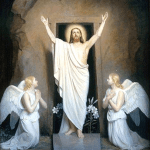
April 18-23 (weekdays)

Kindly click onhttps://frtonyshomilies.com/ for missed Sunday and weekday homilies, RCIA & Faith formation classes:

April 18 Monday: Mt 28:8-15: 8 So they departed quickly from the tomb with fear and great joy and ran to tell his disciples. 9 And behold, Jesus met them and said, “Hail!” And they came up and took hold of his feet and worshiped him. 10 Then Jesus said to them, “Do not be afraid; go and tell my brethren to go to Galilee, and there they will see me.” 11 While they were going, behold, some of the guard went into the city and told the chief priests all that had taken place. 12 And when they had assembled with the elders and taken counsel, they gave a sum of money to the soldiers 13 and said, “Tell people, `His disciples came by night and stole him away while we were asleep.’ 14 And if this comes to the governor’s ears, we will satisfy him and keep you out of trouble.” 15 So they took the money and did as they were directed; and this story has been spread among the Jews to this day. Additional reflections(Click on these links) https://bible.usccb.org/podcasts/video; https://catholic-daily-reflections.com/daily-reflections/; https://www.epriest.com/reflections

The context: Today’s Gospel describes how the two Marys who had been at the foot of the cross – Mary Magdalene and “the other Mary” (sister or cousin of Jesus’ mother) – went to the tomb of Jesus early on Sunday morning. They were shocked at seeing an open tomb without Jesus’ body in it. As they ran back with fear and joy to report the news to the apostles, the risen Jesus greeted them and told them to inform the apostles that he would meet them in Galilee. The guards, too, went to the chief priests to report the Resurrection of Jesus. But they were promptly silenced by the Temple authorities who bribed them to spread the false news that Jesus’ body had been stolen by his disciples.

Life messages: 1) The Resurrection of Christ is the most sublime and foundational truth of our Faith. It is the presence of the risen Lord everywhere that gives meaning to our worship and prayers, because Jesus is present everywhere to hear our prayers and grant our petitions.

2) The Risen Lord is present in the Holy Eucharist, in the Bible, in the praying assembly, and in believing Christians, so we need never be out of contact with him. 3) Let us renew this fundamental belief of our Faith every day and let us recognize and serve the risen Christ in everyone around us, thus becoming the Marys, “apostles to the apostles”. (Fr. Tony) (https://frtonyshomilies.com/) L/22

April 19 Tuesday: Jn 20:11-1811 But Mary stood weeping outside the tomb, and as she wept she stooped to look into the tomb; 12 and she saw two angels in white, sitting where the body of Jesus had lain, one at the head and one at the feet. 13 They said to her, “Woman, why are you weeping?” She said to them, “Because they have taken away my Lord, and I do not know where they have laid him.” 14 Saying this, she turned round and saw Jesus standing, but she did not know that it was Jesus. 15 Jesus said to her, “Woman, why are you weeping? Whom do you seek?” Supposing him to be the gardener, she said to him, “Sir, if you have carried him away, tell me where you have laid him, and I will take him away.” 16 Jesus said to her, “Mary.” She turned and said to him in Hebrew, “Rabboni!” (which means Teacher). 17 Jesus said to her, “Do not hold me, for I have not yet ascended to the Father; but go to my brethren and say to them, I am ascending to my Father and your Father, to my God and your God.” 18 Mary Magdalene went and said to the disciples, “I have seen the Lord”; and she told them that he had said these things to her. Additional reflections: https://bible.usccb.org/podcasts/video; https://catholic-daily-reflections.com/daily-reflections/; https://www.epriest.com/reflections

The context: Today’s Gospel presents the great recognition scene in the New Testament in which Mary Magdalene, at the tomb early in the morning, was not able to recognize the Risen Jesus until Jesus called her by name. Gradual recognition, or misunderstanding, as a stage on the path to belief and understanding, frequently occurs in the narratives of John’s Gospel. [See, for example, the conversations Jesus had with Nicodemus (ch. 3), and the Samaritan woman (ch. 4).] In today’s passage, we find it once again: Mary thought at first that Jesus was the gardener.

Mary Magdalene failed to recognize Jesus because of her false assumption that his body had been stolen. Her attention was concentrated on the empty tomb. Her tears of intense grief could also have blurred her vision. Once Mary had recognized Jesus, he gave her a message to be conveyed to his Apostles about His plan to leave them and ascend to his Father. She was the first to see the Risen Christ and the first to tell the apostles about the Lord’s resurrection. Mary’s message to Jesus’ disciples, “I have seen the Lord,”(Jn 20: 18),” became the basis and essence of later preaching and Christians’ witness-bearing. St Thomas Aquinas said that one old lady (una vetera), might have more Faith than a host of learned theologians.

Life messages: 1) Just like Mary Magdalene, we too may fail to recognize the presence of the risen Lord in our neighbor because of our preoccupations, spiritual blindness, and evil habits. But we can be open to experience the presence of the Risen Lord in our lives through our prayer, our Sacramental life, and our meditative reading of the Bible. These all enable us to bear witness to the Risen Lord in our daily lives.

2) It is our powerful conviction of the Real Presence of the Risen Lord, both in the Eucharist and in our lives, which gives us the strength to fight temptations and to serve our brothers and sisters in corporal and spiritual works of mercy. (Fr. Tony) (https://frtonyshomilies.com/)L/22

April 20 Wednesday: Luke 24:13-35: 13 That very day two of them were going to a village named Emmaus, about seven miles from Jerusalem, 14 and talking with each other about all these things that had happened. 15 While they were talking and discussing together, Jesus himself drew near and went with them. 16 But their eyes were kept from recognizing him. 17 And he said to them, “What is this conversation which you are holding with each other as you walk?” And they stood still, looking sad. 18 Then one of them, named Cleopas, answered him, “Are you the only visitor to Jerusalem who does not know the things that have happened there in these days?” 19 And he said to them, “What things?” And they said to him, “Concerning Jesus of Nazareth, who was a prophet mighty in deed and word before God and all the people, 20 and how our chief priests and rulers delivered him up to be condemned to death, and crucified him. 21 But we had hoped that he was the one to redeem Israel. Yes, and besides all this, it is now the third day since this happened. 22 Moreover, some women of our company amazed us. They were at the tomb early in the morning 23 and did not find his body; and they came back saying that they had even seen a vision of angels, who said that he was alive. 24 Some of those who were with us went to the tomb, and found it just as the women had said; but him they did not see.” 25 And he said to them, “O foolish men, and slow of heart to believe all that the prophets have spoken! 26 Was it not necessary that the Christ should suffer these things and enter into his glory?” 27 And beginning with Moses and all the prophets, he interpreted to them in all the scriptures the things concerning himself. 28 So they drew near to the village to which they were going. He appeared to be going further, 29 but they constrained him, saying, “Stay with us, for it is toward evening and the day is now far spent.” So he went in to stay with them. 30 When he was at table with them, he took the bread and blessed, and broke it, and gave it to them. 31 And their eyes were opened and they recognized him; and he vanished out of their sight. 32 They said to each other, “Did not our hearts burn within us while he talked to us on the road, while he opened to us the scriptures?” 33 And they rose that same hour and returned to Jerusalem; and they found the eleven gathered together and those who were with them, 34 who said, “The Lord has risen indeed, and has appeared to Simon!” 35 Then they told what had happened on the road, and how he was known to them in the breaking of the bread.Additional reflections: https://bible.usccb.org/podcasts/video; https://catholic-daily-reflections.com/daily-reflections/; https://www.epriest.com/reflections

The context: The Emmaus episode, which is found only in Luke’s Gospel, describes how Jesus shared the sorrow and frustration of the disciples at the sad and shameful death of their Master. Their hopes of Jesus’ conquest of the Romans and establishment of the glorious Davidic kingdom with his Divine power had been shattered. The risen Lord, unrecognized, joined them as they walked along. He explained the Scriptures and reminded them of the prophecies about the Messiah’s death and Resurrection in order to show them how the events that had happened were the fulfillment of Messianic prophecies. But it was only at supper, when Jesus blessed and broke the bread and gave it to them, that they recognized Jesus, who promptly vanished from their sight. The phrase, “the Breaking of the Bread”, is used repeatedly in the Acts of the Apostles (also written by Luke), to refer to the ritual meal of the Christian community, the Eucharist (Acts 2:42, 46; 20:7; 27:35). Disciples in every century have continued to recognize Jesus in “the Breaking of the Bread.”

Life messages: 1) The risen Lord is with us in both the joyful and the sad moments of our lives. Too often, we have our hopes and dreams shattered by the untimely deaths of our dear ones, by a split in family relationships, by the worsening of our illnesses, or by the loss of jobs. On such occasions, we have to learn to experience the risen Lord’s consoling and supporting presence in our lives. 2) As the disciples met the risen Lord on their way to Emmaus, we too must recognize and appreciate his presence in the Holy Eucharist, in the Word of God, in the praying community, at home, and in our Churches. Jesus is still beside his followers. Often, he is only dimly recognized and only by few. “You were with me,” wrote St. Augustine some centuries later, “but I was not with You” (Confessions, X, 27). Let us learn to talk to Jesus whenever we are alone and listen to him when we read the Bible, hear it preached or have it explained to us. (Fr. Tony) (https://frtonyshomilies.com/) L/22

April 21 Thursday: Lk 24:35-48: 35 Then they told what had happened on the road, and how he was known to them in the breaking of the bread. 36 As they were saying this, Jesus himself stood among them. 37 But they were startled and frightened and supposed that they saw a spirit. 38 And he said to them, “Why are you troubled, and why do questionings rise in your hearts? 39 See my hands and my feet, that it is I myself; handle me, and see; for a spirit has not flesh and bones as you see that I have.” 41 And while they still disbelieved for joy, and wondered, he said to them, “Have you anything here to eat?” 42 They gave him a piece of broiled fish, 43 and he took it and ate before them. 44 Then he said to them, “These are my words which I spoke to you, while I was still with you, that everything written about me in the Law of Moses and the prophets and the psalms must be fulfilled.” 45 Then he opened their minds to understand the scriptures, 46 and said to them, “Thus it is written, that the Christ should suffer and on the third day rise from the dead, 47 and that repentance and forgiveness of sins should be preached in his name to all nations, beginning from Jerusalem. 48 You are witnesses of these things. Additional reflections: https://bible.usccb.org/podcasts/video; https://catholic-daily-reflections.com/daily-reflections/; https://www.epriest.com/reflections

The context: Today’s Gospel passage describes the first post-Resurrection appearance of Jesus to the apostles while they were listening to the first-hand account of his appearance by the two disciples who had gone to Emmaus and had met Jesus on the way. This apparition is reported by both Luke and John.

The apostles could not believe that their Risen Lord was before them. Hence, Jesus had to show them the marks of the wounds in his hands and feet in proof. He also asked for a piece of broiled fish and ate it before them. Thus, Jesus confirmed his apostles’ Faith in his Resurrection by inviting them to touch Him, and by giving them these two proofs. Then Jesus explained to them that all that had happened during the past week had been done to fulfill the Messianic prophecies given in the Torah, by the Prophets and in the Psalms. His suffering, death, and Resurrection took place exactly as they had been prophesied. (Throughout his account, St. Matthew cites the Old Testament prophecies that have been fulfilled in Christ, because the Evangelist’s immediate readers were Jews, who needed and would accept these fulfillments as proofs that Jesus was indeed the promised Messiah). The next unfolding of Jesus’ mission was to be the preaching of repentance and the forgiveness of sins. That would be begun by the apostles; it would be carried on (and will finally be brought to completion), by the Church at Jesus’ Second Coming and Final Judgment of the living and the dead.

Life messages: 1) We, too, are called to bear witness for all around us to the Resurrection of Jesus Christ from the dead, just as the first apostles were commissioned by Jesus to bring the Good News of salvation to all the nations.

2) What is essential for the success of our preaching and witnessing mission is our firm and lively awareness of the presence and support of the Risen Lord in our lives. (Fr. Tony) (https://frtonyshomilies.com/) L/22

April 22 Friday:Jn 21: 1-14: Simon Peter, Thomas called the Twin, Nathaniel of Cana in Galilee, the sons of Zebedee, and two others of his disciples were together. 3 Simon Peter said to them, “I am going fishing.” They said to him, “We will go with you.” They went out and got into the boat; but that night they caught nothing. 4 Just as day was breaking, Jesus stood on the beach; yet the disciples did not know that it was Jesus. 5 Jesus said to them, “Children, have you any fish?” They answered him, “No.” 6 He said to them, “Cast the net on the right side of the boat, and you will find some.” So they cast it, and now they were not able to haul it in, for the quantity of fish. 7 That disciple whom Jesus loved said to Peter, “It is the Lord!” When Simon Peter heard that it was the Lord, he put on his clothes, for he was stripped for work, and sprang into the sea. 8 But the other disciples came in the boat, dragging the net full of fish, for they were not far from the land, but about a hundred yards off. 9 When they got out on land, they saw a charcoal fire there, with fish lying on it, and bread. 10 Jesus said to them, “Bring some of the fish that you have just caught.” 11 So Simon Peter went aboard and hauled the net ashore, full of large fish, a hundred and fifty-three of them; and although there were so many, the net was not torn. 12 Jesus said to them, “Come and have breakfast.” Now none of the disciples dared ask him, “Who are you?” They knew it was the Lord. 13 Jesus came and took the bread and gave it to them, and so with the fish. 14 This was now the third time that Jesus was revealed to the disciples after he was raised from the dead. Additional reflections: https://bible.usccb.org/podcasts/video; https://catholic-daily-reflections.com/daily-reflections/; https://www.epriest.com/reflections

The context: Today’s Gospel story is about our risen Lord’s persistent search for the apostles, even when they had gone back to their fishing profession, trying, perhaps, to forget the disastrous events leading to the crucifixion of their Master. John presents this incident as the third of Jesus’ post-Resurrection appearances. The incident proves that Jesus’ post-Resurrection appearances were not mere hallucinations. In the first part of today’s Gospel, the risen Jesus appears to the apostles and gives them a symbol of their mission in a miraculous catch of fish, followed by a grilled-fish breakfast which Jesus had prepared for them. The second part is a dialogue between Jesus and Simon where Simon is asked three times whether he loves Jesus and answers that he does, as if in reparation for his triple denial of Jesus. As his primary mission, Peter is given the care of the vulnerable lambs and sheep, and he is told that fidelity to this mission will lead him to martyrdom.

Life messages: We need to open our eyes, ears, minds, and hearts wide to see, hear and experience the risen Lord coming into our lives in various forms, circumstances and events. These include: 1) The risen Lord blessing us with success and achievements: We often fail to acknowledge the presence of the risen Lord behind our unexpected successes, great achievements, promotions at work, miraculous healings, and success in relationships. But the risen Lord is right there at our parties, celebrations, and occasions of rejoicing.

2) The risen Lord is present in our pains and suffering: Acts 9:1-13 tells us how the risen Lord transformed the life of Saul by flattening him on the Damascus Road, and by making him temporarily blind, so that he would come to see that Jesus was the Christ and the Son of God and believe. The same Jesus often visits us in the form of accidents, illnesses, the loss of dear ones, pain, suffering, and problems in relationships.

3) The risen Lord visits us through our friends and well-wishers: He is present in those who visit us and encourage us in our sad and desperate moments. The risen Lord visits us in our dire needs in the form of unexpected help from the least expected persons. 4) The risen Lord is present in our Christian worship: Jesus is present on our altars during the Holy Mass to share his Divine life with us, in the words of the Holy Scripture, in the Sacraments, especially the Eucharist, and wherever two or three are gathered in his name (Matthew 18:20). (Fr. Tony) (https://frtonyshomilies.com/) L/22

April 23 Saturday: Mk 16: 9-15: 9 Now when he rose early on the first day of the week, he appeared first to Mary Magdalene, from whom he had cast out seven demons. 10 She went and told those who had been with him, as they mourned and wept. 11 But when they heard that he was alive and had been seen by her, they would not believe it. 12 After this he appeared in another form to two of them, as they were walking into the country. 13 And they went back and told the rest, but they did not believe them. 14 Afterward he appeared to the eleven themselves as they sat at table; and he upbraided them for their unbelief and hardness of heart, because they had not believed those who saw him after he had risen. 15 And he said to them, “Go into all the world and preach the gospel to the whole creation Additional reflections: https://bible.usccb.org/podcasts/video; https://catholic-daily-reflections.com/daily-reflections/; https://www.epriest.com/reflections

The context: Today’s Gospel mentions the three appearances of the risen Lord and Jesus’ entrusting to the apostles their mission to preach his Good News: “Go into the whole world and proclaim the Gospel to every creature.” (Mk 16:15). According to Mark (in the longer ending), Jesus first appeared to Mary Magdalene. But Jesus’ apostles did not believe her. Later, he appeared to two disciples during their trip to Emmaus. When they had returned to Jerusalem and while they were explaining their experience, Jesus appeared to the eleven apostles gathered there. After gently chiding them for their unbelief and hard-heartedness, Jesus gave them his preaching mission or the “universal Apostolic mandate.”

Life messages: 1) The preaching and witnessing mission of Jesus applies especially to the successors of the Twelve Apostles, namely, the Bishops in communion with Peter’s successor, the Pope. 2) However, Vatican II declared in the Decree on the Apostolate of the Laity (Apostolicum Actuositatem), that the whole “Church was founded to spread the Kingdom of Christ over all the earth for the glory of God the Father, to make all men partakers in Redemption and Salvation” (AA, 2). “On all Christians, accordingly, rests the noble obligation of working to bring all men throughout the whole world to hear and accept the Divine message of salvation” (AA, 3). (Fr. Tony) (https://frtonyshomilies.com/) L/22

Easter Sunday homily (April 17, 2022)

Easter Sunday (April 17) Eight-minute homily in one page 

Introduction: Significance of Easter: “Easter” literally means “the feast of fresh flowers.” Easter is the greatest and the most important feast in the Church for four reasons:

1) The Resurrection of Christ is the basis of our Christian Faith. It is the greatest of the miracles, for it proves that Jesus is God. That is why St. Paul writes:If Christ has not been raised, then our preaching is in vain; and your Faith is in vain” (I Cor 15:14). “Jesus is Lord, He is risen” (Rom 10:9), was the central theme of the kerygma (or “preaching”), of the Apostles

2) Easter is the guarantee of our own resurrection. Jesus assured Martha at the tomb of Lazarus: “I am the resurrection and the life; whoever believes in me will live even though he dies…” (Jn 11:25-26).

3) Easter is a feast which gives us hope and encouragement in this world of pain, sorrows and tears. It reminds us that life is worth living. It also gives us strength to fight against temptations and freedom from unnecessary worries and fears.

4) Easter gives meaning to our prayers: It supports our belief in the Real Presence of the Risen Jesus in and around us, in His Church, in the Blessed Sacrament and in Heaven, hearing our prayers, and so gives meaning to our personal as well as our communal prayers. (An anecdote may be added here)

Reasons why we believe in the Resurrection of Jesus (1) Jesus himself testified to his Resurrection from the dead, giving it as a sign of his divinity. (Mark 8:31; Matthew 17:22; Luke 9:22).Tear down this temple and in three days I will build it again”(Jn 2: 19).

(2) The tomb was empty on Easter Sunday (Luke 24:3). Although the guards claimed (Matthew 28:13), that the disciples of Jesus had stolen the body, every sensible Jew knew that it was impossible for the terrified disciples of Jesus to steal the body of Jesus from a tomb guarded by an armed, 16-member Roman Guard detachment.

(3) The initial disbelief of Jesus’ own disciples in Jesus’ Resurrection, in spite of His repeated apparitions, serves as a strong proof of his Resurrection. Their initial disbelief explains why the Apostles started preaching the Risen Christ only after receiving the anointing of the Holy Spirit on the day of Pentecost.

(4) The transformation of Jesus’ disciples: Jesus’ Resurrection and the anointing of the Holy Spirit transformed men who were hopeless and fearful after the crucifixion (Luke 24:21, John 20:19), into men who now were confident and bold witnesses to the Resurrection (Acts 2:24, 3:15, 4:2)powerfully preaching the Risen Lord.

(5) Neither the Jews nor the Romans could disprove Jesus’ Resurrection by presenting the dead body of Jesus.

(6) The Apostles and early Christians would not have fearlessly preached Christ as Savior and faced martyrdom if they were not absolutely sure of Jesus’ Resurrection.

(7) The Apostle Paul’s conversion from a persecutor of Christians to a zealous preacher of Jesus supports the truth of Jesus’ Resurrection (Galatians 1:11-17, Acts 9:1, Acts 9:24-25, Acts 26:15-18).

(8) The sheer existence of a thriving, empire-conquering early Christian Church, bravely facing and surviving three centuries of persecution, supports the truth of the Resurrection claim.

(9) The New Testament witnesses do not bear the stamp of dupes or deceivers. The Apostles and the early Christians were absolutely sure about the Resurrection of Jesus.

Life Messages: 1) Let us live the lives of Resurrection people: We are not supposed to lie buried in the tomb of our sins, evil habits, dangerous addictions, despair, discouragement or doubts. Instead, we are expected to live a joyful and peaceful life, constantly experiencing the living presence of the Risen Lord Who loves us in all the events of our lives and amid the boredom, suffering, pain and tensions of our day-to-day life.

2) The conviction of the real presence of the Risen Lord with us and within us and all around us, enables us to lead disciplined Christian lives. It will help us to control our thoughts, desires, words, behavior and actions.

3) This salutary awareness of the presence of the Risen Lord within us inspires us to honor our bodies, keeping them holy, pure and free from evil habits and addictions. Our conviction that the loving presence of the Risen Lord dwells in our neighbors and in all those we encounter, should encourage us to respect them and to render them loving, humble and selfless service.

4) We need to become transparent Christians, radiating the Risen Lord around us in the form of selfless and sacrificial agape love, mercy, compassion and a spirit of humble service. each time we try to practice Christian charity, mercy and forgiveness and each time we fight against temptations, we share in the Resurrection of Jesus. (L/22)

May the Risen Lord be a living experience to you,

pervading every area of your life,

blessing you, strengthening you, inspiring you, guiding you and supporting you

in your pastoral ministry. Fr. Tony

EASTER SUNDAY: Acts 10:34a, 37-43; Col 3:1-4; Jn 20:1-9 or Lk 24:1-12

Homily starter anecdotes: # 1: “He is not here.” The Egyptian pyramids are world-famous as one of the “seven Wonders” of the ancient world. But they are actually gigantic tombs containing the mummified bodies of Egyptian Pharaohs. Westminster Abby is famous, and thousands visit it, because the dead bodies of famous writers, philosophers, and politicians are entombed there. But there is a Shrine of the Holy Sepulcher in Jerusalem, and pilgrims from all over the world visit a tomb there which is empty with a note at its entrance which says, “He is not here.” It is famous because Jesus Christ, Who was once buried there, rose from the dead, leaving an empty tomb, as He had told his disciples he would. Thus, Jesus worked the most important miracle in His life, defying the laws of nature and proving that He is God. (https://frtonyshomilies.com/).

# 2:    The phoenix:  The late Catholic Archbishop of Hartford, John Whealon, (d. August 2, 1991), had undergone cancer surgery resulting in a permanent colostomy when he wrote these very personal words in one of his last Easter messages: “I am now a member of an association of people who have been wounded by cancer.  That association has as its symbol the phoenix, a bird of Egyptian mythology. The Greek poet Hesiod, who lived eight centuries before Jesus was born, wrote about this legendary bird in his poetry.  When the bird felt its death was near (every 500 to 1,461 years), it would fly off to Phoenicia, build a nest of aromatic wood and set itself on fire.  When the bird was consumed by the flames, a new phoenix sprang forth from the ashes.

Thus, the phoenix symbolizes immortality, resurrection, and life after death.  It sums up the Easter message perfectly.  Jesus gave up His life, and from the grave He was raised to Life again on the third day.  New life rises from the ashes of death.  Today, we are celebrating Christ’s victory over the grave, the gift of eternal life for all who believe in Jesus.  That is why the phoenix was one of the earliest symbols of the Risen Christ.  The phoenix also symbolizes our daily rising to new life.  Every day, like the phoenix, we rise from the ashes of sin and guilt and are refreshed and renewed by our living Lord and Savior with His forgiveness and the assurance that He still loves us and will continue to give us the strength we need.” —  Archbishop John Whealon could have lived in a gloomy tomb of self-pity, hopeless defeat, and chronic sadness, but his Faith in the Risen Lord opened his eyes to new visions of life.(https://frtonyshomilies.com/).

# 3: The greatest comebacks in history:   In its November 12, 2001 issue, Sports Illustrated ranked the 10 greatest comebacks in world history.  Among those making the list, the following names are to be specially noted.

  1. Michael Jordan, 1995. Made his first triumphant basketball comeback after having quit basketball in 1993.5. Muhammad Ali, 1974. Seven years after being stripped of his title and his boxing license, defeated George Foreman in Zaire to win back the belt.8. Japan and Germany, 1950s. They were the former Axis Powers which rose from the ashes of World War II to become industrial superpowers.

    10. Jesus Christ, 33 A.D. Defied Jewish critics and stunned the Romans with his Resurrection. It was the greatest comeback of all time. And He’s been specializing in comebacks ever since.  (https://frtonyshomilies.com/).

Introduction: Significance of Easter: Easter is the greatest and the most important feast in the Church. It marks the birthday of our eternal hope.  “Easter” literally means “the feast of fresh flowers.”  We celebrate it with pride and jubilation for three reasons:

1) The Resurrection of Christ is the basis of our Christian Faith, for it proves that Jesus is God.  That is why St. Paul writes: “If Christ has not been raised, then our preaching is in vain; and your Faith is in vain…  And if Christ has not been raised, then your Faith is a delusion, and you are still lost in your sins…  But in fact, Christ has been raised from the dead, the first fruits of those who have fallen asleep” (I Cor 15:14, 17, 20). In the words of the Catechism of the Catholic Church: “The Resurrection of Jesus is the crowning truth of our Faith in Christ, a Faith believed and lived as the central truth by the first Christian community; handed on as fundamental by Tradition; established by the documents of the New Testament; and preached as an essential part of the Paschal mystery along with the cross…” (CCC # 638). If Jesus Christ did not rise from the dead, then the Church is a fraud and Faith is a sham. But if Jesus really did rise from the dead, his message is true! Without the Resurrection, Jesus would have remained forever a good person who had met a tragic end.  People would remember some of his teachings, and a handful of people might try to live according to them. All the basic doctrines of Christianity are founded on the truth of the Resurrection.  “Jesus is Lord; He is risen!” (Rom 10:9) was the central theme of the kerygma (or “preaching”), of the apostles.     There is a story of two women who stood before Notre Dame Cathedral in Paris. One asked, “Why can’t we build structures like this anymore?” Her friend answered, “The people who built this had Faith. Today we have only opinions. And you can’t build a cathedral with opinions.”

2) Easter is the guarantee of our own resurrection.  Jesus assured Martha at the tomb of Lazarus: “I am the Resurrection and the Life; whoever believes in Me will live even though he die” (Jn 11:25-26).  Christ will raise us up on the last day, but it is also true, in a sense, that we have already risen with Christ.  By virtue of the Holy Spirit, our Christian life is already a participation in the death and Resurrection of Christ (CCC #1002, #1003).

3) Easter is a feast which gives us hope and encouragement in this world of pain, sorrows, and tears.  Easter reminds us that life is worth living.  It is our belief in the Real Presence of the Risen Jesus — in our souls, in His Church, in the Blessed Sacrament,  and in Heaven — that gives meaning to our personal, as well as to our common, prayers.   Our trust in the all-pervading presence of the Risen Lord gives us strength to fight against temptations and freedom from unnecessary worries and fears.  The prayer of St. Patrick, the Apostle of Ireland, reads: “Christ before me, Christ beside me, Christ within me, never to part.”

4) Reasons why we believe in the Resurrection of Jesus: (a) Jesus himself testified to his Resurrection from the dead (Mark 8:31; Matthew 17:22; Luke 9:22). (b) The tomb was empty on Easter Sunday (Luke 24:3). Although the guards claimed (Matthew 28:13) that the disciples of Jesus had stolen the body, every sensible Jew knew that it was impossible for the terrified disciples of Jesus to steal the body of Jesus from a tomb guarded by a 16-member team of armed Roman soldiers. (c) The initial disbelief of Jesus’ own disciples in his Resurrection, in spite of his repeated apparitions.  This serves as a strong proof of his Resurrection. It explains why the apostles started preaching the resurrected Christ only after receiving the anointing of the Holy Spirit on the day of Pentecost. (d)  The transformation of Jesus’ disciples: The disciples of Jesus were almost immediately transformed from men who were hopeless and fearful after the crucifixion (Luke 24:21, John 20:19) into men who were confident and bold witnesses of the Resurrection (Acts 2:24, 3:15, 4:2). (e) The Jews and the Romans could not disprove Jesus’ Resurrection by presenting the dead body of Jesus. f) The apostles and early Christians would not have faced martyrdom if they were not absolutely sure of Jesus’ Resurrection. (g)  The Apostle Paul’s conversion from a persecutor of Christians into a zealous apostle, preaching the Good News of Jesus throughout much of the Gentile world, supports the truth of Jesus’ Resurrection (Galatians 1:11-17, Acts 9:1Acts 9:24-25Acts 26:15-18). (h) The sheer existence of a thriving, Empire-conquering early Christian Church, bravely facing three centuries of persecution, supports the truth of the Resurrection claim. (i) The New Testament witnesses do not bear the stamp of dupes or deceivers. (ii)The apostles and the early Christians were absolutely sure about the Resurrection of Jesus.

Exegesis: The Resurrection of Jesus had certain special features. First, Jesus prophesied it as a sign of His Divinity: “Destroy  this temple, and in three days I will raise it up.”(Jn 2:19).  Second, the founder of no other religion has an empty tomb as Jesus does.  We see the fulfillment of Christ’s promise on the empty cross and in the empty tomb. The angel said to the women at Jesus’ tomb: “Why are you looking among the dead for One Who is alive?  He is not here but has risen” (Luke 24:5-6). The real proof, however, is not the empty tomb but the lives of believers filled with His Spirit today! The third special feature is the initial disbelief of Jesus’ own disciples in his Resurrection, in spite of his repeated apparitions.  This serves as a strong proof of his Resurrection. It explains why the apostles started preaching the Risen Christ only after receiving the anointing of the Holy Spirit on the day of Pentecost.  Proclamation and witness-bearing are the main themes of today’s readings. In the first reading, St. Peter shares his own experience of Christ’s Resurrection and its joy with the members of the pagan Cornelius’ family who received the Holy Spirit as he spoke and then were baptized. In the second reading, St. Paul, bearing witness to his conversion experience and Faith in the risen Lord, reminds the Colossians, “you have died, and your life is hidden with Christ in God! When Christ your Life, appears, then you, too, will appear with Him in glory.” Today’s Gospel explains the empty-tomb Resurrection experiences of Mary Magdalene, Peter, and John. Mary Magdalene proclaims her personal experience: “I have seen the Lord(Jn 20:18).

Life messages: 1) We are to be Resurrection people:  Easter, the feast of the Resurrection, gives us the joyful message that we are a “Resurrection people.”  This means that we are not supposed to lie buried in the tomb of our sins, evil habits, and dangerous addictions.  It gives us the Good News that no tombs can hold us down any longer – not the tombs of despair, discouragement, doubt, or death itself.  Instead, we are expected to live a joyful and peaceful life, constantly experiencing the real Presence of the Risen Lord in all the events of our lives.  “This is the day the Lord has made; let us rejoice and be glad” (Ps 118:24). 

2) We need to seek our peace and joy in the Risen Jesus:  The living presence of the Risen Lord gives us lasting peace and celestial joy in the face of the boredom, suffering, pain, and tensions of our day-to-day life.  “Peace be with you!(Jn 20:19), was Jesus’ salutation to his disciples at all post-Resurrection appearances.  For the true Christian, every day must be  an Easter Day, lived joyfully in the close company of the Risen Lord.

3) We are to be transparent Christians: We are called to be transparent Christians, showing others, through our lives of love, mercy, compassion, and self-sacrificing service that the Risen Jesus is living in our hearts.

4) We need to live new, disciplined lives in the Risen Jesus:  Our awareness of the all-pervading presence of the Risen Lord in and around us, and the strong conviction of our own coming resurrection, help us control our thoughts, desires, words, and behaviors.  This salutary thought inspires us to honor our bodies, keeping them holy, pure and free from evil habits and addictions. Our conviction about the presence of the Risen Lord in our neighbors, and in all those with whom we come into contact, should encourage us to respect them, and to render them loving, humble, selfless service.

5) We need to remember Easter in our Good Fridays:  Easter reminds us that every Good Friday in our lives will have an Easter Sunday, and that Jesus will let us share the power of his Resurrection.  Each time we display our love of others, we share in the Resurrection.  Each time we face a betrayal of trust and, with God’s grace, forgive the betrayer and forget the offense, we share in the Resurrection of Jesus.  Each time we fail in our attempts to ward off temptations – but keep on trying to overcome them – we share in the Resurrection.  Each time we continue to hope – even when our hope seems unanswered – we share in the power of Jesus’ Resurrection.  In short, the message of Easter is that nothing can destroy us – not pain, sin, rejection, betrayal, or death. Because Christ has conquered all these, we, too, can conquer them — if we put our Faith and trust in Him.

6) We are to be bearers of the Good News of Resurrection power. Resurrection is Good News, but at the same time, it’s sometimes painful because it involves death. Before the power of the Resurrection can take hold in our own lives, we’re called to die to sin, to die to self. We may even have to die to our own dreams, so that God can do what He wants to do with our lives. Resurrection is about seeing our world in a new way. Early that Easter morning, Mary Magdalene  did not find what she was looking for, the dead body of Jesus. But she found something better than she could have imagined: the Risen Jesus. Sometimes, the things we think we want most are not granted to us.  What we get instead is an experience of God’s new ways of working in the world. That’s the power of the Resurrection. When those moments come, we must spread the news–just as Mary Magdalene did: “I have seen the Lord!” (Jn 20:18)

JOKE OF THE WEEK (The reason for these jokes according to an ancient Russian Orthodox tradition, is that  the day before Easter was devoted to telling jokes. The reason was to reflect the joke God pulled on the devil in the Resurrection. Satan thought he had won on Friday, but God had the last laugh on Easter Sunday)

1) “TA-DA!”A Sunday school teacher had just finished telling her third graders about how Jesus was crucified and placed in a tomb with a great stone sealing the opening. Then, wanting to share the excitement of the Resurrection, she asked: “And what do you think were Jesus’ first words when He came bursting out of that tomb alive?” A hand shot up into the air from the rear of the classroom. Attached to it was the arm of a little girl. Leaping out of her chair she shouted out excitedly “I know, I know!” “Good” said the teacher, “Tell us, what were Jesus first words?” And extending her arms high into the air she said: “TA-DA!” Another little boy offered, “Please stop staring and pass me the fish sandwiches —  it’s been three days and I’m starving!” The teacher asked a second question: “Why did Jesus appear to women first after the Resurrection?” A girl answered, “He wanted to be sure the news spread quickly!”

2) Mother-in-law in Jerusalem: George went on a vacation to the Middle East with most of his family including his mother-in-law. During their vacation and while they were visiting Jerusalem, George’s mother-in-law died. With the death certificate in hand, George went to the American Consulate to make arrangements to send the body back to the States for proper burial. The Consul, after hearing of the death of the mother-in-law, told George that the sending of a body back to the States for burial is very, very expensive. It could cost as much as $5,000. The Consul continued, “In most cases the person responsible for the remains normally decides to bury the body here. This would only cost $150.” George thought for some time and answered, “I don’t care how much it will cost to send the body back; that’s what I want to do.”
The Consul, after hearing this, said, “You must have loved your mother-in-law very much, considering the difference in price.” “No, it’s not that!” said George. “You see, I know of a case many years ago of a man who died and was buried here in Jerusalem. On the third day he arose from the dead. I just can’t take that chance!”

3) See what happens.  One lady wrote into a question-and-answer forum. “Dear Sirs, our preacher said on Easter, that Jesus just swooned on the cross and that the disciples nursed Him back to health. What do you think?” Sincerely, Bewildered.
Dear Bewildered, Beat your preacher with a cat-of-nine-tails, nail him to a cross; hang him in the sun for 6 hours; run a spear through his side…put him in an airless tomb for 36 hours and see what happens.” Sincerely, Charles.   

4) Loaned for a weekend: Joseph of Arimathaea was a very wealthy Pharisee, a member of the Council, and a secret follower of Jesus. It was Joseph who went to Pilate and asked for Jesus’ body after the crucifixion. And it was Joseph who supplied the tomb for Jesus’ burial. I wonder if someone pulled him aside and said, “Joseph that was such beautiful, costly, hand-hewn tomb. Why on earth did you give it to someone to be buried in?”  “Why not?” Joseph may have answered.  “He only needed it for the weekend.”

5) Resurrection in election: Presidential candidate Mike Huckabee was once asked if he believed in the Resurrection. “Of course, I do,” said Huckabee. “Dead people vote in every election we have in Arkansas. Resurrection is very real to us!”

Easter links: 1) http://re-xs.ucsm.ac.uk/re/religion/christianity/easter.html

2) http://textweek.com/yearc/easterdc.htm

3) http://www.catholicsermons.com/homilies/sunday_homilies

4)http://www.wingclips.com/categories/easter-good-friday?gclid=CLTnmIOZzb0CFQsSMwodcFoAFQ

5)  Did Jesus really rise from the dead? http://strangenotions.com/did-jesus-really-rise-from-the-dead-interview-with-carl-olson/

6) A scientist’s arguments for resurrection of Christ: http://www.veritas.org/evidence-easter-scientists-list/

6) Easter videos: http://www.history.com/topics/holidays/history-of-easter/videos/history-of-the-holidays-easter-video

http://www.catholic.org/lent/easter.php

7)Fr. Geoffrey Plant: The latest: https://www.youtube.com/user/GeoffreyPlant2066;  Easter A (2020): Easter B(2018)= https://youtu.be/r1eoXOAxQ4w  Easter C (2019)=  https://youtu.be/ZcsJ5F7-wcE

8) Fr. Don’ collection of video homilies & blogs: https://sundayprep.org/  (Copy and paste this web address on the Address bar of any Internet website)

Easter Sunday movie clips: (1) https://youtu.be/smUHqg3npAE   2) https://youtu.be/evoOaIQwITg  3) https://youtu.be/KH6ZKO_Y5iQ

Easter Sunday songs: 1) https://youtu.be/VXp6xcY5IqU?list=RDQMSqIjd9ibido  2) https://youtu.be/fa8w7mGug0c?list=RDQMSqIjd9ibido 3) https://youtu.be/VXp6xcY5IqU?list=RDfa8w7mGug0c

Note: (Pictures are available only in my emailed homilies because permission from the publishers is necessary for legally uploading pictures in a website. You may get pictures  from Google images, by typing the subject Easter Sunday under Google images).

25– Additional anecdotes:

1)    “The Godfather of Fitness.” You may recall years ago when fitness legend Jack LaLanne celebrated his seventieth birthday by towing 70 boats containing 70 people for a mile across Long Beach Harbor. Amazing! But wait. He did it by holding the rope in his teeth. Why? Well, he was handcuffed and wearing leg shackles! Unbelievable! LaLanne was still going strong in his nineties. —  But friends, this “The Godfather of Fitness” and “First Fitness Superhero” died of pneumonia, on January 24, 2011, proving that this world is not our final destination. It is but a prelude to a grander production. This world is a preparatory school. Without the Resurrection, it is simply impossible to explain a world in which people suffer and die. But the Resurrection is real. Christ rose from the dead. Christ is still alive and He is available in our world today. Fr. Tony (https://frtonyshomilies.com/) 2021.

2)  Bright light in the “black holes” of life: Have you ever heard of a “black hole”? If you have ever watched movies or TV programs about travelling in outer space, like the TV series Star Trek, you will know what a black hole is. Roughly speaking, it is a spot in the vastness of space, which astronomers believe is like a giant vacuum or whirlpool sucking everything around it into the hole. Using Newton’s laws, scientists first theorized black holes in the 1790s but it wasn’t until 1994 that the Hubble Space Telescope discovered a massive supersized black hole – fortunately a long way from our own galaxy. There is also a black hole in our galaxy, the Milky Way. What if scientists said that it was not beyond the realms of possibility that one day our sun and everything around it would be sucked into this “black hole,” and everything would be gone? — “Black holes” are symbols of hopelessness, and the message of Easter tells us that there is something beyond those “black holes.” Maybe our personal   “black hole” includes grief for a loved one, anxiety over a work situation or what is happening in our family. Maybe it is a “black hole” of depression and stress, and we feel there is nothing we can do to change what is happening. Maybe it’s the “black hole” of sickness and pain. Maybe it’s the “black hole” of guilt and failure. Whether those “black holes” are right here and now or show up at some time in the future, Easter tells us there is hope, there is a living Saviour and Friend who will help us when we feel as if we have been sucked into the deepest darkness. Easter tells us that there is nothing to fear. We have a Risen Saviour who promises never to leave us, to love us always, always to brighten our darkest paths, and to guide us from death to eternal life in Heaven. Even when we are in the middle of something deep and dark, our Risen Saviour will always be there with us. “I am the Living One! I was dead, but now I am alive forever and ever. I have authority over death and the world of the dead” (Rv 1:8).    (https://frtonyshomilies.com/).  

http://science.nationalgeographic.com/science/space/universe/black-holes-article/

3) “We believe you.” There is a beautiful story told recently about a woman named Rosemary who works in the Alzheimer’s Unit of a nursing home. Rosemary and a colleague named Arlene brought the residents of the home together one Good Friday afternoon to view Franco Zeffirelli’s acclaimed production, Jesus of Nazareth. They wondered whether these elderly Alzheimer’s patients would even know what was going on, but they thought it might be worth the effort. When they finally succeeded in getting everyone into position, they started the video. Rosemary was pleasantly surprised at the quiet attention being paid to the screen. At last came the scene where Mary Magdalene comes upon the empty tomb and sees that Jesus’ body is not there. An unknown man, in reality the Risen Christ, asks Mary why she is looking for the living among the dead. Mary runs as fast as she can back to the disciples and tells Peter and the rest with breathless excitement, “He’s alive! I saw Him, I tell you! He’s alive.” The doubt in their eyes causes Mary to pull back. “You don’t believe me . . . You don’t believe me!” From somewhere in the crowd of Alzheimer’s patients came the clear, resolute voice of Esther, one of the patients. “WE BELIEVE YOU,” she said, “WE BELIEVE YOU!” [Rosemary Kadrmas in Jeff Cavins, et.al, Amazing Grace for the Catholic Heart (West Chester, PA: Ascension Press, LLC, 2003), pp. 211-212.](https://frtonyshomilies.com/).

4) The killers asked her if there was anyone [in the classroom] who had faith in Christ.  A day after the terrible tragedy at Columbine High, CNN journalist Larry King did a live interview with a teenage girl named Mickie Cain, a student who had witnessed the massacre. Mickie was having a difficult time maintaining her composure and was able to blurt out only a few words before lapsing into uncontrollable sobs. Larry King was patient and gave her plenty of time to regain her composure. Mickie recounted the chilling story: “Let me tell you about my friend Cassie,” she said. “[Cassie] was amazing . . . She completely stood up for God when the killers asked her if there was anyone [in the classroom] who had faith in Christ. She spoke up [and said she did] and they shot her for it.” [Franklin Graham, The Name (Nashville, TN: Thomas Nelson, Inc., 2002), pp. 14-15].  —  Such a testimony as Cassie made that day makes our witness look pretty pathetic, doesn’t it? The critical question is, would you make such a sacrifice for something that you knew was patently untrue? Of course not. And neither would those early disciples of Christ. They had met Christ, risen from the grave, and they would not testify otherwise, even while being tortured. The witnesses are so credible, the change in their lives so dramatic, that their testimony cannot be disregarded.(https://frtonyshomilies.com/).

5) Cape of Good Hope: You may remember a geography lesson from elementary school in which you learned that the southernmost point of Africa is a point which for centuries has experienced tremendous storms. For many years no one knew what lay beyond that cape, for no ship attempting to round that point had ever returned to tell the tale. Among the ancients it was known as the “Cape of Storms,” and for good reason. But then a Portuguese explorer in the sixteenth century, Vasco De Gama, successfully sailed East around that very point and found beyond the wild raging storms, a great calm sea, and beyond that, the shores of India. The name of that cape was changed from the Cape of Storms to the Cape of Good Hope. Until Jesus Christ rose from the dead, death had been the “cape of storms” on which all hopes of life beyond death had been wrecked. No one knew what lay beyond that point until, on Easter morning, Jesus arose.   The ancient visions of Isaiah became the victory of Jesus over our last great enemy. — Like those sixteenth century explorers, we can see beyond human death to the hope of Heaven and eternal life with the Father. More than that, we dare to believe that we shall experience in our own human lives exactly what the Son of God experienced in His, for the Risen Christ says to us, “Because I live, you shall live also.” This is the heart of our Faith.(https://frtonyshomilies.com/).

6) “I choose death….by old age.” Long ago, there was an exceedingly clever court jester at the court of the Caliph of Baghdad. For years he’d never failed to amuse the court whenever they called him. But one day, in a split second of carelessness, he offended the caliph who ordered him put to death. “However,” said the caliph, “in consideration of your many years of fine and faithful service, I’ll let you choose how you wish to die.” “Oh, mighty Caliph,” replied the jester. “I thank you for your great kindness. I choose death….by old age.” — Wouldn’t we all! But that just delays the big question: Then what? What comes after you finally die at the age of 110 on the tennis court? Only Jesus has the answer. He says, “I am the Resurrection and the Life. Whoever believes in Me, even though he die, will live with Me forever”(Jn 11:25). (Msgr. D. Clarke)(https://frtonyshomilies.com/).

7) He always whistled:  Have you heard the story of the man whose hobby was growing roses? When he worked in his rose garden, he always whistled. It seemed to everyone that he was whistling much louder than was needed for his own enjoyment. One day a neighbor asked him why it was that he always whistled so loudly. The man then took the neighbor into his home to meet his wife. The woman was not only an invalid but was completely blind as well. The man, you see, was whistling, not for his benefit, but rather for the benefit of his wife. He wanted his blind wife to know that he was nearby, and that she was not alone. — That story is a wonderful illustration of the significance of Easter Day. The affirmation, “Christ is risen!” reminds us that God is near, and the experiencing of His presence strengthens us in our weakness. (Donald William Dotterer, Living the Easter Faith,).(https://frtonyshomilies.com/).

8) And so, the Iron Lady wept.   On October 12, 1984, at a Conservative Party Conference held at the Grand Brighton Hotel in Brighton England, a long-delay time-bomb, planted in the conference room where many of the government meetings were held, exploded.  The intention of the terrorists was to kill Prime Minister Margaret Thatcher and her Cabinet.  Mrs. Thatcher survived this blast, but some of her cabinet members were killed. The following Sunday, Margaret Thatcher went to Church as she always did. But that particular Sunday seemed different. As Margaret Thatcher sang the hymns, listened to the message, saw the candles upon the altar and the sunshine streaming through the stained-glass windows, she began to weep. She wept because everything around her had been changed by the loss of her friends. The familiar had now become strange. The goodness and beauty of the world around her seemed almost too much to bear. She knew she would not only miss her friends, but also the wonderful times they had had together. And so, the Iron Lady wept. — If we can relate to Maggie Thatcher’s grief, maybe we can relate to the grief of Jesus’ disciples and friends on that first Easter morning.(https://frtonyshomilies.com/).

9) I want to see your Resurrection!” Father Basil Pennington, a Catholic monk, tells of an encounter he once had with a teacher of Zen. Pennington was at a retreat. As part of the retreat, each person met privately with this Zen teacher. Pennington says that at his meeting the Zen teacher sat there before him smiling from ear to ear and rocking gleefully back and forth. Finally, the teacher said: “I like Christianity. But I would not like Christianity without the Resurrection. I want to see your Resurrection!” Pennington notes that, “With his directness, the teacher was saying what everyone else implicitly says to Christians: “You are a Christian. You are risen with Christ. Show me (what this means for you in your life) and I will believe.” [(http://www.stjohnslaverne.org/SermonReadingArchive/OmernickEasterSundaySermon20 06.rtf.) Marilyn Omernick.] –That is how people know if the Resurrection is true or not? Does it affect how we live?(https://frtonyshomilies.com/).

10) “Do you mean like Elvis?” A father was explaining to his five-year-old son how Jesus died and then, on the third day, rose from the dead. “That’s what we believe,” the father said. “That’s how we know Jesus is the Son of God, because He came back from the dead just as He said He would.” “Do you mean like Elvis?” the boy replied. —  Well, no. Not exactly like Elvis. This is a new world. People nowadays believe just about everything, except that which is most true. We have to work a little bit harder in this new world to help people. (https://frtonyshomilies.com/).

11) From the empty tomb: It was a hot summer afternoon. The famous Hollywood film director Cecil B. DeMille was drifting in a canoe on a lake in Maine, reading a book. He looked away from the book momentarily, down to the lake. There a bunch of water beetles were at play. Suddenly one of the beetles began to crawl up the side of the canoe. When it got halfway up, it attached the talons of its legs to the wooden side of the canoe and died. DeMille watched for a minute; then he turned back to his book. About three hours later, DeMille looked down at the dead beetle again. What he saw amazed him. The beetle had dried up, and its back was starting to crack open. As he watched, something began to emerge from the opening: first a moist head, then wings. It was a beautiful dragonfly. DeMille sat there in awe. Then the dragonfly began to move its wings. It hovered gracefully over the water where the other beetles were at play. But they didn’t recognize the dragonfly. They didn’t realize that it was the same beetle they had played with three hours earlier. DeMille took his finger and nudged the dried-out shell of the beetle. It was like an empty tomb (Mark Link in Sunday Homilies) . (https://frtonyshomilies.com/).  

12) Easter: surprising or amazing? There is an old story about Noah Webster, who wrote the famous dictionary that bears his name. As you can imagine, he was a stickler for the precise use of language. He was also something of a womanizer. One day he was in the pantry kissing the maid when Mrs. Webster walked in on them. Mrs. Webster said, “Why, Noah, I’m surprised.” Noah said, “No, my dear. We’re surprised. You’re amazed.” [Mark Trotter, “Do You Amaze Anybody?” (May 22, 1988).] — I think the story is apocryphal. I’m sure Mr. Webster was a stickler for the right word, but when you look in his own Webster’s Dictionary, he says surprise is a synonym for amaze. Amaze is the stronger word. — Easter is both surprising and amazing. Here is God’s ultimate act of love and power. It is an act of love that has gone to its limit in Jesus’ gift of himself on the cross. It is an act of power that burst the tomb and announced to the world that Love is stronger than hate, Good prevails over evil, and Life is triumphant over death. (https://frtonyshomilies.com/).

13)“Suppose he isn’t in there!” Two famous Broadway producers were pallbearers at the funeral of the great escape artist, Harry Houdini. As they lifted the beautiful, heavy casket to their shoulders, one of them turned and whispered to the other, “Suppose he isn’t in there!” — He was, of course. Only one man in human history has conquered the grave, and it is he whom we call Lord. “Christ has been raised from the dead,” writes St. Paul, “the first fruits of those who have fallen asleep” (I Cor 15:20). What deliriously Good News that is! No wonder our Church is full on Easter Sunday! That is news that turns the world upside down: Jesus Christ is risen! v(https://frtonyshomilies.com/).

14) Resurrection Bay:  In the movie The Hunt for Red October, the opening scene was filmed in Resurrection Bay, Alaska. This dramatic setting received its name in 1792 when the Russian trader and explorer Alexandr Baranov was forced to find refuge there during a vicious storm on Easter Sunday. Resurrection Bay has the distinction of remaining ice-free even in the dead of winter. Even in squalls and storms, it provides safe harbor. —  As Christians, we anchor our souls in Resurrection Bay. The world may be caught in a thousand tempests, and storms may arise from all directions. But the empty tomb assures us of tranquility and a passageway to Heaven that will never ice over. Jesus died and rose again to give us peace with God and the peace of God — life both eternal and abundant. We anchor our souls in the haven of rest. (Turning Point). (https://frtonyshomilies.com/).

15) Many infallible proofs: Albert L. Roper was a prominent Virginia attorney, a graduate of the University of Virginia and its law school, who eventually became mayor of the city of Norfolk. He once began a thorough legal investigation into the evidence for the Resurrection of Christ, asking himself the question: “Can any intelligent person accept the Resurrection story?” After examining the evidence at length, he came away asking a different question: “Can any intelligent person deny the weight of this evidence?” — Even those who traveled for three years with Jesus experienced disbelief over His Resurrection, but Jesus showed Himself alive by many infallible proofs. We don’t base our Faith on legends, myths, or fairy tales. The Resurrection of Jesus Christ is well-documented, and many critics have been silenced (and even converted) when they’ve carefully investigated the evidence [Albert L. Roper, Did Jesus Rise From the Dead (Grand Rapids: Zondervan, 1965), foreword.] We have a Risen Savior! He offers Himself to us today with many infallible proofs. (Turning Point- 3/29/13). (https://frtonyshomilies.com/).

16) Joke Saturday:  According to an ancient Russian Orthodox tradition, the day before Easter was devoted to telling jokes. Priests would join the people in telling their best jokes to one another (presumably “clean” jokes!!) The reason was to reflect the joke God pulled on the devil in the Resurrection. Satan thought he had won on Friday, but God had the last laugh on Easter Sunday.

17) “He is risen indeed!”: You probably do not remember the name Nikolai Ivanovich Bukharin. Many years ago, he was one of the most powerful men on earth. A Russian Communist leader, he took part in the Bolshevik Revolution of 1917. He was the editor of the Soviet newspaper Pravda and was a full member of the Politburo. His works on economics and political science are still read today. There is a story told about a journey he took from Moscow to Kiev in 1930 to address a huge assembly of Communists.  The subject was atheism. Addressing the crowd, he attacked Christianity, hurling insults and arguments against it. When he had finished, he looked out at the audience. “Are there any questions?” he demanded. Deafening silence filled the auditorium, but then one man approached the platform and mounted the lectern.   After surveying the crowd, he shouted the ancient greeting of the Russian Orthodox Church: “CHRIST IS RISEN!”   The crowd stood up and shouted in a thundering voice:   “HE IS RISEN INDEED!”  —  Amazed and dejected, Bukharin left the stage in silence.  Perhaps he had learned the lesson that Faith in Christ’s Resurrection was deeply rooted in his Russian Orthodox Communist followers! (https://frtonyshomilies.com/).

18) He is no longer in the grave:  In 1887, twenty-two years after the assassination of President Abraham Lincoln, his coffin was dug up and opened because there were constant rumors that his body was not in the grave. So, they dug it up and the body was there. The rumors continued so 14 years later they had to dig it up again. Both times witnesses were present who testified that Lincoln was still in the grave. — Three days after the death of Jesus Christ, similar rumors began to spread throughout the land of Israel. Only this time there were no witnesses who could say that they had seen His body. In fact, to the contrary, many witnesses claimed to have seen him out of His grave and even talked with Him after the Resurrection. As great a man as Lincoln was, there were witnesses to prove he was still in the grave. If one of our Presidents or another leader in our government were to cry out today to Lincoln for help, there would be no response. If a scientist were to cry out to Einstein for help today there would only be empty silence. If someone were to call out to Mohammed or Buddha or Gandhi today there would be no help. But if you and I call out to Jesus Christ there is instant power available to us… power to change lives …why? Because He lives! (Rev. David Henderson). (https://frtonyshomilies.com/).

19) The parable of the butterfly: As a butterfly soared overhead, one caterpillar said to the other, “You’ll never get me up in one of those things!” Yet for every caterpillar the time comes when the urge to eat and grow subsides and he instinctively begins to form a chrysalis around himself. The chrysalis hardens and you’d think for all the world that the caterpillar was dead. But one spring morning the life inside the chrysalis will begin to writhe, the top will crack open, and a beautifully formed butterfly will emerge. For hours it will stand stretching and drying its wings, moving them slowly up and down, up and down. And then, before you know it, the butterfly will glide aloft, effortlessly riding the currents of the air, alighting on flower after gorgeous flower, as if to show off its vivid colors to the bright blossoms. — Somehow, the miracle of the butterfly never loses its fascination for us. Perhaps that is because the butterfly is a living parable of the promise of Resurrection. On Easter morning, the disciples saw Jesus’ graveclothes on the cold slab, empty, but still lying in the wrapped folds that had gone around and round the corpse. Only the corpse was gone, the grave clothes left behind, much like an empty chrysalis deserted by a butterfly which has left it to soar free. “He is risen as He said,” (Mt 28:6) an angel told the women who had come to the tomb to anoint His dead Body.(https://frtonyshomilies.com/).

20) “Which one would you ask which way to go?’”  Dr. Seamands tells of a Muslim who became a Christian in Africa. “Some of his friends asked him, ‘Why have you become a Christian?’ He answered, ‘Well, it’s like this. Suppose you were going down the road and suddenly the road forked in two directions, and you didn’t know which way to go, and there at the fork in the road were two men, one dead and one alive–which one would you ask which way to go?'” (https://frtonyshomilies.com/).

21) A real Easter egg: A small chick begins the long journey to birth.  The not-yet-a-bird weighs little more than air; its beak and claws are barely pin pricks.  The bird-to-be is in its own little world: protected by the rigid shell, warmed by the mother hen’s body, nourished by the nutrients within the egg’s membrane. But then the chick begins the work of life.  Over several days the chick keeps picking and picking until it can break out from its narrow world — and into an incomparably wider one. But for this to happen, the egg has to go to pieces.  New life demands shattering the old. — That is the real Easter egg.  Not a complete egg dyed and painted with so many designs and colors.  Not an egg that has been hardboiled, impossible to shatter.  Not an egg made of chocolate. The real Easter egg is shattered and destroyed.  The real Easter egg exists in broken pieces.  The real Easter egg is cracked and opened, yielding new life that has moved out to live in the open. For centuries, the world has marked the Resurrection of the Lord with eggs.  But the Easter meaning of the egg is found in the struggle of the chick to free itself from its confines so as to move into much bigger world beyond it.  We struggle to break out of a world that we perceive is going to pieces; we pick away at an existence that leaves us dissatisfied and unfulfilled.  The promise of the Easter Christ is that we can break out of our self-contained little worlds and move into a world where peace and justice reign, a world illuminated by hope and warmed by love, a world that extends beyond time and place into the forever of God’s dwelling place.   [From a meditation by Brother David Steindl-Rast, O.S.B.].(https://frtonyshomilies.com/).

22) Yes, There Is Hope (Rev. Bill Self):  In the early part of World War II, a Navy submarine was stuck on the bottom of the harbor in New York City. It seemed that all was lost. There was no electricity and the oxygen was quickly running out. In one last attempt to rescue the sailors from the steel coffin, the U.S. Navy sent a ship equipped with Navy divers to the spot on the surface, directly above the wounded submarine. A Navy diver went over the side of the ship to the dangerous depths in one last rescue attempt. The trapped sailors heard the metal boots of the diver land on the exterior surface, and they moved to where they thought the rescuer would be. In the darkness they tapped in Morse code, “Is there any hope?” The diver on the outside, recognizing the message, signaled by tapping on the exterior of the sub, “Yes, there is hope.” —  This is the picture of our dilemma as we worship this glad Easter Day. Humankind is trapped in a dreadful situation. All around we are running low on hope, and we look for a word from beyond offering it to us. This world in which we live is plagued with war and famine, mounting debt and continual destruction. The more we try to rescue ourselves the more we seem to fall behind. We wonder. (https://frtonyshomilies.com/).

23) Hold My Body Down: The all-black musical Your Arms Too Short To Box With God (https://youtu.be/prPzL1bJkXY) is Vinnette Carroll’s vibrant version of what the Gospel of Matthew would have been like, if it had been written with a little bit more of that old-time religion. With buoyant Negro spirituals and exciting choreography, Your Arms Too Short To Box With God celebrates the life, death and Resurrection of Christ. In the final scene of the first act, Jesus has just arisen from the tomb and is standing high at the back of the stage in a glow of yellow celestial light. With a thunderous voice the risen Lord sings a song entitled, “Can’t No Grave Hold My Body Down.” That song sums up the joyous news of Easter. We hear an angel sing it for Jesus as he greets Mary Magdalene and the other Mary at the tomb: “Can’t No Grave Hold My Body Down.” You can almost sense its rhythm keeping pace with the two women as they hurry to tell the good news about Jesus to his disciples: “Can’t No Grave Hold My Body Down.” — The good news of Christ’s Resurrection is symbolized by the Easter lilies that decorate our homes and Churches. With the spring these lilies come alive, break through the ground and bloom. No ground can hold these lilies down. No ground can contain their new living blossoms. If we have Faith, no ground can hold our spirits down! (His Word Resounds; quoted by Fr. Botelho). (https://frtonyshomilies.com/).

24) Easter gives us an eternal warranty for our Faith: When we buy a product we want to make sure that we can count on it and trust it to work the way it is supposed to work. When you go and buy a car you are looking for reliability, a car that you know will carry you and your family safely for years to come. The car company tries to earn your trust by giving you a warranty. The warranty tells you how long and to what extent you can trust them and their product. Some are three years 36,000 miles, while others are 5- year 50,000 mile, some are 10-year 100,000 mile warranties. But the problem with these warranties is they eventually run out. You can trust them but only for a period of time. Our relationship with others is the same way. When looking for a husband or wife we look for someone who is trustworthy, someone we can trust, someone we know is going to be faithful to us over the course of a life time. But even in the best relationships people fail us and let us down. —  I believe that it is in the heart of every person and is every person’s deepest longing to be able to completely trust someone —  someone who won’t lie to you, someone who won’t let you down. If Jesus didn’t rise from the dead then we cannot trust him with our lives and we certainly cannot trust him with our eternity.* — But fortunately for us, Jesus did rise from the dead. Easter does exist, it’s real not fake, it’s true, not a lie! We can trust Him with our lives and live for Him. (Rev. Jim Perdue). (https://frtonyshomilies.com/).

25) “The Case for Christ:” In 1998, Lee Strobel, a reporter for the Chicago Tribune and a graduate of Yale Law School, published “The Case for Christ: A Journalist’s Personal Investigation of the Evidence for Jesus.” Strobel had formerly been an atheist and was compelled by his wife’s conversion to evangelical Christianity to refute the key Christian claims about Jesus. Paramount among these was the historicity of Jesus’ Resurrection, but other claims included the belief in Jesus as the literal Son of God, and the accuracy of the New Testament writings. Strobel, however, was unable to refute these claims to his satisfaction, and he then converted to Christianity as well. His book became one of the bestselling works of Christian apologetics, (that is, a defense of the reasonableness and accuracy of Christianity) of all time. Later, a motion picture adaptation of “The Case for Christ” was released. The movie attempts to make a compelling case for historicity of Jesus’ Resurrection. As one character says to Strobel early in the movie, “If the resurrection of Jesus didn’t happen, it’s [i.e., the Christian Faith] a house of cards.” (https://frtonyshomilies.com/).   (L-22)

Scriptural Homilies” Cycle C (No. 27) by Fr. Tony: akadavil@gmail.com

Visit my website by clicking on https://frtonyshomilies.com/ for missed or previous Cycle A homilies, 141 Year of FaithAdult Faith Formation Lessons” (useful for RCIA classes too) & 197 “Question of the Week.” Contact me only at akadavil@gmail.com. Visit also https://www.catholicsermons.com/homilies/sunday_homilies  under Fr. Tony’s homilies and  under Resources in the CBCI website:  https://www.cbci.in  for other website versions.  (Vatican Radio website: http://www.vaticannews.va/en/church.html uploaded my Cycle A, B and C homilies in from 2018-2020)  Fr. Anthony Kadavil, Chaplain, Sacred Heart Residence of the Little Sisters of the Poor, 1655 McGill Ave, Mobile, AL 36604 .

EASTER GREETINGS & PRAYERS

April 11-16 (Holy Week homilies)

April 11-16 (Holy Week):Kindly click on https://frtonyshomilies.com/ for missed Sunday and weekday homilies, RCIA & Faith formation classes:

April 11 Monday: Jn 12:1-11: 1 Six days before the Passover, Jesus came to Bethany, where Lazarus was, whom Jesus had raised from the dead. 2 There they made him a supper; Martha served, and Lazarus was one of those at table with him. 3 Mary took a pound of costly ointment of pure nard and anointed the feet of Jesus and wiped his feet with her hair; and the house was filled with the fragrance of the ointment. 4 But Judas Iscariot, one of his disciples (he who was to betray him), said, 5 “Why was this ointment not sold for three hundred denarii and given to the poor?” 6 This he said, not that he cared for the poor but because he was a thief, and as he had the money box he used to take what was put into it. 7 Jesus said, “Let her alone, let her keep it for the day of my burial. 8 The poor you always have with you, but you do not always have me.” 9 …10Additional reflections: Click on https://bible.usccb.org/podcasts/video; https://catholic-daily-reflections.com/daily-reflections/; https://www.epriest.com/reflections.(Copy and paste these web addresses on the Address bar of any Internet website like Google or MSN and press the Enter button of your Keyboard).

The context: The scene depicted in today’s Gospel reading took place exactly one week before the crucifixion of Jesus. Jesus was anointed on two different occasions — first, at the start of his public ministry, in Galilee, as recounted by St. Luke (7:36-50: Jesus was anointed by a repentant sinful woman in the house of a Pharisee), and, second, towards the end of his life, in Bethany, as reported here by St. John. Instead of brooding over the sufferings and death waiting for him, Jesus, along with his Apostles, enjoyed a party given for his friend, Lazarus by his family and friends. Jesus was on his way to Jerusalem to be crucified. Probably he halted in Bethany, both because Jerusalem was overcrowded, and because Jesus wanted to spend time in with his closest friends.

The Gospel summarizes two attitudes: Mary’s and Judas.’ Mary expressed her love for Jesus and her gratitude to God by an extravagant action. Before all the Apostles, she anointed Jesus’ feet with nard (a very costly perfume worth the wages of a laborer for 300 days), then wiped them with her hair. Her lovely deed shows the extravagance of love. Judas on the other hand criticized Mary for spending so much on perfume, suggesting that the money could have been used to help the poor. Mary’s action was extravagant, but her motive justified it. However, Judas’ motive in suggesting the good action of helping the poor was selfish and impure, spoiling the action.

Life messages: 1) We need to express our love and gratitude to Jesus during this Holy Week for what he did for us centuries ago and for what he continues to do for us now: a) He poured out his Blood for us and for our salvation. b) He anointed us with his Holy Spirit and made us the Temple of his Spirit. c) He continues to nourish us with his Body and Blood through the Holy Eucharist. 2. We can express our love and gratitude to our Savior Jesus during Holy Week a) by spending more time in prayer and adoration, especially by participating in the liturgical celebrations b) by doing acts of penance for our past sins and c) by actively engaging in acts of loving and humble service. (Fr. Tony) (https://frtonyshomilies.com/) L/22

Aril 12 Tuesday: Jn 13:21-33, 36-3821 When Jesus had thus spoken, he was troubled in spirit, and testified, “Truly, truly, I say to you, one of you will betray me.” 22 The disciples looked at one another, uncertain of whom he spoke. 23 One of his disciples, whom Jesus loved, was lying close to the breast of Jesus; 24 so Simon Peter beckoned to him and said, “Tell us who it is of whom he speaks.” 25 So lying thus, close to the breast of Jesus, he said to him, “Lord, who is it?” 26 … 38.Additional reflections: Click on https://bible.usccb.org/podcasts/video; https://catholic-daily-reflections.com/daily-reflections/; https://www.epriest.com/reflections.

The context: In today’s Gospel, we hear Jesus’ loving appeal to two of his chosen Apostles, Judas and Peter, who represent hard-heartedness and repentance respectively. Judas was a perfect actor and an accomplished hypocrite who could hide his motives from all except Jesus. He deliberately betrayed Jesus for money. Peter on the other hand was simple at heart, a deeply emotional disciple who really loved Jesus.

(A) Judas – a model of hard-heartedness: Jesus showed his last act of love for Judas: a) by allowing him to sit at His left so that Jesus could rest His head on his chest during the Last Supper; b) by giving him a piece of bread dipped in sauce, from Jesus’ plate, as a sign of honor; c) by making Judas the treasurer of the group and the keeper of money received as an offering to the rabbi from the people, thus giving everyone a sign of his trust and confidence in Judas. But Jesus could not save Judas from his hard-heartedness and greed for money. Judas probably expected the triumphant Messiah in Jesus and hoped to rule Israel with him as his finance minister. If so, he must have been totally disillusioned when Jesus predicted his suffering and shameful death. This might have prompted him to betray Jesus. We, too, can become hard-hearted like Judas when we have become addicted to evil habits, and we can refuse Jesus’ call for repentance and conversion even during Holy Week.

(B) Peter – a model of true repentance: Peter showed good will and generosity in repenting of his sin – denying Jesus out of weakness – by weeping bitterly and finally by suffering a martyr’s death for his Faith in Jesus.

Life messages: 1) Let us imitate Peter by repenting of our choices against Jesus and his ideals in our day-to-day lives. 2) Let us also ask God to liberate us from our evil habits and addictions before they make us hard-hearted. 3) Just as Jesus considered death on the cross as his glory, let us consider humble, committed and sacrificial service for others as our glory and learn to love others as Jesus loves us. (Fr. Tony) (https://frtonyshomilies.com/) L/22

April 13 Wednesday: Mt 26: 14-25: 14 Then one of the twelve, who was called Judas Iscariot, went to the chief priests 15 and said, “What will you give me if I deliver him to you?” And they paid him thirty pieces of silver. 16 And from that moment he sought an opportunity to betray him. 17 Now on the first day of Unleavened Bread the disciples came to Jesus, saying, “Where will you have us prepare for you to eat the Passover?” 18 He said, “Go into the city to a certain one, and say to him, `The Teacher says, My time is at hand; I will keep the Passover at your house with my disciples.'” 19 And the disciples did as Jesus had directed them, and they prepared the Passover. 20 When it was evening, he sat at table with the twelve disciples; 21 and as they were eating, he said, “Truly, I say to you, one of you will betray me.” 22 And they were very sorrowful, and began to say to him one after another, “Is it I, Lord?” 23 He answered, “He who has dipped his hand in the dish with me, will betray me. 24 The Son of man goes as it is written of him, but woe to that man by whom the Son of man is betrayed! It would have been better for that man if he had not been born.” 25 Judas, who betrayed him, said, “Is it I, Master?” He said to him, “You have said so.” Additional reflections: Click on https://bible.usccb.org/podcasts/video; https://catholic-daily-reflections.com/daily-reflections/; https://www.epriest.com/reflections.The context: Today is traditionally known as “Spy Wednesday,” and was called by Christians as early as AD 250 the “the day of betrayal.” Today’s Gospel describes how Judas secretly planned to betray Jesus for thirty silver pieces (the price of a slave), and how he was seeking an opportunity to betray his master. We also learn how Jesus had his plans for celebrating his last Passover supper with his disciples carried out in a house prearranged by him. In Jesus’ time, the Passover supper was celebrated on the first day of the week of Unleavened Bread. During the meal, Jesus dramatically declared that one of the disciples was planning to betray Him and hinted that it was Judas.

Bible scholars suggest three reasons why Judas betrayed Jesus. The primary reason seems to have been his greed for money. John tells us that Judas used to steal from the common fund. Bitter hatred due to disillusionment might have been a second reason. As a zealot who hated the Romans, Judas might have expected that his master would overthrow the Romans using his Divine power. Instead he preached love and peace. A third reason may have been that Judas supposed that his betrayal would give Jesus an occasion to fight back and conquer the Romans. That may be the reason why he committed suicide when he saw Jesus arrested without any resistance from Him.

Life messages: 1) We, too, can betray Jesus and his ideals for money, for power and influence, or for selfish pleasure. Let us examine our conscience when we wrongly think that our God disappoints us by promoting chastity, poverty, justice, and righteousness in the Holy Bible, by not answering our prayers as and when we want, by allowing suffering and premature death in our families and communities, and by not punishing the wicked right here, right now. Let us be on our guard not to betray Jesus as Judas did.2) Holy Week is the time to assess our life, examine our conscience, do penance for our infidelity and make practical resolutions to reform our lives with God’s help.

3) We are little Judases—we fall to small temptations we can’t seem to overcome. These little things can have a negative impact on our spiritual life over time. Fr. Tony L/22

April 14, 2022: Holy Thursday: Introduction: We celebrate three anniversaries on Holy Thursday: 1) the anniversary of the first Holy Mass; 2) the anniversary of the institution of ministerial priesthood in order to perpetuate the Holy Mass, to convey God’s forgiveness to repentant sinners, and to preach the Good News of salvation; 3) the anniversary of Jesus’ promulgation of his new commandment of love: “Love one another as I have loved you” (Jn 13:34). First, we remember how Jesus transformed the Jewish Passover into the New Testament Passover. The Jewish Passover was, in fact, a joint celebration of two ancient thanksgiving celebrations. The descendants of Abel, who were shepherds, used to lead their sheep from the winter pastures to the summer pastures after the sacrificial offering of a lamb to God. They called this celebration the “Pass over.” The descendants of Cain, who were farmers, held a harvest festival called the Massoth in which they offered unleavened bread to God as an act of thanksgiving. The Passover feast of the Israelites (Ex 12:26-37) harmoniously combined these two feasts, in a ritual meal instituted by God, to be celebrated yearly, thanking Him for His miraculous liberation of their ancestors from Egyptian slavery, their exodus from Egypt, and their final arrival in the Promised Land.

Scripture lessons summarized: In the first reading, God gives the Hebrews two instructions: prepare for the moment of liberation by a ritual meal and make a symbolic mark on your homes to exempt yourselves from the coming slaughter. In the second reading, Paul teaches that the celebration of the Lord’s Supper was an unbroken tradition from the very beginning of the Church, by which Christians reminded themselves of the death and Resurrection of Jesus. Today’s Gospel describes how Jesus transformed the Jewish Passover into the Eucharistic celebration. After washing the feet of his apostles and commanding them to do humble service for each other, Jesus concluded the Seder meal with its roasted Paschal lamb by giving his apostles his own body and blood under the appearances of bread and wine as spiritual food and drink.

Life Messages: 1) A challenge for humble service. Our celebration of the Eucharist requires that we wash one another’s feet, i.e., serve one another, and revere Christ’s presence in other persons. In practical terms, that means we are to consider others’ needs to be as important as our own and to serve their needs, without expecting any reward.

2) A loving invitation for sacrificial sharing and self-giving love. Let us imitate the self-giving model of Jesus who shares with us his own Body and Blood and who enriches us with his Real Presence in the Holy Eucharist. It is by sharing our blessings – our talents, time, health, and wealth – with others, that we become true disciples of Christ and obey his new commandment: “Love one another as I have loved you.”

3) An invitation to become Christ-bearers and Christ-conveyers: “Go forth, the Mass is ended,” really means, “Go in peace to love and serve one another.’’ We are to carry Jesus to our homes and places of work, conveying to others around us the love, mercy, forgiveness, and spirit of humble service of Christ whom we carry with us. (https://frtonyshomilies.com/) L/22

April 15, 2022: Good Friday: CHALLENGE TO CARRY OUR CROSSES: A)The cross and the crucifix are meaningful symbols, as the dove symbolizes peace and the heart symbolizes love. The crucifix and the cross are the symbols of the loving and sacrificial offering of self for others. First, it is only in the cross that we see the face of God’s love. There is no greater love than that of a person who is willing to die for another, and the cross tells this love story. Second, the cross is the symbol of the remission of our sins: The Bible says that when Jesus died, he took all our sins to himself on the cross, and so he conquered sin, death, and the devil’s power forever. Whenever we see the cross, we should realize that Jesus was bruised, crushed, and killed for our iniquities. “But he was pierced for our offenses, crushed for our sins; upon him was the chastisement that makes us whole, by his stripes we were healed.” (Is 53:5). Third, the cross is the symbol of humble self-emptying for others. It is the symbol of the cross-bearing Christ leading us in our life’s journey of pain and suffering, carrying his heavier cross, and still encouraging us, strengthening us, and supporting us. Fourth, the cross is the symbol of the risen Christ who promises us a crown of glory as a reward for our patient bearing of our daily crosses.

(B) The Cross always means pain. But the pain we suffer for our own sake (for example, dieting to lose weight, as “fasting”), is not Christ’s cross. The true cross of Christ is the pain we suffer for others. It is the sanctifying pain involved in sharing our blessings sacrificially with others. It is the pain involved in controlling our evil tendencies in an attempt to attain a higher degree of holiness. It is the pain involved in standing with Jesus his ideas and ideals and gladly following him even if that means scorn and humiliation from the rest of the world.

(C) We have our crosses mainly from four sources. Some of our crosses like diseases, natural disasters, death arepermitted by God to draw forth a greater good. We face some other crosses when we do our duties faithfully. Our friends and enemies supply a few of our crosses. Finally, we ourselves cause many of our own sufferings as consequences of careless living and evil addictions and, though not technically “crosses,” these can prompt our cooperation with the Holy Spirit and motivate us to change our lives and attitudes.

(D) On Good Friday we should ask the question: why should we carry our crosses? First, cross-bearing is a condition for Christian discipleship. Jesus said: “Whoever wishes to come after me must deny himself, take up his cross, and follow me.” Second, it is by carrying our crosses that we make reparation for our sins and for the sins of others related to us as members (actual or still potential), of the Mystical Body of Christ. That is why St. Paul said that he was suffering in his body what is “lacking” (His Mystical body’s share, so to speak), in Christ’s suffering. Third, it is by carrying our crosses that we become imitators of Christ in his suffering for us. St. Paul explains it thus: “I have been crucified with Christ; yet I live, no longer I, but Christ lives in me.” (Gal 2: 19-20).

Life messages: (1)We should carry our crosses with the right motives:We should carry our crosses in the same spirit as a loving wife does when she nurses her paralyzed husband or sick child, with sacrificial love and dedicated commitment. The carrying of our crosses becomes easier when we compare our light crosses with the heavy crosses of terminally ill patients or patients in emergency wards. We need to draw strength and inspiration from Jesus Who walks ahead of us carrying his heavier cross while supporting us in carrying our crosses. (2) We should plant the cross of Christ in our daily lives: We need to begin every day with a sign of the cross, asking the blessing and protection of the crucified Lord in our lives that day. A loving, prayerful touch on the cross we wear on our body will encourage us to serve others selflessly with real commitment. Such prayer will also open our hearts to receive immunity from a lot of temptations and an increase of Divine strength to fight and defeat stronger temptations. (3)We should heal our inner wounds through the cross of Christ: An area where it is very important for us to apply the cross of Christ in our life concerns the area of inner healing. USCCB video reflections: https://youtu.be/sCiviovLwgI?list=PLpTzvCOJa7DBazRWSYfhGFvBAEXHvO0Cq (Fr. Tony) (https://frtonyshomilies.com/) L/22

 April 16, 2022: Holy Saturday: A day to remember the burial of Jesus. The early Church commemorated the death of Jesus on Good Friday, the burial of Jesus on Holy Saturday and the Resurrection of Jesus on Easter Sunday.

II- Good Friday and Holy Saturday were days of full fasting in the early Church.

III- A day for Baptism. After A.D. 313 when the Church got freedom of religious practice from Emperor Constantine, Holy Saturday was the day to receive the catechumens into the Church, after their three years of preparation. The Sacrament of Baptism was celebrated by immersion of the catechumens in a body of water or in the Baptismal pool. This ceremony reminded them that they had died to their former Gentile life by their immersion – had “drowned” so to speak — and that they had emerged into a new life in Jesus Christ by rising up from the water.

IV- A day for blessing Baptismal water. The catechumens returned the Book of Creed (catechism book) to the Bishop in a morning ceremony. In the evening the bishop blessed the Baptismal water.

V- A day for lighting the Easter candle. The Bishop re-ignited the fire extinguished on Holy Thursday and lit the Easter candle to represent Jesus as the “Light of the world.” Imitating the Jewish custom of the ceremonial lighting of Sabbath lamps on Friday evenings, the early Christians lighted and displayed lamps on Saturday evenings to honor Jesus as the “Light of the world”.

VI- A day for reading I Peter 2:9 reminding the people of their worth and dignity – as “the chosen people of God”, sanctified, appropriated by God, and honored with the royal priesthood.

VII- A day for renewing the Baptismal promises. The people were asked to repeat their Baptismal promises by rejecting Satan and his empty promises, by accepting Jesus as the Lord and Savior and revesting with the “new man” after removing the vestments of the “old man.”

Life messages: 1) Message of expectation, change of heart and new life.

2) We need to lead a new life with the Risen Lord by dying to sinful life.

3) We need to live a new life recognizing the nobility of Christians as children of God, brothers and sisters of Jesus and members of the Mystical Body of Jesus.

(Fr. Tony) (https://frtonyshomilies.com/) L/22

For Easter Vigil Homily, visit Easter Sunday homily

Good Friday homily (April 15, 2022) Seven words from the cross

Good Friday (April 15, 2022): Seven Words from the Cross

Biblical anecdote: Hagar at Beer-Sheba versus Mary at Calvary: “Let me not watch to see the child die,” (Gn 21:16) lamented Hagar, after putting down her child Ishmael, son of Abraham, under a shrub, and then going and sitting down opposite him, about a bowshot away. Hagar was the slave and maidservant of Sarah, who voluntarily sent Hagar to Abraham’s bed as a substitute for herself for she had proved barren. But later, when Hagar gave birth to Ishmael, Sarah became jealous of her and her son; Sarah insisted that Hagar and her son should be cast out. Early the next morning Abraham got some bread and a skin of water and gave them to Hagar. Then, placing the child on her back, he sent her away. “As she roamed aimlessly in the wilderness of Beer-Sheba, the water in the skin was used up,” (Gn 21:14-15), and Ishmael was about to die of dehydration in the scorching heat of the sun. It was then that, Hagar, his broken-hearted mother, prayed to God, lamenting that she could not watch her son dying of thirst in the hot desert. Genesis tells us how God intervened and saved Hagar and her son. Centuries later on Calvary we see another mother – Mary – remaining at the foot of the cross of her son Jesus, determined to keep watch with him as he died for the sins of mankind and to hear his last sermon of seven words from the cross. We, too, are invited today to hear what she heard and to see how her son died as our Savior. Let us repeat what Peter said on the mountain of Jesus’ Transfiguration: “Lord, it is good that we are here.”

Introduction: There were three crosses on Golgotha. On the right and on the left were two robbers being crucified for rebellion and murder. On the central cross, Jesus died for our sins. On one side of Jesus hung a criminal who taunted Jesus in disbelief; he died in sin. On the other side of Jesus, however, hung a criminal who believed in Jesus. He scolded the mocker and begged, “Jesus, remember me when You come into Your Kingdom.” He died to sin and, Jesus promised this thief would be with him in Paradise that very day. On the central cross (with its mocking title, “Jesus the Nazarene king of the Jews,” in three languages) hung a sinless Sufferer! He was dying for the sins of the world. Hanging on that cross, Jesus spoke seven times during the closing moments of his earthly life. It has been an age-old practice in the Church to reflect on these last words of Jesus from the cross as an integral part of the Good Friday observances so that we may repent of our sins and resolve to renew our lives and thus participate fully in the joy of Jesus’ Resurrection.

1. The word of Forgiveness: Then said Jesus, ‘Father, forgive them, for they know not what they do’” (Lk 23:34). While the crucified convicts would shriek and curse and spit at the spectators, Jesus, innocent of any crime against God or humanity, betrayed, arrested, scourged, and condemned, did not. Now, from the cross, Jesus’ thoughts reached above his pain and rejection. Instead of being consumed by his own pain and misery, Jesus asked forgiveness for those responsible for the evil done to him – and by extension, for all who ignorantly go the way of sin and death. Jesus prayed for those who condemned him, mocked him, and nailed him to the Cross – and for those who from all the nations and down through the years would crucify him by their sins. Jesus was practicing what He preached – unconditional, forgiving love. One day Jesus preached on the mountain, “Love your enemies, bless them that curse you, do good to them that hate you, and pray for them that spitefully use you and persecute you” (Mt 5:44). Jesus reminded Peter that there should not be any limit to forgiveness. He sadly addressed Judas, leading the soldiers to arrest him, as friend. It is this model which the first Martyr Stephen followed (Acts 7:60). Archbishop Oscar Romero, the outspoken champion of the oppressed, said the same first word of Jesus from the cross, as he was shot dead at the altar. St. Cyprian gave gold coins as his farewell gift to his executioner, and St. Thomas More hugged and kissed his executioner. It was Christ’s unconditional forgiveness, with the darkness at noon and the earthquake, which prompted the centurion in charge of Jesus’ crucifixion to proclaim, “Truly he was the Son of God.”

Anecdote: June 22, 1996 in Ann Arbor, Michigan, there was a rally of the Ku Klux Klan at the City Hall. It was quite legal. There were also 300 anti-Klan people assembled to protest the rally. One white male Klansman stood out, perhaps because he was proudly displaying Confederate flags on his vest and T-shirt. Suddenly, without warning, a swarm of angry anti-Klan demonstrators rushed him, pushed him to the ground, beat him with their signs and kicked him. Appalled, an 18-year-old African American girl named Keisha Thomas, threw herself over the fallen man, shielding him with her own body from the kicks and punches. Keisha, when asked why she, a black teenager, would risk injury to protect a man who was a white supremacist said, “He’s still somebody’s child. I don’t want people to remember my name, but I’d like them to remember I did the right thing.” A black teen laying down her life for a racist – an enemy. I think Keisha understood Good Friday, understood Jesus’ words “Father, forgive them for they know not what they do.”

Life lesson–unconditional forgiveness: If someone hurts our feelings can we forgive that person, pray for God’s blessings on him or her and continue to treat him or her as our friend? Here is a Chinese proverb: “One who hates another digs two graves: one for himself and the other for the one he hates.” St. Paul admonishes, “Be ye therefore kind one to another, tenderhearted, forgiving one another” (Eph 4:32). He advises the Romans: “If your enemy is hungry, feed him; if he is thirsty, give him something to drink; for by so doing you will heap burning coals upon his head. Do not be conquered by evil but conquer evil with good” (12:20-21).

2. The word of Assurance: Then [the criminal who had scolded his fellow criminal for mocking Jesus] said, ‘Jesus, remember me when you come into your kingdom.’ He replied to him, ‘Amen, I say to you, today you will be with me in Paradise.’ (Lk 23:42-43). On either side of Jesus, on their crosses were two thieves. These two were guilty men who deserved death. When sunlight falls on wax it melts, but the same heat hardens clay. The waxy heart of the thief on the right (traditionally called Dismas), literally melted with repentance at the sight of Jesus crucified, prompting him to address Jesus humbly and devoutly, “Jesus, remember me when you come into your kingdom.” Jesus said, “Today you shall be with me in Paradise.” Dismas did not have to confess all his sins to Jesus – Jesus forgave and forgot them all… and at once! But the hard-hearted, unrepentant sinner on the left remained that way in spite of Jesus’ presence and exemplary, heroic death right before his eyes. Judas committed the same folly as the thief on the left, hardening his heart with unbridled love for money, in spite of his three years of close association with Jesus and active participation in his healing and preaching ministry. The same thing happened to Cardinal Woolsey of England who sided with the emperor Henry VIII in creating a heretical Christian denomination and died in despair, while Henry’s Vice Chancellor, Sir Thomas More bravely courted martyrdom for his Faith and died a martyr’s death.

Life lesson:
We are here to remember how Jesus died on the cross to save each human soul, paying his life as ransom. Will we follow the example of the repentant thief who, seeing the death of Jesus, was converted — or will we go out of the Church today unmoved, our hearts hardened, returning to the world of our sins and infidelity like the unrepentant sinner who died in his sins in the presence of the Lord of mercy and forgiveness?

3. The word of Comfort: When Jesus saw his mother and the disciple there whom he loved, he said to his mother, ‘Woman, behold your son.’ Then he said to the disciple, ‘Behold, your mother.’ And from that hour the disciple took her into his home” (Jn 19:26-27). Jesus’ disciples had deserted him; his friends had forsaken him; his nation had rejected him; and his enemies cried out for his blood. But his faithful mother stood there sorrowing at the foot of the Cross. Who can grasp the grief of Mary watching her son suffer – the grief of a mother watching her son die as a criminal on a cross? And who can grasp the grief of the son – the son who must see his mother’s heart pierced by a sword as prophesied by Simeon, when Jesus as a baby was presented in the Temple? Jesus announces from the cross that he is going to give us the most valuable and the last gift: “Here is your mother.” Here is the one I love, for you to love, and for her to love you – the one who taught me, the one who fed me, the one who wiped away my tears, the one who hugged me, the one who will be with you and pray for you.

“Woman”: That’s how Jesus called her mother. Jesus is calling his mother by the most glorious word at that moment, “woman,” reminding us that his mother is the “woman” of Gn 3:15, the one who will crush the head of the serpent, Satan, with the Blood of Christ which Jesus poured out for us to the last drop. He had nothing else left but his Mother, and he gave her to us, too. His own Mother was to be our spiritual Mother in his Church, his Mystical Body, of which he is the head, and the Christians the members. And, as in any other body, the Mother of the Head is also the Mother of the members of the Body, the Mother of each one of us (Col.1:18, Eph.4:5-6). Mary is the Mother of Sorrows, because at the foot of the Cross she suffered in spirit all Jesus suffered in the flesh and, so doing, gave birth to us in Christ. She is indeed our Mother.

Life lesson: This is Jesus’ loving death-bed gift to each of us who believe in him: Jesus’ own mother as our mother, — the mother of Christians, mother of the Church — to honor, love, and respect and imitate. She is the supreme model of trusting Faith in God, the model of perfect obedience to the will of God, and the model of perfect surrender of one’s life to God. “Behold, your mother!” Pope St. John Paul II said, in addressing World Youth Day (n. 3; ORE, 19 March 2003, p. 6), “Jesus addresses these words to each of you, dear friends. He also asks you to take Mary as your mother ‘into your home’, to welcome her ‘as one of yours’, because ‘she will discharge her ministry as a mother and train you and mould you until Christ is fully formed in you.'” May Mary make it so that we respond generously to the Lord’s call, and persevere with joy and fidelity in the Christian mission! The words which the Finger of God engraved on two tables of stone at Mount Sinai were never repealed. The Bible still says, “Honor your father and your mother.” Those of us, whose parents are still living, need to follow the example of Jesus on the Cross. Women, behold your children; children, behold your mothers.

4. The word of Desolation: From noon onward, darkness came over the whole land until three in the afternoon. And at about three o’clock Jesus cried out in a loud voice, ‘Eloi, Eloi, lema sabachthani?’ which means, ‘My God, my God, why have you forsaken me?’” (Mt 27:45-46). This fourth and central Word of Jesus on the Cross is another prayer, from the Psalms. All during his ministry Jesus had known what it meant to be forsaken. Early, the members of his own family forsook him. Nazareth, his hometown, had forsaken him. The nation he came to save rejected him. But in every such instance he could always steal away to the tender healing fellowship of his Heavenly Father and find his purpose and strength in His presence. But now, even God seems to have turned away from him, permitting him to experience the ultimate intensity of rejection and loneliness in human life. Hence, Jesus quoted the first portion of Psalm 22:1, a prophecy of the Messiah’s suffering and exaltation.

Life lesson: Every one of us experiences despair and rejection at certain periods of our life. When our dear ones die or fall terminally ill, when the only support of the family is accidentally removed, when the spouses are divorced, when the country faces serious threats to its safety, we ask the question, “Where is God?” Shortly before he died, Voltaire (Francois-Marie Arouet), the French atheist and writer, is reported to have said the following words to his physician, “I am abandoned by God and man! I will give you half of what I am worth if you will give me six more months of life.”

Anecdote: Rose Kennedy’s nine children were a joy to her. In her 1974 autobiography, Times to Remember (as quoted in her obituary), she declares, “I looked upon child-rearing not only as a work of love and a duty but as a profession … What greater aspiration and challenge are there for a mother than the hope of raising a great son or daughter?” Rose, a life-long devout Catholic lost her first son in 1944 in World War II flying a mission from England; her daughter Kathleen, widowed in the same war, in 1948 in a plane crash; her second son, President John Fitzgerald Kennedy, to assassination in 1963; and her third son, Robert Francis (“Bobby”), then running for the Democratic Presidential candidacy, to assassination). Of her family’s response to all these griefs, she wrote (in the context of Jack’s death), “We in the family reacted to our common grief in our own ways. But we could all be reasonably steady because of the faith, hope, and love we shared. And because we knew quite well what Jack would want from us. He would want courage, he would want as many smiles as we could manage, and he would want his death to be an affirmation of life” (382). Rose persevered in her Faith and trust in God, declaring at the end of the autobiography, “If God were to take away all His blessings, health, physical fitness, wealth, intelligence, and leave me but one gift, I would ask for Faith—for with Faith in Him, in His goodness, mercy, love for me, and belief in everlasting life, I believe I could suffer the loss of my other gifts and still be happy—trustful, leaving all to His inscrutable providence. When I start my day with a prayer of consecration to Him, with complete trust and confidence, I am perfectly relaxed and happy regardless of what accident of fate befalls me because I know it is part of His divine plan and He will take care of me and my dear ones” (444). Jesus invites us to have this kind of trusting Faith — the trusting Faith of the Old Testament Job – in our moments of despair and helplessness. (https://www.catholicnewsagency.com/column/rose-mother-of-john-f-kennedy-2741)& video: https://youtu.be/FDnHiiWt1SY)

Life lesson: Jesus’ word of desolation teaches us that there is no despair so deep, no evil so overwhelming, no place so far removed from joy, light, and love, or even from the very heart of God which God Incarnate has not experienced before us, and where God cannot meet us and bring us home. In the hardest moments, when we have been stretched out and are in great pain, we always know that He is there, by our side, feeling everything that we are feeling, and that He will not fail us, forsake us, or abandon us. Jesus is atoning for the sins of despair by experiencing rejection from all quarters. Let us never lose hope of the mercy of a loving and forgiving God despite the number and gravity of our sins. Jesus is also teaching us the truth of the horrible reality of Hell, of the eternal and sad fate of forsaking of God.

5. The word of Suffering:After this, Jesus knowing that all things were now accomplished, that the Scripture might be fulfilled, said, ‘I thirst’” (Jn 19:28). “Zhena” – “I thirst,” the fifth word of Jesus from the cross, is the shortest of the seven, reminding us of Psalm 22:15: “My throat is as dry as dust, and my tongue sticks to the roof of my mouth.” While Jesus was dying on the Cross, he had developed an agonizing thirst. Death by Crucifixion is one of the most painful modes of torture ever devised by man. The draining away of blood from the body brings on intensive thirst. The physical agony of thirst is terrible beyond the power of words to describe. The whole body cries out for water – water to moisten a parched mouth, water to free a swollen tongue, water to open a rasping throat that cannot gasp enough air, water to keep life alive just a few moments longer. The psalmist prayed (Psalm 63:2): “O God, you are my God — for you I long! For you my body yearns; for you my soul thirsts, like a land parched, lifeless, and without water.”

Jesus expressed this thirst for souls in his encounter with the Samaritan woman at the well, offering her the water of everlasting life. Jesus thirsts for souls. He is dying to save our souls from sin and from Satan, souls who will live performing the glorious duty of doing the will of God, souls who will burn with the fire of the love of God, souls who will love their neighbor, because whatever they do to their neighbor they are doing it to Christ (Mt 25:31-46). The chapels of the houses of Mother Teresa of Calcutta have the word, “I thirst” at the side of every Tabernacle. Jesus was thirsty for souls who love, who live this life saved by Christ doing good, feeding the hungry, helping the sick and the needy, and visiting those in prison. All the great missionaries from St. Paul to Pope St. John Paul II have been keenly aware of this great Christian mission. St. Francis Xavier’s prayer was, “give me souls and take away everything else from me.”

Life lesson:
Jesus’ thirst was more for souls who really thirst for God. All Christians are to be missionaries who satiate this thirst of Christ by preaching him, mainly through their exemplary and transparent Christian lives, and drawing others to love and believe in Him. When Jesus says, “I thirst,” he is not only identifying with the needs of humanity, he is experiencing them. When we thirst, Christ thirsts. When the poor thirst for clean water to drink, Christ thirsts. When children thirst for parents who will love them and not abuse them, Christ thirsts. When those who are marginalized by society because of gender, ethnicity, religion, sexual orientation, or political views thirst for belonging, Christ thirsts.

6. The word of Triumph: “When Jesus therefore had received the vinegar, he said, ‘It is finished’” (Jn 19:30). The Savior was about to die. It was for this cause that Jesus had come into the world and, now that His mission was accomplished, He declared definitively, “It is finished!” meaning that the work of salvation entrusted to him as the Messiah of God is now “accomplished, fulfilled, achieved.” Jesus lived only half the normal span of human life in his century. During that time, he was criticized and despised and rejected. He was captured in the Garden of Gethsemane, led to the Judgment Hall, and condemned to die. Now his suffering has ended. The ordeal is finished, and nothing remains but the blessed peace of the absence of all sensation. Furthermore, all that was prophesied and prefigured in the Old Testament concerning His death has been fulfilled. And finally, the work of redemption planned by God the Father from all eternity has been completed. But Jesus’ declaration is more than just welcoming the ending of pain, and it is more than joy at the deliverance death brings. He does not merely say, “It is over;” he says, “It is accomplished, fulfilled, achieved.” Scholars got more insight into the meaning of this expression a few years ago after some archaeologists dug up in the Holy Land a tax collector’s office that was almost intact, with all the tax records and everything. There were two stacks of tax records and one of them had the word, tetelestai, on the top. In other words, “paid in full.” These people don’t owe anything anymore. So, when Jesus said, “It is finished,” what is finished? It is the debt we owe God by our sins. It has been paid in full! This is a declaration of victory. It echoes the statements of completion in Genesis (2:1) and Revelation (16:17). The words “It is finished” are also a declaration of victory in the sense that Jesus has completed, accomplished, what God had sent him to do in this world. This victory is like that of the athlete who enters a marathon race with the single-minded intention of both reaching the finishing line and coming in first. It is like that of the student who is finally reaching the goal after years of study, namely, graduation and a degree. It is like that of the author or artist, who after years of research and struggle finally completes his masterpiece, his most significant and enduring work. It is like that of the person who has undergone major surgery and has recuperated completely. For John the words of Jesus, “It is finished,” are the epitome of Christ’s life and ministry; the words are spoken by the King of kings on his throne, which is the cross. Jesus has won the victory over sin, evil, and death by willingly, and lovingly, allowing himself to submit to these powers. In so doing, he has defeated them.

Life lesson: Can I die saying joyfully and gratefully the sixth and seventh words of Christ in all sincerity? It is possible if I live my Christian life doing the will of God in all sincerity and commitment. If a Christian is in the kitchen doing the will of God, said, St. Teresa of Calcutta (Mother Teresa), her actions are as important to God as when the Pope is preaching to millions.

7. The word of Committal:“Jesus cried out in a loud voice, ‘Father, into your hands I commend my spirit’; and when he had said this he breathed his last”(Lk 23:46). Jesus was always submitting himself to God, and when he died, he died just as he had lived. Jesus entrusted his spirit — his life — and all that had given it meaning to God his Father in Faith. Even at the point of his own abandonment, when the good seemed so very far away, he proclaimed his Faith in God which the darkness could not overcome: “Father, into your hands, I commend my spirit.”

Life lesson: We, too, are told “Commit your way to the Lord; trust in Him and He will act” (Ps 37:5). Let us live in such a way as to hear the welcome words of God our Father, “This is my beloved son in whom I am well pleased.” The Christian should be able (like Stephen in Acts 7), to cry with his last breath, “Lord Jesus, receive my spirit.” When we see someone hurting, how often have we listened, and invited the sufferer to prayer? How often have we failed to invite someone to Mass, a prayer service, or Bible study, because of the possibility of rejection? Just as Christ taught us to pray, he also offered this small prayer for strength, “Into your hands, Father, I commend my Spirit.”

Concluding anecdotes #1) “HE DIED FOR ME.” It was February 1941, Auschwitz, Poland. Maximilian Kolbe was a Franciscan priest put in the infamous death camp for helping Jews escape Nazi terrorism.
Months went by and in desperation, one of his fellow prisoners escaped from the camp. The camp rule was enforced. Ten people would be rounded up randomly and herded into a cell where they would die of starvation and a final exposure to lethal gas, as a lesson against future escape attempts. Names were called. A Polish Jew, Frandishek Gasovnachek, was called. He cried, “Please spare me, I have a wife and children!” Kolbe stepped forward and said, “I will take his place.” Kolbe was marched into the starvation cell with nine others where he managed to live until August 14, 1941. This story was chronicled on NBC news special several years ago. Gasovnachek, by this time 82, was shown telling this story while tears streamed down his cheeks. A mobile camera followed him around his little white house to a marble monument carefully tended with flowers. The inscription read: IN MEMORY OF MAXIMILIAN KOLBE HE DIED IN MY PLACE. Every day Gasovnachek lived since 1941, he lived with the knowledge, “I live because someone died for me.” Every year on August 14 he travels to Auschwitz in memory of Kolbe. “Greater love has no one than this, than to lay down one’s life for his friends” (John 15:13).

# 2) The gladiator: Rome was celebrating its temporary victory over Alaric the Goth in its usual manner, by watching gladiators fight to the death in the arena, when suddenly there was an interruption. A rudely-robed figure boldly leaped down into the arena. Telemachus was one of the hermits who devoted themselves to a holy life of prayer and self-denial and kept themselves apart from the wicked life of Rome. Although few of the Roman citizens followed their example, most of them had great respect for these hermits, and the few who recognized Telemachus knew that he had come from the wilds of Asia Minor on a pilgrimage to visit churches and to celebrate Christmas in Rome. Without any hesitation, Telemachus advanced upon the two gladiators who were engaged in their life-and-death struggle. Laying a hand on one of them, he sternly reproved him for shedding innocent blood, and then, turning toward the thousands of angry faces around him, called to them: “Do not repay God’s mercy in turning away the swords of your enemies by murdering each other!”Angry shouts drowned out his voice. “This is no place for preaching! On with the combat!” Pushing Telemachus aside, the two gladiators prepared to continue their combat, but Telemachus stepped between them. Enraged at the interference of an outsider with their chosen vocation, the gladiators turned on Telemachus and stabbed him to death. The crowd fell silent, shocked by the death of this holy man. But his death had not been in vain, for from that day on, no more gladiators ever went into combat in the Roman Colosseum (Source: John Foxe, Foxe’s Christian Martyrs of the World, pp. 26-27).

# 3: How can I ask God “Why Me?” Arthur Ashe, the legendary Wimbledon player was dying of AIDS which he contracted from infected blood he received during a heart surgery in 1983. From the world over, he received letters from his fans. One of them asked, “Why does God have to select you for such a bad disease?”
To this Arthur Ashe replied: “The world over–50,000,000 children start playing tennis, 5,000,000 learn to play tennis, 500,000 learn professional tennis, 50,000 come to the circuit, 5000 reach the grand slam, 50 reach the Wimbledon, 4 to semi-finals, 2 to finals. When I was the one holding the cup, I never asked God, “Why me?” And today in pain, I should not be asking GOD “Why me?” (http://boardofwisdom.com/togo/Quotes/ShowQuote?msgid=181446#.VWobr0oo4dU) L/22

Note: (Pictures are available only in my emailed homilies because permission from the publishers is necessary for legally uploading pictures in a website. You may get pictures  from Google images, by typing the subject Good Friday under Google images).

“Scriptural Homilies” Cycle C(No.26) by Fr. Tony: akadavil@gmail.com

Visit also https://www.catholicsermons.com/homilies/sunday_homilies under Fr. Tony’s homilies and under Resources in the CBCI website: https://www.cbci.in for other website versions. (Vatican Radio website: http://www.vaticannews.va/en/church.html uploaded my Cycle A, B and C homilies in from 2018-2020) Fr. Anthony Kadavil, Chaplain, Sacred Heart Residence of the Little Sisters of the Poor, 1655 McGill Ave, Mobile, AL 36604 .

Holy Thursday Evening Mass (April 14, 2022)

Holy Thursday evening Mass (April 14) 8-minute homily in one page

Introduction: We celebrate three anniversaries on Holy Thursday: 1) the anniversary of the first Holy Mass; 2) the anniversary of the institution of ministerial priesthood in order to perpetuate the Holy Mass, to convey God’s forgiveness to repentant sinners, and to preach the Good News of salvation; 3) the anniversary of Jesus’ promulgation of his new commandment of love: “Love one another as I have loved you” (Jn 13:34). First, we remember how Jesus transformed the Jewish Passover into the New Testament Passover. The Jewish Passover was, in fact, a joint celebration of two ancient thanksgiving celebrations. The descendants of Abel, who were shepherds, used to lead their sheep from the winter pastures to the summer pastures after the sacrificial offering of a lamb to God. They called this celebration the “Pass over.” The descendants of Cain, who were farmers, held a harvest festival called the Massoth in which they offered unleavened bread to God as an act of thanksgiving. The Passover feast of the Israelites (Ex 12:26-37) harmoniously combined these two feasts, in a ritual meal instituted by God, to be celebrated yearly, thanking Him for His miraculous liberation of their ancestors from Egyptian slavery, their exodus from Egypt, and their final arrival in the Promised Land. (A homily starter anecdote may be given)

Scripture lessons summarized: In the first reading, God gives the Hebrews two instructions: prepare for the moment of liberation by a ritual meal and make a symbolic mark on your homes to exempt yourselves from the coming slaughter. In the second reading, Paul teaches that the celebration of the Lord’s Supper was an unbroken tradition from the very beginning of the Church, by which Christians reminded themselves of the death and Resurrection of Jesus. Today’s Gospel describes how Jesus transformed the Jewish Passover into the Eucharistic celebration. After washing the feet of his apostles and commanding them to do humble service for each other, Jesus concluded the Seder meal with its roasted Paschal lamb by giving his apostles his own body and blood under the appearances of bread and wine as spiritual food and drink.

Life Messages: 1) A challenge for humble service. Our celebration of the Eucharist requires that we wash one another’s feet, i.e., serve one another, and revere Christ’s presence in other persons. In practical terms, that means we are to consider others’ needs to be as important as our own and to serve their needs, without expecting any reward.

2) A loving invitation for sacrificial sharing and self-giving love. Let us imitate the self-giving model of Jesus who shares with us his own Body and Blood and who enriches us with his Real Presence in the Holy Eucharist. It is by sharing our blessings – our talents, time, health, and wealth – with others, that we become true disciples of Christ and obey his new commandment: “Love one another as I have loved you.”

3) An invitation to become Christ-bearers and Christ-conveyers: “Go forth, the Mass is ended,” really means, “Go in peace to love and serve one another.’’ We are to carry Jesus to our homes and places of work, conveying to others around us the love, mercy, forgiveness, and spirit of humble service of Christ whom we carry with us.

HOLY THURSDAY (April 14, 2022): EVENING MASS OF THE LORD’S SUPPER (Ex 12:1-8, 11-14; 1 Cor 11:23-26; Jn 13:1-15) [Readings for Bishop’s Chrism Mass: Is 61:1-3a; 6a, 8b-9; Rv 1:5-8; Lk 4:16-21]

Homily Starter Anecdotes

# 1: Communion on the moon: The Lord’s Supper ensures that we can remember Jesus from any place. Apollo 11 landed on the moon on Sunday, July 20, 1969. Most remember astronaut Neil Armstrong’s first words as he stepped onto the moon’s surface: “That’s one small step for man, one giant leap for mankind.” But few know about the first meal eaten on the moon. Dennis Fisher reports that Buzz Aldrin, the NASA astronaut, had taken aboard the spacecraft a tiny pyx provided by his Catholic pastor. (Aldrin was Catholic, probably until his second marriage, when he became a Presbyterian. See the Snopes citation given below). Aldrin sent a radio broadcast to Earth asking listeners to contemplate the events of the day and give thanks. Then, blacking out the broadcast for privacy, Aldrin read, “I am the vine, you are the branches. He who abides in Me, and I in him, bears much fruit.” Then, silently, he gave thanks for their successful journey to the moon and received Jesus in the Holy Eucharist, surrendering the moon to Jesus. Next, he descended on the moon and walked on it with Neil Armstrong [Dan Gulley, “Communion on the Moon,” Our Daily Bread (June/July/August, 2007)]. His actions remind us that in the Lord’s Supper, God’s children can share the life of Jesus from any place on Earth — and even from the moon. God is everywhere, and our worship should reflect this reality. In Psalm 139 we are told that wherever we go, God is intimately present with us. Buzz Aldrin celebrated that experience on the surface of the moon. Thousands of miles from earth, he took time to commune with the One who created, redeemed, and established fellowship with him. (Dennis Fisher) http://www.smithvillechurch.org/html/body_remembering_jesus_on_the_moon.html https://www.rbc.org/devotionals/our-daily-bread/2007/07/20/devotion.aspx, http://www.snopes.com/glurge/communion.asp (https://frtonyshomilies.com/).

# 2: Why is the other side empty? Have you ever noticed that in Leonardo da Vinci’s painting of the Last Supper everybody is on one side of the table? The other side is empty. “Why’s that?” someone asked the great artist. His answer was simple. “So that there may be plenty of room for us to join them.” Want to let Jesus do his thing on earth through you? Then pull up a chair and receive Him into your heart, especially in Holy Week (Fr. Jack Dorsel).(https://frtonyshomilies.com/).

# 3 The Stole and the Towel is the title of a book, which sums up the message of the Italian bishop, Tony Bello, who died of cancer at the age of 58. On Maundy Thursday of 1993, while on his deathbed, he dictated a pastoral letter to the priests of his diocese. He called upon them to be bound by “the stole and the towel.” The stole symbolizes union with Christ in the Eucharist, and the towel symbolizes union with humanity by service. The priest is called upon to be united with the Lord in the Eucharist and with the people as their servant. Today we celebrate the institution of both the Eucharist and the priesthood: the feast of “the stole and the towel,” the feast of love and service. (https://frtonyshomilies.com/).

# 4: Man in the International Space StationAstronaut Mike Hopkins is one of the select few who spent six months on the International Space Station (ISS) in 2013. And though he was thrilled when he was chosen for a space mission, there was one Person he didn’t want to leave behind: Jesus in the Eucharist. Hopkins had been received into the Church less than a year before his launch. After a long wait, he was finally able to receive Our Lord at each Mass. Facing the prospect of being off the planet for half a year, he decided he had to find out if Jesus could travel with him. It turns out Jesus could — and He did. Hopkins says, “In 2011, I got assigned to a mission to the International Space Station. I was going to go up and spend six months in space, starting in 2013. So I started asking the question, ‘Is there any chance I can take the Eucharist up with me into space?’ The weekend before I left for Russia — we launched on a Russian rocket from Kazakhstan — I went to Mass one last time, and the priest [with permission from his bishop] consecrated the wafers into the Body of Christ, and I was able to take the pyx with me. NASA has been great. … They didn’t have any reservations about me taking the Eucharist up or to practicing my Faith on orbit. The Russians were amazing. I went in with all my personal items, and I explained what the pyx was and the meaning of it to me — because for them, they, of course, saw it just as bread, if you will, the wafers — and yet for me [I knew] it was the Body of Christ. And they completely understood and said, ‘Okay, we’ll estimate it weighs this much, and no problem. You can keep it with you.’ All these doors opened up, and I was able to take the Eucharist up — and I was able to have Communion, basically, every week. There were a couple of times when I received Communion on, I’ll say, special occasions: I did two spacewalks; so on the morning of both of those days, when I went out for the spacewalk, I had Communion. It was really helpful for me to know that Jesus was with me when I went out the hatch into the vacuum of space. And then I received my last Communion on my last day on orbit in the “Cupola,” which is this large window that looks down at the Earth, and that was a very special moment before I came home.” (http://www.ncregister.com/daily-news/what-is-it-like-to-receive-the-eucharist-in-space) (https://frtonyshomilies.com/).

Introduction: On Holy Thursday, we celebrate three anniversaries: 1) the anniversary of the first Holy Mass; 2) the anniversary of the institution of the ministerial priesthood in order to perpetuate the Holy Mass, convey God’s forgiveness to repentant sinners, and preach the Good News of salvation; 3) the anniversary of the promulgation of Jesus’ new commandment of love: “Love one another as I have loved you” (Jn 13:34). Today we remember how Jesus transformed the Jewish Passover into the New Testament Passover. In its origins, the Jewish Passover was, in fact, a joint celebration of two ancient thanksgiving celebrations. The descendants of Abel, who were shepherds, used to lead their sheep from the winter pastures to the summer pastures after the sacrificial offering to God of a lamb. They called this celebration the “Pass over.” The descendants of Cain, who were farmers, held a harvest festival called the Massoth in which they offered unleavened bread to God as an act of thanksgiving. The Passover feast of the Israelites (Ex 12:26-37), was a harmonious combination of these two ancient feasts of thanksgiving. It was instituted by the Lord God, Who commanded all Israelites to celebrate the Feast yearly as their thanksgiving to Him for His miraculous liberation of their ancestors from Egyptian slavery, their exodus from Egypt, and their final arrival in the Promised Land.

Scripture lessons explained

Introduction: The Jewish Passover was an eight-day celebration during which unleavened bread was eaten. The Passover meal began with the singing of the first part of the “Hallel” Psalms (Ps 113 & 114), followed by the first cup of wine. Then those gathered at table ate bitter herbs, sang the second part of the “Hallel” Psalms (Ps 115-116), drank the second cup of wine and listened as the oldest man in the family explained the significance of the event in answer to the question raised by a child. This was followed by the eating of a lamb (the blood of which had previously been offered to God in sacrifice), roasted in fire. The participants divided and ate the roasted lamb and unleavened Massoth bread, drank the third cup of wine and sang the major “Hallel” psalms (117-118). In later years, Jews celebrated a miniature form of the Passover every Sabbath day and called it the “Love Feast.”

The first reading (Ex 12:1-8, 11-14)explained: This reading,taken from Exodus, gives us an account of the origins of the Jewish feast of Passover when the Israelites celebrated God’s breaking the chains of their Egyptian slavery and leading them to the land He had given to Abraham, Isaac and Jacob. God established a covenant with them, making of them His own beloved people. God gave the Hebrews two instructions: prepare for the moment of liberation by a ritual meal [to be held annually in later years] and make a symbolic mark on your homes to exempt yourselves from the coming slaughter. This tradition continued in the Church as the Lord’s Supper, with the Eucharist as its focal point. The Passover feast is celebrated by the Jewish communities round the world every year; Passover meal is a re-enactment of that hasty meal the Israelite people had to take before their flight across the Red Sea from Egypt. — a flight from slavery to freedom and liberation. The meal is full of symbols – the lamb eaten whole, the blood of the lamb painted on the door posts, the unleavened bread, the bitter herbs, eating the meal standing and dressed ready for a long journey. It is a sacred remembering of God’s great act to liberate them from slavery, and the beginning their long trek to the Promised Land. It was no coincidence that it was precisely during the celebration of this private Passover meal with his disciples that Jesus instituted and the Sacrament of the Ministerial Priesthood (Holy Orders).

The second reading (1 Cor 11:23-26) explained: Paul identifies a source and purpose for the communal celebration of the Lord’s Supper beyond what was passed on to him upon his conversion, namely that which he had received “from the Lord.” This suggests that, from the very beginning of the Church, the celebration of the Lord’s Supper was an unbroken tradition. Paul implies that another purpose of this celebration was to “proclaim the death of the Lord until He comes again.” Paul may simply mean that Christians, by this ritual act, remind themselves of the death and Resurrection of Jesus; he may also mean that Christians prepare themselves for the proclamation of Christ to the world at large. Addressing abuses and misunderstandings concerning the “breaking of the bread” in the Corinthian Church, Paul gives us all the warning that if we fail to embrace the spirit of love and servanthood in which the gift of the Eucharist is given to us, then “Eucharist” becomes a judgment against us

In the given reading, St. Paul recalls what Jesus did during that Passover meal, that Last Supper. Jesus transformed his Last Supper into the first Eucharistic celebration – “While they were eating Jesus took the Bread, said the blessing, broke it and giving it to his disciples said, ‘Take and eat, this is my Body.’ Then he took a cup, gave thanks and gave it to them saying, ‘Drink from it all of you for this is the blood of the covenant which will be shed on behalf of many for the forgiveness of sins.’ Jesus thus instituted the Holy Eucharist as the sign and reality of God’s perpetual presence with His people as their living, heavenly food, in the form of bread and wine. This was followed by the institution of the Ministerial Priesthood with the command,“Do this in memory of me.”Here is the link between the Hebrew and the Christian Covenants. There is no mention of a lamb because there is a new lamb: Jesus himself is the Pascal Lamb. He served as both the Host and the Victim of a sacrifice and became the Lamb of God, who would take away the sins of the world. He is the sacrificial victim of the New Covenant whose blood will adorn the wood of the cross. In this meal, the emphasis is on the unleavened bread and Body, on wine and Blood. This meal becomes now the sacrament of a new liberation, not just from physical slavery, but from every kind of slavery, especially that of sin and evil, through the broken Body of Jesus and his poured-out Blood on the cross, and the basis for the celebration of the Eucharist, which is at the heart of all our Christian living.

The Gospel explained.Today’s Gospel describes how Jesus transformed the Jewish Passover into the Eucharistic celebration. First, he washed His Apostles’ feet – a tender reminder of his undying affection for them. On Good Friday he washes us again, in the humble flow of his own blood. Then he commanded them to do the same for each other. The incident reminds us that our vocation is to take care of one another as Jesus always takes care of us. Finally, Jesus gave his apostles his own Body and Blood under the appearances of bread and wine as Food and Drink for their souls, so that, as long as they lived, they’d never be without the comfort and strength of his presence. Thus, Jesus washed their feet, fed them, and then went out to die for us all. This Gospel episode challenges us to become for others Christ the healer, Christ the compassionate and selfless brother, and Christ the humble “washer of feet.”The Gospel Reading of today is not off the point or out of place as it may appear, as the institution of the Eucharist isn’t mentioned at all. But St. John in his Last Supper account also makes no mention of the bread being Jesus’ Body and the wine being his Blood. This Gospel is actually in perfect harmony with the other two Scripture Readings, for Eucharist and loving service to others go together. There is obviously a clear and important link here between the two. We cannot choose one over the other. Just as we are nourished by the body and blood of Jesus, we are also called to nourish others materially and spiritually. Just as the Body of Jesus is broken up for us, we are also called to be broken up for others. Our Christian living is a seamless robe weaving together Gospel, liturgy, daily life, and personal interaction. There is something lacking if we are devout in our regular attendance at Mass, but our lives are lived individualistically and selfishly. There is also something lacking if we are totally committed to caring for others but never gather in community to remember, give thanks and break the bread together.

Exegetical notes:

Jesus’ transformation of his last Seder meal (Last Supper) into the first Eucharistic celebration is described for us in today’s Second Reading and Gospel. (John in his account of the Last Supper, makes no mention of the establishment of the Eucharist because his theology of the Eucharist is detailed in the “bread of life” discourse following the multiplication of the loaves and fish at Passover, in Chapter 6 of his Gospel.) Jesus, the Son of God, began his Passover celebration by washing the feet of his disciples (a service assigned to household servants), as a lesson in humble service, demonstrating that he “came to the world not to be served but to serve.” (Mk 10:45). He followed the ritual of the Jewish Passover meal through the second cup of wine. After serving the roasted lamb as a third step, Jesus offered his own Body and Blood as food and drink under the appearances of bread and wine. Thus, he instituted the Holy Eucharist as the sign and reality of God’s perpetual presence with His people as their living, Heavenly Food. This was followed by the institution of the ministerial priesthood with the command, “Do this in memory of me.” Jesus concluded the ceremony with a long speech incorporating his command of love: “Love one another as I have loved you”(Jn 13:34). Thus, Jesus instituted the Sacrament of the Holy Eucharist at a private Passover meal with the apostles (Mt 26:17-30; Lk 21:7-23). There, He served as both the Priest and the Victim of His sacrifice. As John the Baptist had previously predicted (Jn 1:29, 36), Jesus became the Lamb of God, Who would “take away the sins of the world.”

The transformation of Jesus’ Passover into the Holy Mass: The early Jewish Christians converted the Jewish “Sabbath Love Feast” of Fridays and Saturdays (the Sabbath), into the “Memorial Last Supper Meal” of Jesus on Sundays. The celebration began with the participants praising and worshipping God by singing Psalms, reading the Old Testament Messianic prophecies, and listening to the teachings of Jesus as explained by an apostle or by an ordained minister. This was followed by an offertory procession, bringing to the altar the bread and wine to be consecrated and the covered dishes (meals) brought by each family for a shared common meal after the Eucharistic celebration. Then the ordained minister said the “institution narrative” over the bread and wine, and all the participants received the consecrated Bread and Wine, the living Body and Blood, Soul, and Divinity, of the crucified and risen Jesus. This ritual finally evolved into the present-day Holy Mass in various rites, incorporating various cultural elements of worship and rituals.

Life Messages:

1) We need to render humble service to others. Our celebration of the Eucharist requires that we wash one another’s feet, i.e., serve one another and revere Christ’s presence in other persons. To wash the feet of others is to love them, especially when they don’t deserve our love, and to do good for them, even when they don’t return the favor. It is to consider others’ needs to be as important as our own. It is to forgive others from the heart, even though they don’t say, “I’m sorry.” It is to serve them, even when the task is unpleasant. It is to let others know we care when they feel downtrodden or burdened. It is to be generous with what we have. It is to turn the other cheek instead of retaliating when we’re treated unfairly. It is to make adjustments in our plans in order to serve others’ needs without expecting any reward. In doing and suffering all these things in this way, we love and serve Jesus Himself, as He has loved and served us and has taught us to do. (Mt 25:31-ff).

2) We need to practice sacrificial sharing and self-giving love. Let us imitate the self-giving model of Jesus who shares with us his own Body and Blood and enriches us with his Real Presence in the Holy Eucharist. It is by sharing our blessings – our talents, time, health and wealth – with others that we become true disciples of Christ and obey his new commandment: “Love one another as I have loved you” (Jn 13:34). The Eucharist, if it is to be real, is essentially the sign of a living, loving, mutually serving community of brothers and sisters. A living, loving community celebrates and strengthens what it is through the Eucharist. It is this spirit of love and service of brothers and sisters which is to be the outstanding characteristic of the Christian disciple.

3) We need to show our unity in suffering. The Bread we eat is produced by the pounding of many grains of wheat, and the Wine we drink is the result of the crushing of many grapes. Both are thus symbols of unity through suffering. They invite us to help, console, support, and pray for others who suffer physical or mental illnesses.

4) We need to heed the warning: We need to make Holy Communion an occasion of Divine grace and blessing by receiving it worthily, rather than making it an occasion of desecration and sacrilege by receiving Jesus while we are in grave sin. That is why we pray three times before we receive Communion, “Lamb of God, You take away the sins of the world, have mercy on us,” with the final “have mercy on us” replaced by “grant us peace.” That is also the reason we pray the Centurion’s prayer, “Lord, I am not worthy that You should enter under my roof, but only say the word and my soul shall be healed” (Mt 8:8). And that is why the priest, just before he receives the consecrated Host, prays, “May the Body of Christ keep me safe for eternal life,” while, just before drinking from the Chalice, he prays, “May the Blood of Christ keep me safe for eternal life.”

5) We need to become Christ-bearers and Christ-conveyers: In the older English version of the Mass, the final message was, “Go in peace to love and serve one another,” that is, to carry Jesus to our homes and places of work, conveying to others around us the love, mercy, forgiveness, and spirit of humble service of Christ whom we carry with us. That message has not changed, though the words are different.

Note: (Pictures are available only in my emailed homilies because permission from the publishers is necessary for legally uploading pictures in a website. You may get pictures  from Google images, by typing the subject Holy Thursday under Google images).

24 additional anecdotes:

1) What did you have for breakfast today?” President Nelson Mandela of South Africa (d. December 5, 2013), was one of those rare politicians who had the common touch even when the cameras were not rolling. When he spoke at banquets, he made a point of going into the kitchen and shaking hands with every dishwasher and busboy. When out in public, he often worried his bodyguards because he was prone to stop to talk with a little child. Typically, he would ask, “How old are you son?” Then his next question is, “What did you have for breakfast today?” — In that strange, wonderful company called the Kingdom of God, even the bosses wash feet. Have you allowed Jesus to give you a servant’s heart and servant’s hands? Be servant leaders in a serving community! (https://frtonyshomilies.com/).

2) Jesus has no desire to be cloned: That night in the upper room Jesus knew what it would take to change the world — not strife and revolution, not warfare and bloodshed, but love — sincere, self-sacrificing love on the part of his people. Last November, Dr. Avi Ben-Abraham, head resident of the American Cryogenics Society, told an audience in Washington, D.C., that several high-ranking Roman Catholic Church leaders had privately told him that despite the Church’s public stance against research in genetics and gene reproduction and experimentation in artificial life production, they personally supported his way-out research. According to Ben-Abraham, those Church leaders hope to reproduce Jesus Christ from DNA fibers found on the Shroud of Turin. — If Dr. Ben-Abraham is right, somebody’d better tell those venerable church leaders that Jesus has no desire to be cloned, except in the lives of those who love him and follow him. That’s why He takes bread and wine and gives us Himself in Holy Communion, to bring us forgiveness and to strengthen us to love one another. “This is My will, this is My commandment for you,  love one another” (Jn 13:34). (https://frtonyshomilies.com/).

3)“Jesus Christ gave a lasting memorial”: One of his Catholic disciples asked the controversial god-man Osho Rajneesh about the difference between Buddha the founder of Buddhism and Jesus Christ.  Rajneesh told a story to distinguish between Buddha and Christ. When Buddha was on his deathbed, his disciple Anand asked him for a memorial and Buddha gave him a Jasmine flower. However, as the flower dried up, the memory of Buddha also dwindled. But Jesus Christ instituted a lasting memorial without anybody’s asking for it by offering his Body and Blood under the appearances of bread and wine and commanding his disciples to share his Divinity by repeating the ceremony. So Jesus continues to live in his followers while Buddha lives only in history books. — On Holy Thursday we are reflecting on the importance of the institution of the Holy Eucharist and the ministerial priesthood. [Osho Rajneesh claimed himself to be another incarnation of God who attained “enlightenment” at 29 when he was a professor of Hindu philosophy in Jabalpur University in India. He had thousands of followers for his controversial “liberation through sex theology,” based on Hindu, Buddhist, and Christian theology.] (https://frtonyshomilies.com/).

4) “Now she’s ready for living–in this life and the next.” TV pastor Robert Schuller tells about the time Bishop Fulton Sheen spoke at the Crystal Cathedral. Fulton Sheen was one of the most effective religious communicators of his time. In the early 1950s, his weekly television broadcast was the most popular program in the country. Because he was so popular, thousands of people came to hear Sheen at the Crystal Cathedral. After the message, he and Robert Schuller were able to get to their car only because a passageway was roped off. Otherwise, they would have been mobbed. Along both sides of the ropes, people were reaching out in an attempt to touch the bishop. It was as if the pope himself had come to town.  As Sheen was passing through this section on his way to his car, someone handed him a note, which he folded and put into his pocket. Then, as he and Schuller were on their way to the restaurant where they were going to eat lunch, Bishop Sheen pulled out that note, read it, and asked Schuller, “Do you know where this trailer park is?”  Schuller looked at the note and said, “Yes, it’s just a couple of miles from here.” The bishop said, “Do you think we could go there before we go to lunch?”  “Sure,” Schuller answered. “We have plenty of time.”  So they drove to this little trailer park, and Bishop Sheen went up to one of the trailers and knocked on the door. An elderly woman opened the door, and seemed surprised–flabbergasted, really–when she saw who had come to visit her. She opened the door and the bishop went in.  After a few moments, he came out, got back in the car and said, “Now she’s ready for living–in this life and the next.” [Robert A. Schuller, Dump Your Hang-ups (Grand Rapids: Fleming H. Revell, 1993).] — Bishop Sheen showed the Spirit of Jesus on Holy Thursday.  (https://frtonyshomilies.com/).

 5) A president in servant’s role: “When I try to tell people what Ronald Reagan was like,” says Peggy Noonan, former White House speechwriter, “I tell them the bathroom story.”  A few days after President Reagan had been shot, when he was able to get out of bed, he wasn’t feeling well, so he went into the bathroom that connected to his room. He slapped some water on his face and some of the water slopped out of the sink. He got some paper towels and got down on the floor to clean it up. An aide went in to check on him, and found the president of the United States on his hands and knees on the cold tile floor, mopping up water with paper towels. “Mr. President,” the aide said, “what are you doing? Let the nurse clean that up!” And President Ronald Reagan said, “Oh, no. I made that mess, and I’d hate for the nurse to have to clean it up.” [Pat Williams, The Paradox of Power (New York: Warner Faith, 2002).] (https://frtonyshomilies.com/).

6) Waiting and remembering: One day the professor of Eucharistic theology came in carrying a brown paper bag and declared that his theology students were going to learn the significance of the Lord’s Supper. As he began to talk he reached into the bag and pulled out a hand full of Buckeyes, and began throwing them, one by one, to each member of the class. (If you are not familiar with the Buckeye, it is the large, shiny brown seed of the Horse Chestnut tree. It is especially abundant in Ohio, which is the reason Ohio is known as the Buckeye State.) The professor then reached into his own pocket and removed a small, brown, shriveled up something. Holding it between his two fingers for all to see he said to the class, “See this? This is a Buckeye like you have. I have been carrying it around in my pocket since 1942. I had a son who went off to the war that year. When he left he gave me this Buckeye, and told me to put it in my pocket and keep it there until he came home. That way each time I reached in my pocket I would always remember him. Well, I have been carrying that Buckeye in my pocket since 1942. And I have been waiting. Waiting for my son to come back, and each time I reach in my pocket I remember my son.” — Eucharistic celebration is about waiting and remembering. Each time, we, as a community of Faith, gather around the table to take the consecrated Bread and Wine we are remembering, and we are proclaiming that we are waiting for our Lord to return. (Jerry Fritz, http://leiningers.com/waiting.html). (https://frtonyshomilies.com/).

7) “You don’t recognize me, do you? There is an old legend about DaVinci’s painting of the Last Supper. In all of his paintings he tried to find someone to pose who fit the face of the particular character he was painting. Out of hundreds of possibilities he chose a 19-year old to portray Jesus. It took him six months to paint the face of Jesus. Seven years later DaVinci started hunting for just the right face for Judas. Where could he find one that would portray that image? He looked high and low. Down in a dark Roman dungeon he found a wretched, unkempt prisoner who could strike the perfect pose. The prisoner was released to his care and when the portrait of Judas was complete the prisoner said to the great artist, “You don’t recognize me, do you? I am the man you painted seven years ago as the face of Christ. O God, I have fallen so low.” (https://frtonyshomilies.com/).

8) “I am among you as one who serves.” One of our most famous Memphians is the brilliant soprano, Kallen Esperian. We swell with pride as we see her recognized as one of the world’s most talented vocalists. But when I think of Kallen, something else comes to mind. Almost two years ago a member of our Christ Church prison ministry had the nerve to invite Kallen to go along to the city jail.  —  Here was a world-class talent, the toast of concert halls around the world, singing a Gospel song for free in the Memphis city jail. She imbued the real spirit of Jesus. After washing the feet of the apostles Jesus said, “I am among you as one who serves.” (https://frtonyshomilies.com/).

9) Precious gift: We are all familiar with the situation of the little boy who wants to give his father a birthday present but does not have any money to buy one. His father, realizing his son is too young to be able to earn any money, slips him five bucks so that he can do some shopping the next time they are in town. The big day comes, and the little boy proudly presents his father with a beautifully-wrapped, birthday gift. He is so very happy and proud of himself. So is his father – proud and happy to have such a loving son. — God gave us his Son so that we could give him back as a gift and become once again his sons and daughters. Jesus Christ was placed in our hands so that we could have a gift, the best of gifts. During each Eucharistic celebration we give this precious gift back to God the Father. Today we celebrate the feast of the First Mass (Fr. Jack Dorsel). (https://frtonyshomilies.com/).

 10) “Gone, But Not for Cotton:” There is an absolutely terrible old joke about a bill collector in Georgia who knocked on the door of a client who lived out in a rural area. This client owed the bill collector’s company money. “Is Fred home?” he asked the woman who answered the door.” Sorry,” the woman replied. “Fred’s gone for cotton.” The next day the collector tried again. “Is Fred here today?” “No, sir,” she said, “I’m afraid Fred has gone for cotton.” When he returned the third day, he said sarcastically, “I suppose Fred is gone for cotton again?” “No,” the woman answered solemnly, “Fred died yesterday.” Suspicious that he was being avoided, the bill collector decided to wait a week and check out the cemetery himself. Sure enough, there was poor Fred’s tombstone. On it was this inscription: “Gone, But Not for Cotton.” — That’s terrible, I know, but it is a reminder that tonight as we participate in the Lord’s Supper, proclaiming that Christ is neither gone nor forgotten. We assert our Faith that He is present, here with us, as we receive Holy Communion in remembrance of him. (https://frtonyshomilies.com/).

11) I still think they are wonderful.” Dr. Robert Kopp tells of an interview someone did with the great composer Irving Berlin. We remember Berlin for favorites like “God Bless America,” “Easter Parade,” and “I’m Dreaming of a White Christmas.” Berlin was asked, “Is there any question you’ve never been asked that you would like someone to ask you?” “Well, yes, there is one,” Berlin replied. He posed the question himself: “What do you think of the many songs you’ve written that didn’t become hits?” Then he answered his own question: “My reply would be that I still think they are wonderful.” Then he added, “God, too, has an unshakable delight in what–and whom–He has made. He thinks each of His children is wonderful, and, whether they’re a ‘hit’ in the eyes of others or not, He will always think they’re wonderful.” — Irving Berlin hit it right on the head. Here is the critical truth about Faith: it is grounded in God’s wondrous love for us. We may not feel worthy to be loved, we may even repudiate that love, but we cannot keep God from loving. That is God’s very nature. God is love. (https://frtonyshomilies.com/).

 12) “Forget-me-not:”a.There is an old legend that after God finished creating the world, He still had the task of naming every creature and plant in it. Anyone who has ever faced the task of naming a newborn knows this is not as easy as it seems. Thinking Himself finished at last, God heard a small voice saying, “How about me?” Looking down, the Creator spied a small flower. “I forgot you once,” He said, “but it will not happen again.” And, at that moment, the forget-me-not was born. [The Great American Bathroom Reader by Mark B. Charlton, (Barnes & Noble, New York, 1997), p. 260.] — It’s just a silly legend–a myth, if you will–but the reason such legends and myths abound is that they reflect the truth about God. God loves. God loves each of us as if God had no one else to love. (https://frtonyshomilies.com/).

  1. The $5,000 battery-less Sky-Eye chip was originally developed to track Israeli secret-service agents abroad. Sold by Gen-Etics, Sky-Eye runs solely on the neurophysiological energy generated within the human body. Gen-Etics won’t reveal where the chip is inserted but says 43 people have had it implanted. [“World Watch,” edited by Anita Hamilton, Timedigital (Nov. 30, 1998), p. 107.] –It is amazing to me that it is easier for some people to believe that technology can track an individual person’s movements anywhere in the world, but that, somehow, we are lost to God. How absurd! We are under the watchful eye of a Heavenly Father Who never forgets us, never leaves us, and is always concerned about our well-being. (https://frtonyshomilies.com/).

 13) “I missed!” Former President Reagan told a humorous story during the last days of his administration. It was about Alexander Dumas, author of The Three Musketeers and The Count of Monte Cristo. It seems that Dumas and a friend had a severe argument. The matter got so out of hand that one challenged the other to a duel. Both Dumas and his friend were superb marksmen. Fearing that both men might fall in such a duel, they resolved to draw straws instead. Whoever drew the shorter straw would then be pledged to shoot himself. Dumas was the unlucky one. He drew the short straw. With a heavy sigh, he picked up his pistol and trudged into the library and closed the door, leaving the company of friends who had gathered to witness the non-duel outside. In a few moments a solitary shot was fired. All the curious pressed into the library. They found Dumas standing with his pistol still smoking. “An amazing thing just happened,” said Dumas. “I missed!” — I am amazed how many Christians have been in the Church all their lives and still have missed the Gospel. So many folks still live in the Old Testament, bound by legalisms, restricted by the “Thou shalt nots” without being empowered by “Thou shalts.” Some are experts at the Ten Commandments, but absolute failures at the eleventh and most important of all. Jesus said, “A new commandment I give to you, that you love one another; even as I have loved you, that you also love one another. By this all men shall know that you are my disciples, if you have love one for another” (Jn 13:34; RSV) (https://frtonyshomilies.com/).

 14) He picked it up and returned it to the bench: Many years ago, a sticky situation arose at the wedding ceremony for the Duke of York. All the guests and the wedding attendants were in place. Majestic organ music filled the sanctuary of Westminster Abbey. But something was wrong. As part of the marriage ceremony, the Duke and his bride were to kneel on a cushioned bench to receive a blessing. A nervous whisper spread through the congregation as guests noticed that one of the cushions from the kneeling bench had fallen on the floor. Most of the attendants standing near the kneeling bench had royal blood-lines; at the very least, they were all from the upper crust of British society. To reach down and pick up the pillow would have been beneath them. They all pretended to ignore the misplaced pillow until finally the Prince of Wales, Heir to the Throne, who was a groomsman, picked it up and returned it to the bench (George C. Pidgeon). — That may not impress us very much, but in a society that is as class-conscious as British society, this was an extraordinary act. No wonder Jesus washed the feet of his disciples. (https://frtonyshomilies.com/).

15) The Beloved Captain:  Donald Hankey’s The Beloved Captain tells how the captain cared for his men’s feet. After long marches he went into the barracks to inspect the feet of his soldiers. He’d get down on his hands and knees to take a good look at the worst cases. If a blister needed lancing, he’d frequently lance it himself. “There was no affectation about this,” says Donald Hankey. “It seemed to have a touch of Christ about it, and we loved and honored him the more” for it. – Is there a “touch of Christ” about our concern for our brothers and sisters? “Jesus, my feet are dirty…. Pour water into your basin and come and wash my feet. I know that I am overbold is asking this, but I dread your warning, when you said, ‘If I do not wash your feet, you can have no companionship with me.’ Wash my feet, then, because I do want your companionship.” (Mark Link in Daily Homilies; quoted by Fr. Botelho). (https://frtonyshomilies.com/).

16) Pope missing: A story from the life of Pope St. John Paul II brings home the profound significance of what we do tonight. Bishop John Magee, who was personal secretary to the Pope, tells about something that happened after Pope John Paul II’s election. An official came to Vatican asking to speak immediately with the new Pope. Bishop Magee went to the Pope’s room. He was not there. He went to the library, the chapel, the kitchen, even the roof. When he couldn’t find the Pope, he began to think about Morris West’s novel, The Shoes of the Fisherman. In that novel a newly-elected Slavic pope slips out of the Vatican to find out what is happening with ordinary people in his new diocese. That was fiction, but if the new Pope actually did it, it might turn out badly. Then Bishop Magee ran to a priest who knew the Pope. “We’ve lost the Holy Father,” he said. “I’ve looked everywhere and cannot find him.” The Polish priest asked calmly, “Did you look in the chapel?” “Yes,” said Bishop Magee, “he was nowhere in sight.” “Go further in,” the Polish priest said, “but do not turn on the light.” Bishop Magee walked quietly into the darkened chapel. In front of the tabernacle, lying prostrate on the floor, was the Pope. The Polish priest knew that, before his election, the Pope often prostrated himself before Jesus truly present in the Blessed Sacrament. — Tonight, we commemorate that greatest of all tangible gifts. St. Paul quotes Jesus saying, “This is my Body that is for you. Do this in remembrance of Me” (1 Cor 11:24).  Jesus gives himself to us in a humble form, unleavened bread like that the Israelites ate during their Passover. (Fr. Phil Bloom). (https://frtonyshomilies.com/).

17) Gathering together in His Name: A religious persecution in 1980 left a region of Guatemala without priests. But the people continued to meet in various parishes. Once a month they sent a delegate to a part of Guatemala where priests were still functioning. Traveling up to eighteen hours on foot, the delegate celebrated the Lord’s Supper in the name of the parish. Describing one of these celebrations, Fernando Bermudez writes in his book, Death and Resurrection in Guatemala: “The altar was covered with baskets of bread. After the Mass, each participant came up to take his or her basket home again. Now the bread was Holy Communion for the brothers and sisters of each community. In time the authorities closed all Churches. But the people refused to stop gathering, recalling Jesus’ words, “where two or three are gathered in my name, there I am in the midst of them” (Mt 18:20). [Mark Link in Journey: Life-giving Blood; quoted by Fr. Botelho.] (https://frtonyshomilies.com/).

 18) Film: Entertaining Angels: Twenty-year-old Dorothy Day was a reporter and a part of an elite Socialist group in New York. Dorothy encountered a homeless man and a friendly nun and followed them to a Church that had opened a soup kitchen for the poor. She often went to the kitchen to help. She began to read Catholic books and was converted. She was urged to start feeding the poor and caring for the sick. During the 1930’s Dorothy became even more socially active. She opened hospitality houses and tried to improve the lives of the poor. Dorothy led a very unconventional life by Catholic standards. Her pre-conversion past, her  abortion, and her decision not to marry, but to remain a single parent, are interesting because she used these unusual circumstances to follow Christ by helping the poor and homeless. She is a twentieth century model of lay holiness. Dorothy Day, like the apostles, was someone who did not have Faith at first. She gradually accepted the gift of Faith and grew in it by serving others. She spent most of her adult life living Jesus’ commandment of love. She personally cared for the indigent and homeless people in many ways, from preparing and serving meals to washing their feet. This was the life of Dorothy Day. An exasperated volunteer agreed to go on working when she wanted to quit because Dorothy had said, “You never know… you might be entertaining angels.” –- On this Holy Thursday we are reminded to blend our beliefs and actions into one life lived for God. (Peter Malone in Lights, Camera, Faith; quoted by Fr. Botelho.) (https://frtonyshomilies.com/).

19) Meaningful Explanation: A man came to a priest and wanted to make fun of his Faith, so he asked, “How can bread and wine turn into the Body and Blood of Christ?” The priest answered, “No problem. You yourself change food into your body and blood, so why can’t Christ do the same?”  But the man did not give up. He asked, “But how can the entire body of Christ be in such a small host?”
“In the same way that the vast landscape before you can fit into your little eye.”  But he still persisted, “How can the same Christ be present in all your Churches at the same time? The priest then took a mirror and let the man look into it. Then he let the mirror fall to the ground and break and said to the skeptic. “There is only one of you, and yet you can find your face reflected in each piece of that broken mirror at the same time.” (https://frtonyshomilies.com/).

 20) A Walking Sermon: Reporters and city officials gathered at a Chicago railroad station one afternoon in 1953. The person they were meeting was the 1952 Nobel Peace Prize winner. A few moments after the train came to stop, a giant of a man — six foot four inches — with bushy hair and a large mustache stepped from the train. Cameras flashed. City officials approached him with hands outstretched. Various people began telling him how honored they were to meet him. The man politely thanked them and then, looking over their heads, asked if he could be excused for a moment. He quickly walked through the crowd until he reached the side of an elderly black woman who was struggling with two heavy suitcases. He picked up the bags and with a smile escorted the woman to a bus.  After helping her aboard, he wished her a safe journey. As he returned to the greeting party he apologized, “Sorry to have kept you waiting.” The man was Dr. Albert Schweitzer, the famous missionary doctor who had spent his life helping the poor in Africa. — In response to Schweitzer’s action, one of the members of the reception committee said with great admiration to the reporter standing next to him, “That’s the first time I ever saw a sermon walking.” Our worship should lead us to become walking sermons. Today’s Gospel about the feet washing by Jesus may be called  a washing sermon. (Jeff Strite). (https://frtonyshomilies.com/).

21) Get inspired by the Eucharist: A few months before he died in 1979, Bishop Fulton Sheen gave a television interview. The reporter asked, “Your Excellency, you have inspired millions. Who inspired you? Was it the Pope?” Bishop Sheen responded that it was not the Pope or a cardinal or another bishop or even a priest or nun. It was an eleven-year-old girl. He explained that when the Communists took over China in the late forties, they imprisoned a priest in his own rectory. Looking through the window, the priest saw the soldier enter the Church and break open the tabernacle, scattering the Blessed Sacrament on the floor. The priest knew the exact number of hosts in the tabernacle: thirty-two. Unnoticed by the soldiers, a young girl had been praying in the back of the church and she hid when they came in. That night the girl returned and spent an hour in prayer. She then entered the sanctuary, knelt and bent over to take one of the hosts on her tongue. The girl came back each night, spent an hour in prayer and received Jesus by picking up a sacred host with her tongue. The thirty-second night, after consuming the final host, she made an accidental sound awakening a guarding soldier. He ran after her and when he caught her, he struck her with the rifle butt. The noise woke the priest, but too late. From his house he saw the girl die. — Bishop Sheen said that when he heard about this, it inspired him so much that he made a promise that he would spend one hour each day before Jesus in the Blessed Sacrament. He always said that the power of his priesthood came from the Eucharist.- Get inspired by the Eucharist! (John Pichappilly in The Table of the Word). (https://frtonyshomilies.com/).

22) The altar and the marketplace: Archbishop Rembert Weakland of Milwaukee said in an interview in the magazine, The Critic: “If younger people are having an identity problem as Catholics, I tell them to do two things: Go to Mass every Sunday, and work in a soup kitchen. If one does those two things over a period of time, then something will happen to give one a truly Catholic identity. The altar and the marketplace – these two- must be related to each other; when they are, one works better, and one prays better.” — Application: Is our celebration of the Eucharist completed by our loving deeds? (Gerard Fuller in Stories for all Seasons; quoted by Fr. Botelho.) (https://frtonyshomilies.com/).

 23) Neither is your best good enough for Almighty God.” There was once an old retired Methodist bishop who never missed an opportunity to say a word for his Lord. One day he was in the barbershop receiving a haircut from the young man who was his regular barber. There was enough conversation in the shop to allow him to speak with his barber privately, so he said, “Harry, how are you and the Lord getting along?” Rather curtly the young man replied, “Bishop, I do the best I can and that’s good enough for me.” The bishop said no more. When his haircut was finished, he got up and paid the barber. Then he said with a smile, “Harry, you work so hard that you deserve a break. Sit down, rest, and have a Coke. I’ll cut the next customer’s hair.” The barber smiled and said, “Bishop, I appreciate that, but I can’t let you do it.” “But why not?” asked the Bishop. “I promise to do my best.” “But,” said the barber, “I’m afraid that your best wouldn’t be good enough.” — Then the bishop added the obvious, “And son, neither is your best good enough for Almighty God.” (https://frtonyshomilies.com/).

24) “And the tree was happy:” Shel Silverstein’s parable, entitled The Giving Tree (Harper and Row Publishers, New York: 1964), chronicles the interaction between a tree and a boy, who grows to old age as the story unfolds. In what can only be described as a one-sided relationship, the tree was content to give everything she had to the boy, including a frolic in her leaves, the shade of her full branches and her apples. As the story progresses, and the boy’s appetite turned toward things more material, the tree willingly offers her fruit to be sold, her branches to construct his house and eventually her entire trunk with which to build a boat in which he sailed away. Decades pass and finally, the boy, now an elderly man, returns. The tree which he left as a barren stump greets him with a mixture of joy and sadness, joyful at seeing her beloved friend once again, but saddened that she has nothing left to give. When the aged and wizened “boy” says that he only needs a place to sit and rest, the tree offers her stump to him. The story ends with a sketch of the man resting on the stump and the caption, “And the tree was happy.” — Silverstein’s beautiful interpretation of the gift of selfless giving could be understood as an analogous illustration of the passionate love of Jesus for all of humankind which Paul has described in today’s second reading.(Sanchez Files). (https://frtonyshomilies.com/).

Note: (Pictures are available only in my emailed homilies because permission from the publishers is necessary for legally uploading them in a website. You may get them from Google images, by typing the subject “Holy Thursday” under Google images).

The Big Triduum

Well tonight we start the BIG three, better known as the Triduum. We
wash feet, break bread, embrace our crosses and kick open the tomb again
to the possibilities of a new life, an eternal life with our God so
passionately in love with us. Here is a litany I found and will use on
Easter. A blessed Easter for all of you.

“Lord of Easter promise, I live in Faith of the Resurrection, but such is
the nature of my Faith, that so much of me remains entombed. Break open
the tomb. Please respond “Break open the tomb” to each of these prayers.

Where I have buried my compassion: Break open the tomb.

Where I have buried my sense of mercy: Break open the tomb.

Where I have buried my sense of humanity: Break open the tomb.

Where I have buried my love for my Heavenly Father: Break open the tomb.

Where I have buried my sense of joy: Break open the tomb.

Where I have buried my willingness to forgive: Break open the tomb.

Lord in you I have found a Savior no grave can withstand.
Help me roll away this stone and find the miracle of a new life,
That I may live more fully in your grace.”

Can I hear the Church say AMEN?

Be witnesses to the Resurrection of Christ. Amen. (Fr. Stephen Humphrey

forwarded by engeldosch@gmail.com) ) L/22

 WEBSITES OF THE DAY  ((The easiest method  to visit these websites is to copy and paste the web address or URL on the Address bar of any Internet website like Google or MSN and press the Enter button of your Keyboard).

1) Fr. Don’ collection of video homilies & blogs: https://sundayprep.org/  (copy and paste the web address or URL on the Address bar of any Internet website like Google or MSN and press the Enter button of your Keyboard)

2) Video by Fr. Geoffrey Plant: https://www.youtube.com/user/GeoffreyPlant2066

3) Dr. Brant Pitre’s commentary on Cycle C Sunday Scripture for Bible Class: https://catholicproductions.com/blogs/mass-readings-explained-year-c  

 Scriptural Homilies Cycle C, no. 25 by Fr. Tony (akadavil@gmail.com)

 Visit my website by clicking on https://frtonyshomilies.com/ for missed or previous Cycle A homilies, 141 Year of FaithAdult Faith Formation Lessons” (useful for RCIA classes too) & 197 “Question of the Week.” Contact me only at akadavil@gmail.com. Visit also https://www.catholicsermons.com/homilies/sunday_homilies  under Fr. Tony’s homilies and  under Resources in the CBCI website:  https://www.cbci.in  for other website versions.  (Vatican Radio website: http://www.vaticannews.va/en/church.html uploaded my Cycle A, B and C homilies in from 2018-2020)  Fr. Anthony Kadavil, Chaplain, Sacred Heart Residence of the Little Sisters of the Poor, 1655 McGill Ave, Mobile, AL 36604 .