Jn 8:1-11: [They went each to his own house] 1 but Jesus went to the Mount of Olives. 2 Early in the morning he came again to the temple; all the people came to him, and he sat down and taught them. 3 The scribes and the Pharisees brought a woman who had been caught in adultery and placing her in the midst 4 they said to him, “Teacher, this woman has been caught in the act of adultery. 5 Now in the law Moses commanded us to stone such. What do you say about her?” 6 This they said to test him, that they might have some charge to bring against him. Jesus bent down and wrote with his finger on the ground. 7 And as they continued to ask him, he stood up and said to them, “Let him who is without sin among you be the first to throw a stone at her.” 8 And once more he bent down and wrote with his finger on the ground. 9 But when they heard it, they went away, one by one, beginning with the eldest, and Jesus was left alone with the woman standing before him. 10 Jesus looked up and said to her, “Woman, where are they? Has no one condemned you?” 11 She said, “No one, Lord.” And Jesus said, “Neither do I condemn you; go, and do not sin again.”
The context: The Jewish civil and criminal code considered three grave sins as punishable by death, namely idolatry, murder, and adultery. The Law (Lv 18:20; 20:10; Dt 22:22), prescribes death for both the married woman and her partner if they are caught in adultery. If the guilty woman is betrothed, and she and her partner are within the City, both are to be taken outside the City gate and stoned to death (Dt 22-23). In both cases they have violated God’s sixth commandment and have destroyed the fidelity and unity of marriage. In today’s Gospel, we find the Pharisees preparing a trap for Jesus by bringing to him a woman, (but not her partner), caught in adultery. The trap and the escape: If Jesus consented to her death by strangulation or stoning, he would be violating the Roman law which forbade killing by private citizens. In addition, he would lose his reputation as a merciful rabbi. If Jesus refused, he would violate the Mosaic Law. Hence, Jesus ingeniously escaped from the trap by leaving the judgment to the conscience of the accusers. St. Augustine puts Jesus’ stand as follows: “Let this woman be punished, but not by sinners; let the law be applied, but not by its transgressors.” Jesus condemned sin, but not the sinner. He gave her a stern warning not to sin anymore, but showed her mercy, compassion and forgiveness.
Life messages: 1) We too should learn to hate sin and love the sinners showing them mercy and compassion, sympathy, and acceptance, and leading them to noble ways by our own exemplary lives. 2) We should show mercy and compassion to those who sin because we ourselves are sinners in need of God’s forgiveness. 3) We have no right to judge others because we often commit the very faults we condemn, we are often partial and prejudiced in our judgment, and we do not know the circumstances which led someone to sin. Fr. Tony (https://frtonyshomilies.com/) L/26 For additional reflections, click on: https://bible.usccb.org/podcasts/video;https://catholic-daily-reflections.com/daily-reflections/
March 24 Tuesday: John 8:21-30:21 Again he said to them, “I go away, and you will seek me and die in your sin; where I am going, you cannot come.” 22 Then said the Jews, “Will he kill himself, since he says, `Where I am going, you cannot come’?” 23 He said to them, “You are from below, I am from above; you are of this world, I am not of this world. 24 I told you that you would die in your sins, for you will die in your sins unless you believe that I am he.” 25 They said to him, “Who are you?” Jesus said to them, “Even what I have told you from the beginning. 26 I have much to say about you and much to judge; but He who sent me is true, and I declare to the world what I have heard from Him.” 27 They did not understand that he spoke to them of the Father. 28 So Jesus said, “When you have lifted up the Son of man, then you will know that I am he, and that I do nothing on my own authority but speak thus as the Father taught me. 29 And He who sent me is with me; He has not left me alone, for I always do what is pleasing to Him.” 30 As he spoke thus, many believed in him.Additional reflections:Click onhttps://bible.usccb.org/podcasts/video; https://catholic-daily-reflections.com/daily-reflections/;https://www.epriest.com/reflections.
The context: Through his teaching and healing ministry, Jesus tried to convince his listeners that he was the promised Messiah. But only a few of his followers acknowledged him as the Messiah. The pride and the prejudice of the scribes and the Pharisees prevented them from seeing anything Divine in Jesus. Hence, Jesus gave them the warning that he was going to the place where he had come from, and they would not be able to go there. They misunderstood Jesus’ statement about his going home to Heaven as planning suicide. So, Jesus gave the Jews the warning that they would die in their sins unless they believed in him as the saving Messiah and accepted his teaching. Then Jesus clarified how he was going to save those who believed in him by referring to the story of Moses’ bronze serpent, a symbol of God’s benevolent saving will, exercised toward His wayward, now repentant, children. Just as the complaining Israelites in the desert were healed and saved from the serpent bites by looking at the bronze serpent lifted on the pole, Jesus, too, would be lifted on a cross for the salvation and freedom from sin of all mankind. Jesus further explained that his cross would defeat sin and death and that he would give everlasting life to those who believed in him as the Messiah. Jesus declared his Divinity when he said, “I am He.”
Life messages:
1) We need to be humble instruments in the hand of God, trusting in His power and goodness. St. Augustine reminds us that God Who created us without our permission cannot save us without our active cooperation, for to do so would be a violation of our free will. He gave us free will so that we might love Him and each other freely, or, sadly and foolisly, reject Him and each other in equal freedom. Hence, let us cooperate in the fulfilment of God’s plan for us with Mary’s trusting Faith and humility.
2) Like Mary who brought God to us as Jesus our Savior, we are called to carry Jesus and bring him to the lives of others around us in love, mercy, forgiveness, and service. “Let the soul of Mary be in each one of you to magnify the Lord. Let the spirit of Mary be in each one to exult in Christ.” (St. Ambrose). Fr. Tony (https://frtonyshomilies.com/) L-26.
March 25 Wednesday: The Annunciation of the Lord: For a brief account, click here: https://www.franciscanmedia.org/saint-of-the-day/annunciation-of-the-lord (Lk 1:26-38: 26 In the sixth month the angel Gabriel was sent from God to a city of Galilee named Nazareth, 27 to a virgin betrothed to a man whose name was Joseph, of the house of David; and the virgin’s name was Mary. 28 And he came to her and said, “Hail, O favored one, the Lord is with you!” 29 But she was greatly troubled at the saying and considered in her mind what sort of greeting this might be. 30 And the angel said to her, “Do not be afraid, Mary, for you have found favor with God. 31 And behold, you will conceive in your womb and bear a son, and you shall call his name Jesus. 32 He will be great, and will be called the Son of the Most High; and the Lord God will give to him the throne of his father David, 33 ..38…
The Solemnity of the Annunciation is celebrated nine months before the Nativity of the Lord, a feast which came about earlier historically. The Annunciation recalls the day when the Archangel Gabriel appeared to Mary and revealed God’s will that she become the Mother of the Son of God, and she consented. At that moment, the “Word became Flesh and dwelt among us” (John 1:14). This Solemnity is called “Little Christmas” because it commemorates the great day when God entered our world through the Incarnation. This is a joyful annunciation because it is aimed towards our salvation. Ven. Fulton J. Sheen in his book, Life of Christ, says, “Divinity is always where one least expects to find it” (Life of Christ, p. 27). It was Mother Mary’s humility and sincere heart that made her worthy to be the mother of the creator. Every day, similar annunciations happen. Usually, doctors make an announcement of pregnancy of would-be mothers. Then, mothers will announce the news to their husbands and other relatives. Usually, this is a moment of joy and excitement.
Historical note: The Eastern Church started celebrating the feast of the Annunciation in the 5th century, probably about the time of the Council of Ephesus in AD 431. It is mentioned between AD 530 and 533 by Abraham of Ephesus. In the Western Church the first authentic reference is found in the 7th century, fixing it on March 25th, exactly nine months before Christmas.
Today’s readings explain how God began to keep His promises: 1) to Adam and Eve, (Gen 3-15), that He would send them a redeemer, 2) to King David through the prophet Nathan (II Sam 7:12-16) that his lineal descendant would rule the world in an everlasting kingdom, and 3) to King Ahaz through the prophet Isaiah (Is 7:10-14, 8:10,; today’s first reading) that a virgin would bear a son whose name would be Emmanuel God-with-us). The second reading (Heb 10:4-10) explains the purpose of the Incarnation of the Second Person of the Blessed Trinity, the only-begotten Son of God, as Jesus, the Christ (Messiah) of God, doing, in the most perfect obedience, the will of God his Father by suffering the torture and shameful death of the worst criminals, Roman crucifixion, which would result in the glory of Jesus’ Resurrection. The Gospel shows us the Annunciation scene and Mary’s obedient “Yes” to the will of God. We need to be doers of the Word, respondint to God through His messengers as Mary did: This feast is a reminder to us of the importance of following God’s will. It is His will which should prevail more than our own or anyone else’s will. God knows what is best for us. Jesus, Mary, and Joseph all lived by following God’s will, and we need to do the same. Reflecting on the Annunciation event, St. Augustine reminds us, “God created us without our permission, but He will save us only with our consent and permission, by co-operating with His Holy will,” through obedient co-operation in all things.
2) We need to be grateful to God for His love and Mercy as Mary was. As we are created in the image and likeness of God through His creative Word speaking us into being, so we have become God’s adopted children through Jesus Christ through the grace of Baptism and not by our own unaided efforts. For this reason we, too, step back and recognize God as GOD, and humbly, gratefully, give Him all our thanks and love for the great privilege of being, and living as, His adopted childen
3) We need to be humble instruments in the hands of God by allowing Jesus to be reborn in us, to radiate Jesus goodness and love all around us as agape love, and to ask for (and use!) the great grace of always saying a generous and courageous “Yes!” to God in our everyday choices, and, at the same time, appreciating God’s plan for us in every event of our life.
March 26 Thursday; Jn 8:51-59: 51 Truly, truly, I say to you, if any one keeps my word, he will never see death.” 52 The Jews said to him, “Now we know that you have a demon. Abraham died, as did the prophets; and you say, `If any one keeps my word, he will never taste death.’ 53 Are you greater than our father Abraham, who died? And the prophets died! Who do you claim to be?” 54 Jesus answered, “If I glorify myself, my glory is nothing; it is my Father who glorifies me, of whom you say that he is your God. 55 But you have not known him; I know him. If I said, I do not know him, I should be a liar like you; but I do know him and I keep his word. 56 Your father Abraham rejoiced that he was to see my day; he saw it and was glad.” 57 The Jews then said to him, “You are not yet fifty years old, and have you seen Abraham?” 58 Jesus said to them, “Truly, truly, I say to you, before Abraham was, I am.” 59 So they took up stones to throw at him; but Jesus hid himself, and went out of the temple.
The context: In today’s Gospel, Jesus surprises and infuriates the Jews by the blinding lightning and deafening thunder of his Divine claims. First, Jesus claimed that one who kept his words would not die because his words were God’s words. But the Jews responded, arguing that even a great man of Faith, like Abraham who kept God’s words, had died. Next Jesus claimed that he had unique knowledge of God because he came from God. But the Jews believed that God had revealed everything about Himself through the Torah. Third, Jesus claimed a unique obedience to God, his Father, because he thought, spoke, and acted as God wished. But the Jews believed that their fathers and prophets had obeyed God perfectly. Fourth, Jesus claimed that he was not limited by time and, hence, that he was there with God even before Abraham, and that Abraham had seen Jesus’ “day, and he was glad.” But the Jews believed that Abraham had been given a vision of the entire history of Israel including the vision of the Messiah. At this last claim, the Jews attempted to stone Jesus for blasphemy. But Jesus escaped.
March 27 Friday; Jn 10:31-42:31 The Jews took up stones again to stone him. 32 Jesus answered them, “I have shown you many good works from the Father; for which of these do you stone me?” 33 The Jews answered him, “It is not for a good work that we stone you but for blasphemy; because you, being a man, make yourself God.” 34 Jesus answered them, “Is it not written in your law, `I said, you are Gods’? 35 If he called them Gods to whom the word of God came (and scripture cannot be broken), 36 do you say of him whom the Father consecrated and sent into the world, `You are blaspheming,’ because I said, `I am the Son of God’? 37 If I am not doing the works of my Father, then do not believe me; 38 but if I do them, even though you do not believe me, believe the works, that you may know and understand that the Father is in me and I am in the Father.” 39 Again they tried to arrest him, but he escaped from their hands. 40 He went away again across the Jordan to the place where John at first baptized, and there he remained. 41 And many came to him; and they said, “John did no sign, but everything that John said about this man was true.” 42 And many believed in him there.
The context: In the first reading, the prophet Jeremiah laments over the false accusations leveled against him by his friends and enemies. In the Gospel, Jesus refutes the accusation of blasphemy and avoids the attempt at stoning him to death (the Jewish punishment for blasphemy), by giving two proofs of his Divinity and equality with God as the Son of God. Jesus was called a blasphemer when he forgave the sins of the paralytic (Mt 9:1-8). Later during his trial before the Sanhedrin, the High Priest would do the same when Jesus solemnly confessed his Divinity.
Two arguments supporting Jesus’ Divinity: 1) The Book of Psalms, a book of Jewish Holy Scripture, reminds the Jewish judges of their high dignity and consequent responsibility saying: “You are gods, sons of the Most High” (Ps 82:6) because they are commissioned by God to act in the place of God in promoting His Justice. (God is reprimanding unjust judges reminding them of their position and role). If they can be called sons of God, Jesus argues, his saying, "I am consecrated and sent by God” (meaning, "Hence, I share the Divinity of God and claim it"), is not blasphemy but truth. 2) The truth that Jesus is the Son of God is supported also by the credentials of his miracles. Jesus claims that it is his Father who does these miracles through him. Hence, Jesus challenges his accusers to accept his deeds as proof that the Lord God is working through him in his miraculouir actions and accept him as God’s Man on that account, even if they cannot accept his claim.
Life messages: 1) By Baptism we are made children of God, heirs of Heaven, and members of the Trinitarian family of God. 2) We, too, are consecrated and commissioned by God, through our Baptism, to bear witness to Jesus’ Divinity by living out Jesus’ teachings and displaying Jesus’ ideals. Fr. Tony (https://frtonyshomilies.com/) L-26
March 28 Saturday: Jn 11:45-56:45 Many of the Jews therefore, who had come with Mary and had seen what he did, believed in him; 46 but some of them went to the Pharisees and told them what Jesus had done. 47 So the chief priests and the Pharisees gathered the council, and said, “What are we to do? For this man performs many signs. 48 If we let him go on thus, everyone will believe in him, and the Romans will come and destroy both our holy place and our nation.” 49 But one of them, Caiaphas, who was high priest that year, said to them, “You know nothing at all; 50 you do not understand that it is expedient for you that one man should die for the people, and that the whole nation should not perish.” 51 He did not say this of his own accord, but being high priest that year he prophesied that Jesus should die for the nation, 52 and not for the nation only, but to gather into one the children of God who are scattered abroad. 53 So from that day on they took counsel how to put him to death. 54 Jesus therefore no longer went about openly among the Jews but went from there to the country near the wilderness, to a town called Ephraim; and there he stayed with the disciples. 55 Now the Passover of the Jews was at hand, and many went up from the country to Jerusalem before the Passover, to purify themselves. 56 They were looking for Jesus and saying to one another as they stood in the temple, “What do you think? That he will not come to the feast?”
The context: Today’s Gospel gives the reaction of the High Priest and his associates when the news about Jesus’ raising of Lazarus reached their ears. They convened a session of the Council to consider the matter. [Lectio
Divina: To understand this reaction of one part of the population, it is
necessary to become aware that half of the population of Jerusalem depended
completely on the Temple for their lives and survival. Because of this, it
would have been difficult for them to support an unknown prophet from
Galilee who criticized the Temple and the religious authorities. This also
explains why some were ready even to inform the authorities.They were afraid
of the Romans, because in the past it had been shown many times, by the Roman
invasions in the year 64 before Christ until the time of Jesus, that the Romans
repressed with great violence any attempt at popular rebellion. (Cf. Acts
5:35-37). In the case of Jesus, the Roman reaction could have led to the loss
of everything, even of the Temple, of the privileged position and monitary
benefits (Temple coinage; money changing) that came to the priests and those benefits they had negotiated for their young
men (no military servicem among them)]. Caiaphas, who led the Council, had held the High Priesthood from the year 18 to the year 36 AD. It was the popular belief that when a High Priest asked for God’s counsel for the nation of Israel, God would speak through him. God used Caiaphas to prophesy the redemptive death of Jesus for the whole world when Caiaphas said: “It is expedient for you that One Man should die instead of the people, so that the whole nation may not perish.” –Here, Caiaphas’ words have two meanings: 1) Caiaphas meant he wanted to put Christ to death on the pretext that Jesus’ death would ensure the political peace and survival of Israel. 2) The Holy Spirit meant that the new Israel, the Kingdom of God, the Church, would be founded through the death of Christ on the Cross, and that Jesus’ death would save not only Israel but “all the children of God who are scattered abroad.” The prophets had already announced that the future assembly of Israelites faithful to God would form the new people of Israel. These prophecies were fulfilled by the death of Christ, Who, when raised up on the cross, “drew all things to himself” and gathered together the true people of God, composed of all believers, whether Israelites or not.
PALM SUNDAY OF THE LORD’S PASSION(March 29, 2026)Eight-minute homily in one-page
Introduction: The Church celebrates this sixth Sunday of Lent as both Palm Sunday and Passion Sunday. This is the point in the Liturgical year when the Church stop us so that we can remember and relive the events which brought about our redemption and salvation. What we commemorate and relive during this week is not just Jesus’ dying and rising, but our own dying to sin and selfishness and rising in Jesus, which will result in our healing, reconciliation, and redemption. Attentive participation in the Holy Week liturgy will deepen our relationship with God, increase our Faith, and strengthen our lives as disciples of Jesus. Today’s liturgy combines contrasting moments, one of glory, the other of suffering: the royal welcome of Jesus entering Jerusalem, and the rigged trial, culminating in the crucifixion, death, and burial of the Christ.
Scripture lessons summarized: Today’s first reading, the third of Isaiah’s four Servant Songs, like the other three, foreshadows Jesus’ own life and mission. The Refrain for today’s Responsorial Psalm (Ps 22),”My God, My God, why have You abandoned Me?” plunges us into the heart of Christ’s Passion. The Second Reading, taken from Paul’s letter to the Philippians, is an ancient Christian hymn representing a very early Christian understanding of who Jesus IS, and of how his mission saves us from sin and death. The first part of today’s Gospel describes the royal reception Jesus received from his admirers, who paraded with him for a distance of the two miles between the Mount of Olives and the city of Jerusalem. In the second part of today’s Gospel, we listen to/participate in a reading of the Passion of Christ according to Matthew. We are challenged to examine our own lives in the light of some of the characters in the Passion story – like Peter who denied Jesus, Judas who betrayed Jesus, Herod who ridiculed Jesus, Pilate who acted against his conscience as he condemned Jesus to death on the cross, and the leaders of the people who thought to preserve their position by getting rid of Jesus.
Life Messages: 1) Let us not cause Jesus to weep over us. Instead, let us repent and weep over our sins remembering the Jewish saying, “Heaven rejoices over a repentant sinner and sheds tears over a non-repentant, hardhearted one.” We need to imitate the prodigal son and return to God, our loving Father through the Sacrament of Reconciliation during this last week of Lent and participate fully in the joy of Christ’s Resurrection. 2) We need to be fruit-producing, not barren, fig trees. God expects us to produce fruits of holiness, purity, justice, humility, obedience, charity, and forgiveness, instead of leading barren spiritual lives. 3) Let us not desecrate our hearts, thus prompting Jesus to cleanse them with His whip.Jesus cannot tolerate the desecration of our souls, each a temple of the Holy Spirit, by our addiction to uncharitable, unjust and impure thoughts, words, and deeds. 4) We need to welcome Jesus into our hearts in a special way during the Holy Week, as Jesus’ supporters did on Palm Sunday, by welcoming Jesus into all areas of our life as our Lord and Savior, singing “Hosanna!” and surrendering our lives to Jesus during this Holy Week. 5) We need to be ready to become like the humble donkey that carried Jesus. As we “carry Jesus” to the world, we may receive the same welcome that Jesus received on Palm Sunday, but we may also meet the same opposition, crosses, and trials later. Like the donkey, we are called upon to carry Christ to a world that does not know Him. Hence, let us become transparent Christians during this Holy Week, enabling others to see in us Jesus’ universal love, unconditional forgiveness, and sacrificial service.
(Another one-page synopsis): Palm Sunday of the Lord’s Passion (March 29, 2026)
Significance of Holy Week:
1) A week of remembrance and appreciation
2) A week of thanksgiving
3) A week of repentance and reconciliation
4) A week to keep Christ’s New Commandment of Agape love
5) A week to deepen our Faith and strengthen our relationship with God.
Significance of Palm Sunday: 1) A day to remember the contrasting moments of Christ’s life on earth, first triumph, then tragedy.
Anecdote:American president Abraham Lincoln had his moments of triumph and tragedy in 1865, 161 years ago. Palm Sunday in 1865 marked the end of the Civil war. The General of the Confederate Army surrendered to the General of the Union Army. It was the greatest moment of triumph for the American president, Abraham Lincoln. But he was assassinated five days later, on Good Friday, the greatest tragedy for the president and the nation.
Today’s Scripture readings: In the first reading, Jesus Christ is presented as the “suffering Servant” of Isaiah’s Servant Songs.
In the second readingfrom St. Paul’s Letter to the Philippians, Jesus’ saving mission is highlighted.
In the first part of today’s Gospel reading, we have the details of Jesus’ triumphant reception into the city of Jerusalem. We are told that Jesus’ followers welcomed him, riding on a donkey, as king and savior. We also told how Jesus wept over Jerusalem, cleansed the Temple of Jerusalem, and cursed a barren fig tree.
But in the second part, the reading of the Passion from the Gospel of Matthew, we reflect on Jesus’ unjust trial, humiliating, cruel torture, crucifixion, and death.
Life messages: Questions we should ask:
1) Does Jesus weep over the sinful situation of our souls?
2) Am I a barren fig tree?
3) Will Jesus need to cleanse my heart with his whip?
4) Do I welcome Jesus into my heart as my personal Savior and God?
5) Am I ready to carry Jesus, like the donkey on Palm Sunday, to my home/workplace/school, conveying God’s love, mercy, compassion and spirit of forgiveness to everyone?
PALM SUNDAY of the Passion of the Lord(March 29, 2026):Procession: Mt 21:1-11; Holy Mass: Is 50:4-7, Phil 2:6-11; Passion of Christ: Mt 26: 14-27 or Mt 27: 11-54)
Homily starter anecdotes:#1: Reminder of Maccabaean victory celebration: A key element of understanding the connection between the Palm Sunday reception given to Jesus and Good Friday is to recognize that the actions, words, and symbols of Palm Sunday indicated a religious and political Messiah who would save the Jews from foreign rule and regain for them religious and political freedom. The occasion of this reception was carefully chosen by the Lord God to coincide with the Passover feast which celebrated the Jewish liberation from Egyptian rule and slavery. The palms used in the procession and the slogan used (“Hosanna!” meaning “Save us, God!”) were probably used by Judas Maccabaeus and his men December 14, 164 BC, when they purified the Temple of its desecration by the Greek pagans begun on that same date in 167 BC by order of Antiochus IV Epiphanes, and in the June 3, 141 BC victory parade to the Temple after Simon Maccabaeus, last of the family, had retaken and cleared the Citadel in Jerusalem. In 1 Mc 13:51, we read: “On the twenty-third day of the second month, in the one hundred seventy-first year, the Jews entered it with praise and palm branches, and with harps and cymbals and stringed instruments, and with hymns and songs, because a great enemy had been crushed and removed from Israel.” (At present, the Jews all over the world, celebrate this festival as Hanukkah). It was natural, then, that the Romans saw, in the crowds of people carrying palm branches and giving a royal reception to a very popular, miracle-working rabbi, Jesus, a potential threat to their power and a banner for revolution. Hence, Pontius Pilate, the Roman Procurator who governed Judea and Samaria, and his counselors were justified in their concern. They interpreted people’s slogan “Hosanna!” as “Save us” from Roman occupation! Besides, the Jewish rabbis had been teaching that the final redemption of the Jews would take place with the Messiah’s arrival. With 1½ to 2 million Jews in and around the city for the Passover, the situation was highly volatile, and Jesus’ ride on a donkey, as prophesied by Zechariah, seemed to have all the conditions for producing great trouble and revolt. So, informally, the Romans made allies of some of the members of the Temple priesthood (largely Sadducees), who were already planning to arrest Jesus (the suspected center for the trouble), because these priests were the people most closely allied to Rome, and they would lose their power and income if a popular uprising occurred. This collusion between Pilate and the High Priest Caiaphas and their supporters is exactly what we see in the Passion accounts describing the arrest, trial, crucifixion and death of Jesus. Given the political, religious, and social context, this is hardly surprising. Keeping that in the back of our minds helps us to make sense of certain parts of the action that will follow. (Fr. Murray from Jerusalem).
# 2: Are you a donkey with a Christian name only, or one carrying Christ? An interesting as well as challenging old fable tells of the colt that carried Jesus on Palm Sunday. The colt thought that the reception was organized to honor him. “I am a unique donkey!” this excited animal might have thought. When he asked his mother if he could walk down the same street alone the next day and be honored again, his mother said, “No, you are nothing without Him who was riding you.” Five days later, the colt saw a huge crowd of people in the street. It was Good Friday, and the soldiers were taking Jesus to Calvary. The colt could not resist the temptation of seeking another royal reception. Ignoring the warnings of his mother, he ran to the street, but he had to flee for his life, as soldiers chased him and people tried to stone him. Thus, the colt finally learned the lesson that he was only a poor donkey without Jesus to ride on him. — As we enter Holy Week, today’s readings challenge us to examine our lives to see whether we carry Jesus within us and bear witness to Him through our living or are Christians in name only.
# 3: Zechariah foresaw it. Jesus fulfilled it: The Greek author Plutarch describes how Kings are supposed to enter a city. He tells about one Roman general, Aemilius Paulus, who won a decisive victory over the Macedonians. When Aemilius returned to Rome, his triumphal procession lasted three days. The first day was dedicated to displaying all the artwork that Aemilius and his army had plundered. The second day was devoted to all the weapons of the Macedonians they had captured. The third day began with the rest of the plunder borne by 250 oxen, whose horns were covered in gold. This included more than 17,000 pounds of gold coins. Then came the captured and humiliated king of Macedonia and his extended family. Finally, Aemilius himself entered Rome, riding in a magnificent chariot. Aemilius wore a purple robe, interwoven with gold. He carried his laurels in his right hand. He was accompanied by a large choir singing hymns, praising the military accomplishments of the great Aemilius. (http://www.sigurdgrindheim.com/sermons/king.html ) —- That, my friends, is how a King enters a city. But the King of Kings? He entered riding on a lowly donkey. Zechariah envisioned the King of Kings, the Messiah, coming not on a great stallion, but riding on a humble donkey. Zechariah foresaw it. Jesus fulfilled it. (http://www.tosapres.com/sermons.php?sermon=96).
#4: Hurray to Marcon!: When the ‘Unsinkable’Titanic sank in the abyss of the Atlantic Ocean on April 15, 1912, 1517 people lost their lives. However, 705 people escaped death thanks to the radio communication established between Titanic and Carpathia. When the radio message was received by RMSCarpathia, a transatlantic passenger steamship, it raced at high speeds to pick up the survivors in lifeboats. When Carpathia arrived in New York, Marconi who had invented and introduced radio communication, was at the port to receive the survivors. When the survivors heard that Marconi was there, they sang his praises saying he was their ‘savior’ and they thronged to see him. — Two thousand years ago people sang the praises of Jesus in Jerusalem and they thronged to see him when they found out he had come to save them from their sins and give them new life. (Fr. Jose. P, CMI).
Introduction:The Church celebrates this Sixth Sunday in Lent as both Palm Sunday and Passion Sunday—“Palm Sunday in the Passion of the Lord,” as the Ordo has it. It is on Palm Sunday that we enter Holy Week, welcoming Jesus into our lives and asking Him to allow us a share in Jesus’ suffering, death, and Resurrection. The Church stops us at this point in the Liturgical Year so that we can remember and re-live the events which have brought about our redemption and salvation. The Holy Week liturgies present us with the actual events of the suffering, dying, and rising of Jesus. These liturgies enable us to experience in our lives, here and now, what Jesus went through then. Further, in all that we are commemorating and re-living during this week of Jesus’ Passion and death, we are also re-viewing the quality of our ongoing dying to our own sinful selves, and begging that, by our penitence and His Mercy, we may rise in Him — healed, reconciled, and redeemed. Like Jesus, we must freely lay down our lives for Him, by actively participating in the Holy Week liturgies. In doing this, we are allowing Jesus to forgive us our sins, to heal the wounds in us caused by our sins and the sins of others, and to transform us more completely into the image and likeness of God. In these ways, we will be able to live more fully the Divine life we received at Baptism. Attentive participation in the Holy Week liturgies will also deepen our relationship with God, increase our Faith, and strengthen our lives as disciples of Jesus. But let us remember that Holy Week can become “holy” for us only if we actively and consciously take part in the liturgies of this week. During this week of the Passion — passionate suffering, passionate grace, passionate love, and passionate forgiving – each of us is called to remember the Christ of Calvary and then to embrace and lighten the burden of the Christ Whose passion continues to be experienced in the hungry, the poor, the sick, the homeless, the aged, the lonely, and the outcast. Today’s liturgy combines two moments seen in contrast: one of glory — the welcome of Jesus into Jerusalem — the other of suffering: the drama of his two unjust trials ending in his condemnation, crucifixion, and death. Let us rejoice and sing as Jesus comes into our life today. Let us also weep and mourn as his death confronts us with our sin. The African-American song asks the question, “Were you there when they crucified my Lord? Were you there when they nailed Him to a tree?” The answer is yes, a definite yes. Yes, we were there in the crowd on both days, shouting, “Hosanna!” and later “Crucify Him!”
First reading, Isaiah 50:4-7, explained:In the middle section of the book of the prophet Isaiah, chapters 40-55, there are four short passages which scholars have called the Songs of the Suffering Servant. Today’s first reading is the third Servant Song. These four songs are about a mysterious figure whose suffering brings about a benefit for the people. In the original author’s mind, the servant was probably a figure for the people of Israel, or for a faithful remnant within the people. The Songs portrayed the antithesis of Israel’s messianic expectations, because Israel expected a triumphant Messiah while the prophet foresaw a “suffering servant” Messiah. Jesus saw aspects of his own life and mission foreshadowed in the Servant Songs, and the Church refers to them in this time of solemn meditation on the climax of Jesus’ earthly life. These songs foretell Jesus’ conscious, active choice to remain faithful to his saving mission no matter what the cost: “I have not … turned back” and “I gave my back to those who beat me.” The kingship of Jesus was to mean suffering and humiliation, not just publicity and grandeur. In today’s Responsorial Psalm, (Ps 22), the Psalmist puts his trust in Yahweh for deliverance and salvation. The context of this day’s worship also conveys Jesus’ confidence in God’s protection in the midst of His trial and crucifixion. The passage encourages us to be companions of Jesus in suffering by offering our own sufferings in union with the redemptive sufferings of Christ, so that we may become collaborators in that suffering. The passage also challenges us to accept what we cannot change, so that we may endure the difficulty for as long as it is necessary, just as Christ did.
Personal application of the suffering servant prophecy: This prophecy is speaking to you and me on at least two levels. First, we meditate on the prophet’s words, and recognize how much suffering Jesus underwent for our salvation. Such meditation can only lead us to love him more and to desire that our will accord with his will at all times. Now at another level, we put ourselves into that prophetic scene.Wherever we see the word “I” or “me” we change that by inserting our own first name. In this way we will see that the Lord is calling us to imitate him. It can be an “aha!” moment for us, a sudden understanding and a sudden call for a decision.
Second Reading, Philippians 2:6-11 explained: This section of Paul’s Letter to the Philippians is an ancient Christological hymn representing a very early Christian understanding of Who Jesus IS and how his mission saves us from sin and death. It is a message that Paul received from those who had been converted to Christ, summarizing “the great mysteries of our redemption,” and it rightly serves as a preview for the events of Holy Week. It describes how Jesus, though Son of God, “emptied himself’”of Divine Glory and “took the form of a slave”—a man like us in all things, except sin. Out of love and obedience, Jesus willingly accepted his death, “even death on a cross.” Because Jesus humbled himself and did not cling to any of his special privileges as God’s Son, “God greatly exalted him and bestowed on him the Name which is above all names.”
We are called to have the same attitude of humility and obedience that Christ, our Lord, had. Christians reading this passage today are joining the first people who ever pondered the meaning of Jesus’ life and mission. We’re singing their song and reciting their creed during this special time of the year, when we remember the most important things Our Lord did. God humbled Himself for us! Jesus’ triumph was his self-giving on the cross to open for us the road to the Father. All we can do in response is to bow our heads in awe, and present our loving, contrite hearts to God, begging for mercy. God wants our heart to be humbled, contrite, and truly repentant because only in that condition is it open, and so able, to receive His Mercy and His Love.
The Gospel Readings: Today’s Gospel summarized: The first part of today’s Gospel (Mt 21:1-11) describes the royal reception which Jesus received from His admirers, who paraded with Him for a distance of two miles: from the Mount of Olives to the city of Jerusalem. Two-and-a-half million people were normally present to celebrate the Jewish feast of Passover. Jesus permitted (and organized), such a royal procession for two reasons: 1) to reveal to the general public that He was the promised Messiah, and 2) to fulfill the prophecies of Zephaniah (3:14-19):“Shout for joy, O daughter Zion, …. The King of Israel, the Lord, is in your midst, you have no further misfortune to fear;” and of Zechariah (9:9): “Say to daughter Zion, ‘Behold, your king comes to you, meek and riding on an ass….” The traditional “Palm Sunday Procession” at Jerusalem began in the fourth century AD when the Bishop of Jerusalem led the procession from the Mount of Olives to the Church of the Ascension.
In thesecond part of today’s Gospel (Mt 26: 14-27 or Mt 27: 11-54), we listen to/participate in the reading of the Passion of Christ according to Matthew. Jesus’ passion, death, and resurrection constituted the most important aspect of his life and ours. According to Fr. Raymond E. Brown, “Theologically, Christians have interpreted the death of Jesus on the cross as the key element in God’s plan for the justification, redemption, and salvation of all. Spiritually, the Jesus of the passion has been the focus of Christian meditation for countless would-be disciples who take seriously the demand of the Master to take up the cross and follow him. Pastorally, the passion is the centerpiece of Lent and Holy Week, the most sacred time in the liturgical calendar.” [The Death of the Messiah, Vol. I, (New York: Doubleday, 1994).] Taking into account the Jewish heritage as well as the increasingly Gentile complexion of his Church, Matthew presents Jesus as the Messiah, foretold in Hebrew Scripture, and as the universal Savior of all peoples.
We are challenged to examine our own lives in the light of some of the characters in the story — like Peter who denied Jesus and repented, weeping bitterly, Judas Iscariot who betrayed Jesus, then, remorseful and in despair and what he had done, hanged himself; Pilate who tried to serve two masters and wound up choosing Caesar, acted regretfully, against his conscience, Herod who ridiculed Jesus, and the political and religious leaders of the people who preserved their position by getting rid of Jesus. God humbled himself for us! All we can do in response is to bow our heads in awe, and present our loving, contrite hearts to God, begging for mercy. God wants a humbled, contrite heart as the sign of our true repentance.
GOSPEL EXEGESIS: Notes on Palm Sunday events: 1) Jesus rides on a lowly donkey:Doesn’t it seem odd that Jesus would walk 90 miles from the Galilee to Bethany and then secure a donkey for the final two miles to Jerusalem? In those days, Kings used to travel in such processions on horseback during wartime, but preferred to ride a donkey in times of peace. I Kgs 1:38-41 describes how Prince Solomon used his father David’s royal donkey for the ceremonial procession on the day of his coronation. Jesus entered the Holy City as a King of Peace, fulfilling the prophecy of Zechariah. The Gospel specifically mentions that the colt Jesus selected for the procession was one that had not been ridden before, reminding us of a stipulation given in I Samuel 6:7 concerning the animal that was to carry the Ark of the Covenant.
2) The mode of reception given: Jesus was given a royal reception usually reserved for a king or military commander. I Mc 13:51ff describes such a reception given to the Jewish military leader Simon Maccabaeus in 171 BC. II Mc 10:6-8 refers to a similar reception given to another military general, Judas Maccabaeus, who led the struggle against the Greek Seleucid Emperor, Antiochus IV Epiphanes, and liberated the Temple from pagan control in 163 BC.
3) The slogans used: The participants sang the “Hallel” psalm (Psalm 118), and shouted the words of Psalms 25 and 26. The Greek word “hosiana” originally meant “save us now” (II Sm 14:4). The people sang the entire Psalm 118 on the Feast of the Tabernacles when they marched seven times around the Altar of the Burnt Offering. On Palm Sunday, however, the people used the prayer “Hosanna” as a slogan of greeting. It meant “God save the king of Israel.”
4) The symbolic meaning of the Palm Sunday procession: Nearly 25,000 lambs were sacrificed during the feast of the “Pass Over,” but the lamb which was sacrificed by the High Priest was taken to the Temple in a procession four days before the main feast day. On Palm Sunday, Jesus, the true Paschal Lamb, was also taken to the Temple in a large procession four days before Holy Thursday
5) Reaction of Jesus: Before the beginning of the procession, Jesus wept over Jerusalem (Lk 19:41-42), and when the procession was over, he cleansed the Temple (Lk 19:45-46). On the following day, he cursed a barren fig tree for lying with its leaves. It looked good from the outside, but there was no fruit there. Surely, he must have intended a reference to the Temple. The religious folk of his day were impotent and infertile. They had taken a good thing, religion, and made it into a sham.
Life Messages:1) Let us not cause Jesus to weep over us. There is a Jewish saying, “Heaven rejoices over a repentant sinner and sheds tears over a non-repentant, hardhearted one.” We need to imitate the prodigal son and return to God, our loving Father, through the Sacrament of Reconciliation during this last week of Lent (if not sooner), so that we can participate fully in the joy of Christ’s Resurrection. 2) We need to be fruit-producing and notbarren fig trees. God expects each of us to produce fruits of holiness, purity, justice, humility, obedience, charity, and forgiveness. We should not continue to produce bitter fruits of impurity, injustice, pride, hatred, jealousy, and selfishness. 3) Let us not desecrate our hearts, and so prompt Jesus to cleanse them with His whip. Jesus cannot tolerate the desecration of the temple of the Holy Spirit (which we have become), by our addiction to uncharitable, unjust, and impure thoughts words and deeds, or by our business mentality or calculation of loss and gain in our relationship with God, our Heavenly Father. 4)We need to welcome Jesus into our hearts in a special way during Holy Week. We must be ready to surrender our lives to Jesus during this Holy Week and welcome Him into all areas of our life as our Lord and Savior, singing “Hosanna.” Today, we receive palm branches at the Divine Liturgy. Let us take them to our homes and put them in a place where we can always see them. Let the palms remind us that Christ is the King of our families, that Christ is the King of our hearts, and that Christ is the only true answer to our quest for happiness and meaning in our lives. And if we do proclaim Christ as our King, let us try to make time for Him in our daily life. Let us remember that He is the One with Whom we will be spending eternity. Let us be reminded further that our careers, our education, our finances, our homes, all of the basic material needs in our lives are only temporary. Let us prioritize and place Christ the King as the primary concern in our lives. It is only when we have done this that we will find true peace and happiness in our confused and complex world.
5) We need to be ready to become like the humble donkey that carried Jesus. As we “carry Jesus” to the world, we may receive the same welcome that Jesus received on Palm Sunday, but we may also meet the same opposition, crosses, and trials later. Like the donkey, we are called upon to carry Christ to a world that does not know Him. Let us always remember that a Christian without Christ is a contradiction in terms. Such a one betrays the Christian message. Hence, let us become transparent Christians during this Holy Week, enabling others to see in us Jesus’ universal love, unconditional forgiveness, and sacrificial service.
6) We need face these hard questions on Palm Sunday. Are we willing to follow Jesus, not just to Church but in our daily life? Are we willing to entrust ourselves to Him even when the future is frightening or confusing, believing that God has a plan? Are we willing to serve Him until that day when His plan for us on earth is fulfilled? These are the questions of Palm Sunday. Let us take a fresh look at this familiar event. It could change us forever, because the Passion of Jesus shows us that, though we are sinners who have crucified Jesus, we are able, by His gift, to turn back to Jesus again and ask for his mercy in the Sacrament of Reconciliation. It is through the Passion of Jesus we receive forgiveness: “But He was wounded for our transgressions, He was bruised for our iniquities; upon Him was the chastisement that made us whole, and with His stripes we are healed.” (Is 53:5).
7)We need to ask the question,“On which side will we take a stand? Will we say by our life and the way we live, “Blessed is He who comes in the Name of the Lord?” Or will we say by our life and the way we live, “Crucify Him,” and, like Pilate, wash our hands of Him? Instead of imitating Judas who betrayed Jesus, Peter who denied Jesus thrice, the scribes and Pharisees who ridiculed Jesus, let us join the noble characters of Jesus’ Passion story line: Mary, His Mother and by His gift ours, Mary Magdalene, the women who followed Him, Simon of Cyrene, the good thief, Dismas, and John the Apostle.
Jokes of the Week:1) Little Johnny was sick on Palm Sunday and stayed home from Church with his mother. His father returned from Church holding a palm branch. The little boy was curious and asked, “Why do you have that palm branch, Dad?” His father explained, “You see, when Jesus came into town, everyone waved palm branches to honor Him; so we got palm branches today.” “Aw, shucks,” grumbled Little Johnny. “The one Sunday I can’t go to Church, and Jesus shows up!”
2) The king on a donkey! Some of you heard my story about the husband and the wife who had quarreled. It had been a pitched battle of wills, each digging heels in to preserve the position each had vehemently taken. Emotions had run high. As they were driving to attend a family wedding in a distant city, both were nursing hurt feelings in defensive silence. The angry tension between them was so thick you could cut it with a knife. But, then the silence was broken. Pointing to a donkey standing in a pasture out beside the road, the husband sarcastically asked, “Relative of yours?” The wife quickly replied, “By marriage!”
USEFUL WEBSITES OF THE WEEK:(The easiest method to visit these websites is to copy and paste the web address or URL on the Address bar of any Internet website like Google or MSN and press the Enter button of your Keyboard).
Jesus’ Last Week in Jerusalem (from Agape Bible Study)
Day #1: Saturday is the 9th of Nisan, Six days before the Passover, Jesus attends a dinner in Bethany at the home of Martha, Mary, and Lazarus where Mary anoints His feet (Jn 12:1-8).
Day #2: Sunday is the 10th of Nisan, the dayJesus rode into Jerusalem (Jn 12:12-19). Day #3: Monday is the 11th of Nisan. Day #4: Tuesday is the 12th of Nisan. Day #5: Wednesday is the 13th of Nisan, two days before the Passover as the ancients counted. The chief priests decide to find a way to put Jesus to death. He attends a dinner in Bethany at the home of Simon where a woman anoints His head (Mt 26:2-13; Mk 14:1-9).
Day #6: Thursday is the 14th of Nisan; the day of the Passover sacrifice, six days after the dinner at Bethany. The Passover sacrifice took place at the Temple after the afternoon sacrifice of the Tamid lamb, which was moved forward an hour (See the e-book, “Jesus and the Mystery of the Tamid Sacrifice.”) The liturgical worship service continued with the sacrifice of the Passover victims from 3 – 5 PM our time (the 3rd to the 9th hours Jewish time) unless the day of the sacrifice fell on a Friday. In that case, according to the Jewish Talmud, the afternoon worship service began at twelve-thirty in the afternoon, and the Passover sacrifices began the next hour at 1:30 (Mishnah: Pesahim, 5:1B-D). The meal of the Passover victims took place in residences in Jerusalem after sundown on the first night of the feast of Unleavened Bread (our Thursday night, but for the Jews the beginning of their Friday). Jesus celebrated the sacred meal of the Passover victim, which we call the “Last Supper,” with His friends that night as He completed the Old Covenant sacred meal and instituted the New Covenant sacred meal of the Eucharist ( Mt 26:17-20, 26-29; Mk 14:12-17, 22-25; Lk 22:7-20).
Day #7: Friday: Jesus’ arrest, trials (before the Sanhedrin and the Roman governor, Pilate), and crucifixion.
28 Additional anecdotes:
1)Two processions:“The meaning of the demonstration is clear, for it uses symbolism from the prophet Zechariah in the Jewish Bible. According to the prophet Zechariah, a king would be coming to Jerusalem (Zion), ‘humble, and riding on a colt, the foal of a donkey’ (Zechariah 9:9). Jesus’s procession deliberately countered what was happening on the other side of the city. Pilate’s procession embodied the power, glory, and violence of the empire that ruled the world. Jesus’ procession embodied an alternative vision, the Kingdom of God. The king, riding on a donkey, will banish war from the land—no more chariots, warhorses, or bows. Commanding peace to the nations, Jesus will be a king of peace. Pilate’s military procession was a demonstration of both Roman imperial power and Roman imperial theology — worshipping the emperor as a god. It was the standard practice of the Roman governors of Judea to be in Jerusalem for the Jewish festivals … to be in the city in case there was trouble … The mission of the troops with Pilate was to reinforce the Roman garrison permanently stationed in the Fortress Antonia, overlooking the Jewish Temple and its courts. No wonder, the Roman governor realized that the peasant procession was a threat to his government and, hence, its leader should be exterminated.” (Marcus Borg and John Dominic Crossan, The Last Week: A Day-by-Day Account of Jesus’ Final Week in Jerusalem.
2) Welcome to the triumph and the tragedy of the Holy Week: On Palm Sunday, April 9, 1865, Confederate General Robert E. Lee surrendered to Ulysses S. Grant, General of the Union Army, at the Appomattox Court House, Appomattox, Virginia. This surrender ended the bloodiest war ever fought on American soil. State against state, brother against brother, it was a conflict that literally tore the nation apart. Five days later, on Good Friday, April 14, 1865, America’s most revered president, Abraham Lincoln, was shot and mortally wounded by John Wilkes Booth in Ford’s Theatre. It was Lincoln who wrote the 1863 Emancipation Proclamation that ended slavery in the U.S. forever. It was Lincoln who wrote and gave the Gettysburg Address. Lincoln hated war, but he was drawn into this one because he believed it was the only way to save the nation. On Palm Sunday, the war ended. Triumph! On Good Friday, Abraham Lincoln became the first U.S. president to be assassinated. Tragedy. — Welcome to Holy Week! Welcome to the triumph and the tragedy of the six days preceding Easter. (Surrender location corrected by Fr. Richard W. Frank, richardwfrank1@yahoo.com)
3) The cross and the crucifix down through the centuries: In fact, even bare crosses were rarely depicted until the fourth century AD. As J. H. Miller (op. cit.) explained, there were many reasons for the Church’s reluctance to represent the cross openly as its symbol. For many Jews and Gentiles, the cross underscored the seemingly irreconcilable contradiction of Christian belief, viz. that a crucified man could also be God. As various early heresies attacked either the divinity or humanity of Christ, the symbol of the cross, which seemed to exacerbate the conflict, was avoided. Not until the fourth century (during the reign of Constantine), did the cross begin to appear everywhere in public places as the pre-eminent symbol of Christianity. Despite the frequency of its representation in Christian art and architecture, the cross remains an ambivalent symbol. In its crossbeams meet death and life, sin and salvation, conquest and victory, immanence and transcendence. The cross represents both the basest aspects of the human condition and the most sublime reflection of Divinity. As Karl Rahner once explained, “…the cross of the Lord is the revelation of what sin really is. The cross of Christ mercilessly reveals what the world hides from itself: that it, as it were, devours the Son of God in the insane blindness of its sin — a sin in which Godless hate is truly set on fire upon contact with the love of God” (The Content of Faith, 12:32 (Crossroad Press, New York: 1992). — As the dual revelation of the sinfulness of humanity and the love of God, the cross is unparalleled. –Sanchez Files).
4) “He took the form of a slave…”There is an event in the life of the black Dominican friar, St. Martin de Porres, that is worth recalling on Passion Sunday. Most readers will know something about this lay brother of Lima, Peru. He was born in 1579, died in 1639, and was proclaimed a saint in 1962. Back in Peru’s colonial days, the ruling Spaniards brought over thousands of African blacks as slaves. Some of the slaves eventually won their freedom, but most did not, and there was as much racial discrimination in South America as there has been in the United States. In his own person, Martin summarized the woes of the kidnapped black race. His Mother, Anna Velasquez, was a free black woman; his father a Spanish nobleman – in rank if not in character. When Anna showed Juan de Porres his baby boy, he exclaimed, “I won’t accept him as mine. He’s too dark!” Eventually, he came around and acknowledged his legal paternity. But he did very little to help his son, so Martin had to live out the role of a half-caste on the fringe of Liman society. Another mulatto might have soured on life. Not Martin. He chose sanctity over cynicism. Joining the Dominican Order, he spent his life in utter humility and service of others. One day this unselfish lay brother learned that his superior, faced with a shortage of funds to run the monastery, had set out for the market to sell some of the house’s most valuable items. Martin ran after the priest and caught up with him before he had reached the marketplace. “Please don’t sell our possessions,” the saint blurted out. “Sell me! I’m not worth being kept in the order, anyhow; and I am strong and can work!” The superior, deeply touched, shook his head, “Go back to the monastery.” he said gently, “you are not for sale!” So, Martin remained free. But he had at least tried sincerely to imitate the Christ who did “empty Himself and took on the form of a slave… obediently accepting even death, death on a cross.” (Phil 2:7.8). Today’s second reading. (Father Robert F. McNamara.
5) “What did the Christians’ God do then?” On Marco Polo’s celebrated trip to the Orient, he was taken before the great and fearsome ruler, Genghis Khan. Now what was Marco Polo supposed to do before this mighty pagan conqueror? One false move could cost him his life. He decided to tell the story of Jesus as it is recorded in the Gospels. It is said that when Marco Polo related the events of Holy Week, describing Jesus’ betrayal, His trial, scourging, and crucifixion, Genghis Khan became more and more agitated, more engrossed in the story, and more tense. When Marco Polo pronounced the words, “Then Jesus bowed his head and yielded up His spirit,” Genghis Khan could no longer contain himself. He interrupted, bellowing, “What did the Christians’ God do then? Did He send thousands of angels from Heaven to smite and destroy those who killed his Son?” — What did the Christians’ God do then? He watched His Beloved Son die, that’s what the Christians’ God did then! For that was the way God chose for Jesus to ascend the throne of His Kingdom and to establish His Lordship for all time. Not at all the way we would expect God to demonstrate His might and power, but that’s the way it was, and that is how we know what our God is like. In practical terms, that means that this suffering King who rules in love comes to lay His claim on our life. Our entire life is subject to His Lordship, not just a portion of it. To have Christ for our King means that we must rely on Him for everything, most of all the forgiveness of our sins.
6)“Either give up Christ or give up your jobs.”Constantine the Great was the first Christian Roman emperor. His father, Constantius I (who succeeded Diocletian as emperor in 305 AD), was a pagan with a soft heart for Christians. It is said that when he ascended the throne, he discovered that many Christians held important jobs in the government and in the court. So he issued an executive order to all those Christians: “Either give up Christ or give up your jobs.” The great majority of Christians gave up their jobs rather than disown Christ. Only a few cowards gave up their religion rather than lose their jobs. The emperor was pleased with the majority who showed the courage of their convictions and gave their jobs back to them while he dismissed those who were willing to give up their allegiance to Christ to keep their jobs, saying to them, “If you will not be true to your God, you will not be true to me either.” — Today we join the Palm Sunday crowd in spirit to declare our loyalty to Christ and our fidelity to His teachings by actively participating in the Palm Sunday liturgy. As we carry the palm to our homes, we are declaring our choice to accept Jesus as the King and ruler of our lives and our families. Let us express our gratitude to Jesus for redeeming us by His suffering and death. We do so best by our active participation in the Holy Week liturgy and our reconciliation with God and His Church, as we repent of our sins and receive God’s pardon and forgiveness from Jesus through his Church.
7) Passion Sunday and the shadow of the cross: The Bishop of Notre Dame Cathedral in Paris during the early part of the last century was a great evangelizer who tried to reach out to unbelievers, scoffers, and cynics. He liked to tell the story of a young man who would stand outside the cathedral and shout derogatory slogans at the people entering to worship. He would call them fools and other insulting names. The people tried to ignore him but it was difficult. One day the parish priest went outside to confront the young man, much to the distress of the parishioners. The young man ranted and raved against everything the priest told him. Finally, the priest addressed the young scoffer, saying, “Look, let’s get this over with once and for all. I’m going to dare you to do something and I bet you can’t do it.” And. of course, the young man shot back, “I can do anything you propose, you white-robed wimp!” “Fine,” said the priest. “All I ask you to do is to come into the sanctuary with me. I want you to stare at the figure of Christ on His cross, and I want you to scream at the very top of your lungs, as loudly as you can. ‘Christ died on the cross for me, and I don’t care one bit.” So, the young man went into the sanctuary, and looking at the figure, screamed as loudly as he could, “Christ died on the cross for me, and I don’t care one bit.” The priest said, “Very good. Now do it again.” And, again, the young man screamed, but with a little hesitancy, “Christ died on the cross for me, and I don’t care one bit.” “You’re almost done now,” said the priest. “One more time.” The young man raised his fist, kept looking at the crucifix, but the words wouldn’t come. He just could not look at the face of Christ and say those words any more. The real punch line came when, after he told the story, the Bishop said, “I was that young man. That young man, that defiant young man was I. I thought I didn’t need God but found out that I did.” (World Stories for Preachers and Teachers by William J. Bausch).
8) In the footsteps of Jesus, the donkey rider: There is a biography of a man who was one of the most learned people of his generation. He had two PhDs – one in philosophy, another in theology. Further, he was a world-class musician, and concert halls around the world were sold out when he went on tour. Then, to the surprise of everyone, he decided he wanted to go to a medical college to earn yet another doctoral degree, in medicine. As soon as he had his medical degree, he left the comfortable surroundings of Western Europe and went into the jungles of Africa. There he cleared away part of the jungle and began building a clinic and a hospital. Once these were built, he started providing medical care to the young and old of Africa. Many years later, Dr. Albert Schweitzer won the Nobel Peace Prize for his ministry of healing in the jungles of Africa. When he accepted the Nobel Peace Prize, he shared with that distinguished crowd in Stockholm the reason he had built a hospital in Africa. The reason was summed up, he stated in the first words he always said to his native patients as they awakened from an operation. He would say: “The reason that you have no more pain is because the Lord Jesus told the good doctor and his wife to come to the banks of Ogooue River and help you. If you owe thanks to anyone, you owe it to the Lord Jesus.” He accepted the challenge to be a humble servant of Jesus Christ. — And this is our challenge! This is your challenge, this is my challenge, in this Holy Week. When we look beyond our own needs to the needs of others, we will be walking the road to becoming humble servants of Jesus Christ.
9) “Welcome home, Mr. President.” In 1978, Newsweek magazine carried the story of the memorial service held for Hubert Humphrey, former Vice-President of the United States. Hundreds of people came from all over the world to say good-bye to their old friend and colleague. But one person who came was shunned and ignored by virtually everyone there. Nobody would look at him much less speak to him. That person was former President Richard Nixon. Not long before, he had gone through the shame and infamy of Watergate (which began in June, 1972; it was revealed by news reporters Woodward and Bernstein in Washington Post). Now he was back in Washington for the first time since his resignation from the presidency (August 9, 1974). Then a very special thing happened, perhaps the only thing that could have made a difference and broken the ice. President Jimmy Carter, who was in the White House at that time, came into the room. Before he was seated, he saw Nixon over against the wall, all by himself. He went over to [him] as though he were greeting a family member, stuck out his hand to the former president, and smiled broadly. To the surprise of everyone there, the two of them embraced each other, and Carter said, “Welcome home, Mr. President! Welcome home!” Commenting on that, Newsweek magazine asserted, “If there was a turning point in Nixon’s long ordeal in the wilderness, it was that moment and that gesture of love and compassion.” — The turning point for us is Palm Sunday. It is our moment of triumph. It was a triumph because God, Jesus, decided to ignore our miserable state and act on our behalf.
10) Hosanna leading to the cross: Some years ago, a book was written by a noted American historian entitled When the Cheering Stopped. It was the story of President Woodrow Wilson and the events leading up to and following World War I. When that war was over, Wilson, the 28th president of the United States was an international hero. There was a great spirit of optimism abroad, and people actually believed that the last war had been fought, and the world had been made safe for democracy. On his first visit to Paris after the war, Wilson was greeted by cheering mobs. He was actually more popular than France’s own heroes. The same thing was true in England and Italy. The cheering lasted about a year. Then it gradually began to stop. At home, Woodrow Wilson ran into opposition in the United States Senate, and they refused to ratify US membership in his League of Nations. Under the strain of it all, the President’s health began to break. In the next election his party was defeated. So it was that Woodrow Wilson, a man who barely a year or two earlier had been heralded as the new world Messiah, came to the end of his days a broken and defeated man. — It’s a sad story, but one that is not altogether unfamiliar. The ultimate reward for someone who tries to translate ideals into reality is apt to be frustration and defeat. It happened that way to Jesus. When He emerged on the public scene, He was an overnight sensation. On Palm Sunday, leafy palm branches were spread before Him and there were shouts of “Hosanna!” But before it was all over, a tidal wave of manipulated opposition had welled up that brought Jesus to the cross.
10) Christ-less donkey arrested and handcuffed on a Palm Sunday: The light turns green, but the man doesn’t notice that the light has changed. The woman behind him begins pounding on her steering wheel and yelling at the man to move! The man doesn’t move! The woman is going ballistic, ranting and raving at the man, pounding on her steering wheel. When the light turns yellow, the woman begins blowing her car’s horn and screaming curses at the man. Finally, the man looks up, sees the yellow light, and accelerates through the intersection just as the light turns red. While she is still ranting, she hears a tap on her window and looks up into the barrel of a gun held by a very serious- looking policeman. The policeman tells her to pull her car to the side, shut off the engine, get out and stand facing the car, while keeping both hands on the car roof. She is quickly cuffed, and hustled into the patrol car. The woman is too bewildered to ask any questions, and she is driven to the police station, where she is fingerprinted, photographed, searched, booked, and locked up in a cell. After a couple of hours, a policeman approaches the cell, and opens the door. The policeman hands her the bag containing her things, and says, “I’m sorry for this mistake, but you see, I pulled up behind your car while you were blowing your horn, and cursing at the car in front of you. I noticed the “Choose Christ” license plate holder, and the “Follow Me To Sunday School” bumper sticker, and Palm Sunday palm leaves inside the back windshield. So naturally I assumed you had stolen the car because such a nice Christian, who courageously displays Christian symbols in her car, would never act as you did.”
11) A donkey at Kentucky Derby? Church tradition tells us (though none of the Gospels report it), that this wasn’t Jesus’ first donkey ride. Matthew’s text doesn’t detail how Joseph traveled with Mary to Egypt and back to Nazareth again. Nor does Luke’s Gospel describe how Mary and Joseph journeyed to Bethlehem. But all of us have in our heads the picture of a pregnant Mary perched on the back of a sturdy donkey. Our mind’s eye puts her back on that beast for the escape to Egypt and the homeward trek to Nazareth after Herod had died. Church tradition has long suggested that in honor of the donkey’s humble service to Jesus, the animal was rewarded with a permanent “sign of the cross,” for most donkeys do show a distinctive black cross pattern across their sturdy shoulders. — Despite this lip service from Church tradition, the donkey still remains far beyond the pale of glory. Little girls don’t dream of riding across summer fields on a little donkey. The Kentucky Derby doesn’t blow the herald horn for a herd of dinky donkeys to race around the track. And everyone from Shakespeare to Pinocchio knows that fools and dolts are depicted as donkeys. Of course, the donkey’s other common name says it all: a donkey is just . . . well, you know what that word is. Yet if the mission of the Church is to carry Christ into the world, then each of us is called to be a donkey. There’s no particular glory in being a donkey. There are only long trails, steep roads, heavy loads, and little or no recognition for a completed job. (Rev. Leonard Sweet)
12) An angry Christ: A Catholic priest in Dayton, Ohio defied his archbishop by denying Communion to worshipers who did not observe modesty in dress for Mass. For several years he had denied the Sacraments to anyone who came to Church in “shorts, bare midriffs, tank tops, jeans, and sweatshirts.” Finally, the Archbishop retired the 73-year old priest for defying his authority. The priest said: “I do not hate the Archbishop. I have only pity for him, since he will have to face an angry Christ in judgment.” (Christian Century, January 24, 1990, page 73). — Whatever we may think of the good priest’s desire for modesty in dress in respect for the Eucharist, we must be shocked awake by his words: “an angry Christ.” Yes, according to the Gospel record, Christ did get angry. And He got angry over something a whole lot more important than a dress code. In fact, it might be argued that the attitude expressed by the good father in Dayton was precisely the sort of attitude that made Jesus really angry-putting roadblocks in front of people who wished to come to Him. The first place where it says He got angry was when He was forbidden to heal on the Sabbath. (Mark 3:5) In another place, anger is not mentioned, but implied. That was when He came to the Temple on the Monday of Passion Week. There, His passion burst forth against the moneychangers in the Temple.
13) A parade of humility: A pastor was once asked to speak at a banquet for a charitable organization. After the meeting, the program chairman handed the pastor a check. “Oh, I don’t want this,” the pastor said. “I appreciate the honor of being asked to speak. Keep the check and apply it to something special.” The program chairman asked, “Well, do you mind if we put it in our special fund?” “Of course not!” the pastor replied. “Could you please tell me what your special fund is for?” The chairman answered, “It’s so we can get a good speaker for next year.” — Life is full of humbling experiences. But, when we look at Jesus’ parade through the Holy City, we sense that it was an act of humility. He did not choose to ride into the city upon a stallion, but a donkey. He was not coming in the might and power of a conquering king, but as a humble servant. (Rev. Robert L Allen)
14) “The Hero’s Quest.” Some of you will remember the name of Joseph Campbell. Campbell taught in relative obscurity for many years until Bill Moyers discovered him, did a series on public television about Campbell’s ideas about mythology and comparative religions, and thus elevated him into celebrity, most of it posthumous since Campbell died shortly after that television series. What caught Moyers’ attention was Campbell’s book entitled, The Hero with a Thousand Faces. Incidentally, it also caught George Lucas’ attention and was the inspiration for his film, Star Wars. The thesis of that book is that the same story appears over and over again in all the world’s literature, including the Bible. He called that story, “The Hero’s Quest.” He said that the plot is always the same. A hero must make a solitary journey, sometimes to climb a mountain to get the prize, sometimes to go to the cave to slay the dragon, sometimes to journey the gates of the forbidden city. The hero is the person who faces hostile powers, enters the struggle, prepared to give his or her life, and then comes out of it a new person, with a new life. — Those stories are everywhere. They are a part of every culture. In Greece, we see it as the Golden Fleece. In Britain, we find it in the Arthurian legends and the story of the Holy Grail. And in the Bible, it is the story of Abram leaving Ur of Chaldees, the most civilized part of the world in those days, and journeying through many “dangers, toils, and snares” (Amazing Grace), to a promised land. Or it is Moses, leaving the comfort and security of shepherding in Midian to go to Egypt and confront Pharaoh? Or it is David, leaving the simple life of a shepherd boy and going out to meet the giant Goliath? But unparalleled story in history is Jesus, leaving the safety of Galilee and heading for Jerusalem to accomplish His mission of redeeming mankind by His suffering, death and Resurrection. That is the story of Palm Sunday.
15) “Sir, I just know I love Jesus.” In a Sociology of Religion class at the University of Virginia, the professor asked the students in the first class to describe their religious background and commitments. One young woman named Barb said she was a Christian. The professor asked, “What tradition of the Christian faith do you identify with? The northern European or English pietism or another?” The student did not understand his question. Finally, she said, “Sir, I don’t know exactly what you mean; I just know I love Jesus.” Right there in a classroom, Jesus was declared to be King and perhaps attracted more followers. One of my favorite golfers on the pro tour is Tom Lehman. He often says, “I think of myself as a Christian who plays golf, not as a golfer who is a Christian.” — What about you? Are you first a Christian and then secondarily a banker or a teacher or a salesperson or a Republican or a white person or a husband or a mother? Is the word “Christian” your most important adjective? When you declare, “Jesus is Lord!” have you revealed the essential you? — This Jesus is still marching down the streets of the world, calling people to decision. Jesus is the unidentified King who has no crown to wear or kingdom to command…until one person at a time declares by Faith, “Jesus is Lord for me. He will reign in my life.”
16) The myth of redemptive violence:“In a period when attendance at Christian Sunday schools is dwindling, the myth of redemptive violence has won children’s voluntary acquiescence to a regimen of religious indoctrination more extensive and effective than any in the history of religions. Estimates vary widely, but the average child is reported to log roughly 36,000 hours of television by age 18, viewing some 15,000 murders. What church or synagogue can even remotely keep pace with the myth of redemptive violence in hours spent teaching children or the quality of presentation? (Think of the typical “children’s sermon” – how bland by comparison!)” With that kind of insight as a background, perhaps we should EXPECT what happened to Jesus in the Holy Week. (“The Myth of Redemptive Violence” http://www.biblesociety.org.uk/exploratory/articles/wink99.doc ).
17) After the shouts of “Hosanna!” we should walk to Golgotha: Bishop Kenneth Carder (Tennessee) wrote: “The Church of today has become an institution in which even belief in God is optional or peripheral. Marketing techniques for a multiple option institution have replaced response to the Gospel of Jesus Christ as the means of membership enlistment. The basic appeal is to self-defined needs rather than a call to radical discipleship. The Church’s mission, all too often, is to meet its members’ perceived needs rather than to serve God’s need for a redeemed, reconciled, and healed world.” — Our concept of consumerism has crept into the Church. To recruit persons and to be “marketable,” we think that we need to be able to say: “Look what our Church can offer you.” In this atmosphere of a sorority rush party, talk of discipleship is muted. Discipleship means knowing Who Jesus Christ is and following the Revelation made known to us in His teaching, death, Resurrection, and presence.Commitmentmeans that, after the shouts of Hosanna, we walk to Golgotha carrying His cross of suffering.
18) “And then Superman ducked!” Jesus rides upon a donkey fulfilling an ancient prophecy, but clearly is in total control. He knows what will happen in Jerusalem. Still, Jesus rides on, not seek to avoid the essential Messianic task cying that we may live. . — This reminds me of a routine comedian David Brenner used to do about Superman in the movies. “Go back with me in your minds. Picture this scene. Superman is confronting one of the bad guys. The bad guy would fire at Superman with a gun. Superman would smirk and throw his chest out. The bullets would bounce harmlessly away. But did you ever notice what happened next?” Brenner asked, then answered his own question with, “And then when the guy ran out of bullets, he would throw the gun at Superman. And Superman ducked.” — He ducked! I’ll bet you never thought about that before. Bullets bounced off of him, but when a gun was thrown at him, Superman ducked. Perhaps that amusing insight will serve to remind us that Jesus did not have to enter Jerusalem on Palm Sunday. He could have ducked His mission. But still He rode on. (Rev. King Duncan)
19) “King for a day”?: Once upon a time, before television, there was radio. One of the most popular daytime radio programs in those days was called Queen for a Day. Each day four or five women from the studio audience would tell the host what they would like to do if they could be “Queen for a Day.” Then, on the basis of applause, one woman was chosen, and insofar as they were able, the sponsors fulfilled her wildest desires. She was given a number of valuable prizes, and for one day she reigned as “Queen.” — That sounds like what happened to Jesus, doesn’t it? Jesus was crowned “King for a Day” on that first Palm Sunday.
20) The humble king versus proud kings: The dictator Sulla during the time of the Roman republic invented “proscription,” by which he would just announce whom he wanted dead. This would be read out in public places and he then would reward anyone who would kill that particular person. Caligula abandoned himself to cruelty and lust. He declared himself to be a god and would often go through the streets of Rome dressed as Bacchus, Venus, or Apollo. The Romans were compelled to worship him, and he made the wealthiest citizens his priests. Having exhausted Rome and Italy, in AD. 39 Caligula led a large army across the Alps for the purpose of plundering Gaul, where the richest citizens were put to death and their property confiscated. — The crowd that cheered Jesus was familiar with such cruelties of the Kings and Emperors. Contrary to their experience, they found a new procession where the King was ctowned with thorns and adorned with humility. (Fr. Bobby Jose).
21) “Help! Help!” There is an old story about a preacher who was having problems and decided to leave the ministry. But he ran into trouble finding another job. Finally, in desperation, he took a job at the local zoo. The gorilla had died, and since it had been the children’s favorite animal, the zoo officials decided to put someone in a gorilla costume until a real replacement could be found. To the minister’s surprise, he liked the job. He enjoyed ministering to children as the donkey on Palm Sunday carried Jesus. He got lots of attention and could eat all he wanted. There was no stress: there were no deadlines, complaints or committees. And he could take a nap anytime he wanted. One day he was feeling particularly frisky. So he began swinging on the trapeze. Higher and higher he went. But suddenly he lost his grip, flipped a couple of times, and landed in the next cage. Stunned and dazed, he looked up and saw a ferocious lion. In his panic he forgot he was supposed to be a gorilla and yelled, “Help! Help!” That ferocious lion turned in his direction and said, “0h, shut up, man, I’m a minister too.” — Unlike these gorilla and lion ministers, all of us are supposed to be donkey ministers by becoming “donkey-givers,” like the man Jesus met long ago, who loaned his donkey to Jesus to ride as he entered Jerusalem to be greeted by the people wild joy and waving palm branches. We become “donkey-givers” when we give something that promotes Jesus and His Kingdom. Five hundred years from now as we delight in the glory of God’s Kingdom, we will not even remember how much money we earned on earth or how big our houses were or whether we had much status or popularity. But we will celebrate forever every single donkey we gave to the Master in the form of little things we have done for others in Jesus’ Name for God’s glory.
22) Speaking Donkey:Ever wonder why the donkey is the only animal in the Bible that speaks? Karl Barth at his 80th birthday party offered this testimony: “In the Bible there’s talk of a donkey, or to be quite correct, an ass. It was allowed to carry Jesus to Jerusalem. If I have achieved anything in this life, then I did so as a relative of the ass who at that time was going his way carrying an important burden. The disciples had said to its owner: ‘The Master has need of it.’ And so, it seems to have pleased God to have used me at this time. Apparently, I was permitted to be the ass which was allowed to carry as best I could a better theology, a little piece” [as quoted by John Robert McFarland’s Preacher’s Workshop “The Illustration is the Point,” The Christian Ministry, (January-February, 1988), 21.]
23) “The Traveler”: Richard Matheson wrote a science-fiction story called “The Traveler.” In the story, a scientist called Paul Jairus, is part of a research team that has developed an energy screen to permit people to travel back into time. The first trip is scheduled to take place a few days before Christmas and Jairus has been picked to make the trip. He decides to go back in time to the crucifixion of Jesus on Calvary. Jairus is a non-believer, and anticipates finding the crucifixion different from the way the Bible describes it. When the historic moment comes, Jairus steps into the energy screen and soon finds himself soaring back into time -100 years, 1000 years, 2000 years. The energy screen touches down on target and Calvary is swarming with people, everybody’s attention is focused on three men nailed to crosses about 100 feet away. Immediately Jairus asks the Command Centre for permission to move closer to the crosses; they grant it, but tell him to stay inside the energy screen. Jairus moves closer and as he does, his eyes come to rest on Jesus. Suddenly something remarkable begins to happen, Jairus feels drawn to Jesus, as a tiny piece of metal is drawn to a magnet. He is deeply moved by the love radiating from Jesus; it’s something he’d never experienced before. Then contrary to all his expectations, events on Calvary begin to unfold exactly as the Gospel described them. Jairus is visibly shaken. — The Command Centre realizes this and fears he’s becoming emotionally involved. They tell him to prepare for immediate return to the 20th century. Jairus protests, but to no avail. The trip back goes smoothly. When Jairus steps from the energy screen, it’s clear he’s a changed man. (Mark Link )
24) Victory of St. Polycarp: In Christian art, the martyrs are almost always shown holding palm branches as symbols of victory over temptation and suffering. These martyrs are our older brothers and sisters in the Faith; God wants us to learn from and be encouraged by them. Take the example of St Polycarp, Bishop of Smyrna. • In the year 155, Polycarp was condemned to death for refusing to give idolatrous worship to the Roman Emperor. As he was a well-known Christian leader, even though he was already in his 80s, his execution was made into a large public spectacle. • He was burned to death in the city stadium. • Normally, criminals executed that way were actually fastened to the pile of wood, so that they wouldn’t climb out of the fire. • But not Polycarp. • He told his guards: “He who gives me strength to endure the fire will also grant me to stay on the pyre unflinching even without your making sure of it with nails.” • According to eye witnesses, his last words were a prayer of blessing and thanksgiving to God for giving him the honor of sharing Christ’s cup of suffering. • Those same eye witnesses tell us that when the fire was lit, • a great flame blazed up, • but instead of burning Polycarp right away, • it surrounded him like a fiery force field; • his face was serene and his body glowed like gold being refined in a furnace. • As he peacefully breathed his last, the onlookers perceived a fragrant smell, as if incense were being offered. — This is the paradox of Palm Sunday, which God wants us all to experience: that Christ’s limitless love • can strengthen us to resist even the greatest temptations, • and fill us with interior peace and joy even amidst the flames of suffering that torment us here on earth. (E- Priest)
25) Helplessness of a terminal cancer patient: The renowned spiritual writer Henri Nouwen, shares how he once went to a hospital to visit a man dying of cancer. The man was still relatively young and had been a very hardworking and generative person. He was the father of a family and provided well for them. He was the chief executive officer in a large company and took good care of both the company and his employees. Moreover, he was involved in many other organizations, including his Church, and, because of his leadership abilities, was often the one in charge. But now, this once-so-active man, this person who was so used to being in control of things, was lying on a hospital bed, dying, unable to take care of even his most basic needs. As Nouwen approached the bed, the man took his hand. It’s significant to note the particular frustration he expressed: “Father, you have to help me! I’m dying, and I am trying to make peace with that, but there is something else too: You know me, I have always been in charge—I took care of my family. I took care of the company. I took care of the Church. I took care of things! Now I am lying here, on this bed and I can’t even take care of myself. I can’t even go to the bathroom! Dying is one thing, but this is another! I’m helpless! I can’t do anything anymore!” — Despite his exceptional pastoral skills, Nouwen, like any of us in a similar situation, was left rather helpless in the face of this man’s plea. The man was undergoing an agonizing passivity. He was now a patient. He had once been active, the one in charge; and now, like Jesus in the hours leading up to his death and particularly in His crucifixion, he was reduced to being a helpless patient, one who must have the assistance of his caregivers to meet his smallest most embarrassing needs. Nouwen, for his part, tried to help the man see the connection between what he was undergoing and what Jesus endured in his passion, especially how this time of helplessness, diminishment, and passivity is meant to bea time where we can give something deeper to those around us. (Quoted by Fr. Ron Rolheiser). Among other things, Nouwen read the Passion narratives of the Gospels aloud to him because what this man was enduring paralleled very clearly what Jesus endured in the hours leading up to his death, a time we Christians entitle, “the Passion of Jesus.” What exactly was the Passion of Jesus?
26)“Obediently accepting even death, death on a cross.”: Andy lived in Jersey City. His father worked for the great meat-packing firm of Swift and Company. Andy’s dad used every opportunity to educate his son along practical lines. One day when the boy was about ten, he took him on a tour of the Swift packinghouses in Newark to show him how they killed animals for the meat-markets. Swift called these places their “abattoirs.” The French word abattoir sounds a little less gross, but it means the same as the English “slaughter-house.” What the butchers did there was a necessary but bloody business, not always easy for a visitor to stomach. Andy noticed in particular the way in which the different types of animals reacted to impending death. The beef cattle and calves struggled and bellowed with fear. Pigs squealed and squirmed and tried to escape. But the sheep were different. They simply stood there meek and silent, offering no resistance to their slayers. When Andy grew up, he became a priest. He never forgot the way he had seen sheep behave in the face of death, and he often pointed out in his Holy Week sermons how appropriately the Christ who died for us is called “the Lamb of God.” The Jews of Bible times knew very well how sheep acted under these circumstances. Sheep and goats were their main livestock. Isaiah spoke out of experience when he foretold in vision how the Messiah would die: “Like a lamb led to the slaughter or a sheep before the shearers, he was silent and opened not his mouth.” (Is 53:7) — Today as we enter upon Passion Week, let us bear in mind this symbol of Christ as a lamb, and during the narrative of His passion and death see how well it was fulfilled. (Father Robert F. McNamara).
27)Conversion experience of actress who played Veronica: Now, in Mel Gibson’s movie, The Passion of the Christ, the actress who played St. Veronica had a conversion experience, right there in the midst of filming her scene. Sabrina Impacciatore, the Italian actress, though baptized and raised Catholic, had long ago stopped practicing her Faith. At the time when they began filming, she was at a spiritual low point in her life. She later explained that she really wanted to believe in Jesus, but she just couldn’t do it. Her scene in the movie is memorable. Jesus is carrying his cross to Calvary and falls for the second. The crowds surge in around him, abusing him as he lies on the ground. Without much success the soldiers try to control the crowds. And gliding through the middle of all this confusion is Veronica. She looks at Jesus with love and devotion. She kneels down beside him and says, “Lord, permit me.” She takes a white cloth and wipes his face which is covered with blood, dirt, and sweat. She then offers him a drink. It’s a brief moment of intimacy in the middle of violent suffering. Sabrina said it was a very hard scene to film. The churning crowd kept bumping into her and disrupting the moment of intimacy. And so, they had to film it over and over again. Twenty times they had to film it before getting it right.
And that was providential. Because after twenty times of kneeling before the suffering Christ, looking into his eyes, and calling him “Lord”, the actress felt something start to melt inside her. She wasn’t seeing the actor playing Jesus; she was seeing our Lord Himself. Later, she explained that while she looked into his eyes, she found that she was able to believe. “For a moment,” she said, “I believed!” That experience lit the flame of hope in her darkened heart, and Sabrina finally understood the words Jesus spoke from the Cross when he said, “Father, forgive them; they know not what they do.” The brutality of the scene made a big impression on her. She found herself thinking, “Jesus is someone I can trust — he went through this for me.”Even when we reject him, scourge him, crown him with thorns, betray him, and finally crucify him, our Lord still continues to love us. The Passion is God saying to us, “I will keep loving you.”
–The name Veronica comes from the two words vera and icon and these two words mean true image. This true image refers to the image of Jesus’ face that was left on the cloth that was used to wipe his face. This relic is kept at the Vatican, and scientists can’t explain it. Veraicon, all of us are supposed to be a “Veronica,” a true icon, a true image of Jesus. Because it’s only in Jesus, only when one lives in Jesus’ image as a true icon of our Lord, that we can truly be happy. When we pray the Stations of the Cross, right before station number six we sing of Veronica, “Brave but trembling came the woman,/ none but she would flaunt the Roman,/ moved by love beyond her fear.”So as we enter into Holy Week, like Sabrina the actress, like St. Veronica herself, let us look into the eyes of our Lord, giving ourselves to him in all things, praying for the grace not to be afraid to love … not be afraid to bring Him all of our sins, our hurts, our doubts, our troubles, our hardness of hearts, our everything. … trusting Him in everything. As we are doing this, our Lord will transform us, making us into a true image of Himself. (Fr. Christopher J. Ankley) https://stjeromebc.org/pastors/palm-sunday-of-the-passion-of-the-lord/
28) “You are that man:”After David had committed adultery with Bathsheba and arranged to have her husband Uriah killed, God sent Nathan the prophet to convict David of his sins. Nathan told the story of a rich man who, although he had many flocks and herds, decided to steal and kill the ewe lamb of his poor neighbor to eat with a guest (cf. 2Sam 12:1ff). This outraged David and got him to exclaim, “As the Lord lives, the man who has done this deserves to die.” Then Nathan shocked David by saying, “You are that man!” During our listening to/participating in the Passion of the Lord, we might be tempted to become outraged against Judas, Pilate, Peter, Herod, the soldiers and so many others. But God through the Church gives us this story and then tells us, like Nathan told David, “You are that man!” You are Judas! You are Pilate! You are Peter! There have been great debates through the centuries about who ultimately was responsible for the death of the Lord. Some said the Jews. Some said the Romans. Some said both. But the Second Vatican Council, clearly basing herself on the traditional understanding from St. Paul’s letters and the earliest teachings of the Church, said that — even though clearly the sinful deeds of the Jewish leaders and Roman authorities played a part — ALL OF US killed Jesusby our sins. Jesus died for our sins. Thus, if we’re really going to understand what the terrible consequences of our sins have had, and if we’re ever going to be able to experience the extraordinary joy of Easter that saved us from those sins, we need to enter into these events and recognize that we betrayed the Lord, that we killed him. During this holiest of weeks, therefore, the Church calls us to keep our eyes firmly fixed on the characters we encounter, because, over the course of our lives, we have acted just as they have and our actions have had the same consequences as theirs. (Fr. Roger Landry) (L-26)
Kindly visit my website by clicking on https://frtonyshomilies.com/ for missed or previous Cycle A homilies, 141 Year of Faith “Adult Faith Formation Lessons” (useful for RCIA classes too) & 197 “Question of the Week.” Please contact me by email only atakadavil@gmail.com.For additional homilies, you may visithttps://www.catholicsermons.com/homilies/sunday_homilies of Fr. Nick’s collection of homilies or Resources in the CBCI website: https://www.cbci.in. (Special thankstoVatican Radio website http://www.vaticannews.va/en/church.html -which completed uploading my Cycle A, B and C homilies from 1998 to 2020) My post-retirement U. S. postal address is Fr. Anthony Kadavil, Fr. Anthony Kadavil, C/o Fr. Joseph M. C. , St. Agatha Church, 1001 Hand Avenue, Bay Minette, Al, U. S. A. 36507
HOLY THURSDAY Evening Mass (April 2, 2026)8-minute homily in one page L/26 (revised in 2026)
Introduction:We celebrate three anniversaries on Holy Thursday: 1) the anniversary of the first Holy Mass; 2) the anniversary of the institution of ministerial priesthood in order to perpetuate the Holy Mass, to convey God’s forgiveness of repentant sinners, and to preach the Good News of salvation; 3) the anniversary of Jesus’ promulgation of his new commandment of love: “Love one another as I have loved you” (Jn 13:34). First, we remember how Jesus transformed the Jewish Passover into the New Testament Passover. The Jewish Passover was, in fact, a joint celebration of two ancient thanksgiving celebrations. The descendants of Abel, who were shepherds, used to lead their sheep from the winter pastures to the summer pastures after the sacrificial offering of a lamb to God. They called this celebration the “Pass over.” The descendants of Cain, who were farmers, held a harvest festival, called the Massoth, in which they offered unleavened bread to God as an act of thanksgiving. The Passover feast of the Israelites (Ex 12:26-37) harmoniously combined these two feasts in a ritual meal instituted by God, to be celebrated yearly, thanking Him for His miraculous liberation of their ancestors from Egyptian slavery, their Exodus from Egypt, and their final arrival in the Promised Land. (A homily starter anecdote may be given)
Scripture lessons summarized: In the first reading, God gives the Hebrews two instructions: prepare for the moment of liberation by a ritual meal, and make a symbolic mark on your homes to exempt yourselves from the coming slaughter. In the second reading, Paul teaches that the celebration of the Lord’s Supper has been an unbroken tradition from the very beginning of the Church. The Holy Thursday liturgy enables Christians to remind themselves of the death and Resurrection of Jesus. Today’s Gospel describes how Jesus transformed the Jewish Passover into the Eucharistic celebration. After washing the feet of his apostles and commanding them to do humble service for each other, Jesus concluded the Seder meal with its roasted Paschal lamb by giving his apostles his own body and blood under the appearances of bread and wine as spiritual food and drink.
Life Messages:1)A challenge for humble service. Our celebration of the Eucharist requires that we wash one another’s feet, i.e., serve one another, and revere Christ’s presence in other persons. In practical terms, that means we are to consider others’ needs to be as important as (and sometimes, more than, our own, and to serve their needs, without expecting any reward. 2)A loving invitation for sacrificial sharing and self-giving love. Let us imitate the self-giving model of Jesus who shares with us his own Body and Blood and who enriches us with his Real Presence in the Holy Eucharist. It is by sharing our blessings – our talents, time, health, and wealth — with others, that we become true disciples of Christ, obeying his new commandment: “Love one another as I have loved you.”3)An invitation to become Christ-bearers and Christ-conveyers: “Go forth, the Mass is ended,” really means, “Go in peace to love and serve one another.’’ We are to carry Jesus to our homes, our places of work, our schools, and our communities, conveying to others around us the love, mercy, forgiveness, and spirit of humble service of Christ whom we carry with us.
HOLY THURSDAY (April 2): EVENING MASS OF THE LORD’S SUPPER (Ex 12:1-8, 11-14; 1 Cor 11:23-26; Jn 13:1-15) [Readings for Bishop’s Chrism Mass: Is 61:1-3a; 6a, 8b-9; Rv 1:5-8; Lk 4:16-21]
Homily Starter Anecdotes
# 1:Man in theInternational Space Station Astronaut Mike Hopkins was one of the select few who spent six months on the International Space Station (ISS) in 2013. And though he was thrilled when he was chosen for a space mission, there was one Person he didn’t want to leave behind: Jesus in the Eucharist. Hopkins had been received into the Church less than a year before his launch. After a long wait, he was finally able to receive Our Lord at each Mass. Facing the prospect of being off the planet for half a year, he decided he had to find out if Jesus could travel with him. It turns out Jesus could — and He did. Hopkins says, “In 2011, I got assigned to a mission to the International Space Station. I was going to go up and spend six months in space, starting in 2013. So, I started asking the question, ‘Is there any chance I can take the Eucharist up with me into space?’ The weekend before I left for Russia — we launched on a Russian rocket from Kazakhstan — I went to Mass one last time, and the priest [with permission from his Bishop] consecrated the wafers into the Body of Christ, and I was able to take the pyx with me. NASA has been great. … They didn’t have any reservations about me taking the Eucharist up or to practicing my Faith on orbit. The Russians were amazing. I went in with all my personal items, and I explained what the pyx was and the meaning of it to me — because for them, they, of course, saw it just as bread, if you will, the wafers — and yet for me [I knew] it was the Body of Christ. And they completely understood and said, ‘Okay, we’ll estimate it weighs this much, and no problem. You can keep it with you.’ All these doors opened up, and I was able to take the Eucharist up — and I was able to have Communion, basically, every week. There were a couple of times when I received Communion on, I’ll say, special occasions: I did two spacewalks; so, on the morning of both of those days, when I went out for the spacewalk, I had Communion. It was really helpful for me to know that Jesus was with me when I went out the hatch into the vacuum of space. And then I received my last Communion on my last day on orbit in the ‘Cupola,’ which is this large window that looks down at the Earth, and that was a very special moment before I came home.” (http://www.ncregister.com/daily-news/what-is-it-like-to-receive-the-eucharist-in-space)
# 2 The Stole and the Towel is the title of a book, which sums up the message of the Italian bishop, Tony Bello, who died of cancer at the age of 58. On Maundy Thursday of 1993, while on his deathbed, he dictated a pastoral letter to the priests of his diocese. He called upon them to be bound by “the stole and the towel.” The stole symbolizes union with Christ in the Eucharist, and the towel symbolizes union with humanity by service. The priest is called upon to be united with the Lord in the Eucharist and with the people as their servant. Today we celebrate the institution of both the Eucharist and the priesthood: the feast of “the stole and the towel,” the feast of love and service.
# 3: Why is the other side empty? Have you ever noticed that in Leonardo da Vinci’s painting of the Last Supper everybody is on one side of the table? The other side is empty. “Why’s that?” someone asked the great artist. His answer was simple. “So that there may be plenty of room for us to join them.” — Want to let Jesus do his thing on earth through you? Then pull up a chair and receive Him into your heart, especially in Holy Week (Fr. Jack Dorsel).
4: Communion on the moon: The Lord’s Supper ensures that we can remember Jesus from any place. Apollo 11 landed on the moon on Sunday, July 20, 1969. Most remember astronaut Neil Armstrong’s first words as he stepped onto the moon’s surface: “That’s one small step for man, one giant leap for mankind.” But few know about the first meal eaten on the moon. Dennis Fisher reports that Buzz Aldrin, the NASA astronaut, had taken aboard the spacecraft a tiny pyx provided by his Catholic pastor. (Aldrin was Catholic, probably until his second marriage, when he became a Presbyterian. See the Snopes citation given below). Aldrin sent a radio broadcast to Earth asking listeners to contemplate the events of the day and give thanks. Then, blacking out the broadcast for privacy, Aldrin read, “I am the vine, you are the branches. He who abides in Me, and I in him, bears much fruit.” Then, silently, he gave thanks for their successful journey to the moon and received Jesus in the Holy Eucharist, surrendering the moon to Jesus. Next, he descended on the moon and walked on it with Neil Armstrong [Dan Gulley, “Communion on the Moon,” Our Daily Bread (June/July/August, 2007)]. — His actions remind us that in the Lord’s Supper, God’s children can share the life of Jesus from any place on Earth, and even from the moon. God is everywhere, and our worship should reflect this reality. In Psalm 139 we are told that wherever we go, God is intimately present with us. Buzz Aldrin celebrated that experience on the surface of the moon. Thousands of miles from earth, he took time to commune with the One who created, redeemed, and established fellowship with him. (Dennis Fisher) http://www.smithvillechurch.org/html/body_remembering_jesus_on_the_moon.htmlhttps://www.rbc.org/devotionals/our-daily-bread/2007/07/20/devotion.aspx, http://www.snopes.com/glurge/communion.asp
Introduction:On Holy Thursday, we celebrate three anniversaries: 1) the anniversary of the first Holy Mass; 2) the anniversary of the institution of the ministerial priesthood in order to perpetuate the Holy Mass, convey God’s forgiveness to repentant sinners, and preach the Good News of salvation; 3) the anniversary of the promulgation of Jesus’ new commandment of love: “Love one another as I have loved you” (Jn 13:34). Today we remember how Jesus transformed the Jewish Passover into the New Testament Passover. In its origins, the Jewish Passover was, in fact, a joint celebration of two ancient thanksgiving celebrations. The descendants of Abel, who were shepherds, used to lead their sheep from the winter pastures to the summer pastures after the sacrificial offering to God of a lamb. They called this celebration the “Pass over.” The descendants of Cain, who were farmers, held a harvest festival called the Massoth in which they offered unleavened bread to God as an act of thanksgiving. The Passover feast of the Israelites (Ex 12:26-37), was a harmonious combination of these two ancient feasts of thanksgiving. It was instituted by the Lord God Who commanded all Israelites to celebrate the Feast yearly as their thanksgiving to Him for His miraculous liberation of their ancestors from Egyptian slavery, their exodus from Egypt, and their final arrival in the Promised Land.
Scripture lessons explained
Introduction:The Jewish Passover was an eight-day celebration during which unleavened bread was eaten. The Passover meal began with the singing of the first part of the Hallel Psalms (Ps 113 & 114), followed by the first cup of wine. Then those gathered at table ate bitter herbs, sang the second part of the Hallel Psalms (Ps 115-116), drank the second cup of wine, and listened as the oldest man in the family explained the significance of the event in answer to the question raised by the youngest child old enough to participate with understanding. This was followed by the eating of a lamb (the blood of which had previously been offered to God in sacrifice), roasted in fire. The participants divided and ate the roasted lamb and unleavened Massoth bread, drank the third cup of wine, and sang the major Hallel psalms (117-118). In later years, Jews celebrated a miniature form of the Passover every Sabbath day and called it the “Love Feast.”
Exodus, gives us an account of the origins of the Jewish feast of Passover when the Israelites celebrated God’s breaking the chains of their Egyptian slavery and leading them to the land He had given to Abraham, Isaac, and Jacob. God established a covenant with them, making of them His own beloved people. God gave the Hebrews two instructions: prepare for the moment of liberation by a ritual meal [to be held annually in later years] and make a symbolic mark on your homes to exempt yourselves from the coming slaughter. This tradition continued in the Church as the Lord’s Supper, with the Eucharist as its focal point. The Passover feast is celebrated by the Jewish communities round the world every year; the Passover meal is a re-enactment of that hasty meal the Israelite people had to eat before their flight from Egypt across the desert and then the Red Sea — a flight from slavery to freedom and liberation. The meal is full of symbols – the lamb eaten whole, the blood of the lamb painted on the door posts, the unleavened bread, the bitter herbs, eating the meal standing and dressed ready for a long journey. It is a sacred remembrance of God’s great act of liberation, freeing them all from slavery, and of the start of their long trek to the Promised Land. It was no coincidence that it was precisely during the celebration of this Passover meal with his disciples that Jesus instituted of both the Eucharist and the Sacrament of the Ministerial Priesthood (Holy Orders) to perpetuate his
Eucharistic Sacrifice and Sacrament until the end of time.
The second reading (1 Cor 11:23-26) explained: Paul identifies a source and purpose for the communal celebration of the Lord’s Supper beyond what was passed on to him upon his conversion, namely that which he had received “from the Lord.” This suggests that, from the very beginning of the Church, the celebration of the Lord’s Supper had been an unbroken tradition. Paul implies that another purpose of this celebration was to “proclaim the death of the Lord until He comes again.” Paul may simply mean that Christians, by this ritual act, reminded themselves of the death and Resurrection of Jesus; he may also mean that Christians needed to prepare themselves for the proclamation of Christ to the world at large. Addressing abuses and misunderstandings concerning the “breaking of the bread” in the Corinthian Church, Paul gives us all the warning that if we fail to embrace the spirit of love and servanthood in which the gift of the Eucharist is given to us, then “Eucharist” becomes a judgment against us
In the assigned reading, St. Paul recalls what Jesus did during that Passover meal we call “the Last Supper.” Jesus transformed his Last Supper with the Twelve into the first Eucharistic celebration — “While they were eating Jesus took the Bread, said the blessing, broke it and giving it to his disciples said, ‘Take and eat, this is my Body.’ Then he took a cup, gave thanks and gave it to them saying, ‘Drink from it all of you for this is the blood of the new and eternal covenant which will be shed for you and for many, for the forgiveness of sins.’” Jesus thus instituted the Holy Eucharist as both sign and reality of God’s perpetual presence with His people as their living, Heavenly Food and Drink. This was followed by the institution of the Ministerial Priesthood with the command,“Do this in memory of me.” Here is the link between the Hebrew and the Christian Covenants. There is no mention of a lamb because there is a new Lamb: Jesus himself is the Pascal Lamb. He serves as High Priest, Host, and Victim of this sacrifice and thus becomes the Lamb of God, who will take away the sins of the world. He is the sacrificial victim of the New Covenant whose blood will adorn the wood of the cross. In this meal, the emphasis is on the unleavened bread and Body, on wine and Blood. This meal becomes now the sacrament of a new liberation (not just from physical slavery, but from every kind of slavery, especially to sin and evil), through the broken Body of Jesus and his poured-out Blood on the cross. At the same time, this Sacrifice becomes Sacrament, serving as the basis for the celebration, adoration, and reception of the Holy Eucharist, which is at the heart of all our Christian living. It is through the Eucharist and the rest of the Sacraments that Jesus remains with us here on earth “to the end of the age,” that is, until the coming of the Last Judgment the end of the old Heavens and earth and the beginning of the promised “New Heavens and New Earth”
The Gospel explained.Today’s Gospel describes how Jesus transformed the Jewish Passover into the Eucharistic celebration. First, he washed His Apostles’ feet, then told them they should do the same for each other (On Good Friday he would wash us, not with water but with his own shed Blood). The incident reminds us that our vocation is to take care of one another as Jesus always takes care of us. Finally, Jesus gave his apostles his own Body and Blood under the appearances of bread and wine as Food and Drink for their souls, so that, as long as they lived, they’d never be without the comfort and strength of his presence. Thus, Jesus washed their feet, fed them, and then went out to die for them, and all of us. This Gospel episode challenges us to become “other Christs” for everyone — Christ the healer, Christ the compassionate and selfless brother, and Christ the humble “washer of feet.” The Gospel Reading for today, perhaps surprisingly, does not mention the institution of the Eucharist, and St. John, in his Last Supper account, makes no mention of the bread being Jesus’ Body and the wine being his Blood. (He had no need to do any of this, of course, for he had already fully developed Jesus’ Eucharistic Teaching in his Chapter 6). Rather, the Holy Spirit, through the Church, has chosen this Gospel text as the perfect complement of the other two Scripture Readings. For our reception of Jesus in the Eucharist and our loving service to others necessarily go hand-in-hand, and this set of readings makes the link clear: we cannot choose one over the other. Just as we are nourished by the body and blood of Jesus, we are also called to nourish others materially and spiritually. Just as the Body of Jesus is broken up for us, we are also called to be broken up for others. Our Christian living is a seamless robe, weaving together Gospel, liturgy, daily life, and personal interaction. There is something lacking if we are devout in our regular attendance at Mass, but our live our own lives self-centeredly, indifferent to the everyone else. There is also something lacking if we are totally committed to caring for others but never gather in community to “break bread together” and give thanks to God Who actually does any and every good thought, word and/or deed that we think of as ours.
Exegetical notes:Jesus’ transformation of his last Seder meal (“Last Supper”) into the first Eucharistic celebration is described for us in today’s Second Reading and Gospel. (John in his account of the Last Supper, makes no mention of the establishment of the Eucharist because his theology of the Eucharist is detailed in the “bread of life” discourse (Chapter 6 of John’s Gospel), following the multiplication of the loaves and fish at Passover. Since the Jewish
day ends at sundown, and the new day begins at dark (6:00 PM or so, the Last Supper and Jesus’ crucifixion happened on the same Friday, Jewish Passover day (Nisan 15). Jesus, the Son of God, began his Passover celebration by washing the feet of his disciples (a service assigned to household servants), as a lesson in humble service, demonstrating that he “came to the world not to be served but to serve.” (Mk 10:45). Moses washed Aaron and his sons before anointing them as priests as described in the Book of Leviticus — Lev 8: 7: “Then Moses brought Aaron and his sons forward and washed them with water.”) Jesus followed the ritual of the Jewish Passover meal through the second cup of wine. After serving the roasted lamb as a third step, Jesus offered his own Body and Blood as food and drink under the appearances of bread and wine. Thus, he instituted the Holy Eucharist as the sign and reality of God’s perpetual presence with His people as their living, Heavenly Food. This was followed by the institution of the ministerial priesthood with the command, “Do this in memory of me.” Jesus concluded the ceremony with a lengthy discourse incorporating his command of love: “Love one another as I have loved you” (Jn 13:34). Thus, Jesus instituted the Sacrament of the Holy Eucharist at a Passover meal with the apostles (Mt 26:17-30; Lk 21:7-23). There, He served as the High ffffffffPriest, Host, and Victim of His sacrifice. As John the Baptist had previously predicted (Jn 1:29, 36), Jesus became the “Lamb of God, Who would “take away the sins of the world.”
The transformation of Jesus’ Passover into the Holy Mass: The early Jewish Christians converted the Jewish “Sabbath Love Feast” of Fridays and Saturdays (the Sabbath), into the “Memorial Last Supper Meal” of Jesus on Sundays. The celebration began with the participants praising and worshipping God by singing Psalms, reading the Old Testament Messianic prophecies, and listening to the teachings of Jesus as explained by an apostle or by an ordained minister. This was followed by an offertory procession, bringing to the altar the bread and wine to be consecrated and the covered dishes (meals) brought by each family for a shared common meal after the Eucharistic celebration. Then the ordained minister repeated the “institution narrative” and Jesus’ words of Consecration over the bread and wine, and all the participants received the consecrated Bread and Wine, the living Body and Blood, Soul, and Divinity, of the crucified and risen Jesus. This ritual finally evolved into the present-day Holy Mass in various rites, incorporating various cultural elements of worship and rituals.
Life Messages:1) We need to render humble service to others. Our celebration of the Eucharist requires that we wash one another’s feet, i.e., serve one another and revere Christ’s presence in other persons. To wash the feet of others is to love them, especially when they don’t deserve our love, and to do good for them, even when they don’t return the favor. It is to consider others’ needs to be as important as (and sometimes more important than), our own. It is to forgive others from the heart, even though they don’t say, “I’m sorry.” It is to serve them, even when the task is unpleasant. It is to let others know we care when they feel downtrodden or burdened. It is to be generous with what we have. It is to “turn the other cheek,” instead of retaliating, when we’re treated unfairly. It is to make adjustments in our plans in order to serve others’ needs, without expecting any reward. In doing and suffering all these things in this spirit, we love and serve Jesus Himself, as He has loved and served us and has taught us to do. (Mt 25:31-ff).
2) We need to practice sacrificial sharing and self-giving love. Let us imitate the self-giving model of Jesus who shares with us his own Body and Blood and enriches us with his Real Presence in the Holy Eucharist. We do so by sharing our blessings –- our talents, time, health and wealth — with others, and thus become true disciples of Christ, obeying his new commandment: “Love one another as I have loved you” (Jn 13:34). The Eucharist, if it is to be real, is essentially the sign of a living, loving, mutually-serving community of brothers and sisters. A living, loving community celebrates and strengthens what it is through the Eucharist. It is this spirit of love and service of brothers and sisters which is to be the outstanding characteristic of the Christian disciple.
3) We need to show our unity in suffering. The Bread we eat is produced by the pounding of many grains of wheat, and the Wine we drink is the result of the crushing of many grapes. Both are thus symbols of unity through suffering. They invite us to help, console, support, and pray for others who suffer physical or mental illnesses.
4) We need to heed the warning: We need to make Holy Communion an occasion of Divine grace and blessing by receiving it worthily, rather than making it an occasion of desecration and sacrilege by receiving Jesus while we are in grave sin. That is why we pray three times before we receive Communion, “Lamb of God, Who takes away the sins of the world, have mercy on us,” with the final “have mercy on us” replaced by “grant us peace.” That is also the reason we pray the Centurion’s prayer, “Lord, I am not worthy that You should enter under my roof, but only say the word and my soul shall be healed” (Mt 8:8). And that is why the priest, just before he receives the consecrated Host, prays, “May the Body of Christ keep me safe for eternal life,” while, just before drinking from the Chalice, he prays, “May the Blood of Christ keep me safe for eternal life.”
5) We need to become Christ-bearers and Christ-conveyers: In the older English version of the Mass, the final message was, “Go in peace to love and serve one another,” that is, to carry Jesus to our homes, places of work, schools and communities, conveying to others around us the love, mercy, forgiveness, and spirit of humble service of Christ whom we carry with us. That message has not changed, though the words are different.
USEFUL WEBSITES OF THE WEEK (For homilies & Bible study groups) (The easiest method to visit these websites is to copy and paste the web address or URL on the Address bar of any Internet website like Google or MSN and press the Enter button of your Keyboard).
1) “What did you have for breakfast today?” President Nelson Mandela of South Africa (d. December 5, 2013), was one of those rare politicians who had the common touch even when the cameras were not rolling. When he spoke at banquets, he made a point of going into the kitchen and shaking hands with every dishwasher and busboy. When out in public, he often worried his bodyguards because he was prone to stop to talk with a little child. Typically, he would ask, “How old are you son?” Then his next question is, “What did you have for breakfast today?” — In that strange, wonderful company called the Kingdom of God, even the bosses wash feet. Have you allowed Jesus to give you a servant’s heart and servant’s hands? Be servant leaders in a serving community!
2) Jesus has no desire to be cloned: That night in the upper room Jesus knew what it would take to change the world — not strife and revolution, not warfare and bloodshed, but love — sincere, self-sacrificing love on the part of his people. Last November, Dr. Avi Ben-Abraham, head resident of the American Cryogenics Society, told an audience in Washington, D.C., that several high-ranking Roman Catholic Church leaders had privately told him that despite the Church’s public stance against research in genetics and gene reproduction and experimentation in artificial life production, they personally supported his way-out research. According to Ben-Abraham, those Church leaders hope to reproduce Jesus Christ from DNA fibers found on the Shroud of Turin. — If Dr. Ben-Abraham is right, somebody’d better tell those venerable church leaders that Jesus has no desire to be cloned, except in the lives of those who love him and follow him. That’s why He takes bread and wine and gives us Himself in Holy Communion, to bring us forgiveness and to strengthen us to love one another. “This is My will, this is My commandment for you, love one another” (Jn 13:34).
3)“Jesus Christ gave a lasting memorial”: One of his Catholic disciples asked the controversial god-man Osho Rajneesh about the difference between Buddha the founder of Buddhism and Jesus Christ. Rajneesh told a story to distinguish between Buddha and Christ. When Buddha was on his deathbed, his disciple Anand asked him for a memorial and Buddha gave him a Jasmine flower. However, as the flower dried up, the memory of Buddha also dwindled. But Jesus Christ instituted a lasting memorial without anybody’s asking for it by offering his Body and Blood under the appearances of bread and wine and commanding his disciples to share in his Divinity by repeating the ceremony. So Jesus continues to live in his followers while Buddha lives only in history books. — On this Holy Thursday evening, we are reflecting on the importance of the institution of the Holy Eucharist and the ministerial priesthood. [Osho Rajneesh claimed himself to be another incarnation of God who attained “enlightenment” at 29 when he was a professor of Hindu philosophy in Jabalpur University in India. He had thousands of followers for his controversial “liberation through sex theology,” based on Hindu, Buddhist, and Christian theology.]
4) “Now she’s ready for living–in this life and the next.” TV pastor Robert Schuller tells about the time Bishop Fulton Sheen spoke at the Crystal Cathedral. Fulton Sheen was one of the most effective religious communicators of his time. In the early 1950s, his weekly television broadcast was the most popular program in the country. Because he was so popular, thousands of people came to hear Sheen at the Crystal Cathedral. After the message, he and Robert Schuller were able to get to their car only because a passageway was roped off. Otherwise, they would have been mobbed. Along both sides of the ropes, people were reaching out in an attempt to touch the bishop. It was as if the pope himself had come to town. As Sheen was passing through this section on his way to his car, someone handed him a note, which he folded and put into his pocket. Then, as he and Schuller were on their way to the restaurant where they were going to eat lunch, Bishop Sheen pulled out that note, read it, and asked Schuller, “Do you know where this trailer park is?” Schuller looked at the note and said, “Yes, it’s just a couple of miles from here.” The bishop said, “Do you think we could go there before we go to lunch?” “Sure,” Schuller answered. “We have plenty of time.” So, they drove to this little trailer park, and Bishop Sheen went up to one of the trailers and knocked on the door. An elderly woman opened the door, and seemed surprised — flabbergasted, really — when she saw who had come to visit her. She opened the door and the bishop went in. After a while, he came out, got back in the car and said, “Now she’s ready for living–in this life and the next.” [Robert A. Schuller, Dump Your Hang-ups (Grand Rapids: Fleming H. Revell, 1993).] — Bishop Sheen showed the Spirit of Jesus on Holy Thursday.
5) A president in servant’s role: “When I try to tell people what Ronald Reagan was like,” says Peggy Noonan, former White House speechwriter, “I tell them the bathroom story.” A few days after President Reagan had been shot, when he was able to get out of bed, he wasn’t feeling well, so he went into the bathroom that connected to his room. He slapped some water on his face and some of the water slopped out of the sink. He got some paper towels and got down on the floor to clean it up. An aide went in to check on him, and found the president of the United States on his hands and knees on the cold tile floor, mopping up water with paper towels. “Mr. President,” the aide said, “what are you doing? Let the nurse clean that up!” And President Ronald Reagan said, “Oh, no. I made that mess, and I’d hate for the nurse to have to clean it up.” [Pat Williams, The Paradox of Power (New York: Warner Faith, 2002).]
6) Waiting and remembering: One day the professor of Eucharistic theology came in carrying a brown paper bag and declared that his theology students were going to learn the significance of the Lord’s Supper. As he began to talk he reached into the bag and pulled out a hand full of Buckeyes, and began throwing them, one by one, to each member of the class. (If you are not familiar with the Buckeye, it is the large, shiny brown seed of the Horse Chestnut tree. It is especially abundant in Ohio, which is the reason Ohio is known as the Buckeye State.) The professor then reached into his own pocket and removed a small, brown, shriveled up something. Holding it between his two fingers for all to see he said to the class, “See this? This is a Buckeye like you have. I have been carrying it around in my pocket since 1942. I had a son who went off to the war that year. When he left, he gave me this Buckeye, and told me to put it in my pocket and keep it there until he came home. That way each time I reached in my pocket I would always remember him. Well, I have been carrying that Buckeye in my pocket since 1942. And I have been waiting. Waiting for my son to come back, and each time I reach in my pocket I remember my son.” — Eucharistic celebration is about waiting and remembering. Each time, we, as a community of Faith, gather around the table to take the consecrated Bread and Wine we are remembering, and we are proclaiming that we are waiting for our Lord to return. (Jerry Fritz, http://leiningers.com/waiting.html).
7) “You don’t recognize me, do you?” There is an old legend about DaVinci’s painting of the Last Supper. In all of his paintings he tried to find someone to pose who fit the face of the particular character he was painting. Out of hundreds of possibilities he chose a 19-year-old to portray Jesus. It took him six months to paint the face of Jesus. Seven years later DaVinci started hunting for just the right face for Judas. Where could he find one that would portray that image? He looked high and low. Down in a dark Roman dungeon he found a wretched, unkempt prisoner who could strike the perfect pose. The prisoner was released to his care and when the portrait of Judas was complete the prisoner said to the great artist, “You don’t recognize me, do you? I am theman you painted seven years ago as the face of Christ. O God, I have fallen so low.”
8) “I am among you as one who serves.” One of our most famous Memphians is the brilliant soprano, Kallen Esperian. We swell with pride as we see her recognized as one of the world’s most talented vocalists. But when I think of Kallen, something else comes to mind. Almost two years ago a member of our Christ Church prison ministry had the nerve to invite Kallen to go along to the city jail. — Here was a world-class talent, the toast of concert halls around the world, singing a Gospel song for free in the Memphis city jail. She imbued the real spirit of Jesus. After washing the feet of the apostles Jesus said, “I am among you as one who serves.”
9) Precious gift: We are all familiar with the situation of the little boy who wants to give his father a birthday present but does not have any money to buy one. His father, realizing his son is too young to be able to earn any money, slips him five bucks so that he can do some shopping the next time they are in town. The big day comes, and the little boy proudly presents his father with a beautifully-wrapped, birthday gift. He is so very happy and proud of himself. So is his father – proud and happy to have such a loving son. — God gave us his Son so that we could give him back as a gift and become once again His sons and daughters. Jesus Christ was placed in our hands so that we could have a gift, the best of gifts. During each Eucharistic celebration we give this precious gift back to God the Father. Today we celebrate the feast of the First Mass (Fr. Jack Dorsel).
10) “Gone, But Not for Cotton”: There is an absolutely terrible old joke about a bill collector in Georgia who knocked on the door of a client who lived out in a rural area. This client owed the bill collector’s company money. “Is Fred home?” he asked the woman who answered the door. “Sorry,” the woman replied. “Fred’s gone for cotton.” The next day the collector tried again. “Is Fred here today?” “No, sir,” she said, “I’m afraid Fred has gone for cotton.” When he returned the third day, he said sarcastically, “I suppose Fred is gone for cotton again?” “No,” the woman answered solemnly, “Fred died yesterday.” Suspicious that he was being avoided, the bill collector decided to wait a week and check out the cemetery himself. Sure enough, there was poor Fred’s tombstone. On it was this inscription: “Gone, But Not for Cotton.” — That’s terrible, I know, but it is a reminder that tonight as we participate in the Lord’s Supper, proclaiming that Christ is neither gone nor forgotten. We assert our Faith that He is present, here with us, as we receive Holy Communion in remembrance of him.
11) “I still think they are wonderful.” Dr. Robert Kopp tells of an interview someone did with the great composer Irving Berlin. We remember Berlin for favorites like “God Bless America,” “Easter Parade,” and “I’m Dreaming of a White Christmas.” Berlin was asked, “Is there any question you’ve never been asked that you would like someone to ask you?” “Well, yes, there is one,” Berlin replied. He posed the question himself: “What do you think of the many songs you’ve written that didn’t become hits?” Then he answered his own question: “My reply would be that I still think they are wonderful.” Then he added, “God, too, has an unshakable delight in what–and whom–He has made. He thinks each of His children is wonderful, and, whether they’re a ‘hit’ in the eyes of others or not, He will always think they’re wonderful.” — Irving Berlin hit it right on the head. Here is the critical truth about Faith: it is grounded in God’s wondrous love for us. We may not feel worthy to be loved, we may even repudiate that love, but we cannot keep God from loving. That is God’s very nature. God IS love.
12“Forget-me-not” – TWO Cautionary Tales.
a) There is an old legend that after God finished creating the world, He still had the task of naming every creature and plant in it. Anyone who has ever faced the task of naming a newborn knows this is not as easy as it seems. Thinking Himself finished at last, God heard a small voice saying, “How about me?” Looking down, the Creator spied a small flower. “I forgot you once,” He said, “but it will not happen again.” And, at that moment, the forget-me-not was born. [The Great American Bathroom Reader by Mark B. Charlton, (Barnes & Noble, New York, 1997), p. 260.] — It’s just a silly legend–a myth, if you will–but the reason such legends and myths abound is that they reflect the truth about God. God loves. God loves each of us as if God had no one else to love.
The $5,000 battery-less Sky-Eye chip was originally developed to track Israeli secret-service agents abroad. Sold by Gen-Etics, Sky-Eye runs solely on the neurophysiological energy generated within the human body. Gen-Etics won’t reveal where the chip is inserted but says 43 people have had it implanted. [“World Watch,” edited by Anita Hamilton, Timedigital (Nov. 30, 1998), p. 107.] –It is amazing to me that it is easier for some people to believe that technology can track an individual person’s movements anywhere in the world, but that, somehow, we are lost to God. How absurd! We are under the watchful eye of a Heavenly Father Who never forgets us, never leaves us, and is always concerned about our well-being.
13) “I missed!” Former President Reagan told a humorous story during the last days of his administration. It was about Alexander Dumas, author of The Three Musketeers and The Count of Monte Cristo. It seems that Dumas and a friend had a severe argument. The matter got so out of hand that one challenged the other to a duel. Both Dumas and his friend were superb marksmen. Fearing that both men might fall in such a duel, they resolved to draw straws instead. Whoever drew the shorter straw would then be pledged to shoot himself. Dumas was the unlucky one. He drew the short straw. With a heavy sigh, he picked up his pistol and trudged into the library and closed the door, leaving the company of friends who had gathered to witness the non-duel outside. In a few moments a solitary shot was fired. All the curious pressed into the library. They found Dumas standing with his pistol still smoking. “An amazing thing just happened,” said Dumas. “I missed!” — I am amazed how many Christians have been in the Church all their lives and still have “missed” the Gospel. So many folks still live in the Old Testament, bound by legalisms, restricted by the “Thou shalt nots” without being empowered by “Thou shalts.” Some are experts at the Ten Commandments, but absolute failures at the eleventh and most important of all. Jesus said, “A new commandment I give to you, that you love one another; even as I have loved you, that you also love one another. By this all men shall know that you are my disciples, if you have love one for another” (Jn 13:34; RSV)
14) He picked it up and returned it to the bench: Many years ago, a sticky situation arose at the wedding ceremony for the Duke of York. All the guests and the wedding attendants were in place. Majestic organ music filled the sanctuary of Westminster Abbey. But something was wrong. As part of the marriage ceremony, the Duke and his bride were to kneel on a cushioned bench to receive a blessing. A nervous whisper spread through the congregation as guests noticed that one of the cushions from the kneeling bench had fallen on the floor. Most of the attendants standing near the kneeling bench had royal blood-lines; at the very least, they were all from the upper crust of British society. To reach down and pick up the pillow would have been beneath them. They all pretended to ignore the misplaced pillow until finally the Prince of Wales, Heir to the Throne, who was a groomsman, picked it up and returned it to the bench (George C. Pidgeon). — That may not impress us very much, but in a society that is as class-conscious as British society, this was an extraordinary act. No wonder Jesus washed the feet of his disciples.
15)The Beloved Captain: Donald Hankey’s The Beloved Captain tells how the captain cared for his men’s feet. After long marches he went into the barracks to inspect the feet of his soldiers. He’d get down on his hands and knees to take a good look at the worst cases. If a blister needed lancing, he’d frequently lance it himself. “There was no affectation about this,” says Donald Hankey. “It seemed to have a touch of Christ about it, and we loved and honored him the more” for it. – Is there a “touch of Christ” about our concern for our brothers and sisters? “Jesus, my feet are dirty…. Pour water into your basin and come and wash my feet. I know that I am overbold is asking this, but I dread your warning, when you said, ‘If I do not wash your feet, you can have no companionship with me.’ Wash my feet, then, because I do want your companionship.”(Mark Link in Daily Homilies; quoted by Fr. Botelho).
16) Pope missing: A story from the life of Pope St. John Paul II brings home the profound significance of what we do tonight. Bishop John Magee, who was personal secretary to the Pope, tells about something that happened after Pope John Paul II’s election. An official came to Vatican asking to speak immediately with the new Pope. Bishop Magee went to the Pope’s room. He was not there. He went to the library, the chapel, the kitchen, even the roof. When he couldn’t find the Pope, he began to think about Morris West’s novel, The Shoes of the Fisherman. In that novel a newly-elected Slavic pope slips out of the Vatican to find out what is happening with ordinary people in his new diocese. That was fiction, but if the new Pope actually did it, it might turn out badly. Then Bishop Magee ran to a priest who knew the Pope. “We’ve lost the Holy Father,” he said. “I’ve looked everywhere and cannot find him.” The Polish priest asked calmly, “Did you look in the chapel?” “Yes,” said Bishop Magee, “he was nowhere in sight.” “Go further in,” the Polish priest said, “but do not turn on the light.” Bishop Magee walked quietly into the darkened chapel. In front of the tabernacle, lying prostrate on the floor, was the Pope. The Polish priest knew that, before his election, the Pope often prostrated himself before Jesus truly present in the Blessed Sacrament. — Tonight, we commemorate that greatest of all tangible gifts. St. Paul quotes Jesus saying, “This is my Body that is for you. Do this in remembrance of Me” (1 Cor 11:24). Jesus gives himself to us in a humble form, unleavened bread like that the Israelites ate during their Passover. (Fr. Phil Bloom).
17)Gathering together in His Name: A religious persecution in 1980 left a region of Guatemala without priests. But the people continued to meet in various parishes. Once a month they sent a delegate to a part of Guatemala where priests were still functioning. Traveling up to eighteen hours on foot, the delegate celebrated the Lord’s Supper in the name of the parish. Describing one of these celebrations, Fernando Bermudez writes in his book, Death and Resurrection in Guatemala: “The altar was covered with baskets of bread. After the Mass, each participant came up to take his or her basket home again. Now the bread was Holy Communion for the brothers and sisters of each community. In time the authorities closed all Churches. But the people refused to stop gathering, recalling Jesus’ words,“where two or three are gathered in my name, there I am in the midst of them”(Mt 18:20). [Mark Link in Journey: Life-giving Blood; quoted by Fr. Botelho.]
18) Film: Entertaining Angels: Twenty-year-old Dorothy Day was a reporter and a part of an elite Socialist group in New York. Dorothy encountered a homeless man and a friendly nun and followed them to a Church that had opened a soup kitchen for the poor. She often went to the kitchen to help. She began to read Catholic books and was converted. She was urged to start feeding the poor and caring for the sick. During the 1930’s Dorothy became even more socially active. She opened hospitality houses and tried to improve the lives of the poor. Dorothy led a very unconventional life by Catholic standards. Her pre-conversion past, her abortion, and her decision not to marry, but to remain a single parent, are interesting because she used these unusual circumstances to follow Christ by helping the poor and homeless. She is a twentieth century model of lay holiness. Dorothy Day, like the apostles, was someone who did not have Faith at first. She gradually accepted the gift of Faith and grew in it by serving others. She spent most of her adult life living Jesus’ commandment of love. She personally cared for the indigent and homeless people in many ways, from preparing and serving meals to washing their feet. This was the life of Dorothy Day. An exasperated volunteer agreed to go on working when she wanted to quit because Dorothy had said, “You never know… you might be entertaining angels.” –- On this Holy Thursday we are reminded to blend our beliefs and actions into one life lived for God. (Peter Malone in Lights, Camera, Faith; quotedby Fr. Botelho.)
19) Meaningful Explanation: A man came to a priest and wanted to make fun of his Faith, so he asked, “How can bread and wine turn into the Body and Blood of Christ?”
The priest answered, “No problem. You yourself change food into your body and blood, so why can’t Christ do the same?” But the man did not give up. He asked, “But how can the entire body of Christ be in such a small host?”
“In the same way that the vast landscape before you can fit into your little eye.” But he still persisted, “How can the same Christ be present in all your Churches at the same time?” The priest then took a mirror and let the man look into it. Then he let the mirror fall to the ground and break and said to the skeptic. “There is only one of you, and yet you can find your face reflected in each piece of that broken mirror at the same time.”
20) A Walking Sermon: Reporters and city officials gathered at a Chicago railroad station one afternoon in 1953. The person they were meeting was the 1952 Nobel Peace Prize winner. A few moments after the train came to stop, a giant of a man — six foot four inches — with bushy hair and a large mustache stepped from the train. Cameras flashed. City officials approached him with hands outstretched. Various people began telling him how honored they were to meet him. The man politely thanked them and then, looking over their heads, asked if he could be excused for a moment. He quickly walked through the crowd until he reached the side of an elderly black woman who was struggling with two heavy suitcases. He picked up the bags and with a smile escorted the woman to a bus. After helping her aboard, he wished her a safe journey. As he returned to the greeting party he apologized, “Sorry to have kept you waiting.” — The man was Dr. Albert Schweitzer, the famous missionary doctor who had spent his life helping the poor in Africa. In response to Schweitzer’s action, one of the members of the reception committee said with great admiration to the reporter standing next to him, “That’s the first time I ever saw a sermon walking.” Our worship should lead us to become walking sermons. Today’s Gospel about the feet washing by Jesus may be called a washing sermon. (Jeff Strite). 21) Get inspired by the Eucharist: A few months before he died in 1979, Bishop Fulton Sheen gave a television interview. The reporter asked, “Your Excellency, you have inspired millions. Who inspired you? Was it the Pope?” Bishop Sheen responded that it was not the Pope or a cardinal or another bishop or even a priest or nun. It was an eleven-year-old girl. He explained that when the Communists took over China in the late forties, they imprisoned a priest in his own rectory. Looking through the window, the priest saw the soldier enter the Church and break open the tabernacle, scattering the Blessed Sacrament on the floor. The priest knew the exact number of hosts in the tabernacle: thirty-two. Unnoticed by the soldiers, a young girl had been praying in the back of the church and she hid when they came in. That night the girl returned and spent an hour in prayer. She then entered the sanctuary, knelt and bent over to take one of the hosts on her tongue. The girl came back each night, spent an hour in prayer and received Jesus by picking up a sacred host with her tongue. The thirty-second night, after consuming the final host, she made an accidental sound awakening a guarding soldier. He ran after her and when he caught her, he struck her with the rifle butt. The noise woke the priest, but too late. From his house he saw the girl die. — Bishop Sheen said that when he heard about this, it inspired him so much that he made a promise that he would spend one hour each day before Jesus in the Blessed Sacrament. He always said that the power of his priesthood came from the Eucharist. Get inspired by the Eucharist! (John Pichappilly in The Table of the Word).
22) The altar and the marketplace: Archbishop Rembert Weakland of Milwaukee said in an interview in the magazine, The Critic: “If younger people are having an identity problem as Catholics, I tell them to do two things: Go to Mass every Sunday, and work in a soup kitchen. If one does those two things over a period of time, then something will happen to give one a truly Catholic identity. The altar and the marketplace – these two- must be related to each other; when they are, one works better, and one prays better.” — Application: Is our celebration of the Eucharist completed by our loving deeds? (Gerard Fuller in Stories for all Seasons;quotedby Fr. Botelho.)
23) “Neither is your best good enough for Almighty God.” There was once an old retired Methodist bishop who never missed an opportunity to say a word for his Lord. One day he was in the barbershop receiving a haircut from the young man who was his regular barber. There was enough conversation in the shop to allow him to speak with his barber privately, so he said, “Harry, how are you and the Lord getting along?” Rather curtly the young man replied, “Bishop, I do the best I can and that’s good enough for me.” The bishop said no more. When his haircut was finished, he got up and paid the barber. Then he said with a smile, “Harry, you work so hard that you deserve a break. Sit down, rest, and have a Coke. I’ll cut the next customer’s hair.” The barber smiled and said, “Bishop, I appreciate that, but I can’t let you do it.” “But why not?” asked the Bishop. “I promise to do my best.” “But,” said the barber “I’m afraid that your best wouldn’t be good enough.”- — Then the bishop added the obvious, “And son, neither is your best “good enough” for Almighty God.”
24) “And the tree was happy:” Shel Silverstein’s parable, entitled The Giving Tree (Harper and Row Publishers, New York: 1964), chronicles the interaction between a tree and a boy, who grows to old age as the story unfolds. In what can only be described as a one-sided relationship, the tree was content to give everything she had to the boy, including a frolic in her leaves, the shade of her full branches and her apples. As the story progresses, and the boy’s appetite turned toward things more material, the tree willingly offers her fruit to be sold, her branches to construct his house and eventually her entire trunk with which to build a boat in which he sailed away. Decades pass and finally, the boy, now an elderly man, returns. The tree which he left as a barren stump greets him with a mixture of joy and sadness, joyful at seeing her beloved friend once again, but saddened that she has nothing left to give. When the aged and wizened “boy” says that he only needs a place to sit and rest, the tree offers her stump to him. The story ends with a sketch of the man resting on the stump and the caption, “And the tree was happy.” — Silverstein’s beautiful interpretation of the gift of selfless giving could be understood as an analogous illustration of the passionate love of Jesus for all of humankind, which Paul has described in today’s second reading. (Sanchez Files).
The Big Triduum
Well tonight we start the BIGTHREE, better known as the Triduum. We wash feet, break bread, embrace our crosses and kick open the tomb again to the possibilities of a new life, an eternal life with our God so passionately in love with us. Here is a litany I found and will use on Easter. A blessed Easter for all of you.
“Lord of Easter promise, I live in Faith of the Resurrection, but such is the nature of my Faith, that so much of me remains entombed.
Break open the tomb. [Please respond “Break open the tomb” to each of these prayers
Where I have buried my compassion: Break open the tomb.
Where I have buried my sense of mercy: Break open the tomb.
Where I have buried my sense of humanity: Break open the tomb.
Where I have buried my love for my Heavenly Father: Break open the tomb.
Where I have buried my sense of joy: Break open the tomb.
Where I have buried my willingness to forgive: Break open the tomb.
Lord in you I have found a Savior no grave can withstand.
Help me roll away this stone and find the miracle of a new life, that I may live more fully in your grace.”
Can I hear the Church say AMEN?
Be witnesses to the Resurrection of Christ. Amen. (Fr. Stephen Humphrey
USEFUL WEBSITES OF THE WEEK(For homilies & Bible study groups) (The easiest method to visit these websites is to copy and paste the web address or URL on the Address bar of any Internet website like Google or MSN and press the Enter button of your Keyboard).
Kindly visit my websiteby clicking on https://frtonyshomilies.com/ for missed or previous Cycle A homilies, 141 Year of Faith “Adult Faith Formation Lessons” (useful for RCIA classes too) & 197 “Question of the Week.” Please contact me by email only atakadavil@gmail.com.For additional homilies, you may visithttps://www.catholicsermons.com/homilies/sunday_homilies of Fr. Nick’s collection of homilies or Resources in the CBCI website: https://www.cbci.in. (Special thankstoVatican Radio website http://www.vaticannews.va/en/church.html -which completed uploading my Cycle A, B and C homilies from 1998 to 2020) My post-retirement U. S. postal address is Fr. Anthony Kadavil, Fr. Anthony Kadavil, C/o Fr. Joseph M. C. , St. Agatha Church, 1001 Hand Avenue, Bay Minette, Al, U. S. A. 36507
WHY JESUS DIED ON THE CROSS? (synopsis of Good Friday sermon)-
IS 52: 13-53:12; Ps 31: 2, 6 12-13, 15-16, 17, 25; Heb 4: 14-16; 5:7-9; Jn 18: 1-19:42.
The passion of the Christ: On April 12th, 2004, the cover of TIME magazine asked, “Why Did Jesus Have to Die?” The main reason why Time asked this question was the unprecedented impact of Mel Gibson’s film, The Passion of the Christ, which brought in more than $ 370 million in two months. The film was 126 minutes long, and at least 100 of those minutes graphically portrayed the torture and death of Jesus. On Good Friday Catholics hear the answer when the priest recites the verse from Isaiah–“He was wounded for our transgressions … by his stripes we are healed.” Catholics on Good Friday during the ‘long gospel’ cry out, ‘Crucify him! Crucify him,’ acknowledging the truth that it is not the Romans or the Jewish leaders but the sinners down through the centuries who killed Jesus. Naturally, the question believers ask is, how is Jesus’ death atonement for human sins leading to the salvation of humanity? John the evangelist gives the answer: “For God so loved the world that he gave his one and only Son, that whoever believes in him shall not perish but have eternal life. For God did not send his Son into the world to condemn the world, but to save the world through him. “(John 3:16-17).
One page summary of theories explaining why Jesus suffered and died for us: 1) The theory of substitutionary atonement: By Jesus’ time, Jewish Temple ritual included regular sin sacrifices for reconciliation, or atonement, with God. By around A.D. 57, the Apostle Paul explained that Jesus’ death was a redemptive and atoning act because “Jesus died for us on account of our sins” (Romans 4:25). In other words, Christ died for man, in man’s place, taking his sins and bearing them for him. Since humanity’s sin against an infinite God required infinite atonement, only Jesus who was God and man could make that atonement. 2) The ransom payment theory: Mark in his gospel uses this Roman legal terminology for the freeing of slaves when he quotes Jesus: “the Son of Man came … to give his life as a ransom for many.” St. Anselm in his book “Cur Deus Homo?” explains this theory. “No sin can be forgiven without satisfaction. In other words, an infinite debt had to be paid to God for our sins, and only a God-man could pay it by his suffering and death.
3) Exemplary Atonement Theory” or demonstration of God’s love for us: Jesus’ death was designed to impress mankind greatly with a sense of God’s love, resulting in softening their hearts and leading them to repentance.
4) The theory of Solidarity with suffering humanity. Yet another explanation of the reason for Christ’s suffering and death is the theory of Solidarity with suffering humanity. It enables us to find meaning for our sufferings in the sufferings of Christ. The examples of numerous martyrs of the Church and secular martyrs like Mahatma Gandhi, Dr. Martin Luther King and Archbishop Oscar Romero will help us to convert our sufferings salvcific.
Life messages 1) Let us welcome our crosses as Jesus did for the atonement of our sins and those of others. 2) Let us experience and share Christ’s love.
WHY DIDJESUS DIE ON THE CROSS? (Good Friday sermon)- 2026
The passion of the Christ: On April 12th, 2004, the cover of TIME magazine asked (http://www.time.com/time/magazine/article/0,9171,993793,00.html), “Why Did Jesus Have to Die?” TIME put this question in the spotlight partly because it was the beginning of Holy Week and the time of the year when Christians throughout the Western world remember the crucifixion of Christ. But the main reason was the unprecedented impact of Mel Gibson’s film, The Passion of the Christ, which brought in more than $370 million in two months, passing Jurassic Park as seventh on the all-time U.S. box office list. The film was 126 minutes long, and at least 100 of those minutes graphically portrayed the torture and death of Jesus. This movie prompted more people to ask the question which St. Augustine asked centuries ago: why did Jesus suffer so much to accomplish our salvation? Why couldn’t God just be merciful and forgive our sins without needing all that torture and horrific pain? On Good Friday Catholics hear the answer when the priest recites the verse from Isaiah–“He was wounded for our transgressions … by his stripes we are healed.” It was with those words that Gibson commenced his depiction of the scourging of Jesus. Who killed Jesus? Catholics on Good Friday during the ‘long gospel’ cry out, ‘Crucify him! Crucify him,’ acknowledging the truth that it is not the Romans or the Jewish leaders but the sinners down through the centuries who killed Jesus. Naturally the question believers ask is, how is Jesus’ death atonement for human sins leading to the salvation of humanity?
Jesus’ Death: Historical Context: The story of Jesus’ death begins hundreds of years before his birth. The Hebrew prophets foretold the birth and death of the coming Savior of the world several hundred years before the birth of Jesus Christ. Most notably, around 700 B.C., the prophet Isaiah described in detail the execution of the coming savior in Isaiah chapter 53. When this reference is compared to the descriptions of Jesus’ death by crucifixion, the similarities are stunning because Jesus died in precisely the same way that prophets had predicted. Jesus suggested that his death was a necessary element in God’s eternal plan for sending him into the world. He described the purpose of his life in this manner, “For God so loved the world that he gave his one and only Son, that whoever believes in him shall not perish but have eternal life. For God did not send his Son into the world to condemn the world, but to save the world through him. “(John 3:16-17). Each of the Gospel writers describes the event of Jesus’ death: “When Jesus had cried out again in a loud voice, he gave up his spirit”; “With a loud cry, Jesus breathed his last”; “When he had said this, he breathed his last”; “He bowed his head and gave up his spirit” (Matthew 27:50; Mark 15:37; Luke 23:46; John 19:30). But none of the Gospel writers focuses on the physical sufferings of Jesus. Each tells part of the whole horrific story, with his own emphasis and understanding of its significance. The death of Jesus was not only unusual – it was unique.
Traditional theories: Based on the Bible and the teachings of the Fathers of the Church, Bible scholars and theologians try to explain the reason for Jesus’ death by various theories. But all these theories are based on the central fact that man can not atone for his sin against the infinite justice of God. Since God is just, he cannot merely sweep our sins “under the rug.” God’s justice demands that our sins be punished. Not to punish sin would be unjust. God is both just and loving. Therefore, God’s love is willing to meet the demands of His justice. But only a God–man could do that, and Jesus made that atonement by his suffering and death. Out of perfect love for us, Jesus took upon himself the punishment we deserve. His willingness to suffer in our place balanced the divine “scales of justice.” The debt was now paid. His love paid the price. His passion and death atoned for our sins and redeemed us. St. Augustine and St. Thomas Aquinas arrive at the conclusion that God could have found another way to save us. But Christ’s making satisfaction for the penalty of our sins through suffering was, in fact, the way God chose to make possible our salvation.
1) The theory of substitutionary atonement: By Jesus’ time, Jewish Temple ritual included regular sin sacrifices for reconciliation, or atonement, with God. By around A.D. 57, the Apostle Paul explained that Jesus’ death was a redemptive and atoning act because “Jesus died for us on account of our sins” (Romans 4:25). In other words, Christ died for man, in man’s place, taking his sins and bearing them for him. Thus Jesus’ suffering and death were considered ‘saving realities’ and an ‘atoning sacrifice.” According to the Synod of Trent (AD 325), the “atonement” is the “satisfaction” of Christ, whereby God and the world are reconciled or made to be at one. “For God indeed was in Christ, reconciling the world to himself” (2 Corinthians 5:19) – (NAE – New Advent Encyclopedia). The Nicene Creed, proclaimed it thus: “who for us men and for our salvation, came down, took flesh, was made man; and suffered.” This theology of salvation considered Jesus’ death on the cross as a positive act of God which ‘expiated the sins of the world’. Since humanity’s sin against an infinite God required infinite atonement, only Jesus who was God and man could make that atonement. In other words, nothing less than the atonement made by one who was God as well as man could suffice as satisfaction for the offense against the Divine Majesty. St. Thomas Aquinas explains that by reason of the infinite dignity of the Divine Person, the least action or suffering of Christ had an infinite value, so that in itself it would suffice as an adequate satisfaction for the sins of the whole world. (NAE). The Catechism of the Catholic Church states: “Justification has been merited for us by the Passion of Christ who offered himself on the cross as a living victim, holy and pleasing to God, and whose blood has become the instrument of atonement for the sins of all men-” (CCC-1992). Theologians call this explanation the theory of substitutionary atonement. The Catholic Church adopted substitution as a legitimate doctrine at the Council of Trent. The Incarnation is, indeed, the source and the foundation of the Atonement. By the union of the Eternal Word with the nature of man all mankind was lifted up and, so to speak, deified. “He was made man“, says St. Athanasius, “that we might be made gods” (De Incarnatione Verbi, 54) (NAE). In the final analysis, restoration of fallen man was the work of God’s free mercy and benevolence. St. Peter explained this idea to the Jews of Jerusalem in his first sermon on Pentecost: “This Jesus [was] delivered up according to the definite plan and foreknowledge of God-“(CCC-600).
2) The ransom payment theory: A second group of theologians and bible scholars view Jesus’ atonement by his death as ransom paid. They use the legal term “ransom” to explain the reason for Jesus’ death on the cross (the ransom payment theory). This explanation is founded on the expressed words of Scripture, and is supported by many of the greatest of the early Fathers and later theologians. (NAE- New Advent Encyclopedia). Mark in his gospel uses this Roman legal terminology for the freeing of slaves when he quotes Jesus: “the Son of Man came … to give his life as a ransom for many.” St. Anselm in his book “Cur Deus Homo?” explains this theory. “No sin can be forgiven without satisfaction. A debt to Divine justice has been incurred; and that debt must be paid. But man could not make this satisfaction for himself because the debt is something far greater than he can pay. Moreover, all the service that he can offer to God is already due on other titles. Hence the only way in which the satisfaction could be made, and men could be set free from sin, was by the coming of a Redeemer who is both God and man” (NAE). In other words, an infinite debt had to be paid to God for our sins, and only a God-man could pay it by his suffering and death. That is why St. Paul reminds us: “For you are bought with a great price” (1 Corinthians 6:20). Hence the atonement appears as the deliverance of man from captivity under the devil by the payment of a ransom to God. The blood of Christ was the price (NAE). The Scriptures had foretold this divine plan of salvation through the putting to death of “the righteous one, my Servant” as the ransom that would free men from the slavery of sin (CCC-601). Citing a confession of faith that he himself had received, St. Paul professes that “Christ died for our sins in accordance with the scriptures” (1 Cor 15:3; Acts 3; 18). In fact, Jesus himself explained the meaning of his life and death in the light of God’s suffering Servant. Besides, after his Resurrection he gave this interpretation of the Scriptures to the disciples at Emmaus, and then to the apostles. Consequently, St. Peter formulated the apostolic faith in the divine plan of salvation in this way: “You were ransomed from the futile ways inherited from your fathers… with the precious blood of Christ, like that of a lamb without blemish or spot..” (CCC-602).
3) A unique and definitivesacrifice for the atonement of human sins. A third group of theologians consider Jesus’ suffering and death as a unique and definitivesacrifice for the atonement of human sins. Isaiah 53:10 calls our Savior a “guilt offering.” John the Baptist calls him the Lamb “who takes away the sin of the world” (John 1:29). Paul calls him a “sacrifice of atonement,” a “sin offering,” a “Passover lamb,” a “fragrant offering” (Romans 3:25; 8:3; 1 Corinthians 5:7; Ephesians 5:2). Hebrews 10:12 calls him a “sacrifice for sins.” John calls him “the atoning sacrifice for our sins” (1 John 2:2; 4:10). What is important is simply that we are saved through the death of Jesus. “By his wounds we are healed.” He died to set us free, to remove our sins, to suffer our punishment, to purchase our salvation. Christ’s death is both the Paschal sacrifice that accomplishes the definitive redemption of men, through “the Lamb of God, who takes away the sin of the world“, and the sacrifice of the New Covenant, which restores man to communion with God by reconciling him to God through the “blood of the covenant, which was poured out for many for the forgiveness of sins“(CCC-613). This death is the offering of the Son of God made man, who in freedom and love offered his life to his Father through the Holy Spirit in reparation for our disobedience. This sacrifice of Christ is unique because it completes and surpasses all other sacrifices (CCC 614). That is why the Council of Trent emphasized the unique character of Christ’s sacrifice as “the source of eternal salvation.” (CCC 617).
4)Exemplary Atonement Theory” or demonstration of God’s love for us. A fourth group of theologians propose their “Exemplary Atonement Theory” to explain Christ’s sacrificial death as demonstration of God’s love for us. The CCC explains it thus: By giving up his own Son for our sins, God manifests that His plan for us is one of benevolent love, prior to any merit on our part: “In this is love, not that we loved God but that He loved us and sent His Son to be the expiation for our sins. God shows his love for us in that while we were yet sinners Christ died for us” (CCC 614). It was out of love for his Father and for men, whom the Father wants to save, that Jesus freely accepted his Passion and death. In his First Epistle Peter presents Jesus’ trials as occasion for imitation: “because Christ also suffered for you, leaving you an example that you should follow in his steps.” Jesus’ death was designed to impress mankind greatly with a sense of God’s love, resulting in softening their hearts and leading them to repentance. When Jesus died he was demonstrating that the God who was his Father had entered our life and loved us even to the point of death. The cross primarily demonstrates the greatness of the love of God, a love that should move us to turn away from our sin and to love God in return. The Johannine theological
accent that the death of Jesus was the greatest manifestation of God’s
love for the world is more appreciated today in Theology. The Cross is made by the crossing of two loves – the horizontal love of God and the vertical love of Jesus as he was the fullest expression of Father’s love in the world. He became the sacrament of redemption on the Cross and the Cross today is the sacrament of Jesus today.
5) Thetheory ofSolidarity with suffering humanity. Yet another explanation of the reason for Christ’s suffering and death is the theory of Solidarity with suffering humanity. The Church teaches us that Jesus saved and reconciled humanity to God in and through his death and resurrection. Since God could have saved humanity in any number of ways, one may wonder why he would choose the cruel death of his Son to be his method. In Rom 11:33, Paul reminds us of the “inscrutable and unsearchable ways of God.” God was willing to allow a cruel execution for His only Son to show His solidarity with suffering humanity. As the mediator of salvation, Jesus endured torment of body and anguish of spirit. It enables us to find meaning for our sufferings in the sufferings of Christ. As we lay down our lives in the service of others, we open ourselves to receiving God’s abundant life. In the same way, as we empty ourselves of all selfish tendencies, we are filled with the life of the risen Christ. As we struggle to overcome addictions and sin in our lives, we share in Christ’s victory over sin and destruction.
Heroes who voluntarily shared Christ’s suffering: The examples of numerous martyrs of the Church and secular martyrs like Mahatma Gandhi, Dr. Martin Luther King and Archbishop Oscar Romero will help us to convert our sufferings salvcific. Gandhi, King and Romero felt called by God to carry out a certain mission – to be liberators of their people, and to speak with courage of their convictions. All three were assassinated or executed for their “crime” of speaking truth to political power. All three knew that they, like Jesus, would most likely pay the ultimate price for their fidelity to their mission. They could easily have escaped death by preaching a safe message. But in doing so, they would be unfaithful to God and to their mission. So they continued to say and do things that endangered their lives. Did God will for them to die? “No” and “yes”. All three men died because their enemies wished to get rid of them. It certainly was not God’s will that evil people kill good men. But it was God’s will that all three be faithful to their mission, even if it meant sacrificing their lives for the liberation of their people. In this sense, God willed the death of Gandhi, King and Romero. But we also know that God always turns the tables on such evil acts. The deaths of Gandhi, King and Romero brought about significant progress in the liberation of their people from oppression. Their sacrificial deaths give us some glimpse into the significance of the death of Jesus. Because he was God in human form, his death was infinitely more valuable for all of humanity. Looking at Jesus’ death in this way helps us to see that we are saved by an act of sacrificial love. God took what was intended as an evil act and used it to save the world. Many of the Christians who have viewed Mel Gibson’s film report that it brought them to tears to realize what our Lord did for us. More than ever before, they have been made aware of just how high a price was paid by God the Son—and God the Father—to save us. They have been inspired to a stronger faith in God’s love and a firmer hope in his desire to bring them to heaven.
Life messages 1) Let us welcome our crosses as Jesus did for the atonement of our sins and those of others: We may have been crucified several times in our lives. We may have been betrayed by our dear ones. We may have been misunderstood in the most calculated and deliberate of ways by those whom we trusted and loved. We may have been forced to take up the cross for others several times. We may have felt forsaken and abandoned on several occasions. The question we should ask ourselves on Good Friday is whether we have accepted these painful experiences gracefully from a loving God and offered all these painful occasions as atonement for our sins and for the sins of our dear ones. By dying on the cross Jesus embraced human suffering. So, when we are troubled and in distress, we can turn to him in confidence that he will be with us. Jesus unites his cross with our own and calls upon us to share in the sufferings of others. This means we are to bear the burdens of one another just as Christ has carried our burdens. That’s one way we can show we’ve accepted Christ’s precious gift.
2) Let us experience and share Christ’s love: Since on Good Friday we gratefully remember the depth of the sacrificial love shown by Jesus, we should see the reality we celebrate as an invitation to show our gratitude to our Savior by loving those who don’t deserve our love and by showing compassion to those who suffer and those who may have no one to help them face the prospect of death.
Additional anecdotes: 1) Uncle Tom’s Cabin; or, Life Among the Lowly is an anti-slavery novel written by American author Harriet Beecher Stowe and published in 1852. Stowe, a Connecticut-born teacher at the Hartford Female Academy and an active Abolitionist, focused the novel on the character of Uncle Tom, a long-suffering, faithful black slave around whom the stories of other characters—both fellow slaves and slave owners—revolve. The sentimental novel depicts the cruel reality of slavery while also asserting that Christian love can overcome something as destructive as the enslavement of one’s fellow human beings. In the first year after it was published, 300,000 copies of the book were sold in the United States alone. Uncle Tom’s Cabin was the best-selling novel of the 19th century and the second best-selling book of that century, following the Bible, and it is credited with helping fuel the Abolitionist cause in the 1850s.The novel had a profound effect on attitudes toward African-Americans and slavery in the United States, so much so in the latter case that the novel intensified the sectional conflict leading to the American Civil War. The book’s impact was so great that when Abraham Lincoln met the author Stowe at the start of the American Civil War, he exclaimed, “So this is the little lady who made this big war.”
The story follows the fortunes of a slave, the dutiful Uncle Tom. He was a slave on the Shelby plantation in Kentucky. There he was loved by his owners, their son, and every slave on the property. He lived contentedly with his wife and children in their own cabin until Mr. Shelby decided to sell him and another slave to pay off debts to Augustine St. Clair in New Orleans. In the idealistic St. Clair’s household, the young daughter, Eva, became fond of Tom, and his life with his new master was relatively happy. However, following the deaths of the decent master St. Clair and the kindly Eva, Tom was sold again. His new master was Simon Legree, the owner of a cotton plantation. The embodiment of cruelty, Legree treated the good and loyal Tom so terribly that the slave died just before rescue arrived in the form of George Shelby, his first owner’s son. The novel ends describing George Shelby who returned to the Shelby plantations and set all his slaves free in order to perpetuate the memory of the sacrificial, loving and dedicated service of Uncle Tom. George freed his slaves with the advice, “Remember about your freedom when you look at the wooden cabin of our dear Uncle Tom. Remember that great man and his sacrificial suffering and heroic death which gave you your freedom.” On Good Friday, our Mother the Church gives us her children a similar challenging reminder: “Look at this Holy Cross of Christ and learn to appreciate the great price he paid for our freedom from sin’s enslavement by his suffering and death on the cross.”
Anecdote 2)Christian powder: Comedian Yakov Smirnoff, who emigrated from Russia to the U. S., tells his first experiences in an American grocery store: I saw milk power and told my friend that we got milk from cows and sheep in Russia. My friend explained that if we put milk powder in hot water it becomes milk. Then I saw “orange powder” and told my friend how we picked oranges from orange trees. Then to my great astonishment I saw the packet “baby powder,” and asked my friend if Americans get babies by putting it in hot water! Next Sunday, when my friend took me to his Church, the preacher told the congregation that instant Christian can be made from “Christian powder” by just accepting Jesus as Lord & Savior and confessing our sins to him, just as we use milk powder and orange powder to get milk and orange juice. But Jesus’ teaching is “Whoever wishes to come after me must deny himself, take up his cross and follow Me.” (Mt 16:24). On Good Friday, we reflect on the question of why Jesus died on the cross.
3) Their son’s vital organs be harvested and donatedSeveral months ago, the television and print media carried the story of a seven-year-old boy who died in tragic circumstances while on vacation with his family in Italy. Armed thieves, attempting to take the family’s car and valuables waited in ambush in the Italian countryside. As the car passed, thieves sprayed a shower of bullets at the vehicle. Although the family was able to escape, some of the bullets had hit the young boy, while he slept in the back seat. A short time later, the child was pronounced dead at a nearby hospital. People were shocked and outraged as the sad news was reported. But public outrage was soon replaced by wonder and admiration. The boy’s family arranged that all of their son’s vital organs be harvested and donated. As a result, the lives of eight Italians, each of whom received one or more of the child’ healthy organs, were forever changed. For some it meant being able to see again; for others death was postponed because a young vital organ had replaced an aged, defective one. Because organ donation was such a rarity in Italy, the gift of life was all the more remarkable. As I heard the story of the young boy and learned of the aftermath of his death, I was reminded of another time and place and the death of another son, whose dying brought life to so many. It is the life-giving death of this other son, viz., Jesus, which is the focus of our scripture readings for today. (Sanchez files).
The cross exemplifies every virtue(From a conference by Saint Thomas Aquinas, priest)
Why did the Son of God have to suffer for us? There was a great need, and it can be considered in a twofold way: in the first place, as a remedy for sin, and secondly, as an example of how to act.
It is a remedy, for, in the face of all the evils which we incur on account of our sins, we have found relief through the passion of Christ. Yet, it is no less an example, for the passion of Christ completely suffices to fashion our lives. Whoever wishes to live perfectly should do nothing but disdain what Christ disdained on the cross and desire what he desired, for the cross exemplifies every virtue.
If you seek the example of love: Greater love than this no man has, than to lay down his life for his friends. Such a man was Christ on the cross. And if he gave his life for us, then it should not be difficult to bear whatever hardships arise for his sake.
If you seek patience, you will find no better example than the cross. Great patience occurs in two ways: either when one patiently suffers much, or when one suffers things which one is able to avoid and yet does not avoid. Christ endured much on the cross, and did so patiently, because when he suffered he did not threaten; he was led like a sheep to the slaughter and he did not open his mouth. Therefore Christ’s patience on the cross was great. In patience let us run for the prize set before us, looking upon Jesus, the author and perfecter of our faith who, for the joy set before him, bore his cross and despised the shame.
If you seek an example of humility, look upon the crucified one, for God wished to be judged by Pontius Pilate and to die.
If you seek an example of obedience, follow him who became obedient to the Father even unto death. For just as by the disobedience of one man, namely, Adam, many were made sinners, so by the obedience of one man, many were made righteous.
If you seek an example of despising earthly things, follow him who is the King of kings and the Lord of lords, in whom are hidden all the treasures of wisdom and knowledge. Upon the cross he was stripped, mocked, spat upon, struck, crowned with thorns, and given only vinegar and gall to drink.
Do not be attached, therefore, to clothing and riches, because they divided my garments among themselves. Nor to honors, for he experienced harsh words and scourging. Nor to greatness of rank, for weaving a crown of thorns they placed it on my head. Nor to anything delightful, for in my thirst they gave me vinegar to drink.
March 16-21: March 16 Monday: Jn 4:43-54: 43 After the two days he departed to Galilee. 44 For Jesus himself testified that a prophet has no honor in his own country. 45 So when he came to Galilee, the Galileans welcomed him, having seen all that he had done in Jerusalem at the feast, for they too had gone to the feast. 46 So he came again to Cana in Galilee, where he had made the water wine. And at Capernaum there was a royal official whose son was ill. 47 When he heard that Jesus had come from Judea to Galilee, he went and begged him to come down and heal his son, for he was at the point of death. 48 Jesus therefore said to him, “Unless you see signs and wonders you will not believe.” 49 The official said to him, “Sir, come down before my child dies.” 50 Jesus said to him, “Go; your son will live.” The man believed the word that Jesus spoke to him and went his way. . [51] As he was going down, his servants met him and told him that his son was living. [52] So he asked them the hour when he began to mend, and they said to him, “Yesterday at the seventh hour the fever left him.” [53] The father knew that was the hour when Jesus had said to him, “Your son will live”; and he himself believed, and all his household. [54] This was now the second sign that Jesus did when he had come from Judea to Galilee.
The context: According to John’s Gospel, after facing rejection by his hometown, Nazareth, Jesus went to Jerusalem in Judea for the Passover feast. From Jerusalem, Jesus returned to Galilee and to his headquarters, Capernaum, where the people received him as a miracle-working preacher and prophet. Today’s Gospel describes how Jesus did a long-distance (telepathic) healing for the dying son of an official employed in the royal court of king Herod. Jesus was preaching at Cana, twenty miles away from Capernaum. Herod’s officer came on horseback from Capernaum to Cana urgently seeking Jesus’ presence for the healing of his dying son. He was desperate enough to swallow his pride and make a public request to a wandering preacher for this healing. Jesus’ critical comment on the lack of belief in the Pharisees did not discourage the official. With expectant Faith he pleaded with Jesus, reminding him of the seriousness of the illness. So, Jesus told him, “Go; your son will live.” With trusting Faith in the assurance Jesus had given him, the officer rushed back toward his house. On the way there, he received the good news that his son had been healed at the very time Jesus gave his assurance. The officer was so grateful that he and the other members of his family accepted Jesus as the promised Messiah without fearing the ridicule of fellow-officers and friends.
Life message : 1) Miraculous healings can take place in our lives, too, if we approach Jesus the healer with true humility, trusting Faith, earnest prayer, and the willingness to surrender ourselves to God’s will. We might not experience immediate answers or healing, but no prayer ever goes unanswered. Each prayer is answered according to God’s will. (Fr. Tony) (https://frtonyshomilies.com/) L/26
March 17 Tuesday:St. Patrick, Bishop: (St. Patrick’s Day)https://www.franciscanmedia.org/saint-of-the-day/saint-patrickSt. Patrick was born to Roman parents in Banwen in Wales, so he called himself both a Roman and a Briton. He was the son of a Deacon named Calpornius; his mother was named Conchessa. Patrick was taken captive by Irish marauders at about the age of 16. While in captivity for six years, he learned Irish (Gaelic), which would be essential for his later mission in Ireland. Since his master was a high priest of the Druids, Patrick had access to information about this religion from him, which might have proved very useful to him in his later mission, converting the Irish to Christianity. While Patrick was working as a shepherd in Ireland, he underwent a conversion experience and became a man of deep prayer. He managed to escape his captivity, return to his native Wales , then make his way to France for training as a missionary. A few years after his ordination, Fr. Patrick was consecrated bishop at the age of 43, and the ecclesiastical authorities sent him to Ireland, probably in 432.
Before Patrick came to Ireland, the people strongly believed in all kinds of gods, including the sun. Patrick tapped into these pagan beliefs and taught the people the true Faith about the true God. He understood the Irish clan system. Hence, he knew that if the chieftains of the various clans became Christian, the rest of the clans would also. Patrick used every means possible to spread the word of God. The shamrock was the sacred plant of the Druids, and a legend says Patrick used it to teach the people about the Trinity. He worked night and day to bring the Faith all over Ireland. He was a charismatic person who preached with authority and acted with miracles. We have two of Patrick’s writings, his Confessionsin which we see his humility and his Letter to Coroticus in which we see the courage of his Christian convictions.
Contrary to popular belief, it was not St. Patrick who brought the Christian Faith for the first time to Ireland. It was there already before him in the south and east of Ireland, probably due to traders and contacts with the continent. But it was St. Patrick who revitalized the Faith of the local minority of Christians and converted the whole country to the Christian faith. First, he went to the west and north, where the Faith had never been preached. He managed to obtain the protection of local kings and made numerous converts. He ordained many priests, divided the country into dioceses, held Church councils and founded several monasteries. All this groundwork done by St. Patrick later enabled the Church in Ireland to send out missionaries whose efforts were greatly responsible for Christianizing Europe. Patrick died on March 17th, 493(?) and was buried in Ulster in County Down. — As we celebrate the feast of this great missionary saint, let us ask ourselves whether we are grateful to God for the gift of Faith which has been passed down to us. Do we, like Patrick, use every means to pass on this Faith and spread it? St. Patrick’s life was penitential and prayerful as well as active, his spirituality solid, and his dependence on God absolute. St. Patrick can serve as a model for all of us to get our priorities straight. (Fr. Tony) L-26
Patrick’s poem of faith and trust in God, in his “The Breastplate”: “Christ be within me, Christ behind me, Christ before me, Christ beside me, Christ to win me, Christ to comfort and restore me, Christ beneath me, Christ above me, Christ inquired, Christ in danger, Christ in hearts of all that love me, Christ in mouth of friend and stranger.”
March 17 Tuesday: Jn 5:1-16:1 After this there was a feast of the Jews, and Jesus went up to Jerusalem. 2 Now there is in Jerusalem by the Sheep Gate a pool, in Hebrew called Bethesda, which has five porticoes. 3 In these lay a multitude of invalids, blind, lame, paralyzed.5 One man was there, who had been ill for thirty-eight years. 6 When Jesus saw him and knew that he had been lying there a long time, he said to him, “Do you want to be healed?” 7 The sick man answered him, “Sir, I have no man to put me into the pool when the water is troubled, and while I am going another steps downbefore me.” 8 Jesus said to him, “Rise, take up your pallet, and walk.” 9 And at once the man was healed, and he took up his pallet and walked. Now that day was the Sabbath. 10 So the Jews said to the man who was cured, “It is the Sabbath, it is not lawful for you to carry your pallet.” 11 But he answered them, “The man who healed me said to me, `Take up your pallet, and walk.'” 12 They asked him, “Who is the man who said to you, `Take up your pallet, and walk’?” 13 Now the man who had been healed did not know who it was, for Jesus had withdrawn, as there was a crowd in the place. 14 Afterward, Jesus found him in the temple, and said to him, “See, you are well! Sin no more, that nothing worse befall you.” 15 The man went away and told the Jews that it was Jesus who had healed him. 16 And this was why the Jews persecuted Jesus, because he did this on the Sabbath.
The context: The Jews had three major feasts – the Feast of Tabernacles, the Feast of Passover, and the Feast of Pentecost. Although only adult male Jews living within a 15 mile-radius of Jerusalem were bound to participate in the Passover feast, Jesus went to Jerusalem as a practicing Jew. Today’s Gospel passage describes how Jesus healed a paralyzed man who had been lying near the “Probatic”pool of Bethesda (also called Bethzatha), for 38 years, hoping for a healing when the water was miraculously stirred by an angel. Before granting the healing, Jesus asked the paralytic if he wanted to be healed. The man expressed his intense desire for healing and confessed his inability to crawl to the pond in time. At once, Jesus gave the healing command, “Take up your pallet, and walk,” and the man obeyed.The Pharisees sternly told the healed man that he shouldn’t be carrying his mat as that the day was the Sabbath. The man responded that his healer had told him to but was unable to identify Jesus as that healer when they asked. Later, when Jesus caught up with former paralytic in the Temple and warned him, “See, you are well! Sin no more, that nothing worse befall you!” The former paralytic recognized that it was Jesus who had healed him and reported the fact to the Jews who had earlier questioned him about carrying his mat.
Life message: 1) We, too, will experience miracles in our lives when we approach God with trusting Faith in His power to do the impossible and in His mercy for His children. But we need to express our desire to Him with persevering and fervent prayers. This miracle challenges us to give up the blindness of our heart, the lameness of our mind, and the paralysis of our spirit, and to focus on the Light of God’s unconditional healing and love made visible in Jesus. (Fr. Tony) (https://frtonyshomilies.com/) L/26
Jn 5:17-30: 17 But Jesus answered them, “My Father is working still, and I am working.” 18 This was why the Jews sought all the more to kill him, because he not only broke the Sabbath but also called God his Father, making himself equal with God. 19 Jesus said to them, “Truly, truly, I say to you, the Son can do nothing of his own accord, but only what he sees the Father doing; for whatever he does, that the Son does likewise. 20 For the Father loves the Son, and shows him all that he himself is doing; and greater works than these will he show him, that you may marvel….”30
Context: Today’s Gospel passage gives Jesus’ explanation, vindicating himself when he had been accused by the Jews of breaking the Sabbath by healing on that day, and of being a blasphemer, by claiming, as God’s Son, equality with God and the same authority and power as God.
Jesus’ claims and justification: In general, Jesus claimed that he was one with the Father in all he did as Mediator, and that there was a perfect understanding between him and his Father in the whole matter. But, at the same time, he was obedient, and so entirely devoted to his Father’s will that it was impossible for him to act separately from his Father in anything. Thus, Jesus claimed that his identity with the Father was made visible in his complete obedience: Jesus always did what his Father wanted him to do. Next, Jesus proved his equality with the Father by doing works that were, and are, the exclusively works of God Who, his Father. For example, it was, and still is, God’s prerogative to forgive sins, and to raise the dead, restoring them to life. Having received Divine Power from the Father to exercise His judgment an authority over life and death Jesus brought, and still brings, healing and restoration of life to those who believe in the One Who sent him, and condemnation to those who do not. At the last judgment, all who have heard Jesus’ voice and obeyed his word will be raised to eternal life.
Life message: True Christian life is the surrender of our lives to God with the same love and obedience which Jesus demonstrated for his Father. (https://frtonyshomilies.com/) L/26
ST. JOSEPH IN THE HOLY BIBLE: We have the description of St. Joseph only in the Gospels of Mathew and Luke. They present him as Joseph, the just man, the dreamer, and the silent saint who was the custodian and protector of Jesus and Mary, always doing the will of God.
(A) Joseph, the just man: (Mt 1:19). In the Biblical sense, a just man is one who faithfully does his duties to God, to lawful authorities, and to his fellow human beings.
(1) Joseph did his duties to God faithfully by obeying His laws, revealed through Moses, concerning his king, and his foster-son Jesus.
a) He obeyed the Mosaic laws: i) by circumcising and naming Jesus on the 8th day, ii) by presenting Mary with her child in the Temple for the purification ceremony, iii) by making Jesus “son of the Law,” bringing him to the Temple of Jerusalem for the feast of Passover at the age of twelve.
b) He obeyed his King’s law by taking his pregnant wife Mary to Bethlehem for the census ordered by the emperor.
c) He loved, cared for and protected Jesus during the Flight into Egypt (Mt 2:13)and after their return to Nazareth (Mt 2:20), and when he and Mary searched for Jesus when he remained in the Temple at the age of 12 when they had gone up to Jerusalem for the Passover (Lk 2:44-48) and when they all went back to Nazareth (Lk 2:51-52).
(2) Joseph did his duties to others faithfully:
a) to his wifeby giving her loving protection in spite of his understandable concerns about her miraculous pregnancy. He could have divorced her. Pope St. John Paul II: St. Joseph protects Mary “discreetly, humbly, and silently, but with an unfailing presence and utter fidelity, even when he finds it hard to understand.”
b) to Jesusby loving Jesus as his own son, giving him corrections and praise when merited, and teaching him to be a good, responsible man, training him in his trade, in the Law of Moses, and in good conduct (Lk 2:52).
c) to his neighborsby being an ideal carpenter and good neighbor.
B. Joseph, the dreamer (like Joseph in the O.T.) received answers to his fervent prayers as dreams. Joseph raised his heart and mind to God in all his needs and dangerous situations in life, besides praising and thanking Him.
Dreaming in the Old Testament was one way God used to communicate His will to men. Joseph received instructions from God through four dreams: i) “Do not be afraid to take Mary to be your wife” (Mt.1:20); ii)“Get up, take the Child and his mother and escape to Egypt, and stay there until I tell you to leave” (Mt. 2:13); iii)“Get up, take the Child and his mother, and go back to the land of Israel” (Mt.2:20); iv) as a confirmation of Joseph’s prudent thought of taking Mary and Jesus out of Jerusalem (where a worse ruler might endanger them), and back to Nazareth, a small, out-of- the-way village in the country (Mt 2:22)
(C) As a silent saint, Joseph always did the will of God and protected and provided for Jesus and Mary. Hence, he continues to protect the Mystical Body of Christ, the Church.
How did Joseph provide this protection and provision? By his unfailing presence and committed fidelity. He did it silently and justly by doing the will of God. He is a silent saint in our noisy world, giving himself to others. He continues to protect those who protect and take care of elderly parents, the aged, and the sick in nursing homes. He courageously fulfilled his protective role, starting with his obedient reception of Mary as his wife into his home after the angel had commanded him in a dream to do so, and continuing through the flight to Egypt with Mary and the Child and their sojourn there, all the way back to Nazareth and their life there, where, at some point, he died peacefully in their presence.
Life Messages: 1) We need to lead saintly lives by becomingfaithful in little things, as St. Joseph was. “Bloom where you are planted” was the favorite advice of St. Francis de Sales. Let us love our profession and do good to others.2)We need to consult God daily in prayer to know His will and to do it. 3)We need to be just, as St. Joseph was, by “giving everyone his or her due.” 4) We need to raise our families in the spirit of the Holy Family and to be responsible, God-fearing, ideal parents like Joseph and Mary. 5) Let us become protectors like St. Joseph, by keeping watch over our emotions, over our hearts asking help to keep them the seat of only good intentions that build up ourselves and others, and assistance to notice and respond to the promptings to reject wasteful or directly evil intentions that tear everything and everyone down! “We must not be afraid of goodness or even tenderness!” (Pope St. John Paul II). (https://frtonyshomilies.com/) L/26
March 20 Friday: Jn 7:1-2, 10, 25-30: 1 After this, Jesus went about in Galilee; he would not go about in Judea, because the Jews sought to kill him. 2 Now the Jews’ feast of Tabernacles was at hand. … 10 But after his brothers had gone up to the feast, then he also went up, not publicly but in private…. 25 Some of the people of Jerusalem therefore said, “Is not this the man whom they seek to kill? 26 And here he is, speaking openly, and they say nothing to him! Can it be that the authorities really know that this is the Christ? 27 Yet we know where this man comes from; and when the Christ appears, no one will know where he comes from.” 28 So Jesus proclaimed, as he taught in the temple, “You know me, and you know where I come from? But I have not come of my own accord; he who sent me is true, and him you do not know. 29 I know him, for I come from him, and he sent me.” 30 So they sought to arrest him; but no one laid hands on him, because his hour had not yet come
The context: Today’s Gospel passage describes Jesus’ secret journey to Jerusalem to participate in the Feast of Tabernacles (Booths), amid rumors of his possible arrest. But Jesus courageously made his public appearance in the crowd in Jerusalem and started teaching in the Temple. Naturally, people started wondering why the authorities did not arrest him.
Jesus’ Messianic claim and the Jewish reaction: Jesus made two unique and seemingly blasphemous claims. 1) He claimed that he was the Messiah, God’s Anointed One. 2) Jesus made the additional claim that only he knew God as He is because Jesus had come from God. By this claim, Jesus contradicted the belief of the Jews that they had the perfect and final revelation of God given through Moses in the Torah, and the prophets in their warmings. In addition, Jesus’ claim to be the Messiah, and the “Son of Man” prophesied by Daniel, with exclusive and intimate knowledge of God was, they thought, nothing but blasphemy. The Jews argued that a mere carpenter-turned-wandering-preacher from Nazareth could not be the Messiah because nobody was supposed to know where the Messiah would come from. According to Jewish belief, the Messiah would emerge quite unexpectedly from Mount Olivet, cross the Kedron Valley, enter the city of Jerusalem, be anointed by Elijah the prophet, take possession of the City and the Temple and establish His Messianic kingdom.
Life messages: 1) Like the Jews, we, too, can be prejudiced and occasionally refuse to accept and follow the teachings of the Church. We need to have the humility to honor the teaching authority of the Church and its guidance by the Holy Spirit through the Magisterium, our Pastors and Bishops and our own confessors.
2) We need to accept Jesus as our Lord and personal Savior, experience him through prayer and the Sacramental life and surrender our lives to him.
3) Like the Jews who expected the surprise appearance of a super-human Messiah we, too, show the tendency to seek God only in miraculous and extraordinary events, ignoring His presence within us and in everyone around us, and so fail to serve Jesus in each of them. (Fr. Tony) (https://frtonyshomilies.com/) L/26
March 21 Saturday: Jn 7:40-53: 40 When they heard these words, some of the people said, “This is really the prophet.” 41 Others said, “This is the Christ.” But some said, “Is the Christ to come from Galilee? 42 Has not the scripture said that the Christ is descended from David, and comes from Bethlehem, the village where David was?” 43 So there was a division among the people over him. 44 Some of them wanted to arrest him, but no one laid hands on him. 45 The officers then went back to the chief priests and Pharisees, who said to them, “Why did you not bring him?” 46 The officers answered, “No man ever spoke like this man!” 47 The Pharisees answered them, “Are you led astray, you also? 48 Have any of the authorities or of the Pharisees believed in him? 49 But this crowd, who do not know the law, are accursed.” 50 Nicodemus, who had gone to him before, and who was one of them, said to them, 51 “Does our law judge a man without first giving him a hearing and learning what he does?” 52 They replied, “Are you from Galilee too? Search and you will see that no prophet is to rise from Galilee.” 53 They went each to his own house.
The context: Today’s Gospel describes the reaction of the people, the Pharisees, the Temple police, and Nicodemus, the Sanhedrin member, to Jesus’ pubic claim to be the promised Messiah and the “Son of Man” prophesied by Daniel.
The common people said that Jesus probably was the expected Messiah because of His authoritative teaching and authentic miracles. But the Pharisees, the Scribes, and the Jewish priests could only see Jesus as a Galilean from Nazareth, and they argued from Scripture that the real Messiah must be born in David’s family in Bethlehem. The Temple police, whom the chief priest, scribes and Pharisees had sent to arrest Jesus, reported that they had not arrested Jesus because, “Nobody ever spoke like Him.” They were impressed by Jesus’ wisdom and authoritative teaching. Nicodemus, a prominent member of the supreme council of the Jews defended Jesus, demanding that the Sanhedrin give Jesus a fair trial before they have Him punished for blasphemy on unfounded claims.
Life messages: 1) We believe in Jesus’ teachings, based on His authority as God. We believe in the Sacred Scriptures based on the teaching authority Jesus gave to Peter and his successors. Since Jesus and His Apostles believed in the Old Testament Books as the inspired word of God, and since the Church teaches the same thing, we, too, believe them to be the real word of God, and we follow the instructions given in the Bible. Hence, we need to follow the Bible as the guide of our Christian life and accept the traditional interpretation of Scripture by the Magisterium [Teaching Authority] of the Church, guided and always protected from error by the Holy Spirit Who IS the Guardian and Guide of the Church on earth.
2) Today we Christians are, and need to be, the same “sign of contradiction,” as Simeon prophesied of the Infant Jesus, because we are different and challenging when we stand for Christ, choose, and then live out His teachings in our everyday lives, while others, unhappily, reject them. We need to have, and act on, the courage of our Christian convictions. (Fr. Tony) (https://frtonyshomilies.com/) L/26
Lent V [A] Sunday (March 22) Eight-minute homily in one page
Introduction:Death with hope in our Resurrection, challenging us to be alive and not spiritually dead by mortal sin, is the central theme today. Jesus challenges us to live in loving relationship with him every day, so that he may raise us up at our death to inherit eternal life with him.
Scripture lessons summarized: Reporting his prophetic vision in the first reading, Ezekiel bears witness to the reanimation of the dead Israel in preparation for the return of the exiles to the Promised Land. He assures them that God’s life-giving Breath will restore them, His people, will give them new life, and will resettle them in their land. St. Paul, in the second reading, assures the early Roman Christians who were facing death by persecution (and us who live surrounded by a culture of death), that the same Spirit Who raised Jesus from the dead and Who dwells within us, will raise our mortal bodies to life on the Last Day. Paul considers the Resurrection of Jesus the basis for our Hope of sharing in Jesus’ Resurrection. For John, in today’s Gospel, the raising of Lazarus, the “sixth of seven Signs” (RSV 2 Catholic) that Jesus will work to demonstrate that he is the promised Messianic Deliverer, is a symbolic narrative of his Final Victory over death at the cost of his human life, and a sign anticipating his Resurrection. Describing this great miracle, the Church assures us that we, too, will be raised into eternal life after our battle with sin and death in this world. Thus, Resurrection Hope is the central theme of the Scripture readings for the Fifth Sunday of Lent. The readings assure us that our Faith in Jesus, who is “the Resurrection and the Life,” promises our participation in his Resurrection and new life.
Life messages: #1: “Roll away the stone, unbind him and let him go.” We often bind ourselves with chains of addiction to alcohol, drugs, sexual deviations, slander, gossip, envy, prejudice, hatred, and uncontrollable anger, and bury ourselves in the tombs of despair. Sometimes we are in the tomb of selfishness, filled with negative feelings, like worry, fear, resentment, hatred, and guilt. If we want Jesus to visit our dark dungeons of sin, despair, and unhappiness, we need to ask him during this Holy Mass to bring the light and the power of the Holy Spirit into our private lives and liberate us from our tombs. Are there times when we refuse to let God enter into our wallets, fearing that faithful tithing will endanger our savings? When we receive the Sacrament of Reconciliation, Jesus will call our name and command, “Come out, Mary,” and “Come out, Joe!” This is Good News for all of us: “Lazarus,come out!” This can be the beginning of a new life.
2) We need to be ready to welcome death any moment. We live in a world that is filled with death. We kill each other in acts of murder, abortion, euthanasia/physician-assisted suicide, execution, war, and terrorism. We kill ourselves indirectly through suicide, drug and alcohol abuse, smoking, overwork, stress, bad eating habits, and physical neglect. The most important question is: “Am I ready to face my death NOW?” All of us know that we will surely die, but each of us foolishly thinks that he or she will not die any time in the near future. Let us be wise, well-prepared and ever ready to meet our Lord with a clear conscience when the time comes, and to give Him a clean account of our lives. L/26
LENT V [A] SUNDAY (March 22):Ez 37:12-14; Rom 8:8-11; Jn 11:1-45
Homily starter anecdotes:#1: A sign of resurrection: As Vice President, George H.W. Bush represented the U.S. at the funeral of former Soviet leader Leonid Brezhnev (November, 1982). Bush was deeply moved by a silent protest carried out by Brezhnev’s widow. She stood motionless by the coffin until seconds before it was closed. Then, just as the soldiers touched the lid, Brezhnev’s wife performed an act of great courage and Hope, a gesture that must surely rank as one of the most profound acts of civil disobedience ever committed in Communist Russia: she made the sign of the cross on her husband’s chest. There in the citadel of secular, atheistic power, the wife of the man who had run it all made a gesture suggesting that her husband had been wrong. She hoped that there was another way of life – a life best represented by Jesus who died on the cross, and that this same Jesus might yet have mercy on her husband and raise him up on the Day of the Judgment. — In today’s Gospel, Martha expresses her Faith in Jesus’ assurance that her brother would rise
#2) Carrying a dead soul in a living body? In Virgil, there is an account of an ancient king, who was so unnaturally cruel in his punishments that he used to chain a dead man to a living criminal. It was impossible for the poor wretch to separate himself from his disgusting burden. The carcass was bound fast to his body — its hands to his hands; its face to his face; the entire dead body to his living body. Then he was put into a dungeon to die suffocated by the foul emissions of the stinking dead body. Many suppose that it was in reference to this that Paul cried out: “O wretched man that I am!” — Today’s readings invite us to turn away from sin, approach the Sacrament of Reconciliation and restore the Life of God to the spiritually dead soul we are carrying within our body, thus becoming eligible for the glorious resurrection Jesus promised to believers at the tomb of Lazarus.
# 3) “Mike, come out!” “Joe, come out!” Dr. A. L. Jenkins was an emergency-room doctor for 48 years in Knoxville, Tennessee. In this capacity, Dr. Jenkins saw the best and the worst side of the field of medicine. But his most vivid memories are of those moments that are medically unexplainable. Dr. Jenkins recalls one man who was dead on arrival in the emergency room. It was Dr. Jenkins’ policy to attempt resuscitation anyway. After fifteen minutes of CPR, the previously dead man began to show signs of life. The man sat up, looked around him, then said to Dr. Jenkins, “Oh, I wish I was still out there! It was beautiful!” The man would never explain what he meant but would only repeat that the place he had been was “so beautiful, so beautiful.” (Kristi L. Nelson, “From near-death to dynamite,”The Knoxville News-Sentinel, date unknown). — Now, many explanations have been given for so-called near-death experiences, including chemical changes in the brain. But, all explanations aside, it is amazing how these experiences affirm what the Bible teaches us about life beyond the grave. There will come a time when the doctor can do no more for us, but somewhere on the other side, Christ will say, “Mike, come out!” “Joe, come out!” “Sally, come out!” This is a story that affirms resurrection.
Introduction:Resurrection Hope is the central theme of the Scripture readings for the Fifth Sunday of Lent. We can see the progression in themes from the thirst for living water (on the Third Sunday of Lent), through the desire to be healed of our spiritual blindness (Fourth Sunday) to our ultimate desire to share in eternal life with the risen Lord (Fifth Sunday).
Scripture lessons summarized:Death and resurrection are the themes that permeate today’s Scripture lessons. The Psalmist (Responsorial Psalm, Ps 130), singing, “I trust in the Lord, my soul trusts in His word. More than sentinels wait for the dawn, let Israel wait for the Lord,” awaits Yahweh’s redemption both for himself and for Israel. Reporting his vision in the first reading, Ezekiel bears witness to the reanimation of the dead Israel in preparation for the return of the exiles to the Promised Land. Through Ezekiel, the Lord God promises His chosen People that He will one day bring them back to live in the freedom of the Promised Land, that not even their death will stop Him from carrying out this promise. Yahweh states, “I will open your graves, have you rise from them, and bring you back to the land of Israel.” St. Paul, in the second reading, assures the early Roman Christians, who were facing death by persecution (and us, surrounded by a culture of death), that the same Spirit Who raised Jesus from the dead and Who dwells within us will raise our mortal bodies to Life on the Last Day. Paul considers the Resurrection of Jesus as a reality — the ground of our Faith, and the basis for our Hope of sharing in Jesus’ Resurrection. In today’s Gospel, John shows us Jesus raising Lazarus to life again, on the fourth day after his death. This wonder was the sixth Sign (of seven), that Jesus worked, to demonstrate to all his identity as the Promised Messianic Deliverer. The raising of Lazarus, thus, is a symbolic narrative of Jesus’ victory over sin and death at the cost of his own human life, and points to Jesus’ own coming Resurrection on the third day after his death on the cross. Describing this great miracle, the Church assures us that we, too, will be raised into eternal life after our battle with sin and death in this world. Thus, Resurrection Hope is the central theme of the Scripture readings for the Fifth Sunday of Lent. The readings assure us that our Faith in Jesus, who is “the Resurrection and the Life,” promises our participation in Resurrection and new life.
The first reading: (Ez 37:12-14) explained: The haunting vision of the valley of dry bones described by Ezekiel (37:1-11), forms the background for today’s first reading. The imagery may well have come from an actual battle site, probably that of the battlefield after the destruction of Jerusalem by Nebuchadnezzar, king of Babylon, in 586 BC. After a few years, the Babylonian soldiers uprooted many of God’s people and dragged them into slavery in Babylon, some 750 miles east of their homeland. This was the beginning of the period known as the Babylonian Captivity, or simply the Exile. Ezekiel was a priest of the Temple of Jerusalem up to 597 B.C., when he was deported to Babylon with King Jehoiachin and the first deportees. In his vision, the release of the Jews from the captivity and slavery of Babylon is described as a rising from their graves to return to a new life in their own homeland. Through the prophet, God assures the exiles that they will live again. They will be raised from death and filled with life. They will experience new life, life that springs from God’s own Spirit. The prophet urges his devastated nation to look beyond that catastrophe to a future that vindicates God’s justice and promises the restoration of the nation through the Spirit of God.
The second reading: Rom 8:8-11 explained: In the second reading, St. Paul reassures the Romans of a future resurrection to a life of unending glory for all those who during their time on earth have been loyal to God and His Son Jesus and have gone through the door of death in that condition. This coming resurrection has been won for us by the suffering, death, and Resurrection of Jesus. Paul advises the Roman Christians, and us, to allow the Holy Spirit who dwells within each person to renew and sanctify them/us, thus making them/us eligible for resurrection. “If the Spirit of the One who raised Jesus from the dead dwells in you, the One who raised Christ from the dead will give life to your mortal bodies also, through His Spirit dwelling in you.” This indwelling Spirit of God, whom we have received in Baptism, will release us from the “grave” of the flesh and allow us to live the life of the Spirit. The Spirit-filled life is a life of intimacy with God. In this passage, Paul stresses the empowering action of God the Father, Christ His Son, and the Holy Spirit.
Gospel exegesis:Picture of death and resurrection: The five Sundays of Lent, combined, give the picture of death and resurrection in faith and in life. 1) The first two Sundays depict Jesus’ own death and Resurrection in daily life: Temptation/Desert/Rejection and Transfiguration/ Mountain/Belovedness. 2) Then we have three Sundays with three scenarios of death and resurrection:
a) The Samaritan woman at the well: sociological death to becoming the first missionary). Coming to belief in Jesus who had shown her her own self and declared to her his identity as Messiah, the woman left her bucket and ran to the men of her town to ask, rhetorically, “I have met someone who has told me all I have ever done; can this be the Messiah?” which sent those men her town to see for themselves and come to elief. b) The Man Born Blind(Physical and spiritual death to growth in Faith). The man born blind and healed by Jesus recognizes Jesus, first as “the man,’ then as “the prophet” and finally as “Lord.” Then he serves as missionary by proclaiming his healing and his Faith by to the hostile Temple crew of chief priests, scribes and Pharisees, and suffers ostracism from Temple ane Jewish worship. c). Lazarus – (Physical death to actual revivification). Beloved by his siblings, Mary and Martha and by Jesus, their Faith answered their Faith. . d.) Passion Sunday: Moving from Kingly donkey and wild crowd adulation (“HOSANAH!”) to total rejection by another crowd at the end of the same week, prompted by the prieses, screamed, “Crucify him”! Life is a constant journey from Baptism to the desert to the Transfiguration to simple realities of our daily life and mission with occasional anniversaries and jubilees. (Quoted by Fr. Kayala). This is the longest single narrative/story in the four Gospels – 45 verses. This story marks a key turning-point in John’s Gospel: not only is it the sixth “sign” (of seven; the seventh being Jesus. Resurrection), but it is effectively Jesus’ last public appearance before His Passion and death.
Resurrection or reanimation? Traditionally, we have often referred to what happened to Lazarus as a “resurrection,” but we need to ask ourselves if that description is really accurate. It is perhaps more accurate to speak of this chapter in terms of the “reanimation” of Lazarus, or his “revivification” or “being brought back to life” – because we believe that true Resurrection is a very particular category which no one except Jesus will experience before the end of time. The Gospels describe two other “reanimation of life” instances given by Jesus: first to the dead daughter of Jairus (Mk 5 : 22-43, Lk 8: 41-56, Mt 9: 18-26) and second to the widow of Naim’s son being taken to the place of burial (Lk 7: 11-`17). All three of these people later died, but Jesus will die no more, nor will we when we finally share in His Resurrection, at the end of the world.
Jesus in our culture of death: We live in a world that has been caught up in death for a long time. We kill each other in acts of murder, abortion, euthanasia, execution, war, terrorist activities, and drunken, reckless driving. We kill ourselves through suicide, drug and alcohol abuse, smoking, overwork, stress, bad eating habits, and physical neglect. We watch calmly as others die from poverty, hunger, a malnutrition, homelessness, unemployment, poor education, disease, lack of health coverage, child abuse, human trafficking, arms proliferation, discrimination, pollution, destruction of the environment, unsafe working conditions, and all the laws, policies, practices and attitudes which contribute to these conditions. (Gerald Darring). “The right to life … is basic and inalienable. It is grievously violated in our day by abortion and euthanasia, by widespread torture, by acts of violence against innocent parties, and by the scourge of war. The arms race is an insanity which burdens the world and creates the conditions for even more massive destruction of life.” (Pope St. Paul VI, 1974). Jesus is the Resurrection and the Life. He is the God who will put His Spirit in you that you may live. Our Lenten celebration must serve to remind us that the Paschal Mystery represents a victory over death.
The motives behind the miracle: According to John, the raising of Lazarus is the sixth of seven signs and it is the climactic culmination of Jesus’ public ministry. In addition to revealing Jesus as the Lord of life, the Lazarus story presents Jesus as the one whose ministry fulfilled the servant prophecies like Isaiah 42:7, 49:9, and Psalm 16:1-11. It is the longest single narrative/story in the four Gospels, covering 45 verses. It is also Jesus’ last public appearance before His Passion and death. In addition, it is the last and greatest of the pre-Passion and death miracles worked by our Lord to demonstrate that He is the Messiah, the Christ, the Son of God, and to remind us that it is through living out their Faith in Jesus that believers will receive eternal life. In other words, Jesus wanted to make this miracle a convincing demonstration that he was what he claimed to be — the Messiah, sent by God to give new life, eternal life, to mankind. As this miracle took place a few miles from Jerusalem, Jesus also knew it would give his enemies the impulse and motivation to carry out his condemnation and death by crucifixion, which was the “debt” he, “the suffering servant” of God, was to pay for the sins of mankind. Jesus explains the “why” of this miracle as, “It is for God’s glory, so that the Son of God may be glorified through it.”First, when Jesus brings Lazarus back to life, people will give God glory for the miracle. Second, in this Gospel, Jesus’ glorification involves the cross, and verses 45-53 make it clear that Lazarus’ raising will lead to Jesus’ death and Resurrection. This is another way of saying that Jesus’ death on the cross will lead to his glorification.This miracle story, taking place as Jesus is on his final journey to Jerusalem, prepares us for his death and Resurrection. The story is presented in five distinct, self-contained scenes: Jesus receiving the news of Lazarus’ death, the disciples’ protesting Jesus’ return to Judea, Martha’s pleading with Jesus, Mary’s arrival as Jesus stands waiting in the road, and the miraculous raising of Lazarus.
The moving story of sorrow and Faith: John’s Gospel begins with a wedding and closes with a funeral. There are four primary characters in this story: Jesus, Martha, Mary, and Lazarus. Martha, Mary and Lazarus, siblings, were good friends of Jesus. John tells us that he “loved” them. The funeral rituals of Jesus’ day were obviously different from ours, though very like those practiced by Orthodox Jews even today. When somebody died, there was no embalming. Instead, the body was wrapped in linen and, before sunset on the day of death, was put into the burial vault — a cave carved into limestone rock – often with myrrh, frankincense and perfumes. (There is some later evidence (early 3rd century) of a rabbinic belief that the soul hovered near the body of the deceased for three days). Then there was intense mourning for seven days followed by a less intense mourning period of twenty-three days. Lazarus’ sisters had sent word to Jesus that their brother Lazarus was ill and perhaps would soon die. On receiving the message, Jesus waited two days so that the will of God might be demonstrated, and God be glorified by His Son, through a major miracle. At last, Jesus went to the house of Lazarus, knowing very well that his friend had died. On his arrival, Jesus comforted Martha with one of the most treasured of his teachings, which brings great consolation at funeral service, “I am the Resurrection and the Life. Whoever lives and believes in me will never die.” Jesus offers “eternal life,” which begins with Faith now and lasts forever in its fullness. Then Jesus asked one of the most important questions found in the Bible, “Do you believe this, Martha?” Martha answered, “I have come to believe that you are the Christ, the Son of God, the One who is coming into the world.” Martha pronounced her confession of Faith as a response to Jesus who had revealed himself as the Resurrection and the Life. Her Faith did not depend upon seeing her brother raised from the dead. Proof begets knowledge and confirms Faith; Faith does not rest on proof but precedes it. As John writes this story for his persecuted early Christian community, Martha represents that grieving community in asking the perennial question: “If Jesus gave us eternal life, why are believers still dying?” John’s story offers a challenging response and offers us all those words that bring such consolation at funeral services: “I am the Resurrection and the Life; whoever believes in me even if he [or she] dies will live, and everyone who believes in me will never die.”
The supporting community and the reassuring Jesus. Martha returned home and told her sister Mary that Jesus wanted to talk with her. Mary went immediately, surrounded by grieving friends, to find Jesus. Then comes that classic line, the shortest verse in the Bible. “Jesus wept.” The Greek translation literally means that Jesus “burst into tears.” This showed that he was not only the Son of God, but also the Son of Man, fully human, sharing our grief and our sorrow and comforting us with his declaration, “Blessed are those who mourn for they shall be comforted.” Mary’s friends who grieved with her are the model of a supporting Church community. There is something therapeutic about having friends around us when we are grief-stricken. Hence, the Church must be a community offering compassion and consolation to one another. Often, in our busy and active culture, we don’t have (or make?) time to live deeply with our feelings and to share deep love or deep sorrow.
The touch of human sentiments: While the miracle of raising Lazarus from grave shows Jesus’ Divine power over death itself it also shows him as a wonderfully sensitive human being. His love for Lazarus and his sisters is palpable. Martha’s and Mary’s complaint that Jesus’ presence would have averted Lazarus’ death shows us how real their friendship was. So do Jesus’ tears. The story also represents the best of that special human quality in Jesus of openly expressing real feelings. This interpretive description of Jesus’ greatest mission miracle is also John’s reflection on the significance of Jesus’ Resurrection.
Immortality and resurrection: Immortality and resurrection are quite different. “Immortality” tells us that life goes on but “Resurrection” tells us that life is transformed. Today’s liturgy calls us to meditate on life, immortality, and resurrection. Ezekiel speaks of the resurrection of Israel through the infusion of the Spirit. St. Paul tells us that the Spirit of God that raised Jesus will also raise us to new life. The raising of Lazarus is not only a great miracle; it is a symbol of that deeper awakening to the fullness of Life that comes with Christian Faith. This transformation is the work of the same Spirit who raised Jesus to the new life of resurrection. That Spirit is already at work in us through Faith and Baptism. Our transformation, which will be completed at our resurrection, has already begun. The Spirit enables us to share in the risen life of Jesus and moves us to live that new life through acts of love, patient endurance, generosity, and self-control.
Life Messages:#1: “Roll away the stone, unbind him and let him go.” There can be many dark areas, some of them unacknowledged, in our private lives. We often bind ourselves with chains of addiction to alcohol, drugs, sexual deviations, slander, gossip, envy, prejudices, hatred, and uncontrollable anger, and we bury ourselves in the tombs ofdespair. Sometimes we are buried in the tomb of selfishness, filled with negative feelings such as worry, fear, resentment, hatred, and guilt. Jesus asks us today to seek his help and that of the community around us to loosen those chains and come out of tombs of our own creation. Is there an area of life where Hope is gone? Why not invite Jesus to visit this area? If we want Jesus to visit our dark dungeons of sin, despair, and unhappiness, let us ask him during this Holy Mass to bring the light and the power of the Holy Spirit into our private lives and liberate us from our tombs. Are there times when we refuse to let God enter into our wallets, fearing that faithful tithing will endanger our savings? When we receive the Sacrament of Reconciliation, Jesus will call our name and command, “Come out!” Jesus calls each of us by name to come out of our graves and to help others to do the same. “Lazarus, come out! Mary, come out! Jim and Joe, Kathy and Lisa, come out!” This is particularly Good News to someone who is addicted, whether to a chemical substance or to unsavory habits. “Lazarus, come out!” This is Good News for the person who has lived an empty, meaningless life, “Lazarus, come out!” This is Good News for the tired, the hurting, the person at his or her wit’s end. “Lazarus, come out!” This is good news for all of us: “Lazarus, come out!” This can be the beginning of a new life.
2) We need to be ready to welcome death any moment. We live in a world that is filled with death. We kill each other in acts of murder, abortion, euthanasia, execution, war and terrorist activities. We kill ourselves through suicide, drug and alcohol abuse, smoking, overwork, stress, bad eating habits, and physical neglect. We watch calmly as others die from poverty, hunger and malnutrition, homelessness, unemployment, poor education, disease, child abuse, arms proliferation, discrimination, pollution, and destruction of the environment. The most important question is: “Am I ready NOW to face my death? We find a strange question and its truthful answer in the sacred scriptures of the Hindus. “What is the greatest wonder in the world?” The answer is: “All of us know that we will surely die, but each of us foolishly thinks that he or she will not die any time in the near future.” Let us not be foolish; let us be wise, well-prepared and ever ready to meet our Lord with a clear conscience when the time comes. Thomas a Kempis wrote: “Every action of yours, every thought, should be those of one who expects to die before the day is out. Death would have no great terrors for you if you had a quiet conscience …. Then why not keep clear of sin instead of running away from death? If you aren’t fit to face death today, it’s very unlikely you will be tomorrow ….” (The Imitation of Christ, 1, 23, 1) (CCC #1014).
JOKES OF THE WEEK ON DEATH: 1) A dear old lady knew that she was about to die and hence asked her pastor to give her the Sacrament of the Anointing of the Sick. After being anointed she said: “Soon I’ll be rocking in the bosom of Moses.” “No dear,” corrected the pastor, “the Bible says the bosom of Abraham.” She replied: “Father, at my age, you don’t care too much whose bosom it is!”
2) A funeral director called a man for further instructions about his mother-in-law’s body. “Do you want her embalmed, cremated, or buried?” “All the three!’ the man answered promptly. “Don’t take any chances.”
3) After an atheist died, a friend looked at him in the casket, shook his head, and remarked: “All dressed up and no place to go.”
4) A man was surprised to read the announcement of his own death in the obituary column of the local newspaper. Ringing up his close friend, he enquired, “Did you see the announcement of my death in the paper this morning?” ”Yes,” was the frightened answer in a shivering voice. “But where are you speaking from? Heaven or Hell?”
5) Alexander the Great once found his philosopher friend Diogenes standing in a field, looking intently at a large pile of bones. Asked what he was doing, the old man turned to Alexander and replied, “I am searching for the bones of your father Philip, but I cannot distinguish them from the bones of the slaves.” — Alexander got the point: everyone is equal in death. From the greatest to the least, from the most beautiful to the most ordinary, death is the universal equalizer.
6) The pastor was visiting a terminally sick parishioner in the hospital. As he started consoling the patient the sick man said: “Don’t worry about where I am heading to, Father. I have friends in both places.”
7) Three friends were discussing death and one of them asked: “What would you like people to say about you at your wake service while your dead body in the coffin is visible to everyone?” The first of the friends said: “I would like them to say, ‘He was a great humanitarian who cared about his community.’” The second said: “He was a great husband and father who was an example for many to follow.” The third friend said, “I would like them to say, ‘Look, he’s moving in the coffin!!’”
8) Dwight L. Moody. Moody said, “One day you will read in the newspaper that D. L. Moody of East Northfield, Massachusetts is dead. Well, don’t believe a word of it. I will have gone up higher, that’s all — out of this old clay tenement into a house not made with hands, eternal in the heavens. And at that moment, I will be more alive than I have ever been.”
9) A Catholic priest spied a parishioner enjoying some tasty smoked sausage on Friday during Lent — a strict no-no in the church. The priest, being a pragmatic soul, told the man for his Penance he was to bring a load of lumber to the church to help repair the roof.The man grumbled, but went off to do his penance. He arrived at the Church on the next Friday and proceeded to dump a huge load of sawdust into the parking lot.“What’s this?” the priest wanted to know. “I told you your penance was a load of lumber, not sawdust.”
The man replied coolly, “Well, if that sausage I ate was meat, then this sawdust is lumber.”
USEFUL WEBSITES OF THE WEEK (For homilies & Bible study groups) (The easiest method to visit these websites is to copy and paste the web address or URL on the Address bar of any Internet website like Google or MSN and press the Enter button of your Keyboard).
1) “There is no reason to fear death.” Lee Trevino was sitting under a tree when lightning hit. “It bolted my arms and legs out stiff, jerked me off the ground,” he recalls, “and killed me. I knew I was dead. There was no pain. Everything turned a warm, gentle orange color. I saw my mama who had been dead for years. I saw other people from my life. It was a newsreel like you read about – my life passing before my eyes. But it was so pleasant, so wonderful, I felt great. I thought, boy this dying is really fun! It was when I woke up in the hospital badly burned and in pain that I knew I had come back to life again for some reason.” — Eternal life means that we do not have to live our lives fearing death. Lee Trevino said after his experience, “There is no reason to fear death.” [Willie: An Autobiography. Willie Nelson with Bud Shrake. (New York: Simon & Schuster, 1988), pp. 218-219.]
2) “What a friend we have in Jesus!”: One of the simplest and the most consoling hymns ever written is: ‘What a friend we have in Jesus, / all our sins and griefs to bear! / What a privilege to carry, / everything to God in prayer! //O what peace we often forfeit; / O what needless pain we bear, / All because we do not carry ,/ everything to God in prayer.’ Joseph Scriven wrote this hymn in 1857. He was a Christian missionary working in Canada, when he heard that his mother was seriously ill in Ireland. He could not go there to be with her. Instead, he wrote a consoling letter enclosing it with the words of this hymn, and mailed it to her. He offered to her in her illness the company and the comfort of Jesus. He knew that in times of illness and loneliness, there is none who can give us a better company and comfort than Jesus. There can be no greater friend then Jesus. (John Rose in John’s Sunday Homilies).
3) “Now, when will I die?” A little boy was asked to give blood to his injured brother because he possessed the same rare blood type. Realizing that his brother would die without this blood, he agreed. When the transfusion was completed, the young donor asked the doctor, “Now, when will I die?” — We are moved by the innocent courage of a child who would give his blood to his brother thinking that it would cost him his life. Our Lord, however, knew for certain that the blood needed to save humankind was a total transfusion. To raise Lazarus and us to eternal life, our Lord literally had to bleed to death for us. To give life to us, Jesus had to give his life for us.
4) “Look, he is moving!” I am reminded of the story of three buddies who are all killed in a car crash and they are immediately in Heaven going to orientation. They are all asked the question, “When you are in your casket and friends and family are mourning you, what would you like to hear them say at your funeral?” The first guy said, “I would like to hear them say, ‘He was a great doctor and a great family man.'” The second guy said, “I would love to hear them say, ‘He was a wonderful husband, a great school teacher and made a huge difference in our children of tomorrow.'” The last guy said, “I would like to hear them say, ‘Look, he is moving!’” — Lazarus was moving, because Lazarus was once again alive.
5) “What I want to know is how can I come back?” When Tiger Woods won the Masters and was holding at the same time, all four major titles to what is known as golf’s “Grand Slam,” he was asked in the press conference what he would say to the great golfer, Bobby Jones, if he walked into the room. Of course, Bobby Jones has been dead for many years and Tiger Woods said, “I would ask how he came back, because when I go out what I want to know is how can I come back!” — I’ve got the answer for Tiger Woods – believe in the Lord Jesus Christ and you will find out that death does not have the final say – Jesus does. He has conquered the fear of death and He is the only hope because Easter Sunday tells us that Jesus paid it all.
6) “I’m having my autopsy!”: Over the years, Reader’s Digest has printed many quirky items from the daily lives of ordinary people. Many of these items are quite amusing. A woman wrote in with a funny excuse she heard from a co-worker. The man explained his absence from work by saying, “I’m having my autopsy. But with any luck I’ll be in tomorrow.” (“All in a Day’s Work,” April 2006, p. 69). — I don’t know what kind of medical procedure the man was having, but few people are able to return to work the day after their autopsy. Perhaps Lazarus, the man Jesus raised from the dead, came back to work five or six days later, but there is no indication they did an autopsy on his body.
7) Good news and bad news: John and Jim were professional players with the Atlanta Braves who lived and breathed baseball. These guys breathed, discussed, ate, and slept baseball. One of their big concerns was whether there would be baseball in Heaven. They loved baseball so much that they were not sure at all they wanted to spend eternity in heaven unless they could play baseball. They had an agreement that the first one who died would somehow get a message back to earth, letting the other know whether baseball was in heaven or not. Well, it happened. John died, and Jim grieved. He grieved for days – deeply saddened over his friend John’s death. About two weeks went by, and then it happened. Jim was awakened in the middle of the night by the calling of his name, “Jim, Jim, Jim, wake up! This is John.” “John, where are you?” “I’m in Heaven – and I have some good news and bad news. It’s exciting, Jim. We do have baseball in Heaven. It’s great. We play every day and there are marvelous teams, and tough, exciting competition.” “That’s great,” said Jim. “But what’s the bad news?” “Well,” said John, “You are scheduled to pitch next Tuesday.”
8) He had been “turned loose, untied.” Robert McAfee Brown was a chaplain in World War II. He was on a troop ship with 1,500 Marines on their way home after having served in Japan. To his surprise, he was approached by a group of Marines asking him to lead a Bible study during the voyage. One day, after the group had studied the passage about the raising of Lazarus, a Marine came to Dr. Brown saying, “The story is about me!” The young man had gotten into a lot of trouble before going into the service. He could not stand the thought of facing his family. The story of Lazarus gave him hope and courage to face the consequences back home. He had been “turned loose, untied.” [William Barclay, The Gospel of John, Revised Edition (Philadelphia: The Westminster Press, 1975), pp. 102-103.] — Christ had rolled away the stone of his past life. That’s what Christ does for us. He gives us the power to start again, to live again. He said to Lazarus, “Lazarus, come out!” Then to those who were present, “Take off the grave-clothes and let him go.”
9)“Is that Jesus knocking?” There was a nurse who, before listening to the heartbeats of children, would plug the stethoscope into their ears and let them listen to their own hearts. One day she tucked the stethoscope into the ears of a four-year-old. Then she placed the disk over his heart. “Listen,” she said, “What do you suppose that is?” Thump, thump, thump. He drew his eyebrows together in a puzzled line and looked up as if lost in the mystery of the strange tap-tap-tapping deep in his chest. Then his face broke out in a wondrous grin. “Is that Jesus knocking?” he asked. — Well, maybe so. Maybe Jesus is knocking at the door of your heart this day. Maybe Jesus is ordering the door rolled away from your tomb. “Lazarus, come out!”
10) Ghost story: There was an article about a judge in Yugoslavia who was electrocuted when he reached up to turn on a light while standing in the bathtub. He was zapped and fell out of the tub. His wife called the doctor who pronounced him dead. In accordance with government health regulation, the judge’s body was immediately placed in a vault beneath the cemetery chapel. In the middle of the night, the judge regained consciousness. He had no idea where he was or what had happened. When he DID realize where he was, he ran to the closed vault door and began shaking it and yelling for help. The guard who was there was terrified and fled. Fortunately, the guard got some help; came back; opened the door and released the newly revived judge. The judge phoned his wife that he was coming home. She screamed and hung up the phone. Next, he tried going to the homes of several friends. They took one look at him, thought he was a ghost and slammed the door in his face. Finally, he found a friend who hadn’t heard he was dead. He convinced that friend to act as a go-between. Gradually, the judge was able to convince his friends and family that he really was alive! –Lazarus from John’s Gospel could have identified with that judge.
11) “But for the last 25 years, I drove a hearse.” There was a guy riding in a cab one day. He was new to the city and was looking for a good place to eat, so he leaned forward, tapped the cabby on the shoulder and said, “Hey, Buddy.” The driver let out a blood curdling scream and lost control of the cab. He nearly hit a bus, jumped the curb and stopped just inches from going through a huge plate-glass window and into a crowded restaurant. For a few minutes, there was dead silence in the cab. All you could hear was two hearts beating like bass drums pounding out a quick march. The driver finally turned around and said, “Man, you scared the living daylights out of me.” The passenger, who was white as a sheet and whose eyes were as big as dinner plates, said, “I’m sorry, I didn’t realize tapping you on the shoulder would scare you so badly.” The cabby said, “Well, it’s not your fault. This is my first day driving a cab. But for the last 25 years, I drove a hearse.” (Patricia Ridpath, Laughter the Best Medicine, Reader’s Digest). — If I’d driven a hearse for 25 years and somebody tapped me on the shoulder, you can bet I’d have screamed like a little girl. I’m kind of goosey anyway. Just ask Mary or the staff. If I’m concentrating on something it’s not hard to startle me. To say that Mary, Martha, the Disciples and the mourners gathered at the grave Lazarus were startled, would be putting it mildly.
12) Carpe Diem, seize the day: In the movie, Dead Poets’ Society, Robin Williams plays the role of John Keating, a transformational teacher in a rigid, regimented private school. On the first day of Literature class, Keating takes his students down to the school lobby where trophy cases display the photos of earlier graduating classes. “Look at these pictures, boys,” says Keating. “The young men you behold had the same fire in their eyes that you do. They planned to take the world by storm and make something magnificent of their lives. That was over 70 years ago. Now they are all fertilizing daisies. If you will listen, they have a message for you.” As the students gazed at the class photographs, Keating begins whispering, “Carpe Diem, Carpe Diem, seize the day, seize the day.” — Life is a gift here and now. Enjoy it as God wishes and be ever ready to share His eternal life.
13) “I was alive! What a blessing!” Sometimes it takes a traumatic moment to awaken us to life. Jane Marie Thibault is a professor of Family and Community Medicine at the University of Louisville. Jane is nationally known for her work in clinical gerontology. In her book, A Deepening Love Affair, Jane writes: “I began seeing life as a gift when I survived a collision with an 18-wheeler on October 2, 1990. After crawling out of my battered car, I wobbled around a field in a daze. What I remember most is being totally aware of the greenness of the grass, the blueness of the sky, a few puffs of cloud overhead, and some birds squawking raucously in the tree. I was alive! What a blessing! What a precious gift everything was at that moment!”
14) “They have swords, we have songs.”Huber Mates, a teacher and journalist, was imprisoned in 1959 when Castro tried to destroy the Church in Cuba. A letter Huber smuggled out of prison to his wife and children contained these words: “I know that I will die in prison. I am sad not to see you again. But I am at peace. They have swords, we have songs.” The people of the Resurrection have songs to sing. Golf pro, Paul Azinger, put it this way while he battled cancer, “We are not in the land of the living going to the land of the dying. We are in the land of the dying going to the land of the living.” –There is a resurrection for you. Get a life! “In the lily bulb there is a flower,/ in the seed an apple tree, /in cocoons a hidden treasure,/ butterflies will soon be free. /In the snow and cold of winter/ there’s a spring that waits to be. “ — If resurrection rings through all of nature, could there not be a resurrection for me?
15) “What is the greatest problem you see in your university?” Harvard University is considered one of the greatest academic institutions in America and around the world; its students have the highest SAT scores, the brightest minds. A few years ago, the President of Harvard University was asked, “What is the greatest problem you see in your university?” He said, “Emptiness! There is no meaning or passion for life. Everybody is bored–no fulfillment.” — Fancy titles and good credentials do not guarantee even a bright mind a meaningful life, unless one is connected to the living God. When Jesus made this bold claim, “I am the Resurrection and the Life,” he was connecting us to the living God, for He is God the Son. Our existence is not filled with some run-of-the-mill expectation, but by Resurrection power. We are called to life.
16) We can find humor even in cemeteries: Every once in a while, a series of epitaphs comes across the Internet. I’m glad that we can find humor even in cemeteries. Here are some of the best ones I’ve seen: “Harry Edsel Smith of Albany, New York: Died 1942. Looked up the elevator shaft to see if the car was on the way down. It was.” Or this one from an English cemetery: “Anna Wallace The children of Israel wanted bread, and the Lord sent them manna. Clark Wallace wanted a wife, and the Devil sent him Anna.” In a New Mexico cemetery: “Here lies Johnny Yeast . . . Pardon me for not rising.” In a Uniontown, Pennsylvania cemetery: “Here lies the body of Jonathan Blake. Stepped on the gas instead of the brake.” In a Silver City, Nevada, cemetery: “Here lays The Kid. We planted him raw. He was quick on the trigger, But slow on the draw.” In a cemetery in Hartscombe, England: “On the 22nd of June, Jonathan Fiddle went out of tune.” In another English cemetery we find this last thoughtful epitaph: “Remember man, as you walk by, As you are now, so once was I. As I am now, so shall you be. Remember this and follow me.” To which someone replied by writing on the tombstone: “To follow you I’ll not consent . . . Until I know which way you went.” — We are not making light of death. We simply hope to put it in the proper perspective. We want to see it in the light of an empty tomb. The story of the raising of Lazarus helps us do just that.
17) “So from that day on they plotted to take his life.” Army Captain David Roselle lost his right foot when the Humvee in which he was riding hit an anti-tank mine in Iraq. Roselle was airlifted to a hospital in Germany and later to Walter Reed where he worked hard to walk again. After taking a leave to witness the birth of his son in Colorado, Captain David Roselle returned to his command post in Iraq to finish the job he had started. Other wounded military personnel have done the same. They are going back to finish the job they started. The highest form of courage belongs to those who won’t quit. Real courage means being perfectly aware of the worst that can happen, yet doing the right thing anyway. — Jesus went back to Jerusalem. In raising Lazarus from the grave, Jesus set in motion his own crucifixion and burial. “So, from that day on they plotted to take his life” (Verse 53). When He set His face toward Jerusalem, He set His face toward the cross and death. Dietrich Bonhoeffer, the 20th century pastor who gave his life resisting Adolph Hitler in Germany, opens his book, The Cost of Discipleship, with these words, “When Christ calls a man, he bids him come and die.”
18) “Nothing. I just helped him cry.” Leo Buscgalia tells about a four-year-old child whose elderly neighbor had recently lost his wife. Seeing the man crying, the kid went over and climbed up in the old man’s lap and sat there. Later the little boy’s mother asked, “What did you say to Mr. Jones in his grief?” The kid replied, “Nothing, I just helped him cry.” — Some of the best things that we can do is to help our friends cry in their sorrow. Every time a heart is broken, every time a grave is opened, every time a divorce happens, every time a child suffers, every time the pain comes, Jesus cries. He weeps because He cares. When buildings are bombed, and wars won’t cease, when children are abused and tsunamis sweep over the innocent, Jesus weeps; his heart is touched with our grief. St. Joseph Catholic Church sits directly across the street from the site of the Oklahoma City bombing. Less than a year after that tragic day, the church erected a statue of Jesus weeping. When terror strikes, when evil reigns, when the wrong has its day, Jesus weeps. Jesus is deeply troubled that death still has its grip on us.
19)The Lord of the Rings: There is a scene in the movie Return of the King, based on J.R.R. Tolkien’s saga The Lord of the Rings, in which Aragorn gives the dead soldiers who had deserted their king a chance to regain their honor if they will help to defend the City of Kings which is under attack by evil powers. He enters a cave through a small crevice in the mountain. It is dark and the sound effects make it clear that this is not a pleasant place. He steps over piles of dry bones heaped up against the walls of the cave. Suddenly, in the center of a large room, these skeletal creatures begin to threaten him, even though they are not really alive. Aragorn offers them a chance to redeem themselves by making good on their pledge to defend the good against evil, and to be a part of a community that will restore the kingdom. — The prophet Ezekiel, in the background for today’s first reading, has a similar experience. In a vision or dream, he is with God in a valley of dry bones (37:1-11). God tells Ezekiel to instruct the bones to listen to the Lord. God restores their bodies with muscle and flesh and then gives them breath, raising them to life and the knowledge that God is the Lord. This powerful image of God’s Spirit being breathed into the bodies brings us back to the creation story in Genesis and also to the way in which the Holy Spirit makes us spiritually alive.
20) No sequels to Lazarus episode: Every now and then, you’ll find a film critic who bemoans the state of Hollywood movies by pointing out that there are too many sequels. Last year, a writer noted that in 2010 there were 86 sequels in various stages of development. Just this year, we have “Scream 4″ about to open, along with “Underworld 4,”“Mission Impossible 4,”“Cars 2,”“The Hangover 2,” “Transformers 3,” and the final part of the Harry Potter Series. Ever since the first story was ever told, human beings have wanted to know: “What happened next?” — I find myself feeling that way about this Sunday’s Gospel – surely one of the most dramatic and moving episodes in all of the New Testament. And it always makes me wonder: What happened to Lazarus after he was brought back from the dead? How much longer did he live? What did people say to him? What did he say to them? Was he haunted by his memories of his former life? Did he remember what happened when he was dead? How did all of that change him? More importantly: what would any of us do if given a second chance at life? Well, there is no Lazarus 2. His story stands alone. (Deacon Greg Kandra: http://www.patheos.com/community/deaconsbench/ )
21)Most athletes cried: One of the most touching moments in the 1984 Summer Olympics in Los Angeles came by surprise. It happened one night on prime-time television, after Jeff Blatnik of the United States defeated Thomas Johansson of Sweden for the gold medal in Graeco-Roman wrestling. When the match ended, Blatnik didn’t jump up and down. He didn’t throw his arms into the air. He simply dropped to his knees, crossed himself, bowed his head, and prayed. When the camera zoomed in on his face, millions of viewers saw the torrent of tears pouring down Blatnik’s cheeks. Blatnik had every right to cry. But it wasn’t because he had taken the gold. There was a bigger reason. Two years before, Jeff Blatnik had contracted cancer. Eighteen months before the games, he had undergone surgery. And now in the face of great odds, he had won the second biggest battle of his life. The next day all major newspapers carried Blatnik’s story. Referring to Blatnik’s tears, sportswriter Bill Lyons wrote: “One of the most worthwhile things about the Olympics is that they remind us of the cleansing, therapeutic value of a good cry. You watch the gold medalists mount the victory platform and listen to their national anthems, and in almost every instance their eyes begin to mist….” — And that’s what happened in Blatnik’s case. Jeff Blatnik became an instant hero, not because of his victory over Johansson, nor because of his victory over cancer, but because he shared his humanity with us.
(Mark Link in Sunday Homilies; quoted by Fr. Botelho).
22)“He would have sent a goat.” Early in his career, young Clarence Darrow was defending a client against an older, more experienced attorney, who sarcastically dismissed Darrow as “that beardless youth.” Darrow rebutted, “My worthy adversary seems to downgrade me for not having a beard. Let me reply with a story: The King of Spain once dispatched a youthful nobleman to the court of a neighboring monarch, who sneered, “Does the King of Spain lack men that he sends me a beardless boy? To which the young ambassador replied, ‘Sire, if my King had supposed that you equated wisdom with a beard, he would have sent a goat.’”— Clarence Darrow won the case. The older attorney and neighboring king were both blinded by prejudice as were the Pharisees who confronted Jesus when he healed the blind man. (Bennet Cerf; quoted by Fr. Botelho).
23)Spiritual blindness: A sixty-year-old woman living in a mid-western town was finally prevailed upon by her family to see the eye doctor. She had never worn glasses in her life. The doctor gave her a thorough test and asked her to return in three days when he would have her glasses ready. He fitted the glasses and asked her to look out of the window. Almost breathless, she exclaimed, “Why, I can see the steeple of our church, and it is three blocks away.” “You mean you have never been able to see that stee,” she declared, “I never knew I was supposed to see that far.” “Madam,” said the eye expert, “You’ve been going around for years, half blind!” — Similarly, many cannot see the truth which God has made known to us….(Msgr. Arthur Tonne; quoted by Fr. Botelho).
24)Getting back your sight! During World War II, John Howard was blinded in an aeroplane explosion and could not see a thing for the next twelve years. But one day as he was walking down a street near his parents’ home in Texas, he suddenly began to see “red sand’ in front of his eyes. Without warning his sight had returned again. According to an eye specialist, a block keeping blood out of the optic nerve, caused by the explosion, had opened. Commenting on his experience John said, “You don’t know what it is like for a father to see his children for the first time.” — But according to the Gospel something more spectacular happened to the man born blind, for Christ conferred on him, not only his physical sight but also spiritual insight; Jesus opened the eyes of Faith for the man born blind, so that the man believed in Jesus as one believes in the sun. (Vima Dasan; quoted by Fr. Botelho).
25) Plato’s Allegory of the Cave: The story of the man born blind in today’s Gospel reminds us of Plato’s “Allegory of the Cave,” an allegory used to illustrate “our want of education.” There we find all humanity chained in a darkened cave throughout life. These captives can see nothing but flickering images on a wall…shadows, appearances, illusions, which they take for reality. One prisoner, liberated from the chains, makes the arduous crawl upwards to the world of the shining sun. When he returns to the cave with his tales of the new-found source of light and life and warmth it gives, the prisoners think him crazy. They simply deny his experience. It just can’t be. The chains and the amusing images on the wall are reality. Thus, his conversion is ridiculed; his invitation is resisted. — Clearly there are parallels between the Platonic myth of the cave and the story of the man born blind. Each figure is given new sight. Each is rejected by the inhabitants of the old world. And even the so-called wise authorities would rather cling to their chains and discuss the shadows than embark on the journey of Faith. (John Pichappilly in The Table of the Word; quoted by Fr. Botelho).
26) ‘Death Be Not Proud’: John Gunther’s book, Death Be Not Proud, tells the story of his son’s last year of life. At sixteen, when most young people are dreaming about their future, John Gunther’s son was dying from a brain tumor. The boy’s quiet courage in his encounter with death prompted critic Judith Crist to write: “His story is a glowing affirmation of the nobility of even the shortest of lives.” Book reviewer Walter Duranty of the New York Herald-Tribune said: “To read Death Be Not Proud is to grasp the meaning of man’s power to defy Death’s hurt; to be filled with confidence and emptied of despair.” (Albert Cylwicki in The Word Resounds)
27)Keep the Fork! There was a young woman who had been diagnosed with a terminal illness and had been given three months to live. So, she contacted her pastor and had him come to her house to discuss certain aspects of her final wishes. She told him which songs she wanted sung at the service, and what Scriptures she would like read. Everything was in order and the pastor was preparing to leave when the young woman suddenly remembered something very important to her. “There’s one more thing,” she said excitedly. “This is very important; I want to be buried with a fork in my right hand. That surprises you, doesn’t it?” The young woman explained. “My grandmother once told me this story and, from there on, I have always tried to pass along its message to those I love and those who are in need of encouragement. In all my years of attending Church socials and potluck dinners, I always remember that when the dishes of the main course were being cleared, someone would inevitably lean over and say, ‘Keep your fork.’ It was my favorite part because I knew that something better was coming…like velvety chocolate cake or apple pie. Something wonderful, and with substance! So, I just want people to see me there in that casket with a fork in my hand and I want them to wonder ‘What’s with the fork?’ Then I want you to tell them: ‘Keep your fork … the best is yet to come.’” The pastor’s eyes welled up with tears of joy as he hugged the young woman good-bye. He knew that the young woman had a better grasp of Heaven than he did. She knew that something better was coming. At the funeral people were walking by the young woman’s casket and they saw the pretty dress she was wearing, and the fork placed in her right hand. Over and over, the pastor heard the question “What’s with the fork?” And over and over he smiled. During his message, the pastor told the people of the conversation he had with the young woman shortly before she died. He also told them about the fork and what it symbolized to her. The pastor told the people how he could not stop thinking about the fork and told them that they probably would not be able to stop thinking about it either. — He was right. So the next time you reach down for your fork, let it remind you ever so gently, that the best is yet to come. (Quoted by Fr. Botelho).
28)Old Rattle-Bones:The Prophet Ezekiel’s haunting vision of the valley of dry bones (Ez 37: 1-11), forms the background for today’s first reading. Many years ago, there was a man, crippled and poor, who was cruelly named “Old Rattle-Bones” by a group of boys in the neighborhood. The leader of the group, Freddie, was worried one day when he saw the crippled man heading right towards his home. Because his friends were with him, the boy attempted to hide his anxiety by taunting. “Go on, Old Rattle-Bones,” he shouted, “see if I care if you talk to my mother.” The man looked at Freddie sadly as he passed the group of boys and said, “You would not be calling me such names if you knew what caused my crippled condition.” He continued along the street arriving at Freddie’s home, whereupon he was warmly welcomed by Freddie’s mother. She called for her son to come in also. While the mother brought out a pot of tea, the man turned to the boy and told him a story. “Years ago, on the first day of spring, a young mother took a baby outdoors for acarriage ride along the river. Stooping to pick a flower, she briefly let go of the handle; suddenly the carriage lurched forward, careening down the hill. Before she could catch up with the carriage, it had plunged into the river. I was sitting on a nearby bench and heard her scream. I ran after the buggy and jumped into the river. After a difficult struggle, I managed to get the baby safely back to shore. I left before anyone could ask my name. But you see the river water was very cold, and it aggravated my rheumatism. Now ten years later, I can scarcely hobble along. For you see Freddie, that baby was you.”– Freddie hung his head in shame and began to cry. “Thank you for saving me,” he wept. “Can you ever forgive me for calling you ‘Old Rattle Bones’? I didn’t know who you were!” (Brian Cavanaugh in Sowers Seeds of Christian Family Values; quoted by Fr. Botelho).
29)Giving up hope until: A pastor tells of the experience of a young woman at a local children’s hospital. She was asked by a teacher from the Church to tutor a boy with some schoolwork while he was in hospital. The woman didn’t realize until she got to the hospital that the boy was in a burn’s unit, in considerable pain and barely able to respond. She tried to tutor him, stumbling through the English lesson, ashamed of putting him through such a senseless exercise. The next day when she returned to the hospital, a nurse asked her, “What did you do to the boy?” Before she could finish apologizing, the nurse interrupted her: “You don’t understand. His entire attitude has changed. It’s as though he has decided to live!” A few weeks later, the boy explained that he had completely given up hope until this young woman arrived. With joyful tears he explained, “They wouldn’t send a tutor to work on nouns and verbs with a dying boy, would they?” — Sometimes we are invited into people’s lives and into places and events that, on the surface, have no meaning or purpose to us. We ask ourselves, what are we doing here? What purpose do we have here? Often, we define ourselves only by what we can see or understand; we forget that we are part of something larger than ourselves. (Anonymous; quoted by Fr. Botelho).
30)The sacraments lift us up: During World War II, Geoffrey Jackson, a young British Catholic, made the acquaintance of an older Catholic man in the Middle East. The older man, who was dying and aware of it, did not hesitate to share his wisdom with this new young friend. The most important thing, he advised, is to cling to the Mass at all costs. No matter how routine it could seem to be at times, he said, hold on to it and you will “surely come out on the other side with certainty and peace of heart.” After the war, Jackson entered the British diplomatic service and was eventually named the United Kingdom’s ambassador to Uruguay. In 1971, during a guerrilla uprising by the Tupamaros, Ambassador Jackson was kidnapped, drugged, and locked into an underground prison. His captors held him there for nine months, with daily threats of death. Only lately has he set down on paper an account of how his faith sustained him before his release, and even enabled him to rise into a better self.
During that long “burial,” he found by experience how much prayer helped him to remember that he was not alone. Now he recalled especially the counsel of his Middle East friend, long since dead, to “cling to the Mass.” He marked a calendar on the wall, and each Sunday in particular he “attended” Mass. Fondly picturing himself back in his parish church and recalling as well as he could the Mass prayers of priest and faithful, he went through the whole rite with devotion. When his captors finally agreed to give him a Bible, that helped his “Eucharistic celebration” even more. Of course, he could not receive communion, to his deep regret. (Ever since those days he has found it unbearable to think that some people in the world are totally deprived of the Bread of Life year after year). The wonderful feature of these spiritual Masses was that he could be taking part in one of them right under the unsuspecting eyes of his masked jailers. Prayer, he concluded, is “tyranny’s enemy, the safeguard of its victim’s mind and life.”
— Today’s special preface fits in with this story when it says “Christ gives us the sacraments to lift us up to everlasting life.” I am sure that since his release Geoffrey Jackson has often prayed in the spirit of today’s final prayer: “Almighty Father, by this sacrifice may we always remain one with your Son, Jesus Christ, whose body and blood we share, for He is Lord for ever and ever.” May his experience help us, who have no problem at all about attending Mass every Sunday and even every day, to better appreciate the Mass as a prayer that will carry us through to “certainty and peace of heart.”-Father Robert F. McNamara. LP/26 FIVE FINGER PRAYER FOR LENT: Begin your prayers by praying on the thumb for those closest to you. They are the easiest to remember. To pray for our loved ones is, as C. S. Lewis once said, a “sweet duty.”
2. The next finger is the pointing finger. Pray for those who teach, instruct and heal. This includes teachers, doctors, and ministers. They need support and wisdom in pointing others in the right direction. Keep them in your prayers.
3. The next finger is the tallest finger. It reminds us of our leaders. Pray for the president, leaders in business and industry, and administrators. These people shape our nation and guide public opinion. They need God’s guidance.
4. The fourth finger is our ring finger. Surprising to many is the fact that this is our weakest finger, as any piano teacher will testify. It should remind us to pray for those who are weak, in trouble or in pain. They need your prayers day and night. You cannot pray too much for them.
5. And lastly comes our little finger, the smallest finger of all, which is where we should place ourselves in relation to God and others. As the Bible says, “The least shall be the greatest among you.” Your pinkie should remind you to pray for yourself. By the time you have prayed for the other four groups, your own needs will be put into proper perspective and you will be able to pray for yourself more effectively. L/26
Kindly visit my website by clicking on https://frtonyshomilies.com/ for missed or previous Cycle A homilies, 141 Year of Faith “Adult Faith Formation Lessons” (useful for RCIA classes too) & 197 “Question of the Week.” Please contact me by email only atakadavil@gmail.com.For additional homilies, you may visithttps://www.catholicsermons.com/homilies/sunday_homilies of Fr. Nick’s collection of homilies or Resources in the CBCI website: https://www.cbci.in. (Special thankstoVatican Radio website http://www.vaticannews.va/en/church.html -which completed uploading my Cycle A, B and C homilies from 1998 to 2020) My post-retirement U. S. postal address is Fr. Anthony Kadavil, Fr. Anthony Kadavil, C/o Fr. Joseph M. C. , St. Agatha Church, 1001 Hand Avenue, Bay Minette, Al, U. S. A. 36507
Lent IV [A] Sunday (March 15) 8-minute homily in 1 page (L-26)
Introduction: The Fourth Sunday of Lent is known as “Laetare (Rejoice) Sunday,” expressing the Church’s joy in anticipation of the Resurrection of our Lord. Today’s readings remind us that it is God Who both gives us proper vision in body as well as in soul and instructs us that we should be constantly on our guard against spiritual blindness.
Scripture lessons summarized: By describing the anointing of David as the second king of Israel, the first reading, taken from the First Book of Samuel, illustrates how blind we are in our judgments and how much we need God’s help. It reminds us that those whom God involves in his saving plans are not necessarily those whom the world perceives as great. In the second reading, St. Paul reminds the Ephesians of their new responsibility as children of light “to live aschildren of the light, producing every kind of goodness and righteousness and truth.” In today’s Responsorial Psalm, (Ps 23), we celebrate the care of God, our Good Shepherd, who keeps us safe in the darkness of this world. Presenting the miracle of Jesus’ giving of sight to a man born blind, today’s Gospel teaches us the necessity of being willing to have our eyes opened by Faith, and warns us that those who assume they see the truth are often blind, while those who acknowledge their blindness are given clear vision. In this episode, the most unlikely person, namely the beggar born blind, receives the light of Faith in Jesus, while the religion-oriented, law-educated Pharisees remain spiritually blind. To live as a Christian is to see and to grow continually, gaining clearer vision about God, about ourselves and about others. Our Lenten prayers and sacrifices should help to heal our spiritual blindness so that we can look at others, see them as children of God, and love them as our own brothers and sisters, saved by the death and Resurrection of Jesus.
Life messages: 1) We need to allow Jesus to heal our spiritual blindness. We all have blind-spots — in our marriages, our parenting, our work habits, and our personalities. We are often blind to the presence of the Triune God dwelling within us and fail to appreciate His presence in others. Even practicing Christians can be blind to the poverty, injustice, and pain around them. Let us remember, however, that Jesus wants to heal our blindness. We need to ask him to remove from us the root causes of our blindness: self-centeredness, greed, anger, hatred, prejudice, jealousy, addiction to evil habits, hardness of heart, and the like. Let us pray with the Scottish Bible scholar William Barclay, “God our Father, help us see Christ more clearly, love him more dearly and follow him more nearly” day by day. 2) We need to get rid of cultural blindness. Our culture also has blind-spots. Often it is blind to things like selfless love, happiness, fidelity with true, committed sexual love in marriage, and the value of human life from birth to natural death. Our culture has become anesthetized to the violence, the sexual innuendo, and the enormous suffering in the world around us. Let us counteract this cultural blindness as, with His grace, we experience Jesus dwelling within us and within others, through personal prayer, meditative reading of the Bible, and a genuine Sacramental life.
Lent IV [A] (March 15): I Sm 16:1b, 6-7, 10-13a; Eph 5:8-14; Jn 9:1-41
Homily starter anecdotes:# 1: –Annie Sullivan enables Helen Keller to conquer her blindness and deafness: When Helen Keller was a healthy child of two years of age a serious illness, probably Scarlet fever, destroyed both her sight and her hearing. When Helen was seven, the inventor of Telephone, Alexander Graham Bell sent an efficient teacher from Perkin’s School for the Bind from Boston, Annie Mansfield Sullivan to tackle the apparently impossible job of making contact with Helen’s mind through the sense of touch. Annie Sullivan worked out a sort of alphabet by which she spelled words on Helen’s hand. Gradually the child was able to connect the words with objects. Once started, Helen made rapid progress. Within three years she could read and write in Braille. At the age of ten she decided to perfect her speech. She was taken to the Perkin School for the Blind in Boston and then to a School for the Deaf in New York. At 16 she entered Radcliff college from which she graduated with honors in 1904 and she became one of the most highly educated women of her time, giving speeches all around the world. Annie Sullivan was constantly at her side until the dedicated teacher died in 1936. Today’s Good News tells us how Jesus cured a man of his blindness, giving him both physical and spiritual eyesight. (Msgr. Arthur Tonne). Watch the Helen Keller Movie “The Miracle Worker” by clicking on https://youtu.be/Y_5zqDjGd5s (https://frtonyshomilies.com/).
#2: “Watson, you idiot, someone has stolen our tent:” Sherlock Holmes and his smart assistant Dr. Watson go on a camping trip, enjoy a heavy barbeque dinner with a bottle of whisky, set up their tent, and fall asleep. Some hours later, Holmes wakes his faithful friend. “Watson, look up at the sky and tell me what you see.” Watson replies, “I see millions of stars.” “What does that tell you?” Watson ponders for a minute. “Astronomically speaking, it tells me that there are millions of galaxies and potentially billions of planets. Astrologically, it tells me that Saturn is in Leo. Timewise, it appears to be approximately a quarter past three. Theologically, it’s evident the Lord is all powerful and we are small and insignificant. Meteorologically, it seems we will have a beautiful day tomorrow. What does it tell you?” Holmes is silent for a moment, then speaks. “Watson, you idiot, someone has stolen our tent!”– Watson had missed the most obvious observation. He was clever enough to notice the complexities of the stars, but he missed what was plain and simple. Today’s Gospel reading is about a whole lot of people who miss the point. In Jesus’ healing of a blind man, the Pharisees missed the most evident point that it was a real miracle by Divine intervention. (http://www.lothlorien.net/collections/humor/watson.html ) . (https://frtonyshomilies.com/).
#3: Obstacles and triumphs: History is replete with stories of people who triumphed over seemingly insurmountable disadvantages and challenges. Homer was blind, as was John Milton, but both men achieved unparalleled status as poets. Beethoven was deaf when he composed his Ninth Symphony, so deaf that when his work was first performed, he could not hear a note of the magnificent ode, “Joy, thou heavenly spark of Godhead,” with which the symphony concludes. Thomas Edison, who lost his hearing at the age of eight went on to invent over 100 useful devices, including the phonograph and moving pictures. Alexander the Great and Alexander Pope suffered skeletal deformities as did Shakespeare, Sir Walter Scott, Lord Byron, Epictetus and Franklin Roosevelt.Francis Mouthelon, a man with no hands was awarded first prize by the French society of artists for the most excellent painting of 1875. Helen Keller, one of the world’s most renowned women, was blind, deaf and mute from early childhood, yet she became a teacher, author and educator. Anne Sullivan, Keller’s teacher and companion for 49 years was half-blind at birth, orphaned, and institutionalized as a young girl. Nevertheless, she devoted her life to the care of the blind. When Sullivan became totally blind as an adult, Keller took on the role of teacher, helping her devoted friend to overcome her inability to see. George Frederick Handel, the great musician suffered several setbacks. He lost his health and his right side was paralyzed. When he lost his money, his creditors threatened to imprison him. In the throes of his darkest days, Handel composed his finest work, The Hallelujah Chorus, which is part of his Messiah, citing his Faith in God as the only thing that sustained him. — Triumphs like these bolster the human spirit with the knowledge that handicaps, and hardships need not remain incapacitating; indeed, such experiences can prove to be the impetus for achieving greatness. The Lenten season challenges us to reflect on those obstacles, which tend to stunt our spiritual development. Let us remember that, like the people mentioned above and like the blind man in today’s Gospel, we are also capable of overcoming whatever stands between us and the wholeness to which God calls us. (Sanchez archives). (https://frtonyshomilies.com/).
# 4: The gift of true eye- sight:Have you ever played a game with a blindfold? Or, have you ever been on a trust walk, where you are blindfolded and led by another person? Playing games with a blindfold helps us appreciate the gift of sight. Sight is a double blessing in a culture in which the media manipulate visual contents, patterns, and timing. A quickly edited, fast moving commercial on television proves the point; your eyes quickly “read” the message. Through the cure of a person born blind, John’s Gospel presents sight in a spiritual sense. Sometimes a person can look, but not see. Here, the blind man received not only the ability to use his eyes but the gift to see the truth. (Word Sunday.com). (https://frtonyshomilies.com/).
Scripture lessons summarized:By describing the anointing of David as the second king of Israel, the first reading, taken from the First Book of Samuel, illustrates how blind we are in our judgments and how much we need God’s help. It also reminds us that those whom God involves in His saving plans are not necessarily those whom the world perceives as great. In today’s Responsorial Psalm, (Ps 23), we celebrate the care of God, our Good Shepherd, singing, “even though I walk in the dark valley, I fear no evil; for You are at my side with Your rod and Your staff that give me courage.” In the second reading, Paul reminds the Ephesians of their new responsibility as children of light: “You were once darkness, but now you are light in the Lord. Live as children of the light, for light produces every kind of goodness and righteousness and truth.” Jesus’ giving of sight to a blind man, reported in today’s Gospel, teaches us the necessity of our having our spiritual and mental eyes opened by Faith and warns us that those who assume they see the truth are often blind, while those who acknowledge their blindness are given clear vision. In this episode, the most unlikely person, namely the beggar born blind, receives the light of Faith in Jesus, while the religion-oriented, law-educated Pharisees remain spiritually blind. “There are none so blind, as those who will not see.” To live as a Christian is to see, to have continually growing and deepening clearer vision about God, about ourselves and about others. Today’s Gospel reminds us that we are to live as children of the light, seeking what is good and right , true and beautiful. Our Lenten prayers and sacrifices should serve to heal our blindness so that we can look at others, see them as children of God, and love them as our own brothers and sisters, saved by the death and Resurrection of Jesus.
First reading: I Sm 16:1a, 6-7, 10-13a explained: For a long time, Israel had been ruled by Judges. Samuel was the last of these Judges, and towards the end of his life he had more or less succeeded in forming a loose confederation among the twelve tribes of the Israelites with the Lord God as their Sovereign Ruler. But the people were displeased with the lack of unity and political security. The pagan nations which surrounded them were ruled by kings who led them to battle and who organized their territories on a sound, political basis. In spite of the Lord’s warning and the wise advice of the elders, the people demanded a king so that they could be like other nations. Finally, the Lord granted them Saul as their first king (1030 BC). Though successful in many battles, Saul offended God, and the kingship was taken from him. The Lord then prompted Samuel, the last Judge in Israel, to go to Bethlehem to anoint the next king. Today’s passage shows us Samuel’s journey to find the Lord’s chosen one and the ritual for anointing the new king. As an old and experienced judge who had studied how the first king (Saul) had failed, Samuel had his own ideas about whom God would choose. But God chose the most unlikely candidate, namely, David, the shepherd boy, the youngest son of Jesse. The reason He gave Samuel for this choice was: “Not as man sees does God see, because man sees the appearance, but the Lord looks into the heart.”
The second Reading: Eph 5:8-14 explained: The whole passage extends the darkness-versus-light metaphor, leading to the blindness-versus-sight theme of today’s Gospel. For Paul, Baptism is a “participation in the death and Resurrection of Jesus” (Rom 6:3-4) and a “clothing with Christ’’ (Gal 3:27). In today’s reading, taken from his letter to the Ephesians, Paul echoes Is 26:19; 60 , saying that Baptism is also an “awakening and living in the light”— that is, Christ: “Awake, O sleeper, and arise from the dead, and Christ will give you light.” That is why in the early Greek-speaking Church, Baptism came to be known as photismos meaning “an illumination or bath in light.” Hence, Paul reminds Christians of their new responsibility as children of light: “You were once darkness, but now you are light in the Lord. Live as children of the light, for light produces every kind of goodness and righteousness and truth. Try to learn what is pleasing to the Lord.” The Benedictine Bible scholar, Ivan Havener explicates today’s passage from Paul’s letter to the Ephesians thus: “The readers of this letter were once Gentiles without Christ and were darkness itself, but now as Gentiles in the Lord, they have become light. Their new identity as children of light requires that they live in a different way. The fruit produced by their light-life is all goodness, righteousness, and truth, considering what is pleasing to the Lord. Therefore, instead of participating in the unproductive works of darkness, they should condemn such deeds.”
Gospel Exegesis:The paradox of blindness. The healing described in today’s Gospel occurred when Jesus came to Jerusalem with his Apostles to participate in the feast of Tabernacles or the festival of tents (Sukkoth). As part of the celebration of Sukkot, four huge golden four-branched candelabra were set up and lit in the courts of the Temple—each was 50 cubits (=75 feet) high. The Mishnah says that “there was not a courtyard in all of Jerusalem” that did not gleam with the light from the Temple menorahs when they were lit for Sukkot. The healing of the blind man, told so dramatically in today’s Gospel, brings out the mercy and kindness of Jesus, “the light of the world.” Isaiah prophesied, and the Jewish people of that era believed, that when the Messiah came, he would heal blindness and other diseases. The type of blindness which we now call ophthalmic conjunctivitis was very common in Biblical times. Jesus gave to the beggar who was born blind not only his bodily eyesight but also the light of Faith. This story also shows how the stubborn pride and prejudice of the Pharisees prevented them from seeing in the humble “Son of Man” the long-expected Messiah, and that made them incapable of recognizing the miracle. The healed beggar begins by identifying Jesus as “a man.” Questioned further by the Pharisees, he declares that the man who healed him is a Prophet. When the parents of the blind man convinced them that their son had been born blind, the Pharisees argued that the healer was a “sinner,” because the miracle had been performed on the Sabbath. But the cured man insisted that Jesus, his healer, must be a man from God, and they excommunicated him from Temple worship. When Jesus heard this, He sought and found the man He had healed, and asked him, “Do you believe in the Son of Man?” the man answered, “Who is he, sir, that I may believe in him?” In response to Jesus,’ “You have seen Him, and the One speaking with you is He,” the now-sighted man said, “… ‘I do believe, Lord,’ and he worshipped Him.” Fr. Harrington S.J. comments, “The blind man’s progress in spiritual sight reminds us that we need God’s grace and revelation to move toward sharper spiritual vision.”
Blindness and Baptism: The healing of the blind man by Jesus involved clay, spittle, smearing or anointing of the eyes with the saliva and a washing in water. Early baptismal rituals incorporated similar gestures and the sacrament of baptism was referred to as enlightenment (Heb 6:4, 10:32; Justin Martyr, Apologia 1.61-12, 65:1)). In the context of the Lenten RCIA scrutinies, the Church challenges us to see this man’s journey from darkness to light as a paradigm for our own spiritual lives—from the darkness of doubt to belief (for catechumens preparing for Baptism); from the darkness of sin to the light of repentance, mercy, and freedom (for those of us already baptized, who are called to renew our Baptismal promises, and to “own” our Baptism more consciously). From earliest times, today’s Gospel story has been associated with Baptism. Just as the blind man went down into the waters of Siloam and came up whole, so also believers who are immersed in the waters of Baptism come up spiritually whole, totally healed of the spiritual blindness with which all of us are born. Raymond Brown comments that in the lectionaries and liturgical books of the early Church, there developed the practice of three examinations before one’s Baptism. These correspond to the three interrogations of the man born blind. When the catechumens had passed their examinations, and were judged worthy of Baptism, the Gospel book was solemnly opened and the ninth chapter of John was read, with the confession of the blind man, “I do believe, Lord,” serving as the climax of the service. Paintings on the walls of the catacombs of Rome portray Jesus healing the man born blind as a symbol of Holy Baptism. One of the writings from that time says: “Happy is the Sacrament of our water, in that, by washing away the sins of our earthly blindness, we are set free unto eternal life.” The early Christians looked at their Baptism as leaving behind blindness and darkness and stepping into the glorious light of God. In other words, they realized that their becoming Christians and then continuing as followers of Christ, was indeed a miracle – as great as, if not greater than, the healing of the physical blindness of the man in the Gospel today.
The spiritual blindness of the Pharisees: The Pharisees suffered from spiritual blindness. They were blind to the Holy Spirit. They had the externals of religion but lacked the spirit of Jesus’ love. They were also blind to the suffering and pain right before their eyes. They refused to see pain and injustice. There was no compassion in their hearts. In short, they were truly blind both to the Holy Spirit and to the human misery around them. “The blind man’s progress in spiritual sight is paralleled by the opponents’ descent into spiritual blindness.” (Fr. Harrington). Here is a contrast between those who know they are blind and those who claim to see. According to these blind Pharisees, Jesus, by healing the blind man doubly broke the Sabbath law, which forbade works of healing, and also kneading which was involved in making clay of spittle and dust. Raymond Brown adds a third and fourth reason that increased the seriousness of what Jesus had done: in the Jewish tradition: “there was an opinion that it was not permitted to anoint an eye on the Sabbath,” and “one may not put fasting spittle on the eyes on the Sabbath.” So, they concluded, “The man who did this cannot be from God, because he does not obey the Sabbath law.”
Spiritual blindness of modern Pharisees: Although the Pharisees have long since disappeared from history, there are still many among us who are blinded by the same pride and prejudice. Spiritual blindness is very common in modern times. Perhaps, the most awful disease in our country today is the spiritual blindness which refuses to see the truths of God’s revelation, and even to admit that God or Christ exists. In their pride, the spiritually blind claim that everything ends with death and that there is no life after death. They propagate their errors and accuse believers of childish credulity and folly. They ignore the gifts of the intellect we all possess. God’s revelation through Christ informs us that there is a future life awaiting us in which our spiritual faculties and our transformed bodies will be fully and fittingly glorified. According to Pope Benedict XVI, the miracle of the healing of the blind man is a sign that Christ wants not only to give us sight, but also to open our interior vision, so that our Faith may become ever deeper and we may recognize Him as our only Savior. He illuminates all that is dark in life and leads men and women to live as “children of the light” (Lenten message-2011).
Life messages:1) We need to allow Jesus to heal our spiritual blindness. Physiologically, the “blind-spot” is the part of our eye where vision is not experienced. It is the spot where the optic nerve enters the eyeball. A blind spot in a vehicle is an area around the vehicle that cannot be directly observed by the driver. In real life, we all have blind-spots — in our marriages, our parenting, our work habits, and our personalities. We often wish to remain in the dark, preferring darkness to light. It is even possible for the religious people in our day to be like the Pharisees: religious in worship, in frequenting the Sacraments, in prayer-life, in tithing, and in knowledge of the Bible – but blind to the poverty, injustice, and pain around them. Let us remember, however, that Jesus wants to heal our blind spots. We need to ask Jesus to remove from us the root causes of our blindness, among them, self-centeredness, greed, anger, hatred, prejudice, jealousy, addiction to evil habits and hardness of heart. Let us pray with the Scottish Bible scholar William Barclay, “God our Father, help us see Christ more clearly, love him more dearly and follow him more nearly” day by day.
2) We need to get rid of cultural blindness. Our culture also has blind-spots. Often it is blind to things like love, happiness, marriage, and true, committed sexual love in marriage. Our culture has become anesthetized to the violence, the sexual innuendo, and the enormous suffering of the world around us. Our culture, our media, our movies and our values, are often blind as to what it means to love selflessly and sacrificially. Our culture, in spite of scientific proofs, is blind to the reality that life begins at the moment of conception, and it callously promotes abortion. We continue to advance destructive practices such as embryonic stem-cell research, homosexual “marriages,” transgenderism, euthanasia, and human cloning, and we refuse to see the consequences of godless behavior on human society. In the name of individual rights, the radical left in our society decries any public demonstration of religious beliefs and practices, or the public appearance of traditional values, questioning the substance of family values. The radical right, on the other hand, decries the immorality of our times, without lifting a finger to help the poor and the underprivileged and without ever questioning unjust foreign policies and wars. This cultural blindness can only be overcome as each one of us enters the living experience of having Jesus dwelling within us and within others, through personal prayer, meditative reading of the Bible and a genuine Sacramental life.
3) We need to pray for clear vision: Peter Marshall, the former chaplain to the United States Congress used to pray, “Give us clear vision that we may know where to stand and what to stand for, because unless we stand for something, we shall fall for anything.” Today’s Gospel challenges our ability to see clearly. Do we see a terrorist in every member of a particular religion? Do we see people who are addicted to drugs as outcasts and sinners? Do we fail to see God at work in our lives because He has shown us no miracles? Jonathan Swift said, “Vision is the art of seeing things invisible.” Let us remember that this gift belongs to those who can see the good hidden in the kernels of suffering and of failure. It resides in those who never give up hope. Let us pray for the grace to see and experience the presence of a loving and forgiving God.
4) Let us not allow the world and Satan to blind us so that we forget our real identity and call – that we have been created by God and bought with the blood of Jesus; that we have been adopted as God’s chosen children; and, consequently, that our role is to become God’s representatives in our community and our world. We are called to “stand out” by the way we show love and concern for others. We are called to promote justice and peace; to set an example of what it means to live according to God’s way. We are called to discipleship – that means leading a disciplined life of prayer, the study of God’s Word, worship with our fellow Christians, and standing out in the crowd (even though that may be difficult to do), when it means sticking up for those who are being wronged and confessing that Christ in our lives does make a difference. It’s so easy to miss the point of what it means to be a Christian, and we end up “blending in” and fail to become a positive and powerful influence bringing about positive changes in people’s lives and in our world. Lent is a good time to take stock of how we are affected by this blindness, to see just how blind we have been to Jesus and His call to discipleship, and to realise how often we have preferred to stay blind. Lent is a good time to renew our vision and fix our eyes again on the Saviour who came so that we can be assured of forgiveness for such blindness, for the times when Jesus has come to us through his word and we have been too blind to see him, and too deaf to hear him calling us to action.
5)“Lord give me Your eyes.” This is a beautiful prayer which enables us to walk in the true light of Christ, a prayer that God always seems to answer – that we may see things as Christ, that is, in the light of faith. This is also a very useful prayer to pray when we are conversing with someone, so that we can see that person as Christ sees him or her. The prayer is especially helpful when we encounter someone who tries our patience, for rather than continuing to see only the person’s irritating defects, we are helped by the Lord to see what He finds so lovable in that person — what, in fact, would lead Him to trade his own life for that person all over again if he had to. The prayer is recommended also to those of us who have difficulty overcoming negative thoughts and habitual criticism of others. We pray, “Lord, give me your eyes,” so that we may see not only the good things that God has given the person, but also that we may be able to look with compassion on the various hardships that the other person has endured, leading to some of that person’s irritating habits. It is useful also to those of us who are encountering serious Crosses. With the eyes of Faith, we can see those crosses not so much as mortifications but as gifts from God to help us to grow in holiness, to acquire Christ’s own virtues, to unite ourselves to Christ on the Cross and follow him up close all the way through the Cross to glory. It is helpful to those of us who have a problem with our own self-esteem and morale, for when we turn to Jesus to ask for His eyes, we are asking him to help us that we can discover our own selves in our true dignity and recognize how tremendously lovable we are to God. For those of us who have trouble with contrition, examining our lives and hearts from God’s perspective — with God‘s eyes — we will be better able to see just how horrible our sins are and what each of them cost the Lord.
JOKES OF THE WEEK
#1: The blind farmer was often taken for a walk in the fields by a kind neighbor. However kindly the neighbor might have been, he was undoubtedly a coward. When a bull charged towards them one day, he abandoned the blind man. The bull, puzzled by a lack of fear, nudged the blind farmer in the back. He turned very quickly, caught the bull by the horns and threw it to the ground with a bump that left it breathless. “Aidan,” shouted the neighbor, “I never knew you were so strong.” “It’s the strength of Faith,” said the blind man. “If I could have got that fella off the handlebars of his bicycle, I’d have thrashed him properly.” (He was under the impression that a bicycle had hit him).
#2: A blind man is walking down the street with his guide dog one day. They come to a busy intersection and the dog, ignoring the high volume of traffic zooming by on the street, leads the blind man right out into the thick of the traffic. This is followed by the screech of tires as panicked drivers try desperately not to run the pair down. Horns blaring around them, the blind man and the dog finally reach the safety of the sidewalk on the other side of the street, and the blind man pulls a cookie out of his coat pocket, which he offers to the dog. A passerby, having observed the near fatal incident, can’t control his amazement and says to the blind man, “Why on earth are you rewarding your dog with a cookie? He nearly got you killed!” The blind man turns partially in his direction and replies, “To find out where his head is, so I can kick his rear end!”
#3: Ode To Myopia
USEFUL WEBSITES OF THE WEEK(For homilies & Bible study groups) (The easiest method to visit these websites is to copy and paste the web address or URL on the Address bar of any Internet website like Google or MSN and press the Enter button of your Keyboard).
1)“Amazing Grace” is the story of the healing of one person’s personal as well as cultural blindness. John Newton was born in 1740 in England. He grew up in the Anglican Church. As a little boy he went to Church and learned Bible lessons. His mother died when he was only eleven, and so he traveled with his father who was the captain and owner of a cargo ship. The “cargo” was two to three hundred black slaves packed, lying next to each other, in the ship’s hold. In a storm, little John Newton was washed overboard and was picked up on the open seas by a slave trader who trained John in his trade as he grew up. Before his conversion, Newton’s life had become so debauched, irreverent, and immoral that even his fellow sailors were shocked by his conduct and coarse speech. On one return voyage to England, Newton was caught in such a fierce storm that all aboard despaired of life. The Scriptures John had once learned at his mother’s knee returned to his mind, and he began to hope that Jesus could deliver him, dreadful sinner though he was. For the first time in years, John sought the Lord in prayer, and as he later wrote, “the Lord sent from on high and delivered me out of deep waters.” It was on March 21, a date he remembered yearly for the rest of his life, that Newton began to realize the enormity of the evil in his life and his complicity with the evil of slavery in his slave-trading. He left the ship, joined the seminary, was ordained and became a zealous pastor. Thanking God for the grace of conversion, he composed a song which is now one of Americans’ favorite hymns: “Amazing Grace how sweet the sound, that saved a wretch like me. I once was lost but now am found, was blind but now I see.” — Jesus always comes to heal people who are spiritually blind if they ask for help. Newton, like his culture, had a huge personal blind-spot — tolerance for slave-trading. And Jesus healed John Newton’s spiritual blindness. (https://frtonyshomilies.com/).
2) Anne Mansfield Sullivan and Helen Keller: Anne Mansfield Sullivan was a “miracle worker” who overcame obstacles in seeking to assist others. Partially blind from birth, she managed to overcome this handicap and graduated from the prestigious Perkins School for the Blind in Boston. The miracle of Anne Sullivan’s life, however, had very little to do with her own handicap, but it had everything to do with the multiple handicaps of a young girl. The miracle began to be manifest on March 2, 1887, when twenty-year-old Anne Mansfield Sullivan met six-year-old Helen Keller. Helen was born in 1880, a healthy and strong child. At nineteen months of age, however, she contracted a disease, which left her blind, deaf, and ultimately mute; Helen Keller lived in a world of total darkness and silence. When Helen was six, her mother sent Helen with her father, to seek out Dr. J. Julian Chisolm, an eye, ear, nose, and throat specialist in Baltimore, for advice. He subsequently put them in touch with Alexander Graham Bell who was working with deaf children at the time. Bell knew Anne Sullivan and arranged for the first meeting between student and teacher. Anne Sullivan’s task was monumental. The first thing that was necessary was for Anne to gain Helen’s confidence, which was accomplished with relative ease. The next step, however, would be much more difficult. Anne needed to teach Helen that her condition afforded her the opportunity to see, hear, and speak in new and different ways, to communicate on another level. Helen Keller could not see images and she could not read the words on the printed page, but she could feel and, thus, learned to read through the use of Braille. Helen could not hear or speak, but she did learn to finger-spell and sign in order to communicate with others. Helen Keller learned her lessons well. In fact, she learned so well that in 1904 she graduated cum laude from Radcliff College, one of the most prestigious institutions of higher education for women. She went on to become a successful author and an internationally known celebrity who aided the cause of handicapped people throughout the world. It was the life of Anne Mansfield Sullivan, however, which in many ways was the true miracle. She opened the mind of Helen Keller to a world of possibilities. Maybe it is odd to say, but it seems that normal sight, hearing, and speech might have been impediments to Helen Keller, for without them she reached her full potential and greatness. Anne Sullivan was a woman who brought the light to a child shrouded in darkness, silence, and fear. She was not able to cure any of the many physical maladies that plagued Helen Keller, but she brought Helen what may have been more important – that is the light and hope of Faith. — Jesus, as we hear in today’s famous passage from John’s Gospel, physically healed the man born blind, but gave him much more; Jesus secured for him the vision of Faith. We, in a similar way, are called to seek the light, cast out the blindness that exists in our lives, and do what we can to assist others to do the same. (https://frtonyshomilies.com/).
3) Seeing is believing. Brennan Manning (from Messy Spiritually: God’s Annoying Love for Imperfect People by Michael Yaconeli, quoted in Pulpit Resource, Vol. 33, No. 1, p. 44) tells the story of a man recently converted to Jesus and how an unbelieving friend sought to “see” why. “So you have been converted to Christ?” “Yes.” “Then you must know a great deal about Him. Tell me, what country was he born in?” “I don’t know.” “What was his age when he died?” “I don’t know.” “How many sermons did he preach?” “I don’t know.” “You certainly know very little for a man who claims to be converted to Christ.” “You are right. I am ashamed at how little I know about him. But his much I know: Three years ago I was a drunkard. I was in debt. My family was falling to pieces; they dreaded the sight of me. But now I have given up drink. We are out of debt. Ours is a happy home. My children eagerly await my return home each evening. All this Christ has done for me. This much I know of Christ.” (Rev. Mike Ripski). (https://frtonyshomilies.com/).
4) What kind of God do some people have? Kathryn Lindskoog has suffered for two decades with multiple sclerosis (MS), a chronic disease that gradually weakens and paralyzes the body. She has been amazed at some of the advice she has received from friends and relatives. A few typical examples: “You must really like to be sick; you bring so much of it on yourself.” That comment was from a nearby relative who never so much as sent a get-well card. “The reason I have perfect health is that I think right; nobody gets sick unless he thinks wrong.” That from another relative. “I know just how you feel about being crippled; I had a bad case of tennis elbow last month.” “Your present improvement is just wishful thinking.” How’s that for encouragement? “I know you fake your limp to try to get attention.” That comment was from her pastor. He was entirely serious. And this last one: “God must cherish you to trust you with this burden.” [Kathryn Lindskoog, “What do You Say to Job?” Leadership (Spring 1985), 93-94. Quoted in Ron Lee Davis, Healing Life’s Hurts (Dallas: Word Publishing, 1986).] — That hurts. What kind of God do some people have? (Rev. King Duncan). (https://frtonyshomilies.com/).
5) “I believe he overdid it this time.” A country preacher was visiting his parishioners after a local flood. He called on a farmer whose crop had washed away and whose cows had all drowned. “Whom the Lord loveth, He chasteneth,” quoted the preacher, trying to offer some comfort. The farmer looked at him and said dryly, “Well, I believe He overdid it this time.” The farmer was right. — What kind of God do some people have? Many people were startled to hear TV evangelists Pat Robertson and Jerry Falwell blame the bombing of the World Trade Center and the Pentagon on God’s unhappiness with gays, feminists and People for the American Way. Did these two influential clergymen really mean that God killed thousands of innocent people because God was unhappy with the lifestyles of other people in our land? Is God the ultimate terrorist? What kind of God do some people have? Jesus and his disciples passed a man blind from birth. “Who sinned,” asked Jesus’ disciples, “this man or his parents, that he was born blind?” What kind of God did these disciples have? (https://frtonyshomilies.com/).
6) “Who sinned,” the disciples asked Jesus, “that this man was born sightless?” Back in 1991, there was an article in The New York Times Magazine concerning a group of more than 100 women who reside in Long Beach, California. These women, Cambodian refugees who witnessed the horror of the Pol Pot Regime, are certifiably blind, yet doctors say their eyes function perfectly well. These sightless women suffer from psychosomatic or hysterical blindness. They are really blind, but their blindness stems from their minds; though they have eyes, they are unable to see. The women from Cambodia are sightless because their minds have subconsciously closed out horrific images they did not want to see. Although those having blind sight also have healthy eyes, because of damage to other parts of their neurological system, they are not aware of the images their eyes are transmitting. — Our lesson from John’s Gospel is about a beggar who was born blind. As far as we know, people in Bible times knew nothing about psychosomatic illness, nor did they know about neurological damage. Their explanation for any form of suffering was that someone must have sinned. “Who sinned,” the disciples asked Jesus, “that this man was born sightless?” (https://frtonyshomilies.com/).
7) “Did you ever have a taste of Jesus?” Bob Allred tells the story about a country preacher who was listening to a seminary professor cast doubt on the core issues of the Faith. When the professor finished his lecture, the elderly pastor got up, took an apple from his lunch bag and started eating it as he said, “Mr. Professor, I haven’t read many of them books you quoted.” Then he took another bite of the apple. “Mr. Professor, I don’t know much about the great thinkers you mentioned,” as he took still another bite of his apple. “Mr. Professor, I admit I haven’t studied the Bible like you have,” as he finished his apple and dropped it back in the bag. “I was just wondering, this apple that I just ate, was it sour or sweet? The Professor — To which the old preacher replied, “With all due respect, sir, I was just wondering if you had ever had a taste of my Jesus?” The now-sighted blind man in today’s Gospel says, “Whether or not the cure was approved by the FDA, I once was blind, but now I see.” You all argue and explain all you want, but that’s enough for me. (Dr. J. Howard Olds) (https://frtonyshomilies.com/).
8) “Lead kindly Light”: Video= (https://youtu.be/3j2hBSgZMrw) St. John Henry Cardinal Newman was a professor at Oxford University. When he was an Anglican priest, along with the other scholars, he started the Oxford movement. When he was thirty-two years old, his health was bad, and he took a break from his writings and went to Europe to recuperate. But unfortunately, he contacted a deadly fever. He wanted to return to England, but no transportation was available. As he waited, his life became lonely and tedious; he was experiencing great physical and emotional despair. It is then that he penned a beautiful hymn asking God for light: “Lead, kindly Light, amid th’encircling gloom, Lead Thou me on; The night is dark, and I am far from home; Lead thou me on: Keep Thou my feet; I do not ask to see: the distant scene — one step enough for me.” — In his confusion and distress, Newman prayed to the God of Light to lead him from darkness to light, from confusion to certainty, and from sickness to health. God heard his prayer and led him home safely. In 1845, he was converted to the Roman Catholic faith. [John Rose in John’s Sunday Homilies; quoted by Fr. Botelho.] (https://frtonyshomilies.com/).
9) As a small child, he lost his sight: Rev. Tony Campolo, in his book Carpe Diem [(Dallas: Word Publishing, 1994), p. 17.], tells a story from the life of a man whom many consider to be one of the truly creative minds of the twentieth century. He is known as a philosopher, thinker, visionary, inventor, architect, engineer, mathematician, poet, cosmologist, and more. R. Buckminster Fuller was born in Milton, Massachusetts on July 12, 1895. Throughout the course of his life Fuller held 28 patents, authored 28 books and received 47 honorary degrees. And while his most well-known artifact, the geodesic dome, has been produced over 300,000 times worldwide, Fuller’s true impact on the world today can be found in his continued influence upon generations of designers, architects, scientists, and artists working to create a more sustainable planet. So numerous are his achievements that a list of his inventions would fill a good-sized book. Fuller explained that the source of his creativity was a painful misfortune that occurred during his childhood. He described how, as a small child, he lost his sight. He went to bed one night able to see and awoke the next morning, blind. Medical experts were not able to explain the cause of his horrific and sudden blindness. There was no reason for it. It just happened. For several years young Fuller remained blind. Then, just as suddenly and as inexplicably as he had lost his sight, he regained it. Without any indication as to what was coming, one morning he woke up able to see again. — In retrospect, Fuller explained, that tragic time proved to be a blessing in disguise. Upon regaining his sight, he found the world miraculously new and strangely wonderful to him. Along with his renewed vision, he put to use the creative imagination developed during his years of blindness. He claimed his excitement for life was intensified beyond anything that would have been possible had he always been able to see. Don’t you imagine that this man Jesus healed had that same excitement about life? (Rev. Frank Lyman) (https://frtonyshomilies.com/).
10) “Why has this happened to me? The Hoover Dam, built in 1935 on the Colorado River, is an engineering wonder. Hoover is what is called an arch-gravity dam. It is so designed that greater the pressure applied to the dam the more it is wedged into the solid rock. The greater the forces against the dam, the stronger it becomes. — So, let it be with us. When heartaches come, as they will, let us not cry out, “Why has this happened to me? Why has this happened to someone I love? What have I done to deserve this?” Rather, let’s surrender our need to a healing God. Let’s allow our hurt to wedge us ever more surely into the solid Rock. (Rev. King Duncan) (https://frtonyshomilies.com/).
11) “Now I see.” During the Depression of the 1930s, a boat captain managed to make a modest living by piloting his boat up and down the Mississippi River. His boat was old and needed repair. The engines were grimy, emitting soot and smoke. The captain was untidy and rude. It so happened that on one of his trips, he met a traveling missionary, who introduced him to Christ and the Gospel. The captain’s conversion was profound and authentic. One of the first things he did was to clean up his boat and repair its engines. The deck and deck chairs were freshly painted, and all the brass fixtures were polished. His personal appearance and demeanor were transformed. Clean-shaven and with a smile he greeted his customers who remarked about the change in the man. — In reply, the captain said, “I was spiritually blind, but now I see people and events as they really are. I have gotten a new glory and it shines out in all I do. That is what Christ does for a person — gives him clear vision and a glory.” (https://frtonyshomilies.com/).
12) Blind to the need for a change of heart. There is a Sufi story about a Muslim on a horse who was determined to kill the enemy he was pursuing. In the middle of the chase the call to prayer rang out from a mosque. Instantly, the Muslim got off his horse, unrolled his prayer mat and prayed the set prayers as fast as he could, then got back on his horse and continued the chase. — He had fulfilled the requirements of the law but was blind to what the law really required: namely, a change of heart. (https://frtonyshomilies.com/).
13)”You are more beautiful than I ever imagined!” When William Montague Dyke was ten years old, he was blinded in an accident. Despite his disability, William graduated from a university in England with high honors. While he was in school, he fell in love with the daughter of a high-ranking British naval officer, and they became engaged. Not long before the wedding, William had eye surgery in the hope that the operation would restore his sight. If it failed, he would remain blind for the rest of his life. William insisted on keeping the bandages on his eyes until his wedding day. If the surgery were successful, he wanted the first person he saw to be his new bride. The wedding day arrived. The many guests – including royalty, cabinet members, and distinguished men and women of society – assembled together to witness the exchange of vows. William’s father, Sir William Hart Dyke, and the doctor who performed the surgery stood next to the groom, whose eyes were still covered with bandages. The organ trumpeted the wedding march, and the bride slowly walked down the aisle to the front of the church. As soon as she arrived at the altar, the surgeon took a pair of scissors out of his pocket and cut the bandages from William’s eyes. Tension filled the room. The congregation of witnesses held their breath as they waited to find out if William could see the woman standing before him. As he stood face-to-face with his bride-to-be, William’s words echoed throughout the cathedral, “You are more beautiful than I ever imagined!” — Author Kent Crockett, who tells this story in his book, Making Today Count for Eternity, writes: “One day the bandages that cover our eyes will be removed. When we stand face-to-face with Jesus Christ and see His face for the very first time, His glory will be far more splendid than anything we have ever imagined in this life.” Rev. Frank Lyman (Sisters Multnomah Publishers, 2001, pp. 101-102). (https://frtonyshomilies.com/).
14) The eye-opening prayer of a pastor with guts: His prayer still upsets some people. When Minister Joe Wright was asked to open the new session of the Kansas Senate, everyone was expecting the usual generalities, but this is what they heard: “Heavenly Father, We come before you today to ask Your forgiveness and to seek Your direction and guidance. We know Your Word says, ‘Woe to those who call evil good.’ But that is exactly what we have done. We have lost our spiritual equilibrium and reversed our values. We have exploited the poor and called it the lottery. We have rewarded laziness and called it welfare. We have killed our unborn and called it choice. We have shot abortionists and called it justifiable. We have neglected to discipline our children and called it building self-esteem. We have abused power and called it politics. We have coveted our neighbor’s possessions and called it ambition. We have polluted the air with profanity and pornography and called it freedom of speech and expression. We have ridiculed the time-honored values of our Forefathers and called it enlightenment. Search us, O God, and know our hearts today; cleanse us from every sin and set us free. Amen!”
— The response was immediate. A number of legislators walked out during the prayer in protest. In six short weeks, Central Christian Church, where Rev. Wright is pastor, logged more than 5,000 phone calls with only 47 of those calls responding negatively. The church is now receiving international requests for copies of this prayer from India, Africa, and Korea. Commentator Paul Harvey aired this prayer on his radio program, The Rest of the Story, and received a larger response to this program than any other he has ever aired. With the Lord’s help, may this prayer sweep over our Nation and wholeheartedly become our desire, so that we again can be called “one nation under God.” (https://frtonyshomilies.com/).
15) “Wwwwhat ddddid tttthe tttturkey ddddo?” I am reminded of a very devout Christian woman who went to a pet store. She saw this beautiful parrot, immediately fell in love with it and decided to buy it. Well, the owner knowing this lady said, “Lady, I cannot sell you that parrot.” The lady said, “Why not?” He said, “Well, you see, he was owned by a sailor and he curses a blue streak.” But the woman was not to be denied. She said, “I will change that parrot and turn him into a good parrot. I do want to buy him.” She took that parrot home, believing that with some Christian love and firm discipline he could be changed. No sooner had she gotten that parrot home and the parrot began cursing and swearing just as the man had warned. Well, she looked at that parrot and said, “I will not have that kind of language in this house, and if I hear any more of it I am going to put you in the freezer for ten minutes and teach you a lesson.” Well, the parrot continued to swear, so the woman took the parrot out of the cage and put him in the freezer. After ten minutes she took him out. The shivering parrot looked at her and said, “Pppplease, Llllady, wwwwould yyyyou ttttell mmmme jjjjust oooone tttthing? Wwwwhat ddddid tttthe tttturkey ddddo?” — When Jesus and his apostles passed a man, bline from birth, the apostles asked, “Rabbi, who sinned, this man or his parents, that he was born blind?” he replied, “It was not that this man sinned or his parents, but that the works of God might be made manifest in him,” and promptly healed the man. Likewise, we are sinners, spiritually blind from birth, thanks to Adam and Eve’s legacy of Original Sin, but for the same reason, that God’s work might be manifest in us, Jesus healed us from our “blindness” through His obedient, loving acceptance of His Passion and Death on the Cross. Our job is to accept that amazing grace and live our Faith out in our lives. (Rev James Merritt) (https://frtonyshomilies.com/).
16) “When he stands up, he can turn around!” The story’s told about a couple who lived on a beautiful piece of ground in an isolated area. In the course of time, the husband died. Before he died, he expressed his strong desire to be buried upon their property. His widow made the necessary arrangements with a funeral service center for digging grave in the North- South direction. But the diggers said: “We always dig them East and West because it has something to do with the Lord’s second coming from the East and the risen people facing Him.” But the practical widow insisted: “Dig it like I laid it out. — When my husband stands up at resurrection, he needs no glasses and hearing aid to turn around and see the Lord coming from the East!” (Gerald Hill, Powderly, TX). (https://frtonyshomilies.com/).
17) Not seeing with both eyes: John Killinger tells the story of a man who visited one day in a classroom for visually impaired children. Troubled by what he saw, the man remarked, insensitively, in their presence, “It must be terrible to go through life without eyes.” One little girl quickly responded, “It’s not half as bad as having two good eyes but still not being able to see.” — Her point was well made. There is physical blindness, and there is another, even more tragic form of blindness that affects the spirit. Both forms of blindness are present in today’s Gospel reading. (Rev. Johnny Dean). (https://frtonyshomilies.com/).
18) “Now I see again!” During World War II John Howard Griffin was blinded in an airplane explosion. For the next 12 years he couldn’t see a thing. Then, one day he was walking down a street near his parent’s home in Texas. Suddenly he began to see “red sand” in front of his eyes. Without warning, his sight returned again. An eye specialist explained to him later that a blockage of blood to the optic nerve, caused by the explosion, had opened, causing his sight to return again. — Commenting on the experience, Griffin told a newspaper reporter “You don’t know what it is for a father to see his children for the first time. They were both much more beautiful than I ever suspected.” (Gerard Fuller in Stories for all Seasons). (https://frtonyshomilies.com/).
19) “We don’t do that. We BELIEVE in it!”: On an ABC News Special, In the Name of God, Peter Jennings interviewed the founder of the Vineyard Christian Fellowship, John Wimber. Wimber said that the first time he went to Church he expected dramatic things to happen, but they didn’t. After attending Church for three Sundays, he became frustrated. After the worship service, he approached a man who looked like someone with authority. “When do you do it?” he asked. “When do we do what?” the man replied. “You know, the stuff,” Wimber answered. “And what stuff might that be?” the man asked. “The stuff in the Bible,” Wimber said, becoming more frustrated by the moment. “I still don’t understand,” the man replied. “You know,” said Wimber, “multiplying loaves and fish, feeding the hungry, healing the sick, giving sight to blind people. That stuff.” “Oh,” the man said, apologetically, “we don’t do that. We BELIEVE in it, and we pray about it. But we don’t actually DO it! Nobody does, except for those crazy fundamentalists.” — Today’s Gospel tells us the story of a blind man who believed with trusting Faith and was healed. (https://frtonyshomilies.com/).
20) “Corpses do bleed.” There was a man in a psychiatric hospital one time, and one of his problems was that he was convinced he was dead. The psychiatrist tried every trick in the book, but nothing could change his mind. Finally, as the psychiatrist thought, he got a brilliant breakthrough. He got the man to agree that a corpse is lifeless, and therefore, not having any blood circulating, it cannot bleed. Having got a clear acceptance of that simple fact, the psychiatrist proceeded to drive home the point. He got a pin, took the man’s finger, and gave him a good enough prod to draw blood. He squeezed the finger until the blood was clearly evident, and he then proclaimed, “Now can you see? That’s blood. You are bleeding.” — The man looked at the blood in apparent disbelief, and then he turned to the psychiatrist with a look of amazement, and said, “Well, what do you know! Corpses do bleed!” The Pharisees in today’s gospel were not different from this mental patient. (Biblical IE). (https://frtonyshomilies.com/).
21) “A poor sinner, your brother.” In Vienna in Austria there is a Church in which deceased members of the former ruling family in Austria, the Hapsburgs, were buried. When royal funerals used to arrive, the mourners would knock at the door of the Church to be allowed in. A priest inside would ask, “Who is it that desires admission here?” A guard would call out, “His Apostolic Majesty, the Emperor.” The priest would answer, “I don’t know him.” They would knock a second time, and again the priest would ask, “Who is there?” The funeral guard outside would announce, “The Highest Emperor.” A second time the priest would say, “I don’t know him.” A third time they would knock on the door and the priest would ask, “Who is it?” The third time the answer would be, “A poor sinner, your brother,” and the funeral cortege would be admitted for the funeral. — We all require inner vision to recognize who we truly are and thus to guard against spiritual blindness as taught by today’s Gospel. (Fr. Tommy Lane) (https://frtonyshomilies.com/).
22) Bearded wisdom: Early in his career, young Clarence Darrow was defending a client against an older, more experienced attorney, who sarcastically dismissed Darrow as “that beardless youth.” Darrow rebutted, “My worthy adversary seems to downgrade me for not having a beard. Let me reply with a story: The King of Spain once dispatched a youthful nobleman to the court of a neighboring monarch, who sneered, “Does the King of Spain lack men that he sends me a beardless boy? To which the young ambassador replied, “Sire, if my King had supposed that you equated wisdom with a beard, he would have sent a goat.” — Clarence Darrow won the case! Prejudice often blinds us. (Bennet Cerf). (https://frtonyshomilies.com/).
23) Spiritual Blindness: A sixty-year-old woman living in a mid-western town was finally prevailed upon by her family to see the eye doctor. She had never worn glasses in her life. The doctor gave her a thorough test and asked her to return in three days when he would have her glasses ready. He fitted the glasses and asked her to look out of the window. Almost breathless, she exclaimed, “Why, I can see the steeple of our church, and it is three blocks away.” “You mean you have never been able to see that steeple at that short a distance?” asked the doctor. “Gracious no”, she declared, “I never knew I was supposed to see that far.” “Madam”, said the eye expert, “you’ve been going for years half-blind.”– Similarly, many cannot see the truth which God has made known to us…(Msgr. Arthur Tonne) (https://frtonyshomilies.com/).
24) Have you heard of the great writer Helen Keller? She was born in the late 19th century in Alabama. Shortly after her birth in 19 months she contracted a serious sickness, a severe fever, which she ultimately survived from but that left her deaf and blind for the rest of her life. She could have easily given up hope, but she did not. Her father who was a writer himself put her in touch with Alexander Graham Bell who organized a teacher for her. The teacher taught her how to read, to speak and to behave. She accomplished a lot in life, reading and writing in Braille, going to the Radcliffe College, withstanding the taunts of those who mocked at her, graduating with a degree in Arts and writing a book etc. At times it was tough for her but through this painful process she only grew as a strong and confident person who stands as a model of hope for those who have disabilities. — In our lives, too, we can be spiritually blind or turn a deaf ear to the unjust happenings that surround us. The readings for today highlight the metaphor of darkness/light and in turn assure us that Christ is our light. By describing the anointing of David as the second king of Israel, the first reading, taken from the First Book of Samuel, illustrates how blind we are in our judgments and how much we need God’s help in our lives (https://frtonyshomilies.com/).
25)What Does 20/20 Vision Mean? Visual acuity is usually measured with a Snellen chart. Snellen charts display letters of progressively smaller size. “Normal” vision is 20/20. This means that the test subject sees the same line of letters at 20 feet that person with normal vision sees at 20 feet. 20/40 vision means that the test subject sees at 20 feet what a person with normal vision sees at 40 feet. Another way of saying this is that a person with 20/40 vision has vision that is only half as good as normal – or, objects must be at half the normal distance for him to see them. A person with 20/20 vision is able to see letters 1/10th as large as someone with 20/200 vision. 20/20 is not the best possible eyesight however, for example, 20/15 vision is better than 20/20. A person with 20/15 vision can see objects at 20 feet that a person with 20/20 vision can only see at 15 feet. 20/20– Normal vision — Fighter pilot minimum: Required to read the stock quotes in the newspaper, or numbers in the telephone book. 20/40 — Able to pass Driver’s License Test in all 50 States. Most printed material is at this level. 20/80 – Able to read alarm clock at 10 feet. News Headlines are this size. 20/200 – Legal blindness. Able to see STOP sign letters. (source: https://www.eyecaretyler.com/resources/how-the-eye-works/what-does-2020-mean/). — We have eyeglasses, contact lenses, eye drops, caps that shade our vision, polarized lens that eliminate glare. We can have perfect vision, and it does little for us in dark room, much less a pitch-black room. We start fumbling for the light switch right away. Christ restores our vision to its fullest spiritual potential through his light and his perfect vision. (E-Priest). (https://frtonyshomilies.com/).
26) The blind genius: Jacqui Kess-Gardner narrates a touching story of how she received light and insight into God’s plan (cf. “These Are the Children We Hold Dear,” Guideposts, May 1997, p. 28-31). When Jermaine, her second baby was born, one eye was sealed shut and the other was a milky mass. He had no bridge to his nose and his face looked crushed. Anger at God surged through her. She could not stand anyone staring at her baby and avoided going out of the house. What hurt Jacqui the most was not getting any smiles from Jermaine, which is common in blind infants who cannot mimic a smile because they do not see anyone smiling at them. She felt it was another slight from God. Her younger sister, Keetie pleaded with her insistently: “Jacqui, you’ve got to pray to God to forgive you. You’ve got to come back to Him. He has a plan.” She resisted. One day when Jermaine was six months old and strapped to her back, she found herself crying as Keetie pleaded with her once more on the phone. She put down the spoon she was using to stir the spaghetti sauce and repeated the words Keetie was praying: “Lord, forgive me. I have been angry at You. I’m sorry. Help me trust in Your wisdom. I know You have some plan in this. Help me see it.” Two months later God’s plan was revealed. Jacqui recounts: “Jamaal had been practicing the piano in the family room, playing ‘Lightly Row’ again and again. (By then I had taken to leaving Jermaine strapped to his high chair next to the piano while his brother played.) He had just finished, and came downstairs to the bedroom where my husband James and I were sitting. Suddenly a familiar plink plunk-plunk, plink plunk-plunk floated down the stairs. I looked at James; James looked at me. It couldn’t be Jamaal. He was jumping on the bed in front of us. We stared at each other for a second, then tore upstairs. At the piano, his head thrown back, a first-ever smile splitting his face, Jermaine was playing ‘Lightly Row.’ The right keys, the right rhythm. It was extraordinary.” Jacqui thanked Jesus and she knew that Jermaine had found the incredible gift of God. At two-and-a-half, the marvelous blind boy was playing Beethoven’s “Moonlight Sonata”. When he was four, he performed with Stevie Wonder. At age five, he played for Nancy Reagan at the White House. He appeared on national television and received invitations to perform from far and wide. The dream of this blind boy who has brought so much light, inspiration and joy to others is to start a music school for the blind. The proud mother happily affirms: “God had a plan for our son. He did indeed.”– Jacqui’s Paschal experience from a situation of spiritual darkness to light gives us a glimpse of the fascinating spiritual journey of the Man Born Blind presented in today’s Gospel reading (Jn 9:1-41). (Lectio Divina). (https://frtonyshomilies.com/).
27) A crucifix, a Divine Mercy image, and a Bible. There’s nothing surprising about a Catholic keeping those three devotional items about. What’s surprising about these particular items is where they’re housed: inside the locker room of the Carolina Panthers football team. Or to be more precise, inside the locker of Panthers wide-receiver Chris Horn. The devotional items housed in his locker are just one of the ways the Idaho native lets his teammates know about his Catholic faith. Horn’s faith is no secret in the NFL, mostly because as Horn, 28, moved through the ranks of professional football, he discovered that the more open he was about his Catholicism, the easier it was to live his Faith. He also discovered that the more open he was, the more chances he had to help others. Now teammates regularly seek counsel from him on issues ranging from abortion ethics to marital problems. Even before he felt free to share his beliefs, Horn still took his faith seriously. The second oldest of five, he remembers his mother coming home early in the morning after working all night and forgoing sleep so she could take the children to Mass. “Her sacrifices and lessons were priceless”, Horn recalled. Now married and the father of two, Horn and his wife, Amy, try to provide the same kind of faithful witness to their young children. Together, they’ve twice prayed the yearlong St. Brigitte novena for each of their children, and family Mass-going and family prayers are integral parts of daily life. In the world of professional sports, where an injury or a bad season can quickly end a career, that daily practice of Faith provides a steady foundation for Horn’s family. Conversely, the discipline that years of training for his sports demanded has helped Horn grow in the practice of spiritual disciplines – prayer, forgiveness, charity. — Horn knows the lessons he’s learned about the Faith through football are lessons others can learn as well, which is why, a year ago, he joined Catholic Athletes for Christ (CAC). The recently founded organization, made up of athletes and former athletes, uses sports as a platform to teach the Faith. Through speaking engagements and conferences arranged by CAC, Horn regularly speaks to youth and men’s groups about God, the Church and football. According to Horn, “As Catholics we haven’t always been as vocal as we need to be about our Faith. But because of the importance our culture gives to sports, we can use athletics as a way to start talking to people about it and reach people who might not normally be open.” (Lectio Divina). (https://frtonyshomilies.com/).
28) Blinded by prejudice: In the late 1700s, the manager of a large hotel in Baltimore refused lodging to a man dressed like a farmer. He turned the farmer away because he thought this fellow’s shabby appearance would discredit the reputation of his distinguished hotel. The farmer picked up his bag and left without saying a further word to anyone. Later that evening, the innkeeper discovered that he had turned away none other than the Vice-President of the United States – Thomas Jefferson! Immediately, the manager sent a note of apology to the famed patriot, asking him to come back and be his guest in the hotel. Jefferson replied by instructing the messenger as follows, “Tell him I have already reserved a room. I value his good intentions highly, but if he has no room for a common American farmer, then he has no room for the Vice-President of the United States of America.” [Brian Cavanaugh in The Sower’s Seeds; quoted by Fr. Botelho.] (https://frtonyshomilies.com/).
29)Dr. Larry Baker became totally blind because of a viral infection when he was 25. The doctor told Baker, “I’m afraid that I have to tell you something that will affect the rest of your life. You will never see again.” Baker replied, “Doctor, I understand what you are saying, but I will determine the effect [this will have on my life].” Baker took what would be a devastating blow to anyone else, and made it a pivotal point from which he grew and expanded his horizons. When Baker lost his sight, he was married, with three children and working for a family dairy delivering milk. Now Baker decided he wanted something more than that. Taking advantage of a scholarship offered to persons with sight disabilities, Baker entered Indiana University and received a bachelor’s degree, ranking fifth in a class of 780. He also received the Presidential Achievement Award, and went on to earn his Master’s and Doctor’s degrees in Business Administration He served as a university professor for 10 years. Then he formed his own company, Time Management Center, Inc. in St. Louis. He now presents time management seminars internationally, and his company produces more than 60 publications on time management and related subjects. — Baker believes everyone has some disability, some lack of ability to do something that they need to do. “The most severe disability I have ever encountered,” he says, “are people who are paralyzed from the neck up–people who are not coping with change in ideas and concepts. We make progress by our willingness to make changes.” Baker learned to ski after the age of 45 and urges his listeners not to let people set limits for them. “Nobody has ever gone broke giving more than they receive,” Baker said. “Have faith in God, your family, friends, and last, but not least, have faith in yourself. Set your objectives and pay the price.” (Rev. King Duncan). (https://frtonyshomilies.com/).
30) Letters to such fictional and historical persons by Pope: In his insightful and entertaining book, Illustrissimi, Albino Luciani (Pope John Paul I), penned a series of letters to such fictional and historical persons as Mark Twain, Pinocchio, Figaro the Barber, Hippocrates, Guglielmo Marconi and Jesus. Luciani’s correspondence with these famous figures reflected the fact that he was first and foremost a pastor. Taking to heart the ancient Christian maxim, “per verbum ad Verbum,” he believed that a believer could reach Word of God through the study of the literary word. Within the familiar, conversant style of each letter, Luciani taught some aspect of the Christian ideal. The pope who died within five weeks of his 26 August, 1978 election, wrote in his letter to David, king of Israel, “The Bible presents the various components of your personality: poet and musician, brilliant officer, a shrewd king, sometimes involved–alas! not always happily–with women and in harem intrigues with the consequent family tragedies; and, nevertheless, a friend of God, thanks to your noble piety, which kept you aware of your insignificance in the face of God.” (Illustrissimi, Letters from Pope John Paul I, Little, Brown and Co., Boston: 1978). David’s insignificance is also acknowledged in this excerpted reading from 1 Sm. Youngest son of Jesse, left at home to tend the family’s flocks, David was nevertheless, the one who was chosen by God to be king because the “Lord who looks into the heart” (vs 7) judges people according to a different standard. David’s youthful inexperience which appeared to his father, brothers and even to Samuel to be an obstacle which would have prevented his accession to the throne did not deter the saving plan of God. (Sanchez Files). (https://frtonyshomilies.com/).
31) Tragedy of blindness: Shakespeare’s play King Lear is a tragedy. One of the essential ingredients of a tragedy is the hero’s fatal flaw, the flaw that leads to the hero’s downfall. The word that the Greek philosopher Aristotle used to name this fatal flaw is harmatia, and that is one of the Greek words that the New Testament uses for sin. Shakespeare’s King Lear is a play about a king who, because of his vanity, is blind to the truth that is staring him in the face. That is his fatal flaw, and it leads to chaos and cruelty. The elderly king decides to give up his power and divide his realm amongst his three daughters, Cordelia, Regan and Goneril. His plan is to give the largest portion of his kingdom to the daughter who professes to love him the most. He is certain that Cordelia, his favourite daughter, will win the contest.. Goneril and Regan shamelessly flatter their father: Goneril says: Sir, I love you more than words can wield the matter; dearer than eye-sight, space, and liberty; Beyond what can be valued, rich or rare. And Regan, not to be outdone, says: I am alone felicitate in your dear highness’ love. And now it’s Cordelia’s turn. What can you say to gain a third more opulent than your sisters? Speak. Nothing, my lord. Nothing? Nothing.
Nothing will come of nothing: speak again. Unhappy that I am, I cannot heave my heart into my mouth. Lear’s fatal flaw is his vanity and his blindness. He cannot see the treachery of his daughters Goneril and Regan, and he is blind to Cordelia’s purity of heart. It’s not hard to be blind to what is right before our very eyes as demonstrated in today’s gospel by the Scribes and Pharisees. (Fr. Geoffrey Plant) (https://frtonyshomilies.com/).
32) Seeing and not seeing: A man who had a serious problem with alcohol
consulted his local doctor. The doctor could tell immediately that alcohol was
seriously affecting his patient’s health. It was clear that he would have to give up
alcohol for good. But anything that the doctor said to his patient seemed to go in
one ear and out the other. The doctor therefore decided that he would demonstrate to his patient how harmful alcohol was. The doctor took two glasses, one of which he filled with ordinary tap water, the other with whisky. He then took an ordinary earth worm and dropped it into the glass of water. The worm swam around in the water, seemingly quite happy. The doctor then took the worm out of the water and dropped it into the glass of whisky. The worm immediately went into contortions and began to cough and splutter before quickly dying. The doctor, looking sternly at his patient, said: There you are! Did you see that? What does that tell you? “Well, Doc, it just goes to show that if you drink whisky you’ll never get worms!” We see what we want to see! Today’s first reading from the first book of Samuel is also about seeing and not seeing. (Fr. Geoffrey Plant) (https://frtonyshomilies.com/). L/23
Visit my website by clicking onhttps://frtonyshomilies.com/for missed or previous Cycle C homilies, 141 Year of Faith “Adult Faith Formation Lessons” (useful for RCIA classes too) & 197 “Question of the Week.” Contact me only atakadavil@gmail.com. Visit https://www.catholicsermons.com/homilies/sunday_homilies of Fr. Nick’s collection of homilies or Resources in the CBCI website: https://www.cbci.in. (Special thanks to Vatican Radio website http://www.vaticannews.va/en/church.html -which completed uploading my Cycle A, B and C homilies in May 2020) (Fr. Anthony Kadavil, Fr. Anthony Kadavil, C/o Fr. Joseph M. C. , St. Agatha Church, 1001 Hand Avenue, Bay Minette, Al 36507)
Lent IV [A] (March 15): I Sm 16:1b, 6-7, 10-13a; Eph 5:8-14; Jn 9:1-41
Homily starter anecdotes:# 1: –Annie Sullivan enables Helen Keller to conquer her blindness and deafness: When Helen Keller was a healthy child of two years of age a serious illness, probably Scarlet fever, destroyed both her sight and her hearing. When Helen was seven, the inventor of Telephone, Alexander Graham Bell sent an efficient teacher from Perkin’s School for the Bind from Boston, Annie Mansfield Sullivan to tackle the apparently impossible job of making contact with Helen’s mind through the sense of touch. Annie Sullivan worked out a sort of alphabet by which she spelled words on Helen’s hand. Gradually the child was able to connect the words with objects. Once started, Helen made rapid progress. Within three years she could read and write in Braille. At the age of ten she decided to perfect her speech. She was taken to the Perkin School for the Blind in Boston and then to a School for the Deaf in New York. At 16 she entered Radcliff college from which she graduated with honors in 1904 and she became one of the most highly educated women of her time, giving speeches all around the world. Annie Sullivan was constantly at her side until the dedicated teacher died in 1936. Today’s Good News tells us how Jesus cured a man of his blindness, giving him both physical and spiritual eyesight. (Msgr. Arthur Tonne). Watch the Helen Keller Movie “The Miracle Worker” by clicking on https://youtu.be/Y_5zqDjGd5s (https://frtonyshomilies.com/).
#2: “Watson, you idiot, someone has stolen our tent:” Sherlock Holmes and his smart assistant Dr. Watson go on a camping trip, enjoy a heavy barbeque dinner with a bottle of whisky, set up their tent, and fall asleep. Some hours later, Holmes wakes his faithful friend. “Watson, look up at the sky and tell me what you see.” Watson replies, “I see millions of stars.” “What does that tell you?” Watson ponders for a minute. “Astronomically speaking, it tells me that there are millions of galaxies and potentially billions of planets. Astrologically, it tells me that Saturn is in Leo. Timewise, it appears to be approximately a quarter past three. Theologically, it’s evident the Lord is all powerful and we are small and insignificant. Meteorologically, it seems we will have a beautiful day tomorrow. What does it tell you?” Holmes is silent for a moment, then speaks. “Watson, you idiot, someone has stolen our tent!”– Watson had missed the most obvious observation. He was clever enough to notice the complexities of the stars, but he missed what was plain and simple. Today’s Gospel reading is about a whole lot of people who miss the point. In Jesus’ healing of a blind man, the Pharisees missed the most evident point that it was a real miracle by Divine intervention. (http://www.lothlorien.net/collections/humor/watson.html ) . (https://frtonyshomilies.com/).
#3: Obstacles and triumphs: History is replete with stories of people who triumphed over seemingly insurmountable disadvantages and challenges. Homer was blind, as was John Milton, but both men achieved unparalleled status as poets. Beethoven was deaf when he composed his Ninth Symphony, so deaf that when his work was first performed, he could not hear a note of the magnificent ode, “Joy, thou heavenly spark of Godhead,” with which the symphony concludes. Thomas Edison, who lost his hearing at the age of eight went on to invent over 100 useful devices, including the phonograph and moving pictures. Alexander the Great and Alexander Pope suffered skeletal deformities as did Shakespeare, Sir Walter Scott, Lord Byron, Epictetus and Franklin Roosevelt.Francis Mouthelon, a man with no hands was awarded first prize by the French society of artists for the most excellent painting of 1875. Helen Keller, one of the world’s most renowned women, was blind, deaf and mute from early childhood, yet she became a teacher, author and educator. Anne Sullivan, Keller’s teacher and companion for 49 years was half-blind at birth, orphaned, and institutionalized as a young girl. Nevertheless, she devoted her life to the care of the blind. When Sullivan became totally blind as an adult, Keller took on the role of teacher, helping her devoted friend to overcome her inability to see. George Frederick Handel, the great musician suffered several setbacks. He lost his health and his right side was paralyzed. When he lost his money, his creditors threatened to imprison him. In the throes of his darkest days, Handel composed his finest work, The Hallelujah Chorus, which is part of his Messiah, citing his Faith in God as the only thing that sustained him. — Triumphs like these bolster the human spirit with the knowledge that handicaps, and hardships need not remain incapacitating; indeed, such experiences can prove to be the impetus for achieving greatness. The Lenten season challenges us to reflect on those obstacles, which tend to stunt our spiritual development. Let us remember that, like the people mentioned above and like the blind man in today’s Gospel, we are also capable of overcoming whatever stands between us and the wholeness to which God calls us. (Sanchez archives). (https://frtonyshomilies.com/).
# 4: The gift of true eye- sight:Have you ever played a game with a blindfold? Or, have you ever been on a trust walk, where you are blindfolded and led by another person? Playing games with a blindfold helps us appreciate the gift of sight. Sight is a double blessing in a culture in which the media manipulate visual contents, patterns, and timing. A quickly edited, fast moving commercial on television proves the point; your eyes quickly “read” the message. Through the cure of a person born blind, John’s Gospel presents sight in a spiritual sense. Sometimes a person can look, but not see. Here, the blind man received not only the ability to use his eyes but the gift to see the truth. (Word Sunday.com). (https://frtonyshomilies.com/).
Scripture lessons summarized: By describing the anointing of David as the second king of Israel, the first reading, taken from the First Book of Samuel, illustrates how blind we are in our judgments and how much we need God’s help. It also reminds us that those whom God involves in His saving plans are not necessarily those whom the world perceives as great. In today’s Responsorial Psalm, (Ps 23), we celebrate the care of God, our Good Shepherd, singing, “even though I walk in the dark valley, I fear no evil; for You are at my side with Your rod and Your staff that give me courage.” In the second reading, Paul reminds the Ephesians of their new responsibility as children of light: “You were once darkness, but now you are light in the Lord. Live as children of the light, for light produces every kind of goodness and righteousness and truth.” Jesus’ giving of sight to a blind man, reported in today’s Gospel, teaches us the necessity of our having our spiritual and mental eyes opened by Faith and warns us that those who assume they see the truth are often blind, while those who acknowledge their blindness are given clear vision. In this episode, the most unlikely person, namely the beggar born blind, receives the light of Faith in Jesus, while the religion-oriented, law-educated Pharisees remain spiritually blind. “There are none so blind, as those who will not see.” To live as a Christian is to see, to have continually growing and deepening clearer vision about God, about ourselves and about others. Today’s Gospel reminds us that we are to live as children of the light, seeking what is good and right , true and beautiful. Our Lenten prayers and sacrifices should serve to heal our blindness so that we can look at others, see them as children of God, and love them as our own brothers and sisters, saved by the death and Resurrection of Jesus.
First reading: I Sm 16:1a, 6-7, 10-13a explained: For a long time, Israel had been ruled by Judges. Samuel was the last of these Judges, and towards the end of his life he had more or less succeeded in forming a loose confederation among the twelve tribes of the Israelites with the Lord God as their Sovereign Ruler. But the people were displeased with the lack of unity and political security. The pagan nations which surrounded them were ruled by kings who led them to battle and who organized their territories on a sound, political basis. In spite of the Lord’s warning and the wise advice of the elders, the people demanded a king so that they could be like other nations. Finally, the Lord granted them Saul as their first king (1030 BC). Though successful in many battles, Saul offended God, and the kingship was taken from him. The Lord then prompted Samuel, the last Judge in Israel, to go to Bethlehem to anoint the next king. Today’s passage shows us Samuel’s journey to find the Lord’s chosen one and the ritual for anointing the new king. As an old and experienced judge who had studied how the first king (Saul) had failed, Samuel had his own ideas about whom God would choose. But God chose the most unlikely candidate, namely, David, the shepherd boy, the youngest son of Jesse. The reason He gave Samuel for this choice was: “Not as man sees does God see, because man sees the appearance, but the Lord looks into the heart.”
The second Reading: Eph 5:8-14 explained: The whole passage extends the darkness-versus-light metaphor, leading to the blindness-versus-sight theme of today’s Gospel. For Paul, Baptism is a “participation in the death and Resurrection of Jesus” (Rom 6:3-4) and a “clothing with Christ’’ (Gal 3:27). In today’s reading, taken from his letter to the Ephesians, Paul echoes Is 26:19; 60 , saying that Baptism is also an “awakening and living in the light”— that is, Christ: “Awake, O sleeper, and arise from the dead, and Christ will give you light.” That is why in the early Greek-speaking Church, Baptism came to be known as photismos meaning “an illumination or bath in light.” Hence, Paul reminds Christians of their new responsibility as children of light: “You were once darkness, but now you are light in the Lord. Live as children of the light, for light produces every kind of goodness and righteousness and truth. Try to learn what is pleasing to the Lord.” The Benedictine Bible scholar, Ivan Havener explicates today’s passage from Paul’s letter to the Ephesians thus: “The readers of this letter were once Gentiles without Christ and were darkness itself, but now as Gentiles in the Lord, they have become light. Their new identity as children of light requires that they live in a different way. The fruit produced by their light-life is all goodness, righteousness, and truth, considering what is pleasing to the Lord. Therefore, instead of participating in the unproductive works of darkness, they should condemn such deeds.”
Gospel Exegesis:The paradox of blindness. The healing described in today’s Gospel occurred when Jesus came to Jerusalem with his Apostles to participate in the feast of Tabernacles or the festival of tents (Sukkoth). As part of the celebration of Sukkot, four huge golden four-branched candelabra were set up and lit in the courts of the Temple—each was 50 cubits (=75 feet) high. The Mishnah says that “there was not a courtyard in all of Jerusalem” that did not gleam with the light from the Temple menorahs when they were lit for Sukkot. The healing of the blind man, told so dramatically in today’s Gospel, brings out the mercy and kindness of Jesus, “the light of the world.” Isaiah prophesied, and the Jewish people of that era believed, that when the Messiah came, he would heal blindness and other diseases. The type of blindness which we now call ophthalmic conjunctivitis was very common in Biblical times. Jesus gave to the beggar who was born blind not only his bodily eyesight but also the light of Faith. This story also shows how the stubborn pride and prejudice of the Pharisees prevented them from seeing in the humble “Son of Man” the long-expected Messiah, and that made them incapable of recognizing the miracle. The healed beggar begins by identifying Jesus as “a man.” Questioned further by the Pharisees, he declares that the man who healed him is a Prophet. When the parents of the blind man convinced them that their son had been born blind, the Pharisees argued that the healer was a “sinner,” because the miracle had been performed on the Sabbath. But the cured man insisted that Jesus, his healer, must be a man from God, and they excommunicated him from Temple worship. When Jesus heard this, He sought and found the man He had healed, and asked him, “Do you believe in the Son of Man?” the man answered, “Who is he, sir, that I may believe in him?” In response to Jesus,’ “You have seen Him, and the One speaking with you is He,” the now-sighted man said, “… ‘I do believe, Lord,’ and he worshipped Him.” Fr. Harrington S.J. comments, “The blind man’s progress in spiritual sight reminds us that we need God’s grace and revelation to move toward sharper spiritual vision.”
Blindness and Baptism: The healing of the blind man by Jesus involved clay, spittle, smearing or anointing of the eyes with the saliva and a washing in water. Early baptismal rituals incorporated similar gestures and the sacrament of baptism was referred to as enlightenment (Heb 6:4, 10:32; Justin Martyr, Apologia 1.61-12, 65:1)). In the context of the Lenten RCIA scrutinies, the Church challenges us to see this man’s journey from darkness to light as a paradigm for our own spiritual lives—from the darkness of doubt to belief (for catechumens preparing for Baptism); from the darkness of sin to the light of repentance, mercy, and freedom (for those of us already baptized, who are called to renew our Baptismal promises, and to “own” our Baptism more consciously). From earliest times, today’s Gospel story has been associated with Baptism. Just as the blind man went down into the waters of Siloam and came up whole, so also believers who are immersed in the waters of Baptism come up spiritually whole, totally healed of the spiritual blindness with which all of us are born. Raymond Brown comments that in the lectionaries and liturgical books of the early Church, there developed the practice of three examinations before one’s Baptism. These correspond to the three interrogations of the man born blind. When the catechumens had passed their examinations, and were judged worthy of Baptism, the Gospel book was solemnly opened and the ninth chapter of John was read, with the confession of the blind man, “I do believe, Lord,” serving as the climax of the service. Paintings on the walls of the catacombs of Rome portray Jesus healing the man born blind as a symbol of Holy Baptism. One of the writings from that time says: “Happy is the Sacrament of our water, in that, by washing away the sins of our earthly blindness, we are set free unto eternal life.” The early Christians looked at their Baptism as leaving behind blindness and darkness and stepping into the glorious light of God. In other words, they realized that their becoming Christians and then continuing as followers of Christ, was indeed a miracle – as great as, if not greater than, the healing of the physical blindness of the man in the Gospel today.
The spiritual blindness of the Pharisees: The Pharisees suffered from spiritual blindness. They were blind to the Holy Spirit. They had the externals of religion but lacked the spirit of Jesus’ love. They were also blind to the suffering and pain right before their eyes. They refused to see pain and injustice. There was no compassion in their hearts. In short, they were truly blind both to the Holy Spirit and to the human misery around them. “The blind man’s progress in spiritual sight is paralleled by the opponents’ descent into spiritual blindness.” (Fr. Harrington). Here is a contrast between those who know they are blind and those who claim to see. According to these blind Pharisees, Jesus, by healing the blind man doubly broke the Sabbath law, which forbade works of healing, and also kneading which was involved in making clay of spittle and dust. Raymond Brown adds a third and fourth reason that increased the seriousness of what Jesus had done: in the Jewish tradition: “there was an opinion that it was not permitted to anoint an eye on the Sabbath,” and “one may not put fasting spittle on the eyes on the Sabbath.” So, they concluded, “The man who did this cannot be from God, because he does not obey the Sabbath law.”
Spiritual blindness of modern Pharisees: Although the Pharisees have long since disappeared from history, there are still many among us who are blinded by the same pride and prejudice. Spiritual blindness is very common in modern times. Perhaps, the most awful disease in our country today is the spiritual blindness which refuses to see the truths of God’s revelation, and even to admit that God or Christ exists. In their pride, the spiritually blind claim that everything ends with death and that there is no life after death. They propagate their errors and accuse believers of childish credulity and folly. They ignore the gifts of the intellect we all possess. God’s revelation through Christ informs us that there is a future life awaiting us in which our spiritual faculties and our transformed bodies will be fully and fittingly glorified. According to Pope Benedict XVI, the miracle of the healing of the blind man is a sign that Christ wants not only to give us sight, but also to open our interior vision, so that our Faith may become ever deeper and we may recognize Him as our only Savior. He illuminates all that is dark in life and leads men and women to live as “children of the light” (Lenten message-2011).
Life messages:1) We need to allow Jesus to heal our spiritual blindness. Physiologically, the “blind-spot” is the part of our eye where vision is not experienced. It is the spot where the optic nerve enters the eyeball. A blind spot in a vehicle is an area around the vehicle that cannot be directly observed by the driver. In real life, we all have blind-spots — in our marriages, our parenting, our work habits, and our personalities. We often wish to remain in the dark, preferring darkness to light. It is even possible for the religious people in our day to be like the Pharisees: religious in worship, in frequenting the Sacraments, in prayer-life, in tithing, and in knowledge of the Bible – but blind to the poverty, injustice, and pain around them. Let us remember, however, that Jesus wants to heal our blind spots. We need to ask Jesus to remove from us the root causes of our blindness, among them, self-centeredness, greed, anger, hatred, prejudice, jealousy, addiction to evil habits and hardness of heart. Let us pray with the Scottish Bible scholar William Barclay, “God our Father, help us see Christ more clearly, love him more dearly and follow him more nearly” day by day.
2) We need to get rid of cultural blindness. Our culture also has blind-spots. Often it is blind to things like love, happiness, marriage, and true, committed sexual love in marriage. Our culture has become anesthetized to the violence, the sexual innuendo, and the enormous suffering of the world around us. Our culture, our media, our movies and our values, are often blind as to what it means to love selflessly and sacrificially. Our culture, in spite of scientific proofs, is blind to the reality that life begins at the moment of conception, and it callously promotes abortion. We continue to advance destructive practices such as embryonic stem-cell research, homosexual “marriages,” transgenderism, euthanasia, and human cloning, and we refuse to see the consequences of godless behavior on human society. In the name of individual rights, the radical left in our society decries any public demonstration of religious beliefs and practices, or the public appearance of traditional values, questioning the substance of family values. The radical right, on the other hand, decries the immorality of our times, without lifting a finger to help the poor and the underprivileged and without ever questioning unjust foreign policies and wars. This cultural blindness can only be overcome as each one of us enters the living experience of having Jesus dwelling within us and within others, through personal prayer, meditative reading of the Bible and a genuine Sacramental life.
3) We need to pray for clear vision: Peter Marshall, the former chaplain to the United States Congress used to pray, “Give us clear vision that we may know where to stand and what to stand for, because unless we stand for something, we shall fall for anything.” Today’s Gospel challenges our ability to see clearly. Do we see a terrorist in every member of a particular religion? Do we see people who are addicted to drugs as outcasts and sinners? Do we fail to see God at work in our lives because He has shown us no miracles? Jonathan Swift said, “Vision is the art of seeing things invisible.” Let us remember that this gift belongs to those who can see the good hidden in the kernels of suffering and of failure. It resides in those who never give up hope. Let us pray for the grace to see and experience the presence of a loving and forgiving God.
4) Let us not allow the world and Satan to blind us so that we forget our real identity and call – that we have been created by God and bought with the blood of Jesus; that we have been adopted as God’s chosen children; and, consequently, that our role is to become God’s representatives in our community and our world. We are called to “stand out” by the way we show love and concern for others. We are called to promote justice and peace; to set an example of what it means to live according to God’s way. We are called to discipleship – that means leading a disciplined life of prayer, the study of God’s Word, worship with our fellow Christians, and standing out in the crowd (even though that may be difficult to do), when it means sticking up for those who are being wronged and confessing that Christ in our lives does make a difference. It’s so easy to miss the point of what it means to be a Christian, and we end up “blending in” and fail to become a positive and powerful influence bringing about positive changes in people’s lives and in our world. Lent is a good time to take stock of how we are affected by this blindness, to see just how blind we have been to Jesus and His call to discipleship, and to realise how often we have preferred to stay blind. Lent is a good time to renew our vision and fix our eyes again on the Saviour who came so that we can be assured of forgiveness for such blindness, for the times when Jesus has come to us through his word and we have been too blind to see him, and too deaf to hear him calling us to action.
5)“Lord give me Your eyes.” This is a beautiful prayer which enables us to walk in the true light of Christ, a prayer that God always seems to answer – that we may see things as Christ, that is, in the light of faith. This is also a very useful prayer to pray when we are conversing with someone, so that we can see that person as Christ sees him or her. The prayer is especially helpful when we encounter someone who tries our patience, for rather than continuing to see only the person’s irritating defects, we are helped by the Lord to see what He finds so lovable in that person — what, in fact, would lead Him to trade his own life for that person all over again if he had to. The prayer is recommended also to those of us who have difficulty overcoming negative thoughts and habitual criticism of others. We pray, “Lord, give me your eyes,” so that we may see not only the good things that God has given the person, but also that we may be able to look with compassion on the various hardships that the other person has endured, leading to some of that person’s irritating habits. It is useful also to those of us who are encountering serious Crosses. With the eyes of Faith, we can see those crosses not so much as mortifications but as gifts from God to help us to grow in holiness, to acquire Christ’s own virtues, to unite ourselves to Christ on the Cross and follow him up close all the way through the Cross to glory. It is helpful to those of us who have a problem with our own self-esteem and morale, for when we turn to Jesus to ask for His eyes, we are asking him to help us that we can discover our own selves in our true dignity and recognize how tremendously lovable we are to God. For those of us who have trouble with contrition, examining our lives and hearts from God’s perspective — with God‘s eyes — we will be better able to see just how horrible our sins are and what each of them cost the Lord.
JOKES OF THE WEEK
#1: The blind farmer was often taken for a walk in the fields by a kind neighbor. However kindly the neighbor might have been, he was undoubtedly a coward. When a bull charged towards them one day, he abandoned the blind man. The bull, puzzled by a lack of fear, nudged the blind farmer in the back. He turned very quickly, caught the bull by the horns and threw it to the ground with a bump that left it breathless. “Aidan,” shouted the neighbor, “I never knew you were so strong.” “It’s the strength of Faith,” said the blind man. “If I could have got that fella off the handlebars of his bicycle, I’d have thrashed him properly.” (He was under the impression that a bicycle had hit him).
#2: A blind man is walking down the street with his guide dog one day. They come to a busy intersection and the dog, ignoring the high volume of traffic zooming by on the street, leads the blind man right out into the thick of the traffic. This is followed by the screech of tires as panicked drivers try desperately not to run the pair down. Horns blaring around them, the blind man and the dog finally reach the safety of the sidewalk on the other side of the street, and the blind man pulls a cookie out of his coat pocket, which he offers to the dog. A passerby, having observed the near fatal incident, can’t control his amazement and says to the blind man, “Why on earth are you rewarding your dog with a cookie? He nearly got you killed!” The blind man turns partially in his direction and replies, “To find out where his head is, so I can kick his rear end!”
#3: Ode To Myopia
USEFUL WEBSITES OF THE WEEK (For homilies & Bible study groups) (The easiest method to visit these websites is to copy and paste the web address or URL on the Address bar of any Internet website like Google or MSN and press the Enter button of your Keyboard).
1)“Amazing Grace” is the story of the healing of one person’s personal as well as cultural blindness. John Newton was born in 1740 in England. He grew up in the Anglican Church. As a little boy he went to Church and learned Bible lessons. His mother died when he was only eleven, and so he traveled with his father who was the captain and owner of a cargo ship. The “cargo” was two to three hundred black slaves packed, lying next to each other, in the ship’s hold. In a storm, little John Newton was washed overboard and was picked up on the open seas by a slave trader who trained John in his trade as he grew up. Before his conversion, Newton’s life had become so debauched, irreverent, and immoral that even his fellow sailors were shocked by his conduct and coarse speech. On one return voyage to England, Newton was caught in such a fierce storm that all aboard despaired of life. The Scriptures John had once learned at his mother’s knee returned to his mind, and he began to hope that Jesus could deliver him, dreadful sinner though he was. For the first time in years, John sought the Lord in prayer, and as he later wrote, “the Lord sent from on high and delivered me out of deep waters.” It was on March 21, a date he remembered yearly for the rest of his life, that Newton began to realize the enormity of the evil in his life and his complicity with the evil of slavery in his slave-trading. He left the ship, joined the seminary, was ordained and became a zealous pastor. Thanking God for the grace of conversion, he composed a song which is now one of Americans’ favorite hymns: “Amazing Grace how sweet the sound, that saved a wretch like me. I once was lost but now am found, was blind but now I see.” — Jesus always comes to heal people who are spiritually blind if they ask for help. Newton, like his culture, had a huge personal blind-spot — tolerance for slave-trading. And Jesus healed John Newton’s spiritual blindness. (https://frtonyshomilies.com/).
2) Anne Mansfield Sullivan and Helen Keller: Anne Mansfield Sullivan was a “miracle worker” who overcame obstacles in seeking to assist others. Partially blind from birth, she managed to overcome this handicap and graduated from the prestigious Perkins School for the Blind in Boston. The miracle of Anne Sullivan’s life, however, had very little to do with her own handicap, but it had everything to do with the multiple handicaps of a young girl. The miracle began to be manifest on March 2, 1887, when twenty-year-old Anne Mansfield Sullivan met six-year-old Helen Keller. Helen was born in 1880, a healthy and strong child. At nineteen months of age, however, she contracted a disease, which left her blind, deaf, and ultimately mute; Helen Keller lived in a world of total darkness and silence. When Helen was six, her mother sent Helen with her father, to seek out Dr. J. Julian Chisolm, an eye, ear, nose, and throat specialist in Baltimore, for advice. He subsequently put them in touch with Alexander Graham Bell who was working with deaf children at the time. Bell knew Anne Sullivan and arranged for the first meeting between student and teacher. Anne Sullivan’s task was monumental. The first thing that was necessary was for Anne to gain Helen’s confidence, which was accomplished with relative ease. The next step, however, would be much more difficult. Anne needed to teach Helen that her condition afforded her the opportunity to see, hear, and speak in new and different ways, to communicate on another level. Helen Keller could not see images and she could not read the words on the printed page, but she could feel and, thus, learned to read through the use of Braille. Helen could not hear or speak, but she did learn to finger-spell and sign in order to communicate with others. Helen Keller learned her lessons well. In fact, she learned so well that in 1904 she graduated cum laude from Radcliff College, one of the most prestigious institutions of higher education for women. She went on to become a successful author and an internationally known celebrity who aided the cause of handicapped people throughout the world. It was the life of Anne Mansfield Sullivan, however, which in many ways was the true miracle. She opened the mind of Helen Keller to a world of possibilities. Maybe it is odd to say, but it seems that normal sight, hearing, and speech might have been impediments to Helen Keller, for without them she reached her full potential and greatness. Anne Sullivan was a woman who brought the light to a child shrouded in darkness, silence, and fear. She was not able to cure any of the many physical maladies that plagued Helen Keller, but she brought Helen what may have been more important – that is the light and hope of Faith. — Jesus, as we hear in today’s famous passage from John’s Gospel, physically healed the man born blind, but gave him much more; Jesus secured for him the vision of Faith. We, in a similar way, are called to seek the light, cast out the blindness that exists in our lives, and do what we can to assist others to do the same. (https://frtonyshomilies.com/).
3) Seeing is believing.Brennan Manning (from Messy Spiritually: God’s Annoying Love for Imperfect People by Michael Yaconeli, quoted in Pulpit Resource, Vol. 33, No. 1, p. 44) tells the story of a man recently converted to Jesus and how an unbelieving friend sought to “see” why. “So you have been converted to Christ?” “Yes.” “Then you must know a great deal about Him. Tell me, what country was he born in?” “I don’t know.” “What was his age when he died?” “I don’t know.” “How many sermons did he preach?” “I don’t know.” “You certainly know very little for a man who claims to be converted to Christ.” “You are right. I am ashamed at how little I know about him. But his much I know: Three years ago I was a drunkard. I was in debt. My family was falling to pieces; they dreaded the sight of me. But now I have given up drink. We are out of debt. Ours is a happy home. My children eagerly await my return home each evening. All this Christ has done for me. This much I know of Christ.” (Rev. Mike Ripski). (https://frtonyshomilies.com/).
4) What kind of God do some people have? Kathryn Lindskoog has suffered for two decades with multiple sclerosis (MS), a chronic disease that gradually weakens and paralyzes the body. She has been amazed at some of the advice she has received from friends and relatives. A few typical examples: “You must really like to be sick; you bring so much of it on yourself.” That comment was from a nearby relative who never so much as sent a get-well card. “The reason I have perfect health is that I think right; nobody gets sick unless he thinks wrong.” That from another relative. “I know just how you feel about being crippled; I had a bad case of tennis elbow last month.” “Your present improvement is just wishful thinking.” How’s that for encouragement? “I know you fake your limp to try to get attention.” That comment was from her pastor. He was entirely serious. And this last one: “God must cherish you to trust you with this burden.” [Kathryn Lindskoog, “What do You Say to Job?” Leadership (Spring 1985), 93-94. Quoted in Ron Lee Davis, Healing Life’s Hurts (Dallas: Word Publishing, 1986).] — That hurts. What kind of God do some people have? (Rev. King Duncan). (https://frtonyshomilies.com/).
5) “I believe he overdid it this time.” A country preacher was visiting his parishioners after a local flood. He called on a farmer whose crop had washed away and whose cows had all drowned. “Whom the Lord loveth, He chasteneth,” quoted the preacher, trying to offer some comfort. The farmer looked at him and said dryly, “Well, I believe He overdid it this time.” The farmer was right. — What kind of God do some people have? Many people were startled to hear TV evangelists Pat Robertson and Jerry Falwell blame the bombing of the World Trade Center and the Pentagon on God’s unhappiness with gays, feminists and People for the American Way. Did these two influential clergymen really mean that God killed thousands of innocent people because God was unhappy with the lifestyles of other people in our land? Is God the ultimate terrorist? What kind of God do some people have? Jesus and his disciples passed a man blind from birth. “Who sinned,” asked Jesus’ disciples, “this man or his parents, that he was born blind?” What kind of God did these disciples have? (https://frtonyshomilies.com/).
6) “Who sinned,” the disciples asked Jesus, “that this man was born sightless?” Back in 1991, there was an article in The New York Times Magazine concerning a group of more than 100 women who reside in Long Beach, California. These women, Cambodian refugees who witnessed the horror of the Pol Pot Regime, are certifiably blind, yet doctors say their eyes function perfectly well. These sightless women suffer from psychosomatic or hysterical blindness. They are really blind, but their blindness stems from their minds; though they have eyes, they are unable to see. The women from Cambodia are sightless because their minds have subconsciously closed out horrific images they did not want to see. Although those having blind sight also have healthy eyes, because of damage to other parts of their neurological system, they are not aware of the images their eyes are transmitting. — Our lesson from John’s Gospel is about a beggar who was born blind. As far as we know, people in Bible times knew nothing about psychosomatic illness, nor did they know about neurological damage. Their explanation for any form of suffering was that someone must have sinned. “Who sinned,” the disciples asked Jesus, “that this man was born sightless?” (https://frtonyshomilies.com/).
7) “Did you ever have a taste of Jesus?” Bob Allred tells the story about a country preacher who was listening to a seminary professor cast doubt on the core issues of the Faith. When the professor finished his lecture, the elderly pastor got up, took an apple from his lunch bag and started eating it as he said, “Mr. Professor, I haven’t read many of them books you quoted.” Then he took another bite of the apple. “Mr. Professor, I don’t know much about the great thinkers you mentioned,” as he took still another bite of his apple. “Mr. Professor, I admit I haven’t studied the Bible like you have,” as he finished his apple and dropped it back in the bag. “I was just wondering, this apple that I just ate, was it sour or sweet? The Professor — To which the old preacher replied, “With all due respect, sir, I was just wondering if you had ever had a taste of my Jesus?” The now-sighted blind man in today’s Gospel says, “Whether or not the cure was approved by the FDA, I once was blind, but now I see.” You all argue and explain all you want, but that’s enough for me. (Dr. J. Howard Olds) (https://frtonyshomilies.com/).
8)”Lead kindly Light”: Video= (https://youtu.be/3j2hBSgZMrw) St.John Henry Cardinal Newman was a professor at Oxford University. When he was an Anglican priest, along with the other scholars, he started the Oxford movement. When he was thirty-two years old, his health was bad, and he took a break from his writings and went to Europe to recuperate. But unfortunately, he contacted a deadly fever. He wanted to return to England, but no transportation was available. As he waited, his life became lonely and tedious; he was experiencing great physical and emotional despair. It is then that he penned a beautiful hymn asking God for light: “Lead, kindly Light, amid th’encircling gloom, Lead Thou me on; The night is dark, and I am far from home; Lead thou me on: Keep Thou my feet; I do not ask to see: the distant scene — one step enough for me.” — In his confusion and distress, Newman prayed to the God of Light to lead him from darkness to light, from confusion to certainty, and from sickness to health. God heard his prayer and led him home safely. In 1845, he was converted to the Roman Catholic faith. [John Rose in John’s Sunday Homilies; quoted by Fr. Botelho.] (https://frtonyshomilies.com/).
9) As a small child, he lost his sight: Rev. Tony Campolo, in his book Carpe Diem [(Dallas: Word Publishing, 1994), p. 17.], tells a story from the life of a man whom many consider to be one of the truly creative minds of the twentieth century. He is known as a philosopher, thinker, visionary, inventor, architect, engineer, mathematician, poet, cosmologist, and more. R. Buckminster Fuller was born in Milton, Massachusetts on July 12, 1895. Throughout the course of his life Fuller held 28 patents, authored 28 books and received 47 honorary degrees. And while his most well-known artifact, the geodesic dome, has been produced over 300,000 times worldwide, Fuller’s true impact on the world today can be found in his continued influence upon generations of designers, architects, scientists, and artists working to create a more sustainable planet. So numerous are his achievements that a list of his inventions would fill a good-sized book. Fuller explained that the source of his creativity was a painful misfortune that occurred during his childhood. He described how, as a small child, he lost his sight. He went to bed one night able to see and awoke the next morning, blind. Medical experts were not able to explain the cause of his horrific and sudden blindness. There was no reason for it. It just happened. For several years young Fuller remained blind. Then, just as suddenly and as inexplicably as he had lost his sight, he regained it. Without any indication as to what was coming, one morning he woke up able to see again. — In retrospect, Fuller explained, that tragic time proved to be a blessing in disguise. Upon regaining his sight, he found the world miraculously new and strangely wonderful to him. Along with his renewed vision, he put to use the creative imagination developed during his years of blindness. He claimed his excitement for life was intensified beyond anything that would have been possible had he always been able to see. Don’t you imagine that this man Jesus healed had that same excitement about life? (Rev. Frank Lyman) (https://frtonyshomilies.com/).
10) “Why has this happened to me? The Hoover Dam, built in 1935 on the Colorado River, is an engineering wonder. Hoover is what is called an arch-gravity dam. It is so designed that greater the pressure applied to the dam the more it is wedged into the solid rock. The greater the forces against the dam, the stronger it becomes. — So, let it be with us. When heartaches come, as they will, let us not cry out, “Why has this happened to me? Why has this happened to someone I love? What have I done to deserve this?” Rather, let’s surrender our need to a healing God. Let’s allow our hurt to wedge us ever more surely into the solid Rock. (Rev. King Duncan) (https://frtonyshomilies.com/).
11) “Now I see.” During the Depression of the 1930s, a boat captain managed to make a modest living by piloting his boat up and down the Mississippi River. His boat was old and needed repair. The engines were grimy, emitting soot and smoke. The captain was untidy and rude. It so happened that on one of his trips, he met a traveling missionary, who introduced him to Christ and the Gospel. The captain’s conversion was profound and authentic. One of the first things he did was to clean up his boat and repair its engines. The deck and deck chairs were freshly painted, and all the brass fixtures were polished. His personal appearance and demeanor were transformed. Clean-shaven and with a smile he greeted his customers who remarked about the change in the man. — In reply, the captain said, “I was spiritually blind, but now I see people and events as they really are. I have gotten a new glory and it shines out in all I do. That is what Christ does for a person — gives him clear vision and a glory.” (https://frtonyshomilies.com/).
12) Blind to the need for a change of heart. There is a Sufi story about a Muslim on a horse who was determined to kill the enemy he was pursuing. In the middle of the chase the call to prayer rang out from a mosque. Instantly, the Muslim got off his horse, unrolled his prayer mat and prayed the set prayers as fast as he could, then got back on his horse and continued the chase. — He had fulfilled the requirements of the law but was blind to what the law really required: namely, a change of heart. (https://frtonyshomilies.com/).
13)”You are more beautiful than I ever imagined!” When William Montague Dyke was ten years old, he was blinded in an accident. Despite his disability, William graduated from a university in England with high honors. While he was in school, he fell in love with the daughter of a high-ranking British naval officer, and they became engaged. Not long before the wedding, William had eye surgery in the hope that the operation would restore his sight. If it failed, he would remain blind for the rest of his life. William insisted on keeping the bandages on his eyes until his wedding day. If the surgery were successful, he wanted the first person he saw to be his new bride. The wedding day arrived. The many guests – including royalty, cabinet members, and distinguished men and women of society – assembled together to witness the exchange of vows. William’s father, Sir William Hart Dyke, and the doctor who performed the surgery stood next to the groom, whose eyes were still covered with bandages. The organ trumpeted the wedding march, and the bride slowly walked down the aisle to the front of the church. As soon as she arrived at the altar, the surgeon took a pair of scissors out of his pocket and cut the bandages from William’s eyes. Tension filled the room. The congregation of witnesses held their breath as they waited to find out if William could see the woman standing before him. As he stood face-to-face with his bride-to-be, William’s words echoed throughout the cathedral, “You are more beautiful than I ever imagined!” — Author Kent Crockett, who tells this story in his book, Making Today Count for Eternity, writes: “One day the bandages that cover our eyes will be removed. When we stand face-to-face with Jesus Christ and see His face for the very first time, His glory will be far more splendid than anything we have ever imagined in this life.” Rev. Frank Lyman (Sisters Multnomah Publishers, 2001, pp. 101-102). (https://frtonyshomilies.com/).
14) The eye-opening prayer of a pastor with guts: His prayer still upsets some people. When Minister Joe Wright was asked to open the new session of the Kansas Senate, everyone was expecting the usual generalities, but this is what they heard: “Heavenly Father, We come before you today to ask Your forgiveness and to seek Your direction and guidance. We know Your Word says, ‘Woe to those who call evil good.’ But that is exactly what we have done. We have lost our spiritual equilibrium and reversed our values. We have exploited the poor and called it the lottery. We have rewarded laziness and called it welfare. We have killed our unborn and called it choice. We have shot abortionists and called it justifiable. We have neglected to discipline our children and called it building self-esteem. We have abused power and called it politics. We have coveted our neighbor’s possessions and called it ambition. We have polluted the air with profanity and pornography and called it freedom of speech and expression. We have ridiculed the time-honored values of our Forefathers and called it enlightenment. Search us, O God, and know our hearts today; cleanse us from every sin and set us free. Amen!”
— The response was immediate. A number of legislators walked out during the prayer in protest. In six short weeks, Central Christian Church, where Rev. Wright is pastor, logged more than 5,000 phone calls with only 47 of those calls responding negatively. The church is now receiving international requests for copies of this prayer from India, Africa, and Korea. Commentator Paul Harvey aired this prayer on his radio program, The Rest of the Story, and received a larger response to this program than any other he has ever aired. With the Lord’s help, may this prayer sweep over our Nation and wholeheartedly become our desire, so that we again can be called “one nation under God.”(https://frtonyshomilies.com/).
15) “Wwwwhatddddidtttthetttturkeyddddo?” I am reminded of a very devout Christian woman who went to a pet store. She saw this beautiful parrot, immediately fell in love with it and decided to buy it. Well, the owner knowing this lady said, “Lady, I cannot sell you that parrot.” The lady said, “Why not?” He said, “Well, you see, he was owned by a sailor and he curses a blue streak.” But the woman was not to be denied. She said, “I will change that parrot and turn him into a good parrot. I do want to buy him.” She took that parrot home, believing that with some Christian love and firm discipline he could be changed. No sooner had she gotten that parrot home and the parrot began cursing and swearing just as the man had warned. Well, she looked at that parrot and said, “I will not have that kind of language in this house, and if I hear any more of it I am going to put you in the freezer for ten minutes and teach you a lesson.” Well, the parrot continued to swear, so the woman took the parrot out of the cage and put him in the freezer. After ten minutes she took him out. The shivering parrot looked at her and said, “Pppplease, Llllady, wwwwould yyyyou ttttell mmmme jjjjust oooone tttthing? Wwwwhat ddddid tttthe tttturkey ddddo?” — When Jesus and his apostles passed a man, bline from birth, the apostles asked, “Rabbi, who sinned, this man or his parents, that he was born blind?” he replied, “It was not that this man sinned or his parents, but that the works of God might be made manifest in him,” and promptly healed the man. Likewise, we are sinners, spiritually blind from birth, thanks to Adam and Eve’s legacy of Original Sin, but for the same reason, that God’s work might be manifest in us, Jesus healed us from our “blindness” through His obedient, loving acceptance of His Passion and Death on the Cross. Our job is to accept that amazing grace and live our Faith out in our lives. (Rev James Merritt) (https://frtonyshomilies.com/).
16) “When he stands up, he can turn around!” The story’s told about a couple who lived on a beautiful piece of ground in an isolated area. In the course of time, the husband died. Before he died, he expressed his strong desire to be buried upon their property. His widow made the necessary arrangements with a funeral service center for digging grave in the North- South direction. But the diggers said: “We always dig them East and West because it has something to do with the Lord’s second coming from the East and the risen people facing Him.” But the practical widow insisted: “Dig it like I laid it out. — When my husband stands up at resurrection, he needs no glasses and hearing aid to turn around and see the Lord coming from the East!” (Gerald Hill, Powderly, TX). (https://frtonyshomilies.com/).
17) Not seeing with both eyes: John Killinger tells the story of a man who visited one day in a classroom for visually impaired children. Troubled by what he saw, the man remarked, insensitively, in their presence, “It must be terrible to go through life without eyes.” One little girl quickly responded, “It’s not half as bad as having two good eyes but still not being able to see.” — Her point was well made. There is physical blindness, and there is another, even more tragic form of blindness that affects the spirit. Both forms of blindness are present in today’s Gospel reading. (Rev. Johnny Dean). (https://frtonyshomilies.com/).
18) “Now I see again!”During World War II John Howard Griffin was blinded in an airplane explosion. For the next 12 years he couldn’t see a thing. Then, one day he was walking down a street near his parent’s home in Texas. Suddenly he began to see “red sand” in front of his eyes. Without warning, his sight returned again. An eye specialist explained to him later that a blockage of blood to the optic nerve, caused by the explosion, had opened, causing his sight to return again. — Commenting on the experience, Griffin told a newspaper reporter “You don’t know what it is for a father to see his children for the first time. They were both much more beautiful than I ever suspected.” (Gerard Fuller in Stories for all Seasons). (https://frtonyshomilies.com/).
19) “We don’t do that. We BELIEVE in it!”: On an ABC News Special, In the Name of God, Peter Jennings interviewed the founder of the Vineyard Christian Fellowship, John Wimber. Wimber said that the first time he went to Church he expected dramatic things to happen, but they didn’t. After attending Church for three Sundays, he became frustrated. After the worship service, he approached a man who looked like someone with authority. “When do you do it?” he asked. “When do we do what?” the man replied. “You know, the stuff,” Wimber answered. “And what stuff might that be?” the man asked. “The stuff in the Bible,” Wimber said, becoming more frustrated by the moment. “I still don’t understand,” the man replied. “You know,” said Wimber, “multiplying loaves and fish, feeding the hungry, healing the sick, giving sight to blind people. That stuff.” “Oh,” the man said, apologetically, “we don’t do that. We BELIEVE in it, and we pray about it. But we don’t actually DO it! Nobody does, except for those crazy fundamentalists.” — Today’s Gospel tells us the story of a blind man who believed with trusting Faith and was healed. (https://frtonyshomilies.com/).
20) “Corpses do bleed.” There was a man in a psychiatric hospital one time, and one of his problems was that he was convinced he was dead. The psychiatrist tried every trick in the book, but nothing could change his mind. Finally, as the psychiatrist thought, he got a brilliant breakthrough. He got the man to agree that a corpse is lifeless, and therefore, not having any blood circulating, it cannot bleed. Having got a clear acceptance of that simple fact, the psychiatrist proceeded to drive home the point. He got a pin, took the man’s finger, and gave him a good enough prod to draw blood. He squeezed the finger until the blood was clearly evident, and he then proclaimed, “Now can you see? That’s blood. You are bleeding.” — The man looked at the blood in apparent disbelief, and then he turned to the psychiatrist with a look of amazement, and said, “Well, what do you know! Corpses do bleed!” The Pharisees in today’s gospel were not different from this mental patient. (Biblical IE). (https://frtonyshomilies.com/).
21) “A poor sinner, your brother.” In Vienna in Austria there is a Church in which deceased members of the former ruling family in Austria, the Hapsburgs, were buried. When royal funerals used to arrive, the mourners would knock at the door of the Church to be allowed in. A priest inside would ask, “Who is it that desires admission here?” A guard would call out, “His Apostolic Majesty, the Emperor.” The priest would answer, “I don’t know him.” They would knock a second time, and again the priest would ask, “Who is there?” The funeral guard outside would announce, “The Highest Emperor.” A second time the priest would say, “I don’t know him.” A third time they would knock on the door and the priest would ask, “Who is it?” The third time the answer would be, “A poor sinner, your brother,” and the funeral cortege would be admitted for the funeral. — We all require inner vision to recognize who we truly are and thus to guard against spiritual blindness as taught by today’s Gospel. (Fr. Tommy Lane) (https://frtonyshomilies.com/).
22) Bearded wisdom:Early in his career, young Clarence Darrow was defending a client against an older, more experienced attorney, who sarcastically dismissed Darrow as “that beardless youth.” Darrow rebutted, “My worthy adversary seems to downgrade me for not having a beard. Let me reply with a story: The King of Spain once dispatched a youthful nobleman to the court of a neighboring monarch, who sneered, “Does the King of Spain lack men that he sends me a beardless boy? To which the young ambassador replied, “Sire, if my King had supposed that you equated wisdom with a beard, he would have sent a goat.” — Clarence Darrow won the case! Prejudice often blinds us. (Bennet Cerf). (https://frtonyshomilies.com/).
23) Spiritual Blindness:A sixty-year-old woman living in a mid-western town was finally prevailed upon by her family to see the eye doctor. She had never worn glasses in her life. The doctor gave her a thorough test and asked her to return in three days when he would have her glasses ready. He fitted the glasses and asked her to look out of the window. Almost breathless, she exclaimed, “Why, I can see the steeple of our church, and it is three blocks away.” “You mean you have never been able to see that steeple at that short a distance?” asked the doctor. “Gracious no”, she declared, “I never knew I was supposed to see that far.” “Madam”, said the eye expert, “you’ve been going for years half-blind.”– Similarly, many cannot see the truth which God has made known to us…(Msgr. Arthur Tonne)(https://frtonyshomilies.com/).
24) Have you heard of the great writer Helen Keller? She was born in the late 19th century in Alabama. Shortly after her birth in 19 months she contracted a serious sickness, a severe fever, which she ultimately survived from but that left her deaf and blind for the rest of her life. She could have easily given up hope, but she did not. Her father who was a writer himself put her in touch with Alexander Graham Bell who organized a teacher for her. The teacher taught her how to read, to speak and to behave. She accomplished a lot in life, reading and writing in Braille, going to the Radcliffe College, withstanding the taunts of those who mocked at her, graduating with a degree in Arts and writing a book etc. At times it was tough for her but through this painful process she only grew as a strong and confident person who stands as a model of hope for those who have disabilities. — In our lives, too, we can be spiritually blind or turn a deaf ear to the unjust happenings that surround us. The readings for today highlight the metaphor of darkness/light and in turn assure us that Christ is our light. By describing the anointing of David as the second king of Israel, the first reading, taken from the First Book of Samuel, illustrates how blind we are in our judgments and how much we need God’s help in our lives(https://frtonyshomilies.com/).
25)What Does 20/20 Vision Mean? Visual acuity is usually measured with a Snellen chart. Snellen charts display letters of progressively smaller size. “Normal” vision is 20/20. This means that the test subject sees the same line of letters at 20 feet that person with normal vision sees at 20 feet. 20/40 vision means that the test subject sees at 20 feet what a person with normal vision sees at 40 feet. Another way of saying this is that a person with 20/40 vision has vision that is only half as good as normal – or, objects must be at half the normal distance for him to see them. A person with 20/20 vision is able to see letters 1/10th as large as someone with 20/200 vision. 20/20 is not the best possible eyesight however, for example, 20/15 vision is better than 20/20. A person with 20/15 vision can see objects at 20 feet that a person with 20/20 vision can only see at 15 feet. 20/20– Normal vision — Fighter pilot minimum: Required to read the stock quotes in the newspaper, or numbers in the telephone book. 20/40 — Able to pass Driver’s License Test in all 50 States. Most printed material is at this level. 20/80 – Able to read alarm clock at 10 feet. News Headlines are this size. 20/200 – Legal blindness. Able to see STOP sign letters. (source: https://www.eyecaretyler.com/resources/how-the-eye-works/what-does-2020-mean/). — We have eyeglasses, contact lenses, eye drops, caps that shade our vision, polarized lens that eliminate glare. We can have perfect vision, and it does little for us in dark room, much less a pitch-black room. We start fumbling for the light switch right away. Christ restores our vision to its fullest spiritual potential through his light and his perfect vision. (E-Priest). (https://frtonyshomilies.com/).
26)The blind genius:Jacqui Kess-Gardner narrates a touching story of how she received light and insight into God’s plan (cf. “These Are the Children We Hold Dear,” Guideposts, May 1997, p. 28-31). When Jermaine, her second baby was born, one eye was sealed shut and the other was a milky mass. He had no bridge to his nose and his face looked crushed. Anger at God surged through her. She could not stand anyone staring at her baby and avoided going out of the house. What hurt Jacqui the most was not getting any smiles from Jermaine, which is common in blind infants who cannot mimic a smile because they do not see anyone smiling at them. She felt it was another slight from God. Her younger sister, Keetie pleaded with her insistently: “Jacqui, you’ve got to pray to God to forgive you. You’ve got to come back to Him. He has a plan.” She resisted. One day when Jermaine was six months old and strapped to her back, she found herself crying as Keetie pleaded with her once more on the phone. She put down the spoon she was using to stir the spaghetti sauce and repeated the words Keetie was praying: “Lord, forgive me. I have been angry at You. I’m sorry. Help me trust in Your wisdom. I know You have some plan in this. Help me see it.” Two months later God’s plan was revealed. Jacqui recounts: “Jamaal had been practicing the piano in the family room, playing ‘Lightly Row’ again and again. (By then I had taken to leaving Jermaine strapped to his high chair next to the piano while his brother played.) He had just finished, and came downstairs to the bedroom where my husband James and I were sitting. Suddenly a familiar plink plunk-plunk, plink plunk-plunk floated down the stairs. I looked at James; James looked at me. It couldn’t be Jamaal. He was jumping on the bed in front of us. We stared at each other for a second, then tore upstairs. At the piano, his head thrown back, a first-ever smile splitting his face, Jermaine was playing ‘Lightly Row.’ The right keys, the right rhythm. It was extraordinary.” Jacqui thanked Jesus and she knew that Jermaine had found the incredible gift of God. At two-and-a-half, the marvelous blind boy was playing Beethoven’s “Moonlight Sonata”. When he was four, he performed with Stevie Wonder. At age five, he played for Nancy Reagan at the White House. He appeared on national television and received invitations to perform from far and wide. The dream of this blind boy who has brought so much light, inspiration and joy to others is to start a music school for the blind. The proud mother happily affirms: “God had a plan for our son. He did indeed.”– Jacqui’s Paschal experience from a situation of spiritual darkness to light gives us a glimpse of the fascinating spiritual journey of the Man Born Blind presented in today’s Gospel reading (Jn 9:1-41). (Lectio Divina). (https://frtonyshomilies.com/).
27) A crucifix, a Divine Mercy image, and a Bible.There’s nothing surprising about a Catholic keeping those three devotional items about. What’s surprising about these particular items is where they’re housed: inside the locker room of the Carolina Panthers football team. Or to be more precise, inside the locker of Panthers wide-receiver Chris Horn. The devotional items housed in his locker are just one of the ways the Idaho native lets his teammates know about his Catholic faith. Horn’s faith is no secret in the NFL, mostly because as Horn, 28, moved through the ranks of professional football, he discovered that the more open he was about his Catholicism, the easier it was to live his Faith. He also discovered that the more open he was, the more chances he had to help others. Now teammates regularly seek counsel from him on issues ranging from abortion ethics to marital problems. Even before he felt free to share his beliefs, Horn still took his faith seriously. The second oldest of five, he remembers his mother coming home early in the morning after working all night and forgoing sleep so she could take the children to Mass. “Her sacrifices and lessons were priceless”, Horn recalled. Now married and the father of two, Horn and his wife, Amy, try to provide the same kind of faithful witness to their young children. Together, they’ve twice prayed the yearlong St. Brigitte novena for each of their children, and family Mass-going and family prayers are integral parts of daily life. In the world of professional sports, where an injury or a bad season can quickly end a career, that daily practice of Faith provides a steady foundation for Horn’s family. Conversely, the discipline that years of training for his sports demanded has helped Horn grow in the practice of spiritual disciplines – prayer, forgiveness, charity. — Horn knows the lessons he’s learned about the Faith through football are lessons others can learn as well, which is why, a year ago, he joined Catholic Athletes for Christ (CAC). The recently founded organization, made up of athletes and former athletes, uses sports as a platform to teach the Faith. Through speaking engagements and conferences arranged by CAC, Horn regularly speaks to youth and men’s groups about God, the Church and football. According to Horn, “As Catholics we haven’t always been as vocal as we need to be about our Faith. But because of the importance our culture gives to sports, we can use athletics as a way to start talking to people about it and reach people who might not normally be open.” (Lectio Divina). (https://frtonyshomilies.com/).
28) Blinded by prejudice:In the late 1700s, the manager of a large hotel in Baltimore refused lodging to a man dressed like a farmer. He turned the farmer away because he thought this fellow’s shabby appearance would discredit the reputation of his distinguished hotel. The farmer picked up his bag and left without saying a further word to anyone. Later that evening, the innkeeper discovered that he had turned away none other than the Vice-President of the United States – Thomas Jefferson! Immediately, the manager sent a note of apology to the famed patriot, asking him to come back and be his guest in the hotel. Jefferson replied by instructing the messenger as follows, “Tell him I have already reserved a room. I value his good intentions highly, but if he has no room for a common American farmer, then he has no room for the Vice-President of the United States of America.” [Brian Cavanaugh in The Sower’s Seeds; quoted by Fr. Botelho.] (https://frtonyshomilies.com/).
29)Dr. Larry Baker became totally blind because of a viral infection when he was 25. The doctor told Baker, “I’m afraid that I have to tell you something that will affect the rest of your life. You will never see again.” Baker replied, “Doctor, I understand what you are saying, but I will determine the effect [this will have on my life].” Baker took what would be a devastating blow to anyone else, and made it a pivotal point from which he grew and expanded his horizons. When Baker lost his sight, he was married, with three children and working for a family dairy delivering milk. Now Baker decided he wanted something more than that. Taking advantage of a scholarship offered to persons with sight disabilities, Baker entered Indiana University and received a bachelor’s degree, ranking fifth in a class of 780. He also received the Presidential Achievement Award, and went on to earn his Master’s and Doctor’s degrees in Business Administration He served as a university professor for 10 years. Then he formed his own company, Time Management Center, Inc. in St. Louis. He now presents time management seminars internationally, and his company produces more than 60 publications on time management and related subjects. — Baker believes everyone has some disability, some lack of ability to do something that they need to do. “The most severe disability I have ever encountered,” he says, “are people who are paralyzed from the neck up–people who are not coping with change in ideas and concepts. We make progress by our willingness to make changes.” Baker learned to ski after the age of 45 and urges his listeners not to let people set limits for them. “Nobody has ever gone broke giving more than they receive,” Baker said. “Have faith in God, your family, friends, and last, but not least, have faith in yourself. Set your objectives and pay the price.” (Rev. King Duncan). (https://frtonyshomilies.com/).
30) Letters to such fictional and historical persons by Pope: In his insightful and entertaining book, Illustrissimi, Albino Luciani (Pope John Paul I), penned a series of letters to such fictional and historical persons as Mark Twain, Pinocchio, Figaro the Barber, Hippocrates, Guglielmo Marconi and Jesus. Luciani’s correspondence with these famous figures reflected the fact that he was first and foremost a pastor. Taking to heart the ancient Christian maxim, “per verbum ad Verbum,” he believed that a believer could reach Word of God through the study of the literary word. Within the familiar, conversant style of each letter, Luciani taught some aspect of the Christian ideal. The pope who died within five weeks of his 26 August, 1978 election, wrote in his letter to David, king of Israel, “The Bible presents the various components of your personality: poet and musician, brilliant officer, a shrewd king, sometimes involved–alas! not always happily–with women and in harem intrigues with the consequent family tragedies; and, nevertheless, a friend of God, thanks to your noble piety, which kept you aware of your insignificance in the face of God.” (Illustrissimi, Letters from Pope John Paul I, Little, Brown and Co., Boston: 1978). David’s insignificance is also acknowledged in this excerpted reading from 1 Sm. Youngest son of Jesse, left at home to tend the family’s flocks, David was nevertheless, the one who was chosen by God to be king because the “Lord who looks into the heart” (vs 7) judges people according to a different standard. David’s youthful inexperience which appeared to his father, brothers and even to Samuel to be an obstacle which would have prevented his accession to the throne did not deter the saving plan of God. (Sanchez Files). (https://frtonyshomilies.com/).
31) Tragedy of blindness:Shakespeare’s play King Lear is a tragedy. One of the essential ingredients of a tragedy is the hero’s fatal flaw, the flaw that leads to the hero’s downfall. The word that the Greek philosopher Aristotle used to name this fatal flaw is harmatia, and that is one of the Greek words that the New Testament uses for sin. Shakespeare’s King Lear is a play about a king who, because of his vanity, is blind to the truth that is staring him in the face. That is his fatal flaw, and it leads to chaos and cruelty. The elderly king decides to give up his power and divide his realm amongst his three daughters, Cordelia, Regan and Goneril. His plan is to give the largest portion of his kingdom to the daughter who professes to love him the most. He is certain that Cordelia, his favourite daughter, will win the contest.. Goneril and Regan shamelessly flatter their father: Goneril says: Sir, I love you more than words can wield the matter; dearer than eye-sight, space, and liberty; Beyond what can be valued, rich or rare. And Regan, not to be outdone, says: I am alone felicitate in your dear highness’ love. And now it’s Cordelia’s turn. What can you say to gain a third more opulent than your sisters? Speak. Nothing, my lord. Nothing? Nothing.
Nothing will come of nothing: speak again. Unhappy that I am, I cannot heave my heart into my mouth. Lear’s fatal flaw is his vanity and his blindness. He cannot see the treachery of his daughters Goneril and Regan, and he is blind to Cordelia’s purity of heart. It’s not hard to be blind to what is right before our very eyes as demonstrated in today’s gospel by the Scribes and Pharisees. (Fr. Geoffrey Plant) (https://frtonyshomilies.com/).
32) Seeing and not seeing: A man who had a serious problem with alcohol
consulted his local doctor. The doctor could tell immediately that alcohol was
seriously affecting his patient’s health. It was clear that he would have to give up
alcohol for good. But anything that the doctor said to his patient seemed to go in
one ear and out the other. The doctor therefore decided that he would demonstrate to his patient how harmful alcohol was. The doctor took two glasses, one of which he filled with ordinary tap water, the other with whisky. He then took an ordinary earth worm and dropped it into the glass of water. The worm swam around in the water, seemingly quite happy. The doctor then took the worm out of the water and dropped it into the glass of whisky. The worm immediately went into contortions and began to cough and splutter before quickly dying. The doctor, looking sternly at his patient, said: There you are! Did you see that? What does that tell you? “Well, Doc, it just goes to show that if you drink whisky you’ll never get worms!” We see what we want to see! Today’s first reading from the first book of Samuel is also about seeing and not
Visit my website by clicking on https://frtonyshomilies.com/for missed or previous Cycle C homilies, 141 Year of Faith “Adult Faith Formation Lessons” (useful for RCIA classes too) & 197 “Question of the Week.” Contact me only at akadavil@gmail.com. Visit https://www.catholicsermons.com/homilies/sunday_homilies of Fr. Nick’s collection of homilies or Resources in the CBCI website: https://www.cbci.in. (Special thanks to Vatican Radio website http://www.vaticannews.va/en/church.html -which completed uploading my Cycle A, B and C homilies in May 2020) (Fr. Anthony Kadavil, Fr. Anthony Kadavil, C/o Fr. Joseph M. C. , St. Agatha Church, 1001 Hand Avenue, Bay Minette, Al 36507)
Lk 4:24-30: [23 And he said to them,
“Doubtless you will quote to me this proverb, `Physician, heal yourself;
what we have heard you did at Capernaum, do here also in your own
country.'”] 24 And he said, “Truly, I say to you, no prophet is acceptable in his own country. 25 But in truth, I tell you, there were many widows in Israel in the days of Elijah, when the heaven was shut up three years and six months, when there came a great famine over all the land; 26 and Elijah was sent to none of them but only to Zarephath, in the land of Sidon, to a woman who was a widow. 27…30….
The context: Today’s Gospel presents Jesus reacting with prophetic courage to the skepticism and criticism with which the people of Nazareth, his hometown, responded to his “Inaugural Address” in their synagogue that Sabbath.
Jesus’ reaction to his people’s skepticism: Jesus reacted to the negative attitude of the Nazarenes with the comment, “No prophet is accepted in his native place!” Next, he referred to the Biblical stories of how God had blessed two Gentiles, while rejecting the many Jews in similar situations, precisely because those Gentiles had been more open to the prophets than the Jewish people were. First, Jesus reminded them of the Gentile widow of Zarephath, in Lebanon (1 Kgs 17:7-24). The Prophet Elijah stayed with her and her son during the three-and-a-half-year drought, fed them miraculously, and later revived her son from death. Then Jesus pointed out that Naaman, the pagan military general of Syria, was healed of leprosy by Elisha the prophet (2 Kgs 5:1-19), while other lepers in Israel were not. Jesus’ words implied that, like the people of his hometown, the Israelites of those former days had been unable to receive miracles because of their unbelief. Jesus’ reference to the unbelief of the Jews and to the stronger Faith of the Gentiles infuriated his listeners at Nazareth. They rushed to seize Jesus and throw him over the edge of the cliff on which their town was built. But Jesus escaped because, “His hour had not yet come.”
Life messages:1) We need to face rejection with prophetic courage and optimism especially when we experience the pain of rejection, betrayal, abandonment, violated trust, neglect, or abuse from our friends, families, or childhood companions. 2) Let us not reject God in our lives, as the people in Jesus’ hometown did. Are we unwilling to be helped by God, or by others? Does our pride prevent us from recognizing God’s direction, help, and support in our lives, coming to us through His words in the Bible, through the teachings of the Church and through the advice and example of others? 3) We must have the prophetic courage of our convictions. The passage challenges us to have the courage of our Christian convictions in our day-to-day lives in our communities, when we face hatred and rejection because of our Christian Faith. (Fr. Tony) (https://frtonyshomilies.com/) L/26
March 10 Tuesday:Mt 18:21-35: 21 Then Peter came up and said to him, “Lord, how often shall my brother sin against me, and I forgive him? As many as seven times?” 22 Jesus said to him, “I do not say to you seven times, but seventy times seven.23 “Therefore the kingdom of heaven may be compared to a king who wished to settle accounts with his servants. 24 When he began the reckoning, one was brought to him who owed him ten thousand talents; 25 and as he could not pay, his lord ordered him to be sold, with his wife and children and all that he had, and payment to be made. 26 So the servant fell on his knees, imploring him, `Lord, have patience with me, and I will pay you everything.’ 27 And out of pity for him the lord of that servant released him and forgave him the debt. 28 …35
The lessons taught by the parable: (1) We must forgive so that we may be forgiven. Jesus explains this truth after teaching the prayer, Our Father. He warns us, “For if you forgive men their trespasses, your Heavenly Father also will forgive you; but if you do not forgive men their trespasses, neither will your Father forgive your trespasses” (Mt 6:14-15).As James states it later, “For judgment is without mercy to the one who has shown no mercy” (Jas 2:13). Clearly, Divine and human forgiveness work together.
(2) We represent the greater debtor in the parable; that is, we owe God the ten thousand talents of the parable. We commit sins every day and, hence, we need God’s forgiveness every day. The sum total of all the offenses which our brothers and sisters commit against us is equivalent to the small debt of the second debtor in the parable, namely 100 denarii. Yet, shockingly and sadly, we are merciless towards our fellow human beings. The moral of Jesus’ story is that, as members of a community, we must treat one another as God has treated each of us. Here is a Divine call to throw away the calculator when it comes to forgiveness. We must choose the more honorable path and forgive one another “from the heart.” We have been forgiven a debt beyond all human paying – the sin of man which God forgave through the willing, sacrificial death of His own Son. Since that is so, we must forgive others as God has forgiven us. Otherwise, we cannot hope to receive any mercy ourselves.
Life messages: 1) We need to forgive: Having experienced forgiveness at the hands of God and God’s people, we are then called to make it possible for others to experience the same forgiveness. Let us forgive the person who has wronged us before hatred eats away our ability to forgive. 2) Forgiveness will not be easy, but God is there to help us. We can call on God’s help by offering that individual to God, not by sitting in judgment, but simply by saying, “Help so-and-so and mend our relationship.” We may never forget the hurt we have experienced, but we can choose both to forgive the one who harmed us and to join our hurt to Jesus in His Passion and death, offering it for the conversion and salvation of all of us for whom he died.
3) We need to remind ourselves that with God’s grace we have already forgiven the one that hurt us. As life goes on, we may remember the incident or occasion that was hurtful. Then let us offer the offender to God’s mercy again, and pray for God’s blessings on him or her. (Fr. Tony) (https://frtonyshomilies.com/) L/26
March 11 Wednesday: Mt 5:17-19:17 “Think not that I have come to abolish the law and the prophets; I have come not to abolish them but to fulfill them. 18 For truly, I say to you, till heaven and earth pass away, not an iota, not a dot, will pass from the law until all is accomplished. 19 Whoever then relaxes one of the least of these commandments and teaches men so, shall be called least in the kingdom of heaven; but he who does them and teaches them shall be called great in the kingdom of heaven.”
The context: Today’s Gospel passage, taken fromJesus’ Sermon on the Mount, presents Jesus as giving the highest compliments to the Mosaic Law. These words of Jesus, which Matthew reports, touched the communities of converted Jews, helping them to overcome the criticism of the brothers of their own race who accused them saying, “You are unfaithful to the Law of Moses.” Ironically, Jesus himself would be falsely condemned and crucified as a Lawbreaker. Jesus says that the Old Testament, as the Word of God, has Divine authority and deserves total respect. The Mosaic Law was ultimately intended to help people honor God by practicing love. Its moral precepts are to be respected and obeyed because they are, for the most part, specific, Divine-positive promulgations of the natural law. ButChristians are not obliged to observe the legal and liturgical precepts of Old Testament because they were laid down by God for specific stages in Salvation History.
Jesus’ teaching: In Jesus’ time, the Law was understood differently by different groups of the Jews to be: 1) The Ten Commandments, 2) The Pentateuch, 3) The Law and the Prophets, or 4) The oral (Scribal) and the written Law. Jesus, and later Paul, considered the oral Law as a heavy burden on the people and criticized it, while honoring the Mosaic Law and the teachings of the prophets. At the time of Jesus, the Jews believed that the Torah (Law given to Moses), was the eternal, unchangeable, Self-Revelation of God. In today’s Gospel, Jesus says that he did not come to destroy the Torah but to bring it to perfection by bringing out its inner meaning because He IS the ultimate self-Revelation of God, the Lawgiver. That is why the Council of Trent declared that Jesus was given to us, “not only as a Redeemer, in whom we are to trust, but also as a Lawgiver whom we are to obey” (“De Iustificatione,” can. 21). Jesus honored the two basic principles on which the Ten Commandments were based, namely the principle of reverence and the principle of respect. In the first four commandments, we are asked to reverence God, reverence His holy Name, reverence His holy day, and reverence our father and mother. The next set of commandments instructs us to respect life, the marriage bond, one’s personal integrity and others’ good name, the legal system, another’s property and spouse, and one’s own spouse. Jesus declares that he has come to fulfill all Divine laws based on these principles. By “fulfilling the law,” Jesus means fulfilling the purpose for which the Law was given: that is, justice, or “righteousness,” as the Scriptures call it – a word that includes a just relationship with God).
Life messages: 1) In obeying God’s laws and Church laws, let us remember these basic principles of respect and reverence. 2) Our obedience to the laws needs to be prompted by love of God and gratitude to God for His blessings. Fr. Tony (https://frtonyshomilies.com/) L/26
March 12 Thursday: Lk 11:14-23:Now he was casting out a demon that was mute; when the evil spirit hadgone out, the dumb man spoke, and the people marveled. 15 But some of them said, “He casts out demons by Beelzebul, the prince of demons”; 16 while others, to test him, sought from him a sign from heaven. 17 But he, knowing their thoughts, said to them, “Every kingdom divided against itself is laid waste, and a divided household falls. 18 And if Satan also is divided against himself, how will his kingdom stand? For you say that I cast out demons by Beelzebul. 19 And if I cast out demons by Beelzebul, by whom do your sons cast them out? Therefore they shall be your judges. 20 But if it is by the finger of God that I cast out demons, then the kingdom of God has come upon you. 21 When a strong man, fully armed, guards his own palace, his goods are in peace; 22 but when one stronger than he assails him and overcomes him, he takes away his armor in which he trusted, and divides his spoil. 23 He who is not with me is against me, and he who does not gather with me scatters.”
The context: Today’s Gospel passage gives the crushing reply of Jesus to the Scribes’ slanderous denigration of Jesus’ miracle, namely, that Jesus expelled devils by using the assistance of the leader of devils, Beelzebul.
Jesus refutes the false allegation raised by the Scribes against him with four counter-arguments. 1) A house divided against itself will perish, and a country engaged in civil war will be ruined. Hence, Satan will not fight against Satan by helping Jesus to expel Satan’s coworkers. 2) If Jesus is collaborating with Satan to exorcise minor demons, one must admit that the Jewish exorcists are doing the same. 3) Jesus claims that he is using the power of his Heavenly Father to evict devils, just as “when a strong man, fully armed, [the devil] guards his own palace, his goods are in peace,” he[the devil] can be routed when “one stronger than he”[Jesus, using the power of God]assails him[the devil]and overcomes him[the devil],he[Jesus]takes away his[the
devil’s]armor in which he[the devil]trusted, and divides his[the devil’s]spoil.”
4) Finally, Jesus delivers a crushing blow to his accusers as described in Mark’s Gospel (Mk 3:22-30), warning them that by telling blatant lies, they are blaspheming against the Holy Spirit; their sins are unforgivable because they deny they are sinning, and so will not repent and ask for forgiveness.
Life messages: 1) We can be influenced by the evil spirit if we listen to him and follow him. 2) Hence, we have to keep our souls daily cleansed and filled with the Spirit of God, leaving no space for the evil spirit to enter our souls. 3) If we disregard and disobey God’s word, we open the door to the power of sin. 4) When we fail to guard our five senses properly we open ourselves, to Satan’s deception and control.
March 13 Friday:Mk 12:28-34: 28 And one of the scribes camd up and heard them disputing with one another and, seeing that [Jesus] answered them well, asked him, “Which commandment is the first of all?” 29 Jesus answered, “The first is, `Hear, O Israel: The Lord our God, the Lord is one; 30 and you shall love the Lord your God with all your heart, and with all your soul, and with all your mind, and with all your strength.’ 31 The second is this, `You shall love your neighbor as yourself.’ There is no other commandment greater than these.” 32 And the scribe said to him, “You are right, Teacher; you have truly said that he is one, and there is no other but he; 33 and to love Him with all the heart, and with all the understanding, and with all the strength, and to love one’s neighbor as oneself, is much more that all whole burnt offerings and sacrifices.” 34 And when Jesus saw that he had answered wisely, he said to him, “You are not far from the Kingdom of God.” And after that , no one dared to ask Him any auestions.
The context: A scribe who believed in both the written Law and the oral tradition was pleased to see how Jesus had defeated the Sadducee who had tried to humiliate him with the hypothetical case of a woman who had married and been widowed by seven husbands in succession. Out of admiration, the scribe challenged Jesus to summarize the most important of the Mosaic Laws in one sentence. In the Judaism of Jesus’ day, there was a double tendency: to expand the Mosaic Law into hundreds of rules and regulations and to condense the 613 precepts of the Torah into a single sentence or few sentences.
Jesus’ novel contribution: Jesus gave a straightforward answer, quoting directly from the Law itself and startling all with his profound simplicity and mastery of the Law of God and its purpose. He combined the first sentence of the Jewish Shema prayer from Deuteronomy 6:4-5: Hear, O Israel, The Lord your God is Lord Alone! Therefore, you shall love the Lord, your God, with all your heart, and with all your soul, and with all your strength” with its complementary law from Leviticus 19:18: “You shall love your neighbor as yourself.” Thus, Jesus proclaims that true religion is to love God both directly, in Himself, and in directly, as living in our neighbor. Jesus underlines the principle that we are to love our neighbor as we love ourselves because both of us bear God’s image. For, to honor God’s image is to honor both Him Who made it and Him Whom it resembles. Besides, our neighbors, too, are the children of God our Father, redeemed by the Blood of Jesus. Love for our neighbor is a matter, not of feelings, but of deeds by which we share with others the unmerited love that God lavishes on us. This is the agape love for neighbor that God commands in His Law. Jesus then uses the parable of the Good Samaritan, as reported in Luke’s Gospel, to show them what God means by “neighbor.”
Life Messages:1) We need to love God whole-heartedly: Loving God with all our heart, soul, mind, and strength, means that we should place God’s will ahead of our own, seek the Lord’s will in all things, and make it paramount in our lives. It also means that we must find time to adore Him, to present our needs before Him, and to ask His pardon and forgiveness for our sins. 2) God’s will is that we should love everyone, seeing Him in our neighbor. This means we have to help, support, encourage, forgive, and pray for everyone without regard to color, race, gender, age, wealth, social status, intelligence, education, or charm. Fr. Tony (L-26)
March 14 Saturday: Lk 18:9-14: 9 He also told this parable to some who trusted in themselves that they were righteous and despised others: 10 “Two men went up into the temple to pray, one a Pharisee and the other a tax collector. 11 The Pharisee stood and prayed thus with himself, `God, I thank Thee that I am not like other men, extortioners, unjust, adulterers, or even like this tax collector. 12 I fast twice a week, I give tithes of all that I get.’ 13 But the tax collector, standing far off, would not even lift up his eyes to heaven, but beat his breast, saying, `God, be merciful to me a sinner!’ 14 I tell you, this man went down to his house justified rather than the other; for every one who exalts himself will be humbled, but he who humbles himself will be exalted.”
The context: The main theme of today’s Gospel is that true humility must be the hallmark of our prayers. However, the central focus of today’s parable is not prayer, but rather pride, humility, and the role of grace in our salvation. The parable was mainly intended to convict the Pharisees who proudly claimed they obeyed all the rules and regulations of the Jewish law, while they actually ignored the Mosaic precepts of mercy and compassion. Through this parable of Jesus, Luke was reminding his Gentile listeners that God values the prayer of any humble, contrite heart.
In the parable, Jesus tells us about two men who went to pray, a Pharisee and a tax-collector. The Pharisee stood in the very front of the Temple, distancing himself from his inferiors, and explained to God his meticulous observance of the Mosaic Law, at the same time despising the publican. But the tax-collector, standing far off, would not even lift up his eyes to Heaven, but beat his breast, saying, “God, be merciful to me a sinner!” Jesus declared that only the humble tax-collector went home justified in the eyes of God.
Life messages: 1) We need to evict the Pharisee and revive the publican in each one of us. There is a big dose of the Pharisee’s pride in us and a small jewel of the tax-collector’s humility. Hence, we have to make the pilgrimage from pride to humility daily, realizing the truth that if we are not sensitive to other people, we are not sensitive to God.
2) Let us have the correct approach in our prayer life. For most of us, prayer means asking God for something when we are in need. We conveniently forget the more important aspects of prayer: adoration, praise, contrition, and thanksgiving. If we have forgotten God through our years of prosperity, how can we expect Him to take Our day’s work, our sufferings, our joys, and our day’s recreation, if offered for the honor and glory of God, are prayers pleasing in His sight. (Fr. Tony) (https://frtonyshomilies.com/) L/26
Lent III [A] Sunday (March 8)Eight-minute homily in one page (L/26)
Introduction: Today’s readings are centered on Baptism and new life. Living Water represents God’s Holy Spirit Who comes to us in Baptism, penetrating every aspect of our lives and quenching our spiritual thirst. The Holy Spirit of God, the Word of God, and the Sacraments of God in the Church are the primary sources of the living water of Divine Grace. We are assembled here in the Church to drink this water of eternal life and salvation. Washed in it at Baptism, renewed by its abundance at each Eucharist, invited to it in every proclamation of the Word, and daily empowered by the anointing of the Holy Spirit, we are challenged by today’s Gospel to remain thirsty for the living water, which only God can give.
Scripture lessons summarized: The first reading describes how God provided water to the ungrateful complainers of Israel, thus placing Jesus’ promise within the context of the Exodus account of water coming from the rock at Horeb. The Responsorial Psalm (Ps 95), refers both to the Rock of our salvation and also to our hardened hearts. It reminds us that our hard hearts need to be softened by God through our grace-prompted, grace-assisted prayer, fasting and works of mercy which enable us to receive the living water of the Holy Spirit, salvation, and eternal life from the Rock of our salvation. In the second reading, Saint Paul asserts that, as the Savior of mankind, Jesus poured the living water of the gift of the Holy Spirit into our hearts. In the Gospel, an unclean, ostracized Samaritan woman is given an opportunity to receive the living water. Jesus awakened in the woman at the well a thirst for the wholeness and integrity which she had lost, a thirst which he had come to satisfy. This Gospel passage also gives us Jesus’ revelation about himself as the Source of Living Water and teaches us that we need the grace of Jesus Christ for eternal life because Jesus IS that life-giving water.
Life messages: 1) We need to allow Jesus free entry into our personal lives. Jesus wishes to come into our “private” life, not to embarrass us, not to judge or condemn us, but to free us, to change us, and to offer us what we really need: the living water of the Holy Spirit. Let us find this living water in the Sacraments, in prayer, and in the Holy Bible, especially during this Lenten season. 2) We need to be witnesses to Jesus as the Samaritan woman was. Let us have the courage to “be” Jesus for others, especially in those “unexpected” places for “unwanted” people. Let us also have the courage of our Christian convictions to stand for truth and justice in our day-to-day life.
3) We need to leave the “husbands” behind during Lent as the Samaritan woman did. Today’s Gospel message challenges us to get rid of our unholy attachments and the evil habits and sinful addictions that keep us enslaved and idolatrous. Lent is our time to learn from our mistakes of over-indulgence in food, drink, drugs, gambling, promiscuity, or any other addiction that distances us from the Living Water.
LENT III [A] (March 8): Ex 17:3-7; Rom 5:1-2, 5-8; Jn 4:5-42 (L/26)
Homily starter anecdotes:# 1: Photeine, the Samaritan woman evangelist: Venerated as a saint among the Greek and Russian Orthodox and given the name Photeine (Greek) or Svetlana (Russian), which means radiant or shining (from the Greek noun phos or light), the woman at the well has been variously praised by Origen, John Chrysostom, Augustine, and Teresa of Avila as: (1) an “apostle,” (2) one who “left her water pot at the well in order to go off and preach the Gospel,” (3) “the first apostle to the Gentiles who invited her neighbors to ‘Come and see’.” (Svetlana Alliluyeva was the youngest and only daughter of the Soviet President Joseph Stalin; she defected to the United States of America on April 21, 1967). Legend has it that when the woman left Samaria to preach the Good News, she eventually made her way to Carthage in Africa where she was imprisoned for the Faith and died a martyr. Another legend, preserved in Spain, says that Photeine (also Photina) converted and baptized Nero’s daughter and 100 of her servants (Margaret Hebblethwaite, Six New Gospels, Cowley Publications, Boston: 1994). Fascinating legends and traditions notwithstanding, the woman of Shechem offers veteran believers and catechumens a living example of the dynamics and ramifications of Christian Baptism including: (1) the overture of God to the sinner 2) the sinner’s growing response in Faith and consequent conversion. (3) the mission of the disciple to proclaim the Good News to others. (Sanchez Archives). (It is also interesting to note that in the Hebrew Scriptures Abraham’s servant found the future wife of Isaac, Rebekah, at a village well, Jacob found his wife, Rachel, at a well and Moses found his wife Zipporah, at a well, and in the New Testament Jesus found his first Samaritan apostle at a well side). (https://frtonyshomilies.com/).
# 2: A Samaritan woman evangelist: There is a Greek monastery at Mount Athos in which nothing female is allowed. Today, it is home to 20 Eastern Orthodox monasteries, and 2,000 monks from Greece and other Eastern Orthodox countries, including Bulgaria, Serbia and Russia. These monks live an ascetic life, isolated from the rest of the world. The Mount – actually a 335 sq km (130 sq mile) peninsula – may be the largest area in the world from which women, and female animals, are banned. Men can enter but not women, roosters but not hens, horses but not mares, bulls but not cows. Armed guards patrol the border to ensure that nothing feminine passes the gates. It has been this way for more than 700 years. [Arnold Prater, The Presence, (Nashville: Thomas Nelson Publishers, 1993).] — Separate and definitely not equal: that has been the attitude toward women of many Churches through the ages. So, it’s really remarkable that this particular Samaritan evangelist happens to be a woman. She would be as surprised about it as anybody. When she first met Jesus, she was surprised that even he talked to her in a culture which did not allow a Jewish rabbi even to talk to his wife in a public place. Once converted, this outcast woman became an evangelist, enthusiastically introducing Jesus to her fellow villagers. (Dr. William P. Barker) (https://frtonyshomilies.com/).
# 3: “No drinkin’ and no dancin’ area”!A couple of Catholic young men from the North were visiting a dusty little town in the back country of West Texas. It was a hard-shell Baptist town in the Bible belt of the South: “No drinkin’ and no dancin’ area”! But since these two men were strangers, they asked a cowboy where they might get a drink. “In this town,” said the cowboy, “we use whiskey only for snakebite: to wash the wound as first aid.” Then he added slyly, “If you guys are so thirsty for whiskey, there’s only one poisonous snake in this town and that is in the zoo. So, you better get a ticket to the zoo, go to the snake park, get hold of a cobra through the iron bar of its cage and give it a big hug! The zookeeper will appear immediately with whisky.” — The woman at the well had a mighty thirst, a thirst like that of these young guys for whiskey, a thirst so big that it led her through five husbands and who knows what else. And still she was thirsty — a thirst caused by the absence of God in her life. A meeting with Jesus gave her the living waters of friendship with Jesus and the anointing of the Spirit of God which restored her dignity and changed her life. (https://frtonyshomilies.com/).
Introduction:Today’s readings are centered on Baptism and new life. Today’s liturgy makes use of the symbol of water to refer to our relationship with God. Water represents God’s Holy Spirit Who comes to us in Baptism. Baptism is the outward, symbolic sign of a deep Reality, the coming of God as a Force penetrating every aspect of a person’s life. The Holy Spirit quenches our spiritual thirst. Just as water in the desert was life-giving for the wandering Israelites, the water of a true, loving relationship with Jesus is life-giving for those who accept him as Lord and Savior. We are assembled here in the Church to share in this water of eternal life and salvation. The Holy Spirit of God, the Word of God, and the Sacraments of God in the Church are the primary sources for the living water of Divine Grace. Washed in it at Baptism, renewed by its abundance at each Eucharist, invited to it in every proclamation of the Word, and daily empowered by the Holy Spirit, we are challenged by today’s Gospel to remain thirsty for the living water which only God can give.
Scripture readings summarized:The first reading describes how God provided water to the ungrateful complainers of Israel, thus placing Jesus’ promise within the context of the Exodus account of water coming from the rock at Horeb. The Responsorial Psalm (Ps 95), refers both to the Rock of our salvation and also to our hardened hearts. It reminds us that our hard hearts need to be softened by God through our grace-prompted, grace-assisted prayer, fasting and works of mercy which enable us to receive the living water of the Holy Spirit, salvation, and eternal life from the Rock of our salvation. In the second reading, Saint Paul asserts that, as the Savior of mankind, Jesus poured the living water of the gift of the Holy Spirit into our hearts. In the Gospel, an unclean, ostracized Samaritan woman is given an opportunity to receive living water. Today’s Gospel tells us how Jesus awakened in the woman at the well a thirst for the wholeness and integrity which she had lost, a thirst which He had come to satisfy. In revealing himself as the Messiah to the Samaritan woman, Jesus speaks to her of the fountain of water he will give — the life-giving waters of Baptism. The water that Jesus promises is closely linked to conversion and the forgiveness of sin. Here is a woman who comes to Faith and then becomes a missionary who brings others to Jesus. Jesus recognizes the gifts and ministries of women in his future Church. This is also a narrative about God wooing the outsider or, as Paul will say, “the godless.” The Samaritans, who were considered godless in general, in this town ended up confessing Jesus as the Savior of “the world.”This Gospel passage also gives us Jesus’ revelation about Himself as the Source of Living Water and teaches us that we need the grace of Jesus Christ for eternal life, because He is that life-giving water.
The first reading: Ex 17:3-7, explained: Today’s Gospel gives us Jesus’ revelation of himself as the Source of Living Water. Hence, the passage chosen from Exodus tells of the Jews’ complaining about their thirst, a figure of human longing for God and spiritual satisfaction. The rock which Moses strikes represents God who gives the water (God’s own life), essential for our spiritual life. This reading shows us a time when God’s people literally thirsted, and God satisfied them. The Israelites had been slaves for several generations in Egypt, and for the most part, they had forgotten their ancestral religion and their God’s Covenant with their patriarch Abraham. Now their new leader, Moses, was telling them that their ancient Lord had at last heard their cries and was now leading their escape from Egypt back to their homeland. In spite of the mighty deeds God had done for their liberation from Egypt, the former slaves complained that in Egypt, at least they were not thirsty! It is astounding to see their lack of Faith.
The second reading: Rom 5:1-2, 5-8 explained: In the second reading, Saint Paul asserts that, as the Savior of mankind, Jesus poured the living water, or the gift of the Holy Spirit, into our hearts. We need the Holy Spirit to sustain us spiritually, just as we need water to sustain us physically. Through Jesus, God gave us the Spirit when we were dying of thirst. Paul realized that he and all the Jews who kept the Law of Moses were trying to become justified on their own. But keeping the Law is not an adequate means of justification because we are unable to make ourselves worthy of God’s favor, whether by good works, by keeping the Commandments, by rituals, or by prayers. The word grace, in this context, means the gratuitous, unearned, undeserved love and favor of God for us. By living water in today’s Gospel, Jesus is referring to this grace as a relationship with God and an active participation in His life. According to Paul, redemption or justification is the gratuitous gift of God, manifested in Jesus’ saving death on the cross. By virtue of his death, Jesus has made just, or put in right relationship with God, every sinner who will appropriate His saving gifts by Faith. Faith, then, is the admission that one cannot justify oneself, and that it is God who will grant us justification by His grace.
Gospel exegesis:The conversion texts for Cycle A Gospel: Since each of the persons featured in the Gospels, e.g. the woman of Samaria (Lent III Sunday), the man born blind (Lent IV) and Lazarus (Lent V), is an example of conversion, their stories offer excellent catechesis for Lenten penitents and OCIA participants, and, hence, they were placed in the Lenten Sunday lectionary from the fourth century, where they have remained. Each of these Gospel texts also features the transforming love of Christ for those whom he calls to salvation; he is living water, light and sight for the blind, and the source of life for all who believe.
Jesus’ mission trip from Judea to Galilee: Palestine is only 120 miles long from north to south. Judea is in the extreme south, Samaria in the middle and Galilee in the extreme North. In order to avoid the controversy about baptism, Jesus decided to concentrate his ministry in Galilee. The usual route around Samaria, normally taken by the Jews to avoid the hated Samaritans, took six days. The shortcut (three days’ journey), from Judea to Galilee crossed through Samaria and, on the way to the town of Sychar, passed Jacob’s well. The well itself was more than 100 feet deep. It was located on a piece of land that had been bought by Jacob (Gn 33:18-19), and later bequeathed to Joseph (Gn 48:22).
Jesus’ encounter with an outcast sinner: Jesus came to the Samaritan town called Sychar, near the land that Jacob had given to his son Joseph. Jacob’s well is there and Jesus, tired by the journey, sat down by the well. When Jesus and his disciples reached the well, it was a hot midday, and Jesus was weary and thirsty from traveling. Ignoring the racial barriers and traditional hostility between Samaritans and Jews, Jesus sent his disciples to buy some food in the Samaritan town. It was at this point that a Samaritan woman came to the well to draw water. She had probably been driven away from visiting the common well in the town of Sychar at dawn by the other women of the town, as a moral outcast. It was this woman whom Jesus asked for water, and it is no wonder that she was surprised, because the petitioner was a Jew who hated her people as polluted outcasts and betrayers of Judaism. The scene recalls Old Testament meetings between future spouses at wells. Abraham’s servant, seeking a wife for Isaac, meets Rebekah at the well of Haran (Gn 24:10-20, ff), Jacob meets Rachel at a well where Laban’s daughters were trying to water their sheep (Gn 29:1-12, ff), and Moses and Zipporah meet at a well in Midian (Ex 1:15-18, ff).
The background history: The mutual hostility between the Jews and the Samaritans had begun centuries earlier when the Assyrians carried the northern tribes of Israel into captivity. The Jewish slaves betrayed their heritage by intermarrying with the Assyrians, thus diluting their bloodline and creating a “mongrel race” called the Samaritans. The Assyrian men who were relocated to Israel married Jewish women, thus producing a mixed race in Israel as well. Hence, southern Jews considered all Samaritan bloodlines and their heritage impure. By the time the Samaritan Jews returned to their homeland, their views of God had been greatly contaminated. By contrast, when the southern Hebrew tribes were carried off into captivity, they stubbornly resisted the Babylonian culture. They returned from Babylon to Jerusalem, proud that they had compromised neither their religious convictions nor their culture. So, when the Samaritans offered to help to rebuild the Jerusalem Temple, the southern Jews who had returned from exile vehemently rejected Samaritan assistance. Consequently, the rejected and ostracized Samaritans built their own temple on Mount Gerizim. But in 129 B.C. a Jewish General destroyed it, a slap in the face for Samaritan dignity that continued to sting for centuries, deepening the mutual scorn and hostility between Samaritans and Jews.
The Divine touch and conversion: So, the water-seeking Samaritan woman who faced Jesus that day belonged to a heritage rejected by the Jews. In addition, she expected scorn simply because she was a woman, for in the ancient Middle East, men systematically degraded women. Finally, this Samaritan woman seemed unwanted by her own people. Since she had had five “husbands,” and was living with a sixth “lover,” she seems to have been considered by “the “decent” women” of the town a social leper endangering their own homes, which is why she came to draw water at the well only after the rest were done and gone. Perhaps she had not stopped wishing that somewhere, sometime, some way, God would touch His people — that He would touch her! Jesus’ meeting the Samaritan woman at Jacob’s well illustrates the principal role of Jesus as the Messiah: to reconcile all men and women to the Father. Hence, Jesus deliberately placed himself face-to-face with this person whom, apparently, no one else wanted. Jesus saw, in this social outcast and moral wreck, a person who mattered to God. The Samaritan woman must have unburdened her soul to this stranger because she had found one Jew with kindness in his eyes instead of an air of critical superiority. She was thirsting for love that would last, love that would fill her full and give purpose to her life. Just as Jesus confronted the woman at the well with the reality of her own sinfulness and brokenness, so we must, with God’s grace, confront our own sinfulness and, in doing so, realize our need for God.
The conversion leading to witnessing: Jesus not only talked with the woman, but, in a carefully orchestrated, seven-part dialogue, he guided her progressively from ignorance to enlightenment, and from misunderstanding to clearer understanding, thus making her the most carefully and intensely catechized person in this entire Gospel! Jesus always has a way of coming into our personal lives. When Jesus became personal with this woman and started asking embarrassing questions about her five husbands, she cleverly tried to change the subject and talk about religion. She didn’t want Jesus to get personal. But Jesus wanted to free her, forgive her, shape her life in a new direction, and change her. He wanted to offer this woman Living Water. [Scholars have debated as to precisely what Jesus meant when he referred to living water. As Raymond E. Brown has explained, there are two possibilities: living water means the revelation or teaching which Jesus came to give, and it also means the Spirit which Jesus bestows (The Gospel According to John, Anchor Bible, Vol. 29, Doubleday, New York: 1966).] The living water may refer to Baptism and the gift of the Spirit, the source of life. It may also refer to Jesus as the source of life. At the end of their long, heart-to-heart conversation, Jesus revealed himself to the woman as the Messiah, which in turn led her to Faith in him. This growth in understanding on the part of the woman moved through several stages: first, she called him a Jew, then Sir or Lord, then Prophet, and finally Messiah. When the Samaritans came to hear Jesus because of her testimony, their affirmation of Faith reached its climax as they declared that Jesus was the Savior of the world, and that they believed in him not just because of what she had said, but because “we have heard for ourselves, and we know that this is truly the Savior of the world.” Step-by-step Jesus had led this marginalized woman in her Faith journey, and her enthusiastic response, powerful personal testimony, and brave witnessing with its dramatic results in her town, stand in vivid contrast to Nicodemus’ hesitance (3:9), the crowd’s demand for proof (6:25-34) and the Pharisees’ refusal to acknowledge the hand of God in the healing of a blind man (9:24-34).
Life messages: 1) We need to allow Jesus free entry into our personal lives. A sign that God is active in our lives is His entering in to our personal, “private” lives. Jesus wants to “get personal” with us, especially during this Lenten season. Jesus wants to get into our “private” life, because this is the part of our life is the part which is contrary to the will of God. Christ wishes to come into that “private” life, not to embarrass us, not to judge or condemn us, not to be unkind or malicious to us, but reconnect us to the Will of God, our Salvation, by freeing us, changing us, and offering us what we really need: living water. The living water is God the Holy Spirit Who enters the soul of the woman through Jesus and his love. We human beings are composed of four parts: mind, body, emotions and spirit. When we let God, the Holy Spirit come into us and take control of our thinking, our physical activity, our emotions and our spirit, He can bring harmony to all four parts of our humanity, and so to the way we live. We can find this living water in the Sacraments, in prayer and in the Holy Bible.
2) We need to be witnesses to God’s work in us, just as the Samaritan woman was, proclaiming Jesus as God and Savior through our loving lives. Let us have the courage to “be” Jesus for others, especially in those “unexpected” places for “unwanted” people. Let us also have the courage of our Christian convictions to stand for truth and justice in our day-to-day life. Today, the invitation of the Samaritan women to “Come and see” reminds all thirsty sinners that we are daily called to be cleansed, taught, renewed and satisfied by Jesus’ great gift.
3) We need to be open to others and accept them as they are, just as Jesus did. We have been baptized into a community of Faith so that we may become one with each other as brothers and sisters of Jesus and as children of God. To live this oneness demands that we open ourselves to others and listen to one another. We need to provide the atmosphere, the room, for all to be honestly what they really are: the children of God. It is the ministry of Jesus that we inherit and share. Jesus did not allow the woman’s status, past, attitude, or anything else obstruct his ability to love her. And loving her, he freed her and made her whole, made her the child of God she already was. Let us also open our hearts to one another and accept each other as God’s gifts to us. Thus, we shall experience resurrection in our own lives and in the lives of our brothers and sisters.
4) We need to leave the “husbands” behind during Lent as the Samaritan woman did. Today’s Gospel message challenges us to get rid of our unholy attachments and the evil habits that keep us enslaved and idolatrous. Lent is the time to learn from our mistakes of over-indulgence in food, drink, drugs, gambling, promiscuity, or any other addiction that keeps us from coming to the living waters of a right relationship with God. We all have our short list, don’t we? And we all know, honest to God, what it is we need to leave behind before we come to the Living Water and the Bread of Heaven! Let us make an earnest attempt to do so during this Lenten season.
5) We need to turn to Jesus who loves us with non-judgmental, unconditional love: We all face moments when guilt plagues us; when we are upset for falling for the same temptations again and again; when we make choices that turn out to be all wrong; when our relationships with others fall in a heap; when we feel lonely, sick, and tired of the way people are treating us; when we are depressed and upset, and can’t see anything good in ourselves; when our Faith is at rock bottom and we feel as if the Church and religion aren’t doing anything for us; when we beat ourselves up for lack of enthusiasm to be true disciples of Jesus ready to do anything for him; when we survey the days that have gone by without a word of prayer; when all we feel is failure and defeat. During such moments it is great to read a story about Jesus and his love and acceptance of the woman at the well. Let us rest, assured, that Jesus is there to accept us warmly and help us to see that he will give us the strength and the power we need to overcome whatever it is that is grieving us.
JOKES OF THE WEEK
# 1: Anthony de Mello tells the story of the little girl who asks a boy, “Are you a Presbyterian?” He answers, “No, we belong to another abomination.”
# 2: Baptizing cow into fish for Lent: John Smith was the only Protestant to move into a large Catholic neighborhood. On the first Friday of Lent, John was outside grilling a big juicy steak on his grill. Meanwhile, all of his neighbors were eating cold tuna fish for supper. This went on each Friday of Lent. On the last Friday of Lent, the neighborhood men got together and decided that something had to be done about John! He was tempting them to eat meat each Friday of Lent, and they couldn’t take it anymore. They decided to try and convert John to Catholicism. They went over and talked to him and were so happy when he decided to join his neighbors and become a Catholic. After an intensive training in Catholic Catechism they took him to their pastor and got him baptized and announced to him: “You were born a Baptist, you were raised a Baptist, but now you are a Catholic.” The men were most relieved, that their biggest Lenten temptation had been resolved. The next year’s Lenten season rolled around. The first Friday of Lent came, and just at supper time, when the neighborhood was setting down to their tuna fish dinner, came the wafting smell of steak cooking on a grill. The neighborhood men could not believe their noses! WHAT WAS GOING ON? They called each other up and decided to meet over in John’s yard to see if he had forgotten it was the first Friday of Lent. The group arrived just in time to see John standing over his grill with a small pitcher of water. He was sprinkling some water over his steak on the grill, saying, “You were born a cow, you were raised a cow, but now you are a fish.”
USEFUL WEBSITES OF THE WEEK (For homilies & Bible study groups) (The easiest method to visit these websites is to copy and paste the web address or URL on the Address bar of any Internet website like Google or MSN and press the Enter button of your Keyboard).
1) “Here comes my friend, Douglass!” Carl Sandberg describes the firm stand that Abraham Lincoln took against racial prejudice. One particularly stirring drama unfolded on the night of Lincoln’s second Inaugural Ball. He had just delivered the blazing address in which he made famous the words, “With malice toward none; with charity for all; with firmness in the right, as God gives us to see the right, let us strive on to finish the work that we are in.” That evening in a White House reception room, Lincoln stood shaking hands with a long line of well-wishers. Someone informed him that Frederick Douglass was at the door, but security wouldn’t let him in because he was black. Lincoln broke off from high-level protocol and instructed security to bring Douglass to him, at once. The crowd of guests hushed as the great black leader appeared at the door. In a booming voice that filled the silence, Lincoln unashamedly announced, “Here comes my friend, Douglass!” And then turning to Douglass, Lincoln said, “I am glad to see you. I saw you in the crowd today, listening to my address. There is no man in the country whose opinion I value more than yours. I want to know what you think of it.” — Those who see and respect the rich human qualities in those individuals whom others reject blaze pioneer trails through thick jungles of bigotry. The next generation can walk on the paths made by such giants as Lincoln who drew inspiration from Jesus’ example and teaching! Today’s Gospel shows us Jesus’ encounter with a Samaritan woman and social outcast, giving us a model to follow in this world. (https://frtonyshomilies.com/).
2) “The dawn is coming!” During those awful days following Dr. Martin Luther King, Jr’s assassination on Thursday, April 4, 1968, pandemonium broke out across America. The New York Times sent a reporter into Harlem to interview a prominent minister. He was asked what he was going to tell his people on the coming Sunday — Palm Sunday that year. The minister replied angrily, “I don’t know, but it won’t be about the love of Jesus.” But on that Palm Sunday, another pastor in another large city stood in his pulpit. His name was Martin Luther King, Sr. If anyone had a right to anger or despair or revenge, it was he. But Dr. King, Sr. declared, “The night is never so dark that you cannot see a star. Hold on. Keep the Faith. The dawn is coming!” — Can we really get along? Yes, with the help of Jesus. Today’s Gospel presents the detailed dialogue between Jesus and an ostracized Samaritan woman, teaching us how to get along with those who are different, sharing with them the love of God. (https://frtonyshomilies.com/).
3) “Is there more than one way to Heaven?” Around the world of religion today, there are about 2 billion Christians, 1 billion Muslims, 750 million Hindus, 334 million Buddhists, 18 million Jews, and a growing number of people who declare no religious allegiance at all. Once upon a time, religious tolerance consisted of Baptists having a worship service with Methodists or a Protestant marrying a Roman Catholic. Now a Hindu may be your next-door neighbor or a Baha’i may be dating your daughter. All of us down deep in our hearts are trying to decide whether we love or hate Muslims. The religious marketplace has become complex. At the crossroads of Faith, we Christians must now consider our relationships with people of other religions. Tibetan leader, His Holiness Dalai Lama says, “All religions are essentially the same in their goal of developing a good human heart that we may become better human beings.” — As the conversation between Jesus and the woman at the well described in today’s Gospel becomes intimate, the woman creates distance by introducing a religious debate: “Is there more than one way to Heaven?” Jesus clarifies that He is the Messiah – the way, truth and life. (Dr. J. Howard Olds) (https://frtonyshomilies.com/).
4) A very special horse: According to a legend, St. Thomas Aquinas told of a man who heard about a very special horse and determined to have it for his own. He traveled all over the world. He spent his entire fortune. He gave his whole life to the search for this horse. At last, just moments before he died, he realized he had been riding on that very special horse all that time! — You are searching for happiness, perhaps? Look no farther. Look no farther than your own heart. Open your heart to God through His Son, Jesus Christ. He will give you the living water he promised to the woman at the well. You need never thirst again. (https://frtonyshomilies.com/).5) “Water is life.” Mohandas Gandhi, India’s great Champion, proved to the whole world that a person can go without food for a long, long time – for weeks – but water is something else. I don’t know how long someone can live without water, but it isn’t very long. A baby who can’t keep down fluids will dehydrate and die in just a few days. Adults last only slightly longer. The only life-sustaining substance that we need more frequently than water is air. Water, then, is essential to life. In one sense, water is life. Where there is no water, there is no life. Cactuses and camels and gnarled trees and grasses of the desert can adapt to conditions of low water, but there isn’t any living thing on this earth that can adapt to no water. “Water is life.” Lack of water is death. To be thirsty is to stare death in the eye. — It’s no wonder that Jesus turned water and thirst into spiritual teachings as he sat there by Jacob’s well, that ancient and sacred place for quenching thirst. If thirst of the body is the very taste of death, then thirst of the soul is the very picture of spiritual despair. (https://frtonyshomilies.com/).
6)Life-giving water: Thirty-four years ago, Hurricane Andrew (1992) devastated southern Florida. Houses were leveled, trees were uprooted, and human lives were severely disturbed. To cope with this chaos, the National Guard was called out to restore a semblance of order and to respond to immediate human needs. One of the first things the Guard did in the midst of people whose lives had been devastated by water and wind was to supply clean drinking water. In the midst of so much loss, clean drinking water was absolutely necessary to sustain health and life. You may recall the image of a National Guardsman standing next to a tanker dispensing clean drinking water to those who were victimized by Hurricane Andrew. In 1994, we saw the same scene in Rwanda, where thousands died of cholera until the UN could get America and other nations to set up clean water systems to supply life-giving water to the dying. — Do we go to Jesus, who alone can satisfy our thirst, as our fountain of water springing up to eternal life? (Gerard Fuller in Stories for all Seasons). (https://frtonyshomilies.com/).
7) “God will not let you stumble or fall.” One of the commencement traditions at Harvard University is Senior Class Chapel. On the morning of graduation, seniors gather in Memorial Church to hear the minister offer words of solace and encouragement as they leave “the Yard” to take their places in the world. The 1998 senior class heard the unvarnished truth from the Rev. Peter Gomes, minister at Harvard and the author of several books on the Bible, including The Good Book and Sermons. In his gentle ringing tones, that call to mind a cross between a Shakespearean actor and the TV sitcom character Frasier, the inimitable Doctor Gomes took no prisoners as he began: “You are going to be sent out of here for good, and most of you aren’t ready to go. The president is about to bid you into the fellowship of educated men and women and,” – and here he paused and spoke each word slowly for emphasis – “you know just – how – dumb – you – really – are.” The senior class cheered in agreement. “And worse than that,” Doctor Gomes continued, “the world – and your parents in particular – are going to expect that you will be among the brightest and best. But you know that you can no longer fool all the people even some of the time. By noontime today, youwill be out of here. By tomorrow you will be history. By Saturday, you will be toast. That’s a fact – no exceptions, no extensions. Nevertheless, there is reason to hope,” Doctor Gomes promised. “The future is God’s gift to you. God has not brought you this far to this place to abandon you or leave you here alone and afraid. The God of Israel never stumbles, never sleeps, never goes on sabbatical. Thus, my beloved and bewildered young friends, do not be afraid.” –What Doctor Gomes did for the senior class at Harvard, Jesus does for the woman at the well described in today’s Gospel. (Rev. Brett Blair and Staff) (https://frtonyshomilies.com/).
8) “Well, we never gave pamphlets to people.” Bruce Larsen, in his book, Ask Me to Dance, includes the story of a member of his congregation who had come from another country. Pastor Larsen said of this person, “Her Faith sparkled, and the living water of the Spirit flowed out of her soul to all around her.” He invited her to go with him to a seminar on the topic of evangelism. The leaders had prepared tables filled with all sorts of pamphlets and strategies and demographic studies, all aimed at reaching the un‑churched in their area. At some point during the program the leaders turned to this woman and asked her to share some of the reasons that made the Church so important and so vital in her home country. At first, she was a bit intimidated by the crowds, but then she had this to say, “Well, we never gave pamphlets to people because we never had any. We just showed people by our life and example what it is like to be a Christian, and when they can see for themselves, then they want to be a Christian, too.” (Cited by Rev. Judith Carrick, http://www.episcopalchurch.org/6087_61962_ENG_HTM.htm) — That’s the bottom line, isn’t it? After her encounter with the Master, the Samaritan woman passed the test for being an effective Christian witness. (Cited by Rev. Judith Carrick) (https://frtonyshomilies.com/).
9) “I want to be that finger.” The highly esteemed theologian Karl Barth had a painting of the crucifixion on the wall of his study that was painted by the artist Matthias Grunewald. In the painting there is an image of John the Baptist. The artist portrayed John the Baptist pointing his finger to the cross of Jesus in the center of the painting. It’s said that when Barth would talk with a visitor about his work, he would direct them to John the Baptist in the painting, and he would say, “I want to be that finger.” Barth wanted to point people to Christ. (Jeremy Troxler, http://faithandleadership.com/sermons/coming-soon). — Pointing people to Christ is our most important task as His people. This is properly referred to as evangelization, sharing with others the love of Jesus Christ. Today’s message is about one of the most effective evangelists who ever lived. But this evangelist had a shady past. (https://frtonyshomilies.com/).
10)Water-bearers and water-sharers: Centuries ago, a waterman used to carry water from the river to the king’s palace in two earthen pots – one perfect, another cracked – and was paid according to the amount of water he brought. Unfortunately, the waterman was poorly paid since much water leaked through his cracked pot. Dejected, the cracked-pot cried, “Master, I’m cracked and bring you less money. Discard me!” The waterman replied, “No! Watch carefully!” Then, he took the two pots back to the river, filled them, and told the cracked pot to look at the pathway on its side. The cracked pot was surprised to see beautiful flowers beneath it. “See that?” explained the waterman, “I knew you were a cracked-pot, so I sowed seeds along the way. You’ve sprayed water on them and made the king’s pathway beautiful!”– Like the king’s waterman, today’s readings describe water-bearers. Two of them, Moses and Jesus bring water to the thirsty. (Francis Gonsalves in Sunday Seeds for Daily Deeds; quoted by Fr. Botelho). (https://frtonyshomilies.com/).
11)Lessons from Noah’s Ark: There’s an anonymous e-mail making the rounds that says “Everything I need to know about life, I learned from Noah’s Ark…”1. Don’t miss the boat. 2. Remember that we’re all in the same boat. 3. Plan ahead. It wasn’t raining when Noah built the Ark. 4. Stay fit. When you’re 600 years old, someone may ask you to do something really big. 5. Don’t listen to critics; just get on with the job that needs to be done. 6. Build your future on high ground. 7. For the sake of safety, travel in pairs. 8. Speed isn’t always an advantage. The snails were on board with the cheetahs. 9. When you’re stressed, float a while. 10. Remember the Ark was built by amateurs; the Titanic by professionals. 11. No matter the storm, when you’re with God, there’s always a rainbow waiting. God promised Noah that there would neveragain be a world-devastating Divine deluge. — In today’s Gospel lesson, Jesus offers the ultimate soul-saturating drink — a living, vital relationship with God made possible by Christ’s own sacrifice. (Rev. Leonard Sweet). (https://frtonyshomilies.com/)
12) “I hope you won’t lose sight of me in the crowd. Amen.”There was a cartoon I saw some time back, which showed a little boy kneeling by his bed saying his bedtime prayers. He prayed: “As you know, God, Monday is the first day of school. I hope you won’t lose sight of me in the crowd. Amen.” Then he climbed in bed, thought for a minute, and then crawled out and said: “Oh, and by the way God, I’ll be the one wearing the red shorts and a Dallas Cowboys T-shirt.” — Like this little boy, the woman in the passage for today needed someone to see her. She had lost sight of her own life and was sure that God had, too. She was thirsty beyond measure and needed to drink deeply of what only God can offer. (https://frtonyshomilies.com/).
13) E. T. is one of the most successful movies of all time. It is about an extra-terrestrial creature who heals cuts with the touch of his finger, raises dead flowers to life, and who himself is raised from the dead before he departs from the earth, his spaceship leaving a rainbow in the sky. — I would guess that millions of people who had never entered the door of a Church flocked to E.T. and were moved by it. They were searching for a source of hope. They were looking for a model of themselves as people who are loved by a Power that will not let them go even in their darkness. Today’s Gospel tells us about a Samaritan woman who was looking for God to quench her thirst. (https://frtonyshomilies.com/).
14) Ingrid Bergman on Ed Sullivan’s show: Some of you are old enough to remember when Ingrid Bergman was invited by Ed Sullivan to appear on his program, The Toast of the Town. This was around 1958. For our younger members, Ed Sullivan’s show was one of the leading programs on television in those days long ago. Bergman had left her husband and had borne a child to her lover. Now here is what is interesting: When it was announced that Bergman was going to be on the Sullivan show, such a public clamor arose that Sullivan had to rescind his invitation to her. — Can you imagine that in light of what is allowed on television today? There has been a definite change in the moral climate in our society. Even in Evangelical Christian circles, it is not unusual to find young adults living together without benefit of wedlock. Meanwhile, the number of unwed mothers is soaring. We think we invented this new amorality. We did not. It has been around since recorded history. All we’ve done in our society today is to make it semi-respectable. — But in Jesus’ time, things were a little different. There were still laws on the books that prescribed that the adulteress be stoned to death. So, you can imagine how surprised this Samaritan woman was that a man of Jesus’ piety and stature had any dealing with her at all, not only because she was a woman but also because she was not a “nice” woman. (Rev. King Duncan) (https://frtonyshomilies.com/).
15) “Some things are just too important not to share.” A Mercedes-Benz TV commercial shows one of their cars colliding with a concrete wall during a safety test. Someone then asks a Mercedes engineer why their company does not enforce their patent on their car’s energy-absorbing car body. The Mercedes’ design has been copied by almost every other car maker in the world in spite of the fact that Mercedes-Benz has an exclusive patent. The engineer replies in a clipped German accent, “Because in life, some things are just too important not to share.” [Jim Wideman, Illustration Digest, (Mar-Apr 1992).] — As Christians we believe that the Good News of Jesus Christ is one of those things that is too important not to share. The work of sharing the news of Jesus Christ we call evangelization. Today’s Gospel describes how Jesus shared the Good News of God’s forgiveness and love with a sinful woman. (https://frtonyshomilies.com/).
16) “Would you read the 23rd Psalm?” Sociologist and evangelical Christian Tony Campolo tells a powerful story about a friend who’s a pastor of a Church in Brooklyn, in a run-down, beat-up area of the city. This friend got a telephone call one day from the local funeral director who said that he had a funeral that nobody wanted to take. None of the ministers in the area wanted anything to do with this funeral. The man had died of AIDS. This friend, Jim, took the funeral. Tony Campolo asked Jim, “What was it like?” Jim said that when he got there, there were about 30 homosexual men. They never looked up at him. Their heads were down and they stared at the floor the whole time he spoke. After the funeral service was over, they got into the waiting automobiles and went out to the cemetery. He stood on one side of the grave with the undertaker and the homosexual men stood on the other side. They were frozen in place like statues. They seemed to be motionless. Not a nerve or sinew moved as he read Scripture and prayed. They lowered the body into the grave and Jim pronounced the benediction. He turned to leave and then he realized that none of them were moving. He turned back and asked, “Is there anything more I can do?” One of the men said, “Yes. They always read the 23rd Psalm at these things and you didn’t do that. Would you read the 23rd Psalm?” Jim said, “Certainly.” And he did. Another man spoke up and he said, “There is a passage in the 3rd chapter of John which says that the spirit of God goeth where it leadeth and you cannot tell on whom the spirit of God falls. Could you read that passage?” And he did. And then one of the men said, “Would you read to me and to all of us that passage that talks about the love of God, that nothing can separate us from the love of God?” And Jim said, “I turned to these homosexual men and I said quite simply this, ‘Neither height nor depth nor principalities nor powers nor things present nor things to come, neither life nor death, nothing can separate us from the love of God that is in Christ Jesus our Lord.’” — Jim said nothing was more thrilling than to say to these men, who had been so ostracized and hurt by the Church, that God still loved them and that nothing could separate them from the love of God, which is in Christ Jesus our Lord. (30 Good Minutes, Chicago Sunday Evening Club, 2006, http://www.csec.org/csec/sermon/campolo_5001.htm) Today’s Gospel tells us how Jesus reached out to a sinful Samaritan woman. Rev. King Duncan (https://frtonyshomilies.com/).
17) “We are the Samaritan woman“: Rev. Randall D. Bell tells a powerful story about a pastor who stood in court beside a member of his congregation–an individual who had been “out with the boys,” and had had too much to drink. As he was driving home on the rain‑soaked streets and through the dense fog, he turned a corner and heard a sickening clash of metal and breaking glass. Two young people lay dead. They had been thrown from their motorcycle. He was charged with manslaughter and driving under the influence. He sat in court trembling after days of testimony. The judge was about to speak. It could mean years of prison, loss of job, and poverty for his family. The judge spoke: The test for drunkenness had not been properly done; the motorcycle had no proper lights; the jury was ordered to render a not guilty verdict. All that was ominous, and foreboding was now gone. He was a free man. The court declared him “not guilty.” His family kissed him–they could go on with their life, all because he had been declared innocent. Then Rev. Bell adds these words, “Now maybe this story and the way it ended angers you, because you hurt over those young people who were killed. But know this–you and I are that man. His story is our story. We are the sinner who finds himself in the presence of God the Eternal Judge.” (http://www.clcaugustamo.org/sermons/August%2021_2005.html.) — You see, not only are we blinded by our prejudices against people like the Samaritan woman with her unseemly lifestyle, we are also blinded to the fact that we are the Samaritan woman. We, too, have fallen short of the grace of God, but the Hand of Grace is reached out to us as well. (https://frtonyshomilies.com/).
18) Dare to be different:Dare to be different in all walks of your life. Dare to stand-alone. Dare to stand up for your convictions, even if the crowd around you may move in another way.Dare to be a fool for the sake of Christ. With the Word of God and power of the Spirit, dare to be a Crusader for Christ. Dare to follow the footsteps of our Lord, Jesus Christ, Son of God and Son of Man. Dare to take up the cross and follow Jesus wherever He leads you. Dare to be a real Christian with a strong backbone. Dare to say “no” to momentary pleasures that the world has to offer.Dare to tell others about your Heavenly Dad. Dare to stand for holiness, purity, and sanctity as a dove, no matter what it takes (Judy Sara Mathew). (https://frtonyshomilies.com/).
19) Doing the impossible: An incredible story of determination and success is reported about Musa Alami, an Arab gentleman educated at Cambridge. He made the Judean desert to blossom like a rose. He went beyond Jordan to the edge of Jericho to the great, bleak, arid desert of Jordan Valley. With the exception of few oases, nothing had been cultivated in this hot and weary land. Everyone said that nothing could be cultivated because no water could be brought to this place. “What about tapping the underground water,” asked Musa. Everyone laughed aloud and said, “Has anyone heard of such a thing in this desert?” There was no water under that hot desert and for ages it was covered by the Dead Sea water; and now the sand was full of salt, which further added to its aridity. Musa Alami decided that he could find water there. A few poverty-stricken refugees from the nearby Jericho refugee Camp helped him in the digging. They dug, not with any drilling-equipment, but with pickaxe and shovels. Day after day, month after month they dug. For six months they dug, then one day the sand beneath was wet, and finally sweet water gushed forth. — The Arabs who had gathered there, did not cheer, but wept. Water had been found in the ancient desert! (John Rose in John’s Sunday Homilies; quoted by Fr. Botelho). (https://frtonyshomilies.com/).
20) Finding our own well: Once, there was a woman who had to make a daily trip of a mile to draw water from a public well. Over the years she grew weary of the journey. No matter how much water she brought home, she always ended up with an empty container. Then one day she was doing some work in her own garden when in a remote corner she came upon a large flagstone lying on the ground. The flagstone was completely covered with moss. Her curiosity flared up. She cleared away the moss then removed the flagstone to discover a lovely well. She was thrilled. –Never again would she have to make that tiresome journey to the public well. She now had an unfailing source of water of her own. (Flor McCarthy in New Sunday and Holyday Liturgies). (https://frtonyshomilies.com/).
21) Barriers erected to prevent abuse: Some of you may be familiar with George Orwell’s book Animal Farm. It’s a bit like a fairy tale but it’s really a comment about a certain political regime. It contains a story of how the animals on a farm oust Farmer Jones and his family and take over the farm. They want a better life and start off with the grand vision that all animals are equal, and that all property is shared. Soon the pigs take control and one of them, Napoleon, becomes the leader of all the animals. He is tyrant. Equality amongst the animals is out, and the pigs use and abuse the rest of the animals on the farm. The pigs use the other animals for their own purposes and discard them if they are no longer useful. — Most of us know what it’s like to feel used and abused by others. We have the best intentions and try our best to be helpful but all we have done is taken for granted and we are discarded like a used Kleenex. It is a well-known fact that when people feel they have been used and abused and their good nature exploited they become suspicious, bitter and cautious for fear of being hurt again. Barriers are erected, relationships shunned, because they never want to be used and abused again. Today’s Gospel tells us how Jesus lifts such a barrier of prejudice to save a sinful woman. (https://frtonyshomilies.com/).
22) Cornea donated transformed a child’s life:Their daughter sees today because of a cornea transplant. Their joy is tempered by the realization that the cornea belonged to another nine-year old killed in an auto accident. The deceased child’s family finds some peace in knowing that a part of their daughter will live on — and the recipient family is transformed by what they have received. Not only a physical piece but the deceased child’s generosity and selflessness live on, as well, in the recipient’s family’s new dedication to advocacy work on behalf of organ donation. –For the evangelist John, today’s Gospel is not just about a sinful woman reconciled to God by Jesus, but about a woman who is so transformed by her encounter with Jesus that she becomes a witness for his reconciling presence in the midst of her people. We have all experienced such grace, such generosity, such compassion that it changes our perspective and approach to life: we embrace the Goodness that has embraced us; we become vehicles of the Compassion and Grace that has blessed our lives. (Connection). (https://frtonyshomilies.com/).
23)What is water? What am I thirsting for? In The Story of My Life, Helen Keller wrote of the ways in which her teacher, Annie Sullivan, led her as a child out of the dark world in which her deafness and blindness had imprisoned her. “I remember the morning that I first asked the meaning of the word, Love. This was before I knew many words… [My Teacher] tried to kiss me but at that time I did not like to have anyone kiss me except my mother. Miss Sullivan put her arm gently round me and spelled into my hand, I LOVE Helen. ‘What is love?’ I asked. She drew me closer to her and said, ‘It is here,’ pointing to my heart, whose beats I was conscious of for the first time…’You cannot touch love, but you feel the sweetness that it pours into everything. Without love you would not be happy.’…” (J. Maurus in Source Book of Inspiration; quoted by Fr. Botelho). (https://frtonyshomilies.com/).
24)He came cursing: The former Supreme Court Justice William O. Douglas once described a visit he had made to a part of the Moslem world that segregates women much as was done in Judea 2,000 years ago. One evening as Douglas was talking with two Moslem women, the husband of one of the women arrived on the scene. He came cursing. “His face was livid,” said Douglas. “He lunged at his wife with closed fist, hit her on the side of the face, and knocked her to the ground.” Later the husband came to apologize to Mr. Douglas, but not for his own behavior. Amazingly he apologized for his wife’s conduct. He hoped Mr. Douglas would not think too badly of his wife for what she had done. What was his wife’s “disgraceful” conduct? She had spoken to Douglas. [Henri Cormier, The Humor of Jesus (New York: Alba House, 1977).] — It’s no wonder that when the woman in today’s Gospel met Jesus, she was shocked that he would talk to her. (Rev. King Duncan) (https://frtonyshomilies.com/).
25)“My soul THIRSTS for God, the living God!” It is said that some years ago a vessel sailing on the northern coast of the South American continent was observed to make signals of distress. When hailed by another vessel, they reported themselves as “Dying for water!” “Dip it up then,” was the response. “You are in the mouth of Amazon river.” There was fresh water all around them, and they had nothing to do but to dip it up, and yet they were dying of thirst because they thought themselves surrounded by sea water. — People are often ignorant of God and without His Word. How sad that they should perish for lack of knowledge! During this Lenten Season, we are challenged to come to the well and meet Jesus there. He will give us living water, which is water that does not run out because it grows from within, and it quenches our deepest thirst – the thirst for God. “My soul thirsts for God, the living God!” And this is the Good News of today. (Fr. Lakra). (https://frtonyshomilies.com/).
26) Jesus the source of “Living Water.” It never ceases to amaze me that my body is composed of seventy percent water. It is hard to imagine that seventy percent of the flesh standing before you today is water. That means about 154 pounds of water is standing before you right now. I am not going to tell you what I weigh but I can guarantee you that 70% of my body weight and your body weight is composed of water. There are two and a half quarts of water in my blood. There are fifteen quarts of water in the extra plasma in my body. There are thirty quarts of water in the cells of my body, allowing all those little cells to grow. It always amazes me that 154 pounds of water are standing before you today at this moment. Truly, I am living water. Some people say that I am a bag of wind. Others say that I am a bag of hot air. But I am really a bag of water. I am a great big bag of water. Standing before you today is walking, breathing, living water. I am truly living water. Water is important to my diet It amazes me that I cannot live without water, that water is more important to my diet than food. It amazes me that I can exist for thirty days without food, but I can exist only one to four days without water. I cannot live without water. It amazes me how absolutely necessary water is for by body to exist. Likewise, it always amazes me that during my first nine months of life, I was in the water of my mother’s womb. I began in a bag of living water. I lived as a fetus for nine months in my mother’s womb. I could not live without that water surrounding me and in me. Truly, as a fetus, I was surrounded by living water. The water around me was truly the water of life. The bag of water around you as a fetus and me as a fetus was living water. — Water is part of our everyday life. Water is part of our essential life. It is with these images that we hear the great words of Jesus when he says, “The water I give is living water. Whoever drinks of the water I give will never thirst. He who believes in me, out of his heart will flow rivers of living water. The rivers of living water I give will become a spring of living water, welling up into eternal life.” (Rev. Edward F. Markquart). (https://frtonyshomilies.com/).
27) Some of you have probably read Lonesome Dove. It is basically a story about a cattle drive from Texas to Montana. At one point they have to cross a vast, arid plain; the lack of water causes the cattle to slow down and even die. The men on horseback do what they can to urge the cattle forward. All of a sudden, things change. The animals’ nostrils expand and they begin snorting. Long before the men sense it, the cattle smell water in the distance and they start to stampede. Now the cowhands have to race to keep up with them. Our lives are like that. Sometimes we begin to slow down, we know not why. We perhaps even feel a desire to stop entirely. We could keep going if we had a sense that somewhere, not too far away, is what we most want – cool, drinkable water. The sad thing is that although water is coming down in cascades very near to us, we cannot pick up the scent. We say that water is odorless, but the beasts know better. Our problem is that we have manufactured so many syrupy substitutes that we cannot recognize the real thing.* Water is at hand, but we remain thirsty. (Fr. Phil Bloom).L/26
Kindly visit my website by clicking on https://frtonyshomilies.com/ for missed or previous Cycle A homilies, 141 Year of Faith “Adult Faith Formation Lessons” (useful for RCIA classes too) & 197 “Question of the Week.” Please contact me by email only atakadavil@gmail.com.For additional homilies, you may visithttps://www.catholicsermons.com/homilies/sunday_homilies of Fr. Nick’s collection of homilies or Resources in the CBCI website: https://www.cbci.in. (Special thankstoVatican Radio website http://www.vaticannews.va/en/church.html -which completed uploading my Cycle A, B and C homilies from 1998 to 2020) My post-retirement U. S. postal address is Fr. Anthony Kadavil, C/o Fr. Joseph M. C. , St. Agatha Church, 1001 Hand Avenue, Bay Minette, Al, U. S. A. 36507
LENT III [A] (March 8): Ex 17:3-7; Rom 5:1-2, 5-8; Jn 4:5-42 (L/26)
Homily starter anecdotes:# 1: Photeine, the Samaritan woman evangelist: Venerated as a saint among the Greek and Russian Orthodox and given the name Photeine (Greek) or Svetlana (Russian), which means radiant or shining (from the Greek noun phos or light), the woman at the well has been variously praised by Origen, John Chrysostom, Augustine, and Teresa of Avila as: (1) an “apostle,” (2) one who “left her water pot at the well in order to go off and preach the Gospel,” (3) “the first apostle to the Gentiles who invited her neighbors to ‘Come and see’.” (Svetlana Alliluyeva was the youngest and only daughter of the Soviet President Joseph Stalin; she defected to the United States of America on April 21, 1967). Legend has it that when the woman left Samaria to preach the Good News, she eventually made her way to Carthage in Africa where she was imprisoned for the Faith and died a martyr. Another legend, preserved in Spain, says that Photeine (also Photina) converted and baptized Nero’s daughter and 100 of her servants (Margaret Hebblethwaite, Six New Gospels, Cowley Publications, Boston: 1994). Fascinating legends and traditions notwithstanding, the woman of Shechem offers veteran believers and catechumens a living example of the dynamics and ramifications of Christian Baptism including: (1) the overture of God to the sinner 2) the sinner’s growing response in Faith and consequent conversion. (3) the mission of the disciple to proclaim the Good News to others. (Sanchez Archives). (It is also interesting to note that in the Hebrew Scriptures Abraham’s servant found the future wife of Isaac, Rebekah, at a village well, Jacob found his wife, Rachel, at a well and Moses found his wife Zipporah, at a well, and in the New Testament Jesus found his first Samaritan apostle at a well side). (https://frtonyshomilies.com/).
# 2: A Samaritan woman evangelist: There is a Greek monastery at Mount Athos in which nothing female is allowed. Today, it is home to 20 Eastern Orthodox monasteries, and 2,000 monks from Greece and other Eastern Orthodox countries, including Bulgaria, Serbia and Russia. These monks live an ascetic life, isolated from the rest of the world. The Mount – actually a 335 sq km (130 sq mile) peninsula – may be the largest area in the world from which women, and female animals, are banned.Men can enter but not women, roosters but not hens, horses but not mares, bulls but not cows. Armed guards patrol the border to ensure that nothing feminine passes the gates. It has been this way for more than 700 years. [Arnold Prater, The Presence, (Nashville: Thomas Nelson Publishers, 1993).] — Separate and definitely not equal: that has been the attitude toward women of many Churches through the ages. So, it’s really remarkable that this particular Samaritan evangelist happens to be a woman. She would be as surprised about it as anybody. When she first met Jesus, she was surprised that even he talked to her in a culture which did not allow a Jewish rabbi even to talk to his wife in a public place. Once converted, this outcast woman became an evangelist, enthusiastically introducing Jesus to her fellow villagers. (Dr. William P. Barker) (https://frtonyshomilies.com/).
# 3:“No drinkin’ and no dancin’ area”!A couple of Catholic young men from the North were visiting a dusty little town in the back country of West Texas. It was a hard-shell Baptist town in the Bible belt of the South: “No drinkin’ and no dancin’ area”! But since these two men were strangers, they asked a cowboy where they might get a drink. “In this town,” said the cowboy, “we use whiskey only for snakebite: to wash the wound as first aid.” Then he added slyly, “If you guys are so thirsty for whiskey, there’s only one poisonous snake in this town and that is in the zoo. So, you better get a ticket to the zoo, go to the snake park, get hold of a cobra through the iron bar of its cage and give it a big hug! The zookeeper will appear immediately with whisky.” — The woman at the well had a mighty thirst, a thirst like that of these young guys for whiskey, a thirst so big that it led her through five husbands and who knows what else. And still she was thirsty — a thirst caused by the absence of God in her life. A meeting with Jesus gave her the living waters of friendship with Jesus and the anointing of the Spirit of God which restored her dignity and changed her life. (https://frtonyshomilies.com/).
Introduction: Today’s readings are centered on Baptism and new life. Today’s liturgy makes use of the symbol of water to refer to our relationship with God. Waterrepresents God’s Holy Spirit Who comes to us in Baptism. Baptism is the outward, symbolic sign of a deep Reality, the coming of God as a Force penetrating every aspect of a person’s life. The Holy Spirit quenches our spiritual thirst. Just as water in the desert was life-giving for the wandering Israelites, the water of a true, loving relationship with Jesus is life-giving for those who accept him as Lord and Savior. We are assembled here in the Church to share in this water of eternal life and salvation. The Holy Spirit of God, the Word of God, and the Sacraments of God in the Church are the primary sources for the living water of Divine Grace. Washed in it at Baptism, renewed by its abundance at each Eucharist, invited to it in every proclamation of the Word, and daily empowered by the Holy Spirit, we are challenged by today’s Gospel to remain thirsty for the living water which only God can give.
Scripture readings summarized: The first reading describes how God provided water to the ungrateful complainers of Israel, thus placing Jesus’ promise within the context of the Exodus account of water coming from the rock at Horeb. The Responsorial Psalm (Ps 95), refers both to the Rock of our salvation and also to our hardened hearts. It reminds us that our hard hearts need to be softened by God through our grace-prompted, grace-assisted prayer, fasting and works of mercy which enable us to receive the living water of the Holy Spirit, salvation, and eternal life from the Rock of our salvation. In the second reading, Saint Paul asserts that, as the Savior of mankind, Jesus poured the living water of the gift of the Holy Spirit into our hearts. In the Gospel, an unclean, ostracized Samaritan woman is given an opportunity to receive living water. Today’s Gospel tells us how Jesus awakened in the woman at the well a thirst for the wholeness and integrity which she had lost, a thirst which He had come to satisfy. In revealing himself as the Messiah to the Samaritan woman, Jesus speaks to her of the fountain of water he will give — the life-giving waters of Baptism. The water that Jesus promises is closely linked to conversion and the forgiveness of sin. Here is a woman who comes to Faith and then becomes a missionary who brings others to Jesus. Jesus recognizes the gifts and ministries of women in his future Church. This is also a narrative about God wooing the outsider or, as Paul will say, “the godless.” The Samaritans, who were considered godless in general, in this town ended up confessing Jesus as the Savior of “the world.”This Gospel passage also gives us Jesus’ revelation about Himself as the Source of Living Water and teaches us that we need the grace of Jesus Christ for eternal life, because He is that life-giving water.
The first reading: Ex 17:3-7, explained: Today’s Gospel gives us Jesus’ revelation of himself as the Source of Living Water. Hence, the passage chosen from Exodus tells of the Jews’ complaining about their thirst, a figure of human longing for God and spiritual satisfaction. The rock which Moses strikes represents God who gives the water (God’s own life), essential for our spiritual life. This reading shows us a time when God’s people literally thirsted, and God satisfied them. The Israelites had been slaves for several generations in Egypt, and for the most part, they had forgotten their ancestral religion and their God’s Covenant with their patriarch Abraham. Now their new leader, Moses, was telling them that their ancient Lord had at last heard their cries and was now leading their escape from Egypt back to their homeland. In spite of the mighty deeds God had done for their liberation from Egypt, the former slaves complained that in Egypt, at least they were not thirsty! It is astounding to see their lack of Faith.
The second reading: Rom 5:1-2, 5-8 explained: In the second reading, Saint Paul asserts that, as the Savior of mankind, Jesus poured the living water, or the gift of the Holy Spirit, into our hearts. We need the Holy Spirit to sustain us spiritually, just as we need water to sustain us physically. Through Jesus, God gave us the Spirit when we were dying of thirst. Paul realized that he and all the Jews who kept the Law of Moses were trying to become justified on their own. But keeping the Law is not an adequate means of justification because we are unable to make ourselves worthy of God’s favor, whether by good works, by keeping the Commandments, by rituals, or by prayers. The word grace, in this context, means the gratuitous, unearned, undeserved love and favor of God for us. By living water in today’s Gospel, Jesus is referring to this grace as a relationship with God and an active participation in His life. According to Paul, redemption or justification is the gratuitous gift of God, manifested in Jesus’ saving death on the cross. By virtue of his death, Jesus has made just, or put in right relationship with God, every sinner who will appropriate His saving gifts by Faith. Faith, then, is the admission that one cannot justify oneself, and that it is God who will grant us justification by His grace.
Gospel exegesis:The conversion texts for Cycle A Gospel: Since each of the persons featured in the Gospels, e.g. the woman of Samaria (Lent III Sunday), the man born blind (Lent IV) and Lazarus (Lent V), is an example of conversion, their stories offer excellent catechesis for Lenten penitents and OCIA participants, and, hence, they were placed in the Lenten Sunday lectionary from the fourth century, where they have remained. Each of these Gospel texts also features the transforming love of Christ for those whom he calls to salvation; he is living water, light and sight for the blind, and the source of life for all who believe.
Jesus’ mission trip from Judea to Galilee: Palestine is only 120 miles long from north to south. Judea is in the extreme south, Samaria in the middle and Galilee in the extreme North. In order to avoid the controversy about baptism, Jesus decided to concentrate his ministry in Galilee. The usual route around Samaria, normally taken by the Jews to avoid the hated Samaritans, took six days. The shortcut (three days’ journey), from Judea to Galilee crossed through Samaria and, on the way to the town of Sychar, passed Jacob’s well. The well itself was more than 100 feet deep. It was located on a piece of land that had been bought by Jacob (Gn 33:18-19), and later bequeathed to Joseph (Gn 48:22).
Jesus’ encounter with an outcast sinner: Jesus came to the Samaritan town called Sychar, near the land that Jacob had given to his son Joseph. Jacob’s well is there and Jesus, tired by the journey, sat down by the well. When Jesus and his disciples reached the well, it was a hot midday, and Jesus was weary and thirsty from traveling. Ignoring the racial barriers and traditional hostility between Samaritans and Jews, Jesus sent his disciples to buy some food in the Samaritan town. It was at this point that a Samaritan woman came to the well to draw water. She had probably been driven away from visiting the common well in the town of Sychar at dawn by the other women of the town, as a moral outcast. It was this woman whom Jesus asked for water, and it is no wonder that she was surprised, because the petitioner was a Jew who hated her people as polluted outcasts and betrayers of Judaism. The scene recalls Old Testament meetings between future spouses at wells. Abraham’s servant, seeking a wife for Isaac, meets Rebekah at the well of Haran (Gn 24:10-20, ff), Jacob meets Rachel at a well where Laban’s daughters were trying to water their sheep (Gn 29:1-12, ff), and Moses and Zipporah meet at a well in Midian (Ex 1:15-18, ff).
The background history: The mutual hostility between the Jews and the Samaritans had begun centuries earlier when the Assyrians carried the northern tribes of Israel into captivity. The Jewish slaves betrayed their heritage by intermarrying with the Assyrians, thus diluting their bloodline and creating a “mongrel race” called the Samaritans. The Assyrian men who were relocated to Israel married Jewish women, thus producing a mixed race in Israel as well. Hence, southern Jews considered all Samaritan bloodlines and their heritage impure. By the time the Samaritan Jews returned to their homeland, their views of God had been greatly contaminated. By contrast, when the southern Hebrew tribes were carried off into captivity, they stubbornly resisted the Babylonian culture. They returned from Babylon to Jerusalem, proud that they had compromised neither their religious convictions nor their culture. So, when the Samaritans offered to help to rebuild the Jerusalem Temple, the southern Jews who had returned from exile vehemently rejected Samaritan assistance. Consequently, the rejected and ostracized Samaritans built their own temple on Mount Gerizim. But in 129 B.C. a Jewish General destroyed it, a slap in the face for Samaritan dignity that continued to sting for centuries, deepening the mutual scorn and hostility between Samaritans and Jews.
The Divine touch and conversion: So, the water-seeking Samaritan woman who faced Jesus that day belonged to a heritage rejected by the Jews. In addition, she expected scorn simply because she was a woman, for in the ancient Middle East, men systematically degraded women. Finally, this Samaritan woman seemed unwanted by her own people. Since she had had five “husbands,” and was living with a sixth “lover,” she seems to have been considered by “the “decent” women” of the town a social leper endangering their own homes, which is why she came to draw water at the well only after the rest were done and gone. Perhaps she had not stopped wishing that somewhere, sometime, some way, God would touch His people — that He would touch her! Jesus’ meeting the Samaritan woman at Jacob’s well illustrates the principal role of Jesus as the Messiah: to reconcile all men and women to the Father. Hence, Jesus deliberately placed himself face-to-face with this person whom, apparently, no one else wanted. Jesus saw, in this social outcast and moral wreck, a person who mattered to God. The Samaritan woman must have unburdened her soul to this stranger because she had found one Jew with kindness in his eyes instead of an air of critical superiority. She was thirsting for love that would last, love that would fill her full and give purpose to her life. Just as Jesus confronted the woman at the well with the reality of her own sinfulness and brokenness, so we must, with God’s grace, confront our own sinfulness and, in doing so, realize our need for God.
The conversion leading to witnessing: Jesus not only talked with the woman, but, in a carefully orchestrated, seven-part dialogue, he guided her progressively from ignorance to enlightenment, and from misunderstanding to clearer understanding, thus making her the most carefully and intensely catechized person in this entire Gospel! Jesus always has a way of coming into our personal lives. When Jesus became personal with this woman and started asking embarrassing questions about her five husbands, she cleverly tried to change the subject and talk about religion. She didn’t want Jesus to get personal. But Jesus wanted to free her, forgive her, shape her life in a new direction, and change her. He wanted to offer this woman Living Water. [Scholars have debated as to precisely what Jesus meant when he referred to living water. As Raymond E. Brown has explained, there are two possibilities: living water means the revelation or teaching which Jesus came to give, and it also means the Spirit which Jesus bestows (The Gospel According to John, Anchor Bible, Vol. 29, Doubleday, New York: 1966).] The living water may refer to Baptism and the gift of the Spirit, the source of life. It may also refer to Jesus as the source of life. At the end of their long, heart-to-heart conversation, Jesus revealed himself to the woman as the Messiah, which in turn led her to Faith in him. This growth in understanding on the part of the woman moved through several stages: first, she called him a Jew, then Sir or Lord, then Prophet, and finally Messiah. When the Samaritans came to hear Jesus because of her testimony, their affirmation of Faith reached its climax as they declared that Jesus was the Savior of the world, and that they believed in him not just because of what she had said, but because “we have heard for ourselves, and we know that this is truly the Savior of the world.” Step-by-step Jesus had led this marginalized woman in her Faith journey, and her enthusiastic response, powerful personal testimony, and brave witnessing with its dramatic results in her town, stand in vivid contrast to Nicodemus’ hesitance (3:9), the crowd’s demand for proof (6:25-34) and the Pharisees’ refusal to acknowledge the hand of God in the healing of a blind man (9:24-34).
Life messages: 1) We need to allow Jesus free entry into our personal lives. A sign that God is active in our lives is His entering in to our personal, “private” lives. Jesus wants to “get personal” with us, especially during this Lenten season. Jesus wants to get into our “private” life, because this is the part of our life is the part which is contrary to the will of God. Christ wishes to come into that “private” life, not to embarrass us, not to judge or condemn us, not to be unkind or malicious to us, but reconnect us to the Will of God, our Salvation, by freeing us, changing us, and offering us what we really need: living water. The living water is God the Holy Spirit Who enters the soul of the woman through Jesus and his love. We human beings are composed of four parts: mind, body, emotions and spirit. When we let God, the Holy Spirit come into us and take control of our thinking, our physical activity, our emotions and our spirit, He can bring harmony to all four parts of our humanity, and so to the way we live. We can find this living water in the Sacraments, in prayer and in the Holy Bible.
2) We need to be witnesses to God’s work in us, just as the Samaritan woman was, proclaiming Jesus as God and Savior through our loving lives. Let us have the courage to “be” Jesus for others, especially in those “unexpected” places for “unwanted” people. Let us also have the courage of our Christian convictions to stand for truth and justice in our day-to-day life. Today, the invitation of the Samaritan women to “Come and see” reminds all thirsty sinners that we are daily called to be cleansed, taught, renewed and satisfied by Jesus’ great gift.
3) We need to be open to others and accept them as they are, just as Jesus did. We have been baptized into a community of Faith so that we may become one with each other as brothers and sisters of Jesus and as children of God. To live this oneness demands that we open ourselves to others and listen to one another. We need to provide the atmosphere, the room, for all to be honestly what they really are: the children of God. It is the ministry of Jesus that we inherit and share. Jesus did not allow the woman’s status, past, attitude, or anything else obstruct his ability to love her. And loving her, he freed her and made her whole, made her the child of God she already was. Let us also open our hearts to one another and accept each other as God’s gifts to us. Thus, we shall experience resurrection in our own lives and in the lives of our brothers and sisters.
4) We need to leave the “husbands” behind during Lent as the Samaritan woman did. Today’s Gospel message challenges us to get rid of our unholy attachments and the evil habits that keep us enslaved and idolatrous. Lent is the time to learn from our mistakes of over-indulgence in food, drink, drugs, gambling, promiscuity, or any other addiction that keeps us from coming to the living waters of a right relationship with God. We all have our short list, don’t we? And we all know, honest to God, what it is we need to leave behind before we come to the Living Water and the Bread of Heaven! Let us make an earnest attempt to do so during this Lenten season.
5) We need to turn to Jesus who loves us with non-judgmental, unconditional love: We all face moments when guilt plagues us; when we are upset for falling for the same temptations again and again; when we make choices that turn out to be all wrong; when our relationships with others fall in a heap; when we feel lonely, sick, and tired of the way people are treating us; when we are depressed and upset, and can’t see anything good in ourselves; when our Faith is at rock bottom and we feel as if the Church and religion aren’t doing anything for us; when we beat ourselves up for lack of enthusiasm to be true disciples of Jesus ready to do anything for him; when we survey the days that have gone by without a word of prayer; when all we feel is failure and defeat. During such moments it is great to read a story about Jesus and his love and acceptance of the woman at the well. Let us rest, assured, that Jesus is there to accept us warmly and help us to see that he will give us the strength and the power we need to overcome whatever it is that is grieving us.
JOKES OF THE WEEK
# 1: Anthony de Mello tells the story of the little girl who asks a boy, “Are you a Presbyterian?” He answers, “No, we belong to another abomination.”
# 2: Baptizing cow into fish for Lent: John Smith was the only Protestant to move into a large Catholic neighborhood. On the first Friday of Lent, John was outside grilling a big juicy steak on his grill. Meanwhile, all of his neighbors were eating cold tuna fish for supper. This went on each Friday of Lent. On the last Friday of Lent, the neighborhood men got together and decided that something had to be done about John! He was tempting them to eat meat each Friday of Lent, and they couldn’t take it anymore. They decided to try and convert John to Catholicism. They went over and talked to him and were so happy when he decided to join his neighbors and become a Catholic. After an intensive training in Catholic Catechism they took him to their pastor and got him baptized and announced to him: “You were born a Baptist, you were raised a Baptist, but now you are a Catholic.” The men were most relieved, that their biggest Lenten temptation had been resolved. The next year’s Lenten season rolled around. The first Friday of Lent came, and just at supper time, when the neighborhood was setting down to their tuna fish dinner, came the wafting smell of steak cooking on a grill. The neighborhood men could not believe their noses! WHAT WAS GOING ON? They called each other up and decided to meet over in John’s yard to see if he had forgotten it was the first Friday of Lent. The group arrived just in time to see John standing over his grill with a small pitcher of water. He was sprinkling some water over his steak on the grill, saying, “You were born a cow, you were raised a cow, but now you are a fish.”
USEFUL WEBSITES OF THE WEEK (For homilies & Bible study groups) (The easiest method to visit these websites is to copy and paste the web address or URL on the Address bar of any Internet website like Google or MSN and press the Enter button of your Keyboard).
1) “Here comes my friend, Douglass!” Carl Sandberg describes the firm stand that Abraham Lincoln took against racial prejudice. One particularly stirring drama unfolded on the night of Lincoln’s second Inaugural Ball. He had just delivered the blazing address in which he made famous the words, “With malice toward none; with charity for all; with firmness in the right, as God gives us to see the right, let us strive on to finish the work that we are in.” That evening in a White House reception room, Lincoln stood shaking hands with a long line of well-wishers. Someone informed him that Frederick Douglass was at the door, but security wouldn’t let him in because he was black. Lincoln broke off from high-level protocol and instructed security to bring Douglass to him, at once. The crowd of guests hushed as the great black leader appeared at the door. In a booming voice that filled the silence, Lincoln unashamedly announced, “Here comes my friend, Douglass!” And then turning to Douglass, Lincoln said, “I am glad to see you. I saw you in the crowd today, listening to my address. There is no man in the country whose opinion I value more than yours. I want to know what you think of it.” — Those who see and respect the rich human qualities in those individuals whom others reject blaze pioneer trails through thick jungles of bigotry. The next generation can walk on the paths made by such giants as Lincoln who drew inspiration from Jesus’ example and teaching! Today’s Gospel shows us Jesus’ encounter with a Samaritan woman and social outcast, giving us a model to follow in this world. (https://frtonyshomilies.com/).
2) “The dawn is coming!”During those awful days following Dr. Martin Luther King, Jr’s assassination on Thursday, April 4, 1968, pandemonium broke out across America. The New York Times sent a reporter into Harlem to interview a prominent minister. He was asked what he was going to tell his people on the coming Sunday — Palm Sunday that year. The minister replied angrily, “I don’t know, but it won’t be about the love of Jesus.” But on that Palm Sunday, another pastor in another large city stood in his pulpit. His name was Martin Luther King, Sr. If anyone had a right to anger or despair or revenge, it was he. But Dr. King, Sr. declared, “The night is never so dark that you cannot see a star. Hold on. Keep the Faith. The dawn is coming!” — Can we really get along? Yes, with the help of Jesus. Today’s Gospel presents the detailed dialogue between Jesus and an ostracized Samaritan woman, teaching us how to get along with those who are different, sharing with them the love of God. (https://frtonyshomilies.com/).
3) “Is there more than one way to Heaven?” Around the world of religion today, there are about 2 billion Christians, 1 billion Muslims, 750 million Hindus, 334 million Buddhists, 18 million Jews, and a growing number of people who declare no religious allegiance at all. Once upon a time, religious tolerance consisted of Baptists having a worship service with Methodists or a Protestant marrying a Roman Catholic. Now a Hindu may be your next-door neighbor or a Baha’i may be dating your daughter. All of us down deep in our hearts are trying to decide whether we love or hate Muslims. The religious marketplace has become complex. At the crossroads of Faith, we Christians must now consider our relationships with people of other religions. Tibetan leader, His Holiness Dalai Lama says, “All religions are essentially the same in their goal of developing a good human heart that we may become better human beings.” — As the conversation between Jesus and the woman at the well described in today’s Gospel becomes intimate, the woman creates distance by introducing a religious debate: “Is there more than one way to Heaven?” Jesus clarifies that He is the Messiah – the way, truth and life. (Dr. J. Howard Olds) (https://frtonyshomilies.com/).
4) A very special horse: According to a legend, St. Thomas Aquinas told of a man who heard about a very special horse and determined to have it for his own. He traveled all over the world. He spent his entire fortune. He gave his whole life to the search for this horse. At last, just moments before he died, he realized he had been riding on that very special horse all that time! — You are searching for happiness, perhaps? Look no farther. Look no farther than your own heart. Open your heart to God through His Son, Jesus Christ. He will give you the living water he promised to the woman at the well. You need never thirst again. (https://frtonyshomilies.com/).
5) “Water is life.” Mohandas Gandhi, India’s great Champion, proved to the whole world that a person can go without food for a long, long time – for weeks – but water is something else. I don’t know how long someone can live without water, but it isn’t very long. A baby who can’t keep down fluids will dehydrate and die in just a few days. Adults last only slightly longer. The only life-sustaining substance that we need more frequently than water is air. Water, then, is essential to life. In one sense, water is life. Where there is no water, there is no life. Cactuses and camels and gnarled trees and grasses of the desert can adapt to conditions of low water, but there isn’t any living thing on this earth that can adapt to no water. “Water is life.” Lack of water is death. To be thirsty is to stare death in the eye. — It’s no wonder that Jesus turned water and thirst into spiritual teachings as he sat there by Jacob’s well, that ancient and sacred place for quenching thirst. If thirst of the body is the very taste of death, then thirst of the soul is the very picture of spiritual despair. (https://frtonyshomilies.com/).
6)Life-giving water:Thirty-four years ago, Hurricane Andrew (1992) devastated southern Florida. Houses were leveled, trees were uprooted, and human lives were severely disturbed. To cope with this chaos, the National Guard was called out to restore a semblance of order and to respond to immediate human needs. One of the first things the Guard did in the midst of people whose lives had been devastated by water and wind was to supply clean drinking water. In the midst of so much loss, clean drinking water was absolutely necessary to sustain health and life. You may recall the image of a National Guardsman standing next to a tanker dispensing clean drinking water to those who were victimized by Hurricane Andrew. In 1994, we saw the same scene in Rwanda, where thousands died of cholera until the UN could get America and other nations to set up clean water systems to supply life-giving water to the dying. — Do we go to Jesus, who alone can satisfy our thirst, as our fountain of water springing up to eternal life? (Gerard Fuller inStories for all Seasons). (https://frtonyshomilies.com/).
7) “God will not let you stumble or fall.” One of the commencement traditions at Harvard University is Senior Class Chapel. On the morning of graduation, seniors gather in Memorial Church to hear the minister offer words of solace and encouragement as they leave “the Yard” to take their places in the world. The 1998 senior class heard the unvarnished truth from the Rev. Peter Gomes, minister at Harvard and the author of several books on the Bible, including The Good Book and Sermons. In his gentle ringing tones, that call to mind a cross between a Shakespearean actor and the TV sitcom character Frasier, the inimitable Doctor Gomes took no prisoners as he began: “You are going to be sent out of here for good, and most of you aren’t ready to go. The president is about to bid you into the fellowship of educated men and women and,” – and here he paused and spoke each word slowly for emphasis – “you know just – how – dumb – you – really – are.” The senior class cheered in agreement. “And worse than that,” Doctor Gomes continued, “the world – and your parents in particular – are going to expect that you will be among the brightest and best. But you know that you can no longer fool all the people even some of the time. By noontime today, youwill be out of here. By tomorrow you will be history. By Saturday, you will be toast. That’s a fact – no exceptions, no extensions. Nevertheless, there is reason to hope,” Doctor Gomes promised. “The future is God’s gift to you. God has not brought you this far to this place to abandon you or leave you here alone and afraid. The God of Israel never stumbles, never sleeps, never goes on sabbatical. Thus, my beloved and bewildered young friends, do not be afraid.” –What Doctor Gomes did for the senior class at Harvard, Jesus does for the woman at the well described in today’s Gospel. (Rev. Brett Blair and Staff) (https://frtonyshomilies.com/).
8) “Well, we never gave pamphlets to people.” Bruce Larsen, in his book, Ask Me to Dance, includes the story of a member of his congregation who had come from another country. Pastor Larsen said of this person, “Her Faith sparkled, and the living water of the Spirit flowed out of her soul to all around her.” He invited her to go with him to a seminar on the topic of evangelism. The leaders had prepared tables filled with all sorts of pamphlets and strategies and demographic studies, all aimed at reaching the un‑churched in their area. At some point during the program the leaders turned to this woman and asked her to share some of the reasons that made the Church so important and so vital in her home country. At first, she was a bit intimidated by the crowds, but then she had this to say, “Well, we never gave pamphlets to people because we never had any. We just showed people by our life and example what it is like to be a Christian, and when they can see for themselves, then they want to be a Christian, too.” (Cited by Rev. Judith Carrick, http://www.episcopalchurch.org/6087_61962_ENG_HTM.htm) — That’s the bottom line, isn’t it? After her encounter with the Master, the Samaritan woman passed the test for being an effective Christian witness. (Cited by Rev. Judith Carrick) (https://frtonyshomilies.com/).
9) “I want to be that finger.” The highly esteemed theologian Karl Barth had a painting of the crucifixion on the wall of his study that was painted by the artist Matthias Grunewald. In the painting there is an image of John the Baptist. The artist portrayed John the Baptist pointing his finger to the cross of Jesus in the center of the painting. It’s said that when Barth would talk with a visitor about his work, he would direct them to John the Baptist in the painting, and he would say, “I want to be that finger.” Barth wanted to point people to Christ. (Jeremy Troxler, http://faithandleadership.com/sermons/coming-soon). — Pointing people to Christ is our most important task as His people. This is properly referred to as evangelization, sharing with others the love of Jesus Christ. Today’s message is about one of the most effective evangelists who ever lived. But this evangelist had a shady past. (https://frtonyshomilies.com/).
10)Water-bearers and water-sharers:Centuries ago, a waterman used to carry water from the river to the king’s palace in two earthen pots – one perfect, another cracked – and was paid according to the amount of water he brought. Unfortunately, the waterman was poorly paid since much water leaked through his cracked pot. Dejected, the cracked-pot cried, “Master, I’m cracked and bring you less money. Discard me!” The waterman replied, “No! Watch carefully!” Then, he took the two pots back to the river, filled them, and told the cracked pot to look at the pathway on its side. The cracked pot was surprised to see beautiful flowers beneath it. “See that?” explained the waterman, “I knew you were a cracked-pot, so I sowed seeds along the way. You’ve sprayed water on them and made the king’s pathway beautiful!”– Like the king’s waterman, today’s readings describe water-bearers. Two of them, Moses and Jesus bring water to the thirsty. (Francis Gonsalves in Sunday Seeds for Daily Deeds; quoted by Fr. Botelho). (https://frtonyshomilies.com/).
11)Lessons from Noah’s Ark: There’s an anonymous e-mail making the rounds that says “Everything I need to know about life, I learned from Noah’s Ark…”1. Don’t miss the boat. 2. Remember that we’re all in the same boat. 3. Plan ahead. It wasn’t raining when Noah built the Ark. 4. Stay fit. When you’re 600 years old, someone may ask you to do something really big. 5. Don’t listen to critics; just get on with the job that needs to be done. 6. Build your future on high ground. 7. For the sake of safety, travel in pairs. 8. Speed isn’t always an advantage. The snails were on board with the cheetahs. 9. When you’re stressed, float a while. 10. Remember the Ark was built by amateurs; the Titanic by professionals. 11. No matter the storm, when you’re with God, there’s always a rainbow waiting. God promised Noah that there would neveragain be a world-devastating Divine deluge. — In today’s Gospel lesson, Jesus offers the ultimate soul-saturating drink — a living, vital relationship with God made possible by Christ’s own sacrifice. (Rev. Leonard Sweet). (https://frtonyshomilies.com/)
12) “I hope you won’t lose sight of me in the crowd. Amen.”There was a cartoon I saw some time back, which showed a little boy kneeling by his bed saying his bedtime prayers. He prayed: “As you know, God, Monday is the first day of school. I hope you won’t lose sight of me in the crowd. Amen.” Then he climbed in bed, thought for a minute, and then crawled out and said: “Oh, and by the way God, I’ll be the one wearing the red shorts and a Dallas Cowboys T-shirt.” — Like this little boy, the woman in the passage for today needed someone to see her. She had lost sight of her own life and was sure that God had, too. She was thirsty beyond measure and needed to drink deeply of what only God can offer. (https://frtonyshomilies.com/).
13) E. T. is one of the most successful movies of all time. It is about an extra-terrestrial creature who heals cuts with the touch of his finger, raises dead flowers to life, and who himself is raised from the dead before he departs from the earth, his spaceship leaving a rainbow in the sky. — I would guess that millions of people who had never entered the door of a Church flocked to E.T. and were moved by it. They were searching for a source of hope. They were looking for a model of themselves as people who are loved by a Power that will not let them go even in their darkness. Today’s Gospel tells us about a Samaritan woman who was looking for God to quench her thirst. (https://frtonyshomilies.com/).
14) Ingrid Bergman on Ed Sullivan’s show: Some of you are old enough to remember when Ingrid Bergman was invited by Ed Sullivan to appear on his program, The Toast of the Town. This was around 1958. For our younger members, Ed Sullivan’s show was one of the leading programs on television in those days long ago. Bergman had left her husband and had borne a child to her lover. Now here is what is interesting: When it was announced that Bergman was going to be on the Sullivan show, such a public clamor arose that Sullivan had to rescind his invitation to her. — Can you imagine that in light of what is allowed on television today? There has been a definite change in the moral climate in our society. Even in Evangelical Christian circles, it is not unusual to find young adults living together without benefit of wedlock. Meanwhile, the number of unwed mothers is soaring. We think we invented this new amorality. We did not. It has been around since recorded history. All we’ve done in our society today is to make it semi-respectable. — But in Jesus’ time, things were a little different. There were still laws on the books that prescribed that the adulteress be stoned to death. So, you can imagine how surprised this Samaritan woman was that a man of Jesus’ piety and stature had any dealing with her at all, not only because she was a woman but also because she was not a “nice” woman. (Rev. King Duncan) (https://frtonyshomilies.com/).
15) “Some things are just too important not to share.” A Mercedes-Benz TV commercial shows one of their cars colliding with a concrete wall during a safety test. Someone then asks a Mercedes engineer why their company does not enforce their patent on their car’s energy-absorbing car body. The Mercedes’ design has been copied by almost every other car maker in the world in spite of the fact that Mercedes-Benz has an exclusive patent. The engineer replies in a clipped German accent, “Because in life, some things are just too important not to share.” [Jim Wideman, Illustration Digest, (Mar-Apr 1992).] — As Christians we believe that the Good News of Jesus Christ is one of those things that is too important not to share. The work of sharing the news of Jesus Christ we call evangelization. Today’s Gospel describes how Jesus shared the Good News of God’s forgiveness and love with a sinful woman. (https://frtonyshomilies.com/).
16) “Would you read the 23rd Psalm?” Sociologist and evangelical Christian Tony Campolo tells a powerful story about a friend who’s a pastor of a Church in Brooklyn, in a run-down, beat-up area of the city. This friend got a telephone call one day from the local funeral director who said that he had a funeral that nobody wanted to take. None of the ministers in the area wanted anything to do with this funeral. The man had died of AIDS. This friend, Jim, took the funeral. Tony Campolo asked Jim, “What was it like?” Jim said that when he got there, there were about 30 homosexual men. They never looked up at him. Their heads were down and they stared at the floor the whole time he spoke. After the funeral service was over, they got into the waiting automobiles and went out to the cemetery. He stood on one side of the grave with the undertaker and the homosexual men stood on the other side. They were frozen in place like statues. They seemed to be motionless. Not a nerve or sinew moved as he read Scripture and prayed. They lowered the body into the grave and Jim pronounced the benediction. He turned to leave and then he realized that none of them were moving. He turned back and asked, “Is there anything more I can do?” One of the men said, “Yes. They always read the 23rd Psalm at these things and you didn’t do that. Would you read the 23rd Psalm?” Jim said, “Certainly.” And he did. Another man spoke up and he said, “There is a passage in the 3rd chapter of John which says that the spirit of God goeth where it leadeth and you cannot tell on whom the spirit of God falls. Could you read that passage?” And he did. And then one of the men said, “Would you read to me and to all of us that passage that talks about the love of God, that nothing can separate us from the love of God?” And Jim said, “I turned to these homosexual men and I said quite simply this, ‘Neither height nor depth nor principalities nor powers nor things present nor things to come, neither life nor death, nothing can separate us from the love of God that is in Christ Jesus our Lord.’” — Jim said nothing was more thrilling than to say to these men, who had been so ostracized and hurt by the Church, that God still loved them and that nothing could separate them from the love of God, which is in Christ Jesus our Lord. (30 Good Minutes, Chicago Sunday Evening Club, 2006, http://www.csec.org/csec/sermon/campolo_5001.htm) Today’s Gospel tells us how Jesus reached out to a sinful Samaritan woman. Rev. King Duncan (https://frtonyshomilies.com/).
17) “We are the Samaritan woman“: Rev. Randall D. Bell tells a powerful story about a pastor who stood in court beside a member of his congregation–an individual who had been “out with the boys,” and had had too much to drink. As he was driving home on the rain‑soaked streets and through the dense fog, he turned a corner and heard a sickening clash of metal and breaking glass. Two young people lay dead. They had been thrown from their motorcycle. He was charged with manslaughter and driving under the influence. He sat in court trembling after days of testimony. The judge was about to speak. It could mean years of prison, loss of job, and poverty for his family. The judge spoke: The test for drunkenness had not been properly done; the motorcycle had no proper lights; the jury was ordered to render a not guilty verdict. All that was ominous, and foreboding was now gone. He was a free man. The court declared him “not guilty.” His family kissed him–they could go on with their life, all because he had been declared innocent. Then Rev. Bell adds these words, “Now maybe this story and the way it ended angers you, because you hurt over those young people who were killed. But know this–you and I are that man. His story is our story. We are the sinner who finds himself in the presence of God the Eternal Judge.” (http://www.clcaugustamo.org/sermons/August%2021_2005.html.) — You see, not only are we blinded by our prejudices against people like the Samaritan woman with her unseemly lifestyle, we are also blinded to the fact that we are the Samaritan woman. We, too, have fallen short of the grace of God, but the Hand of Grace is reached out to us as well. (https://frtonyshomilies.com/).
18) Dare to be different:Dare to be different in all walks of your life. Dare to stand-alone. Dare to stand up for your convictions, even if the crowd around you may move in another way.Dare to be a fool for the sake of Christ. With the Word of God and power of the Spirit, dare to be a Crusader for Christ. Dare to follow the footsteps of our Lord, Jesus Christ, Son of God and Son of Man. Dare to take up the cross and follow Jesus wherever He leads you. Dare to be a real Christian with a strong backbone. Dare to say “no” to momentary pleasures that the world has to offer.Dare to tell others about your Heavenly Dad. Dare to stand for holiness, purity, and sanctity as a dove, no matter what it takes (Judy Sara Mathew). (https://frtonyshomilies.com/).
19) Doing the impossible:An incredible story of determination and success is reported about Musa Alami, an Arab gentleman educated at Cambridge. He made the Judean desert to blossom like a rose. He went beyond Jordan to the edge of Jericho to the great, bleak, arid desert of Jordan Valley. With the exception of few oases, nothing had been cultivated in this hot and weary land. Everyone said that nothing could be cultivated because no water could be brought to this place. “What about tapping the underground water,” asked Musa. Everyone laughed aloud and said, “Has anyone heard of such a thing in this desert?” There was no water under that hot desert and for ages it was covered by the Dead Sea water; and now the sand was full of salt, which further added to its aridity. Musa Alami decided that he could find water there. A few poverty-stricken refugees from the nearby Jericho refugee Camp helped him in the digging. They dug, not with any drilling-equipment, but with pickaxe and shovels. Day after day, month after month they dug. For six months they dug, then one day the sand beneath was wet, and finally sweet water gushed forth. — The Arabs who had gathered there, did not cheer, but wept. Water had been found in the ancient desert! (John Rose in John’s Sunday Homilies; quoted by Fr. Botelho). (https://frtonyshomilies.com/).
20) Finding our own well: Once, there was a woman who had to make a daily trip of a mile to draw water from a public well. Over the years she grew weary of the journey. No matter how much water she brought home, she always ended up with an empty container. Then one day she was doing some work in her own garden when in a remote corner she came upon a large flagstone lying on the ground. The flagstone was completely covered with moss. Her curiosity flared up. She cleared away the moss then removed the flagstone to discover a lovely well. She was thrilled. –Never again would she have to make that tiresome journey to the public well. She now had an unfailing source of water of her own. (Flor McCarthy in New Sunday and Holyday Liturgies). (https://frtonyshomilies.com/).
21) Barriers erected to prevent abuse: Some of you may be familiar with George Orwell’s book Animal Farm. It’s a bit like a fairy tale but it’s really a comment about a certain political regime. It contains a story of how the animals on a farm oust Farmer Jones and his family and take over the farm. They want a better life and start off with the grand vision that all animals are equal, and that all property is shared. Soon the pigs take control and one of them, Napoleon, becomes the leader of all the animals. He is tyrant. Equality amongst the animals is out, and the pigs use and abuse the rest of the animals on the farm. The pigs use the other animals for their own purposes and discard them if they are no longer useful. — Most of us know what it’s like to feel used and abused by others. We have the best intentions and try our best to be helpful but all we have done is taken for granted and we are discarded like a used Kleenex. It is a well-known fact that when people feel they have been used and abused and their good nature exploited they become suspicious, bitter and cautious for fear of being hurt again. Barriers are erected, relationships shunned, because they never want to be used and abused again. Today’s Gospel tells us how Jesus lifts such a barrier of prejudice to save a sinful woman. (https://frtonyshomilies.com/).
22) Cornea donated transformed a child’s life:Their daughter sees today because of a cornea transplant. Their joy is tempered by the realization that the cornea belonged to another nine-year old killed in an auto accident. The deceased child’s family finds some peace in knowing that a part of their daughter will live on — and the recipient family is transformed by what they have received. Not only a physical piece but the deceased child’s generosity and selflessness live on, as well, in the recipient’s family’s new dedication to advocacy work on behalf of organ donation. —For the evangelist John, today’s Gospel is not just about a sinful woman reconciled to God by Jesus, but about a woman who is so transformed by her encounter with Jesus that she becomes a witness for his reconciling presence in the midst of her people. We have all experienced such grace, such generosity, such compassion that it changes our perspective and approach to life: we embrace the Goodness that has embraced us; we become vehicles of the Compassion and Grace that has blessed our lives. (Connection). (https://frtonyshomilies.com/).
23)What is water? What am I thirsting for?In The Story of My Life, Helen Keller wrote of the ways in which her teacher, Annie Sullivan, led her as a child out of the dark world in which her deafness and blindness had imprisoned her. “I remember the morning that I first asked the meaning of the word, Love. This was before I knew many words… [My Teacher] tried to kiss me but at that time I did not like to have anyone kiss me except my mother. Miss Sullivan put her arm gently round me and spelled into my hand, I LOVE Helen. ‘What is love?’ I asked. She drew me closer to her and said, ‘It is here,’ pointing to my heart, whose beats I was conscious of for the first time…’You cannot touch love, but you feel the sweetness that it pours into everything. Without love you would not be happy.’…” (J. Maurus in Source Book of Inspiration; quoted by Fr. Botelho). (https://frtonyshomilies.com/).
24)He came cursing: The former Supreme Court Justice William O. Douglas once described a visit he had made to a part of the Moslem world that segregates women much as was done in Judea 2,000 years ago. One evening as Douglas was talking with two Moslem women, the husband of one of the women arrived on the scene. He came cursing. “His face was livid,” said Douglas. “He lunged at his wife with closed fist, hit her on the side of the face, and knocked her to the ground.” Later the husband came to apologize to Mr. Douglas, but not for his own behavior. Amazingly he apologized for his wife’s conduct. He hoped Mr. Douglas would not think too badly of his wife for what she had done. What was his wife’s “disgraceful” conduct? She had spoken to Douglas. [Henri Cormier, The Humor of Jesus (New York: Alba House, 1977).] — It’s no wonder that when the woman in today’s Gospel met Jesus, she was shocked that he would talk to her. (Rev. King Duncan) (https://frtonyshomilies.com/).
25)“My soul THIRSTS for God, the living God!” Itis said that some years ago a vessel sailing on the northern coast of the South American continent was observed to make signals of distress. When hailed by another vessel, they reported themselves as “Dying for water!” “Dip it up then,” was the response. “You are in the mouth of Amazon river.”There was fresh water all around them, and they had nothing to do but to dip it up, and yet they were dying of thirst because they thought themselves surrounded by sea water. — People are often ignorant of God and without His Word. How sad that they should perish for lack of knowledge! During this Lenten Season, we are challenged to come to the well and meet Jesus there. He will give us living water, which is water that does not run out because it grows from within, and it quenches our deepest thirst – the thirst for God. “My soul thirsts for God, the living God!” And this is the Good News of today. (Fr. Lakra). (https://frtonyshomilies.com/).
26) Jesus the source of “Living Water.” It never ceases to amaze me that my body is composed of seventy percent water. It is hard to imagine that seventy percent of the flesh standing before you today is water. That means about 154 pounds of water is standing before you right now. I am not going to tell you what I weigh but I can guarantee you that 70% of my body weight and your body weight is composed of water. There are two and a half quarts of water in my blood. There are fifteen quarts of water in the extra plasma in my body. There are thirty quarts of water in the cells of my body, allowing all those little cells to grow. It always amazes me that 154 pounds of water are standing before you today at this moment. Truly, I am living water. Some people say that I am a bag of wind. Others say that I am a bag of hot air. But I am really a bag of water. I am a great big bag of water. Standing before you today is walking, breathing, living water. I am truly living water. Water is important to my diet It amazes me that I cannot live without water, that water is more important to my diet than food. It amazes me that I can exist for thirty days without food, but I can exist only one to four days without water. I cannot live without water. It amazes me how absolutely necessary water is for by body to exist. Likewise, it always amazes me that during my first nine months of life, I was in the water of my mother’s womb. I began in a bag of living water. I lived as a fetus for nine months in my mother’s womb. I could not live without that water surrounding me and in me. Truly, as a fetus, I was surrounded by living water. The water around me was truly the water of life. The bag of water around you as a fetus and me as a fetus was living water. — Water is part of our everyday life. Water is part of our essential life. It is with these images that we hear the great words of Jesus when he says, “The water I give is living water. Whoever drinks of the water I give will never thirst. He who believes in me, out of his heart will flow rivers of living water. The rivers of living water I give will become a spring of living water, welling up into eternal life.” (Rev. Edward F. Markquart). (https://frtonyshomilies.com/).
27) Some of you have probably read Lonesome Dove. It is basically a story about a cattle drive from Texas to Montana. At one point they have to cross a vast, arid plain; the lack of water causes the cattle to slow down and even die. The men on horseback do what they can to urge the cattle forward. All of a sudden, things change. The animals’ nostrils expand and they begin snorting. Long before the men sense it, the cattle smell water in the distance and they start to stampede. Now the cowhands have to race to keep up with them. Our lives are like that. Sometimes we begin to slow down, we know not why. We perhaps even feel a desire to stop entirely. We could keep going if we had a sense that somewhere, not too far away, is what we most want – cool, drinkable water. The sad thing is that although water is coming down in cascades very near to us, we cannot pick up the scent. We say that water is odorless, but the beasts know better. Our problem is that we have manufactured so many syrupy substitutes that we cannot recognize the real thing.* Water is at hand, but we remain thirsty. (Fr. Phil Bloom).L/26
Kindly visit my website by clicking on https://frtonyshomilies.com/ for missed or previous Cycle A homilies, 141 Year of Faith “Adult Faith Formation Lessons” (useful for RCIA classes too) & 197 “Question of the Week.” Please contact me by email only atakadavil@gmail.com. For additional homilies, you may visithttps://www.catholicsermons.com/homilies/sunday_homilies of Fr. Nick’s collection of homilies or Resources in the CBCI website: https://www.cbci.in. (Special thankstoVatican Radio website http://www.vaticannews.va/en/church.html -which completed uploading my Cycle A, B and C homilies from 1998 to 2020) My post-retirement U. S. postal address is Fr. Anthony Kadavil, Fr. Anthony Kadavil, C/o Fr. Joseph M. C. , St. Agatha Church, 1001 Hand Avenue, Bay Minette, Al, U. S. A. 36507
March 2-7: March 2 Monday: Lk 6:36-38: 36 Be merciful, even as your Father is merciful. 37 “Judge not, and you will not be judged; condemn not, and you will not be condemned; forgive, and you will be forgiven; 38 give, and it will be given to you; good measure, pressed down, shaken together, running over, will be put into your lap. For the measure you give will be the measure you get back.”
The context: In today’s passage, taken from the Sermon on the Mount, Jesus instructs his followers to be merciful, non-judgmental, forgiving, and generous. He condemns our careless, malicious, and rash judgments about another person’s behavior, feelings, motives, or actions. St. Augustine explains it thus: “What do you want from the Lord? Mercy? Give it, and it shall be given to you. What do you want from the Lord? Forgiveness? ‘Forgive, and you will be forgiven.’”
Reasons why we should not judge others:1) No one except God is good enough to judge others because only God sees the whole truth, and only He can read the human heart; hence, only He has the right and authority to judge us.
2) We are often prejudiced in our judgment of others, and total fairness cannot be expected from us.
3) We do not see all the facts, the circumstances, and the power of the temptation which have led a person to do something evil.
4) We have no right to judge others because we have the same fault as, and often to a more serious degree than, the one we are judging (remember Jesus’ funny example of a man with a wooden beam in his eye trying to remove the dust particle from another’s eye?) St. Philip Neri commented, watching the misbehavior of a drunkard: “There goes Philip but for the grace of God.”
Life message: 1) We should leave all judgment to God and practice mercy and forgiveness, remembering the advice of saints: “When you point one finger of accusation at another, three of your fingers point at you.” Let us pay attention to the Jewish rabbi’s advice: “He who judges others favorably will be judged favorably by God.” Fr. Tony (https://frtonyshomilies.com/) L/26
March 3 Tuesday:St. Katharine Drexel, Virgin (U.S.A):https://www.franciscanmedia.org/saint-of-the-day/saint-katharine-drexelMt 23:1-12:1Jesus spoke to the crowds and to his disciples, 2saying, “The scribes and the Pharisees have taken their seat on the chair of Moses. 3Therefore, do and observe all things whatsoever they tell you, but do not follow their example. For they preach but they do not practice. 4They tie up heavy burdens hard to carry, and lay them on people’s shoulders, but they will not lift a finger to move them. 5All their works are performed to be seen. They widen their phylacteries and lengthen their tassels. 6They love places of honor at banquets, seats of honor in synagogues, 7greetings in marketplaces, and the salutation ‘Rabbi.’ 8As for you, do not be called ‘Rabbi.’ You have but one teacher, and you are all brothers. 9Call no one on earth your father; you have but one Father in heaven. 10Do not be called ‘Master’;you have but one master, the Christ. 11The greatest among you must be your servant. 12Whoever exalts himself will be humbled; but whoever humbles himself will be exalted.”
The context: For Jesus, it was the third day of the very first “Holy Week” in Jerusalem, a day of controversy and personal attacks. Jesus, under fire from the religious leaders of Israel who reject Him as the Messiah, faced them in the public forum and, in agape love, turned the Light of Truth on their behavior. He showed them, in detail, where and how they were failing themselves and their vocation- and so the Lord God. Then He laid out the consequences of their mistaken choices, pronouncing eight woes against them, and clearly identifying their behavior as hypocritical because they were more concerned about self-promotion than serving others. These home truths, spoken publicly, were intended to humble them, in order to cause them to see themselves as God saw them, and, horrified, to reform. USCCB video reflections: http://www.usccb.org/bible/reflections/index.cfm
Three sins of the Scribes and Pharisees: Jesus raises three objections to the Pharisees: (1) “They do not practice what they teach“ (v. 3). They lack integrity of life and fail to practice what they preach, namely, justice, mercy, and charity. (2) They overburden the ordinary people (v. 4). The scribes and the Pharisees, in their excessive zeal for God’s laws, split the 613 laws of the Torah into thousands of rules and regulations affecting every movement of the people, thus making God’s laws a heavy burden. (3) “They do all their deeds to be seen by others“ (v. 5). Jesus accuses the scribes and Pharisees of annexing the glory that rightly belongs to God. They express their love of honor in several ways, thereby converting Judaism into a religion of ostentation: (a) “They make their phylacteries broad and their fringes long” (v. 5). b) They “love to have the place of honor at banquets and the best seats in the synagogues” (v6). (c) They “love to be greeted with respect in the marketplaces and to have people call them rabbi” (v7).
Life messages: 1) We need servant-leaders in a serving community: The Church is a servant-community in which those who hunger, and thirst are to be satisfied; the ignorant are to be taught; the homeless are to receive shelter; the sick are to be cared for; the distressed are to be consoled; and the oppressed are to be set free. Hence, leaders should have a spirit of humble service in thought, word, and deed. 2) We need to live the Faith we profess. Our Faith tells us that we are all brothers and sisters, children of the same Heavenly Father. Hence, we should always pray for each other. Instead of judging the poor, we should be serving them both directly and through our efforts on behalf of economic justice. Instead of criticizing those of other races, we should be serving them both directly and through our efforts on behalf of racial justice. Instead of ignoring the homeless, we should be serving them through efforts to supply them with adequate housing. 3) We need to accept the responsibilities which go with our titles. Titles and polite forms exist to remind each of us of our specific responsibilities in society. Hence, let us use everything we are and have in a way that brings glory to God, by serving His children. Fr. Tony(https://frtonyshomilies.com/) L/26
March 4 Wednesday: St. Casimir: https://www.franciscanmedia.org/saint-of-the-day/saint-casimir (1458-1483) : Mt 20:17-28: 20 Then the mother of the sons of Zebedee came up to him, with her sons, and kneeling before him she asked him for something. 21 And he said to her, “What do you want?” She said to him, “Command that these two sons of mine may sit, one at your right hand and one at your left, in your kingdom.” 22 But Jesus answered, “You do not know what you are asking. Are you able to drink the cup that I am to drink?” They said to him, “We are able.” 23 He said to them, “You will drink my cup, but to sit at my right hand and at my left is not mine to grant, but it is for those for whom it has been prepared by my Father.” 24 And when the ten heard it, they were indignant at the two brothers. 25 But Jesus called them to him and said, ‘You know that the rulers of the Gentiles lord it over them, and their great ones are tyrants over them. 26 It shall not be so among you; but whoever would be great among you must be your servant, 27 and whoever would be first among you must be your slave; 28 even as the Son of man came not to be served but serve, and to give his life as a reasom for many.”
The context: We celebrate the feast of St. James the apostle on July 25th. James was the son of Zebedee, the fisherman and Salome, Mary’s sister (Mt 27:56). John the apostle was his brother. The two, with Simon Peter, made up Jesus’ inner circle of disciples who were given the privilege of witnessing the Transfiguration, the raising to life of the daughter of Jairus, and Jesus’ agony in Gethsemane. Jesus called James and John “sons of thunder,” probably because of their volatile character and high ambitions. Later, James was known as James the Greater to distinguish him from James the Less who wrote the epistles and led the Jerusalem Church community. James the Greater was probably the first apostle martyred by Herod in an attempt to please the Jews (Acts 12:1-3)
The Gospel episode: The incident in today’s Gospel describes how ambitious, far-sighted, and power-crazy James and his brother John were in their youth. They sought the help of their mother to recommend them to Jesus in their desire to be chosen as the two cabinet ministers closest to Jesus when he established his Messianic kingdom after ousting the Romans. But they picked the most inappropriate moment to make this request because Jesus had just predicted his passion and death for a third time.
Jesus’ response: Jesus told them that it was the spirit of service which would make his disciples great because he himself had come, ”not to be served but to serve, and to give his life as a ransom for many.”
Life message: 1:The leaders in Jesus’ Church must be the servants of all as Mary was(“Behold the handmaid of the Lord”). That is why the Pope is called “the servant of the servants of God.” The priesthood of the ordained priests is called the ministerial priesthood because the duty of ordained priests is to give spiritual services to the people of God who share the royal priesthood of Christ by their Baptism (Rv 1:6; cf. 1 Pt 2:5,9). Church leaders must be ready to serve others sacrificially with agape love in all humility. In other words, leaders among Christians must be humble, loving, selfless and “the servants of all.”Fr. Tony(https://frtonyshomilies.com/) L/26
March 5 Thursday: Lk 16:19-31:“There was a rich man, who was clothed in purple and fine linen and who feasted sumptuously every day. 20 And at his gate lay a poor man named Lazarus, full of sores, 21 who desired to be fed with what fell from the rich man’s table; moreover, the dogs came and licked his sores. 22 The poor an died and was carried by the angels to Abraha’s bosom. The rich mana lso died and wa buried; 23 and in Hades, being in torment, he lifted up his eyes and saw Abraham far off and Lazarus in his bosom. 24 … 31
The context: The main theme of today’s Gospel is the warning that the selfish and extravagant use of God’s blessings, including personal wealth, without sharing them with the poor and the needy, is a serious sin deserving eternal punishment. The rich man’s punishment was not for having riches, but for neglecting the Scriptures and what they taught.
Objectives: Jesus told this parable to condemn the Pharisees for their avarice (love of and greed for money), and for their lack of mercy and compassion for the poor. He also used the parable to correct the Jewish misconception that material prosperity in this life is God’s reward for moral uprightness, while poverty and illness are God’s punishments for sin. The parable further reminds us that we will be judged (private judgment), and rewarded or punished immediately after our death. The parable finally offers an invitation to each one of us to be conscious of the sufferings of those around us and to share our blessings generously with the needy.
One-act play: The parable is presented as a one-act play with two scenes. The opening scene presents the luxurious life of the rich man in costly dress enjoying five-course meals every day, in contrast to the miserable life of the poor, sick beggar living on the street by the rich man’s front door, competing with stray dogs for the crumbs discarded from the rich man’s dining table. As the curtain goes up on the second scene, the situation is reversed. The beggar, Lazarus, is enjoying Heavenly bliss as a reward for his fidelity to God in his poverty and suffering, while the rich man has been thrown down into the excruciating suffering of Hell as punishment for ignoring God in his prosperity and for not doing his duty of showing mercy to the poor by sharing with the beggar at his door the mercies and blessings God had given him.
Life messages: 1) We are all rich enough to share our blessings with others. God has blessed each one of us with wealth, or health, or special talents, or social powe, or political influence, or a combination of many other blessings. The parable invites us to share with others, in various ways, what we have been given — instead of using everything exclusively for our own pleasure.. 2) We need to remember that sharing is the criterion of Last Judgment: Matthew (25:31ff), tells us that all six questions Jesus will ask each of us when he comes in glory as our judge are based on how we have/have not shared our blessings from him (food, drink, home, mercy and compassion), with others. Fr. Tony (https://frtonyshomilies.com/) L/26
March 6 Friday: Mt 21:33-43, 45-46: 33 “Hear another parable. There was a householder who planted a vineyard, and set a hedge around it, and dug a wine press in it, and built a tower, and let it out to tenants, and went into another country. 34 When the season of fruit drew near, he sent his servants to the tenants, to get his fruit; 35 and the tenants took his servants and beat one, killed another, and stoned another. 36 Again he sent other servants, more than the first; and they did the same to them. 37 Afterward he sent his son to them, saying, `They will respect my son.’ 38 But when the tenants saw the son, they said to themselves, `This is the heir; come, let us kill him and have his inheritance.’ 39 And they took him and cast him out of the vineyard, and killed him. 40 When therefore the owner of the vineyard comes, what will he do to those tenants?” 41 They said to him, “He will put those wretches to a miserable death, and let out the vineyard to other tenants who will give him the fruits in their seasons.” 42 Jesus said to them, “Have you never read in the scriptures: “’The very stone which the builders rejected has become the cornerstone; this was the Lord’s doing, and it is marvelous in our eyes’?” …45 – 46
The context: Told by Jesus during Passover week, the parable of the wicked tenants is actually an allegorical “parable of judgment,” accusing the Pharisees of not producing the fruits of repentance and renewal of life which God expected from them as leaders of His Chosen people. “I expected my vineyard to yield good grapes. Why did it yield sour ones instead?” The parable also explains the necessity of our bearing fruit in the Christian life and the punishment for sterility and wickedness. The meaning of the parable: As an allegory, this parable has different meanings. Like the Jews, the second- and third-generation Christians also understood God as the landlord. The servants sent by the land-owner represented the prophets of the Old Testament. They were to see that God’s chosen people produced fruits of justice, love, and righteousness. But the people refused to listen to the prophets and produced the bitter grapes of injustice, immorality, and idolatry. Further, they persecuted and killed the prophets. As a final attempt, the landowner sent his son, (Jesus) to collect the rent (fruits of righteousness) from the wicked tenants (the Jews). But they crucified him and continued to lead lives of disloyalty and disobedience. Hence, God’s vineyard was taken away from His Chosen People and was given to a people (Gentile Christians and Jewish converts), who were expected to produce the fruit of righteousness. The parable warns us that if we refuse to reform our lives and become productive, we also could be replaced as the old Israel was replaced by us, the “new” Israel.
Life messages: 1) We need to be good fruit-producers in the vineyard of the Church. Jesus has given the Church everything necessary to make Christians fruit-bearing. Having already received the Gift of Life in Baptism, we find we also have the following: a) the Bible to know the will of God; b) the priesthood to lead the people in God’s ways; c) the Sacrament of Reconciliation for the remission of sins; d) the Holy Eucharist as our spiritual food; e) the Sacrament of Confirmation for a dynamic life of Faith; f) the Sacrament of Matrimony for the sharing of love in families, the fundamental unit of the Church; g) the Sacrament of Anointing of the Sick to heal us in spirit, and in body if God so wills, and to prepare us for bodily death; and h), the Sacrament of Holy Orders by which the priesthood of Jesus is continued on earth and will be continued until the end of the world. We are expected make use of these gifts and to produce fruits for God. 2) We need to be good fruit-producers in the vineyard of our family. By our mutual sharing of blessings, by our sacrificing of our time and talents for the welfare of all the members, by our humbly and lovingly serving others in the family, by our recognizing and encouraging each other, and by our honoring and gracefully obeying our parents, and by teaching and caring for our children, we become producers of “good fruit” or good vine-branches in our families. Fr. Tony (https://frtonyshomilies.com/) L/26For additional reflections, click on: https://bible.usccb.org/podcasts/video;https://catholic-daily-reflections.com/daily-reflections/; https://www.epriest.com/reflections
Lk 15:1-3.11-32: 1Tax collectors and sinners were seeking the company of Jesus, all of them eager to hear what He had to say. 2 But the Pharisees and the scribes frowned at this, muttering: «This man welcomes sinners and eats with them». 3 So Jesus told them this parable …. 11 «There was a man with two sons. 12 The younger said to his father: “Give me my share of the estate.” So the father divided his property between them. 13 Some days later, the younger son gathered all his belongings and started off for a distant land where he squandered his wealth in loose living. 14 Having spent everything, he was hard pressed when a severe famine broke out in that land. 15 So he hired himself out to a well-to-do citizen of that place and was sent to work on a pig farm. 16 So famished was he that he longed to fill his stomach even with the food given to the pigs, but no one offered him anything. 17 Finally coming to his senses, he said: “How many of my father’s hired men have food to spare, and here I am starving to death! 18 I will get up and go back to my father and say to him: ‘Father, I have sinned against God and before you. 19 I no longer deserve to be called your son. Treat me then as one of your hired servants.’” 20 With that thought in mind, he set off for his father’s house. »He was still a long way off when his father caught sight of him. His father was so deeply moved with compassion that he ran out to meet him, threw his arms around his neck, and kissed him. 21 The son said: “Father, I have sinned against Heaven and before you. I no longer deserve to be called your son…”. 22 But the father turned to his servants: “Quick! Bring out the finest robe and put it on him. Put a ring on his finger and sandals on his feet. 23 Take the fattened calf and kill it. We shall celebrate and have a feast, 24 for this son of mine was dead and has come back to life. He was lost and is found.” And the celebration began. 25 »Meanwhile, the elder son had been working in the fields. As he returned and was near the house, he heard the sound of music and dancing. 26 He called one of the servants and asked what it was all about. 27 The servant answered: “Your brother has come home safe and sound, and your father is so happy about it that he has ordered this celebration and killed the fattened calf.” 28 The elder son became angry and refused to go in. His father came out and pleaded with him. 29 The indignant son said: “Look, I have slaved for you all these years. Never have I disobeyed your orders. Yet you have never given me even a young goat to celebrate with my friends. 30 Then when this son of yours returns after squandering your property with loose women, you kill the fattened calf for him’.” 31 The father said: “My son, you are always with me, and everything I have is yours. 32 But this brother of yours was dead, and has come back to life. He was lost and is found. And for that we had to rejoice and be glad.”»
The context: Chapter 15 of Luke’s Gospel has been called “the Gospel within the Gospel,” because it is the distilled essence of the Good News about our Heavenly Father. The whole chapter is essentially one complete parable, the “Parable of the Lost and Found,” with three illustrations: the story of the lost sheep, the story of the lost coin and the story of the lost son. These parables remind us that we have a God Who welcomes sinners and forgives their sins when they return to Him with genuine contrition, resolved to reform. In addition, He is always in search of His lost and straying children.
The lost son: This parable speaks about the deep effects of sin, the self-destruction of hatred, and the infinite mercy of God. This is a story of love, of conflict, of deep heartbreak, and of ecstatic joy. The scene opens on a well-to-do Jewish family. With the immaturity of a spoiled brat, the younger son impudently extracts his share of the coming inheritance from his gracious father. He sells out his share and then squanders the money in a faraway city. Then, bankrupt and starving, the prodigal son ends up feeding pigs, a task that was forbidden to a Jew (Lv 11:7; 14:8). Finally, comng “to his senses” (v. 17), he decides to return to his father, asking for forgiveness and begging to be given the status of a hired servant. When he sees his son returning, however, the father runs to him, embraces him, kisses him and gives him a new robe, a ring and new shoes. The father also throws a great feast for him, to celebrate his return, killing the “fatted calf’” reserved for the Passover feast, so that all may rejoice with him at the wanderer’s return.
Life messages: 1) We need to meet the challenge for self-evaluation: If we have been in sin, God’s mercy is seeking us, searching for our souls with a love that is wild beyond all imagining. God is no less ready to receive and welcome us back than Jesus was to welcome sinners in his time. 2) We should also ask God for the courage to extend this forgiveness to others who have offended us. 3) Let us confess our sins and regain peace and God’s friendship. The first condition for experiencing the joy and relief of having our sins forgiven is to see them as they are and give them up. We have to be humble enough to recognize that we need God’s forgiveness to be whole. Fr. Tony(https://frtonyshomilies.com/) L/26
— and so the Lord God. Then He laid out the consequences of their mistaken choices, pronouncing eight woes against them, and clearly identifying their behavior as hypocritical because they were more concerned about self-promotion than serving others. These home truths, spoken publicly, were intended to humble them, in order to cause them to see themselves as God saw them, and, horrified, to reform. USCCB video reflections: http://www.usccb.org/bible/reflections/index.cfm
Three sins of the Scribes and Pharisees: Jesus raises three objections to the Pharisees: (1) “They do not practice what they teach” (v. 3). They lack integrity of life and fail to practice what they preach, namely, justice, mercy, and charity. (2) They overburden the ordinary people (v. 4). The scribes and the Pharisees, in their excessive zeal for God’s laws, split the 613 laws of the Torah into thousands of rules and regulations affecting every movement of the people, thus making God’s laws a heavy burden. (3) “They do all their deeds to be seen by others” (v. 5). Jesus accuses the scribes and Pharisees of annexing the glory that rightly belongs to God. They express their love of honor in several ways, thereby converting Judaism into a religion of ostentation: (a) “They make their phylacteries broad and their fringes long” (v. 5). b) They “love to have the place of honor at banquets and the best seats in the synagogues” (v6). (c) They “love to be greeted with respect in the marketplaces and to have people call them rabbi” (v7).
Life messages: 1) We need servant-leaders in a serving community: The Church is a servant-community in which those who hunger, and thirst are to be satisfied; the ignorant are to be taught; the homeless are to receive shelter; the sick are to be cared for; the distressed are to be consoled; and the oppressed are to be set free. Hence, leaders should have a spirit of humble service in thought, word, and deed. 2) We need to live the Faith we profess. Our Faith tells us that we are all brothers and sisters, children of the same Heavenly Father. Hence, we should always pray for each other. Instead of judging the poor, we should be serving them both directly and through our efforts on behalf of economic justice. Instead of criticizing those of other races, we should be serving them both directly and through our efforts on behalf of racial justice. Instead of ignoring the homeless, we should be serving them through efforts to supply them with adequate housing. 3) We need to accept the responsibilities which go with our titles. Titles and polite forms exist to remind each of us of our specific responsibilities in society. Hence, let us use everything we are and have in a way that brings glory to God, by serving His children. Fr. Tony(https://frtonyshomilies.com/) L/26
March 4 Wednesday: St. Casimir: https://www.franciscanmedia.org/saint-of-the-day/saint-casimir (1458-1483) : Mt 20:17-28:20 Then the mother of the sons of Zebedee came up to him, with her sons, and kneeling before him she asked him for something. 21 And he said to her, “What do you want?” She said to him, “Command that these two sons of mine may sit, one at your right hand and one at your left, in your kingdom.” 22 But Jesus answered, “You do not know what you are asking. Are you able to drink the cup that I am to drink?” They said to him, “We are able.” 23 He said to them, “You will drink my cup, but to sit at my right hand and at my left is not mine to grant, but it is for those for whom it has been prepared by my Father.” 24 And when the ten heard it, they were indignant at the two brothers. 25 But Jesus called them to him and said, ‘You know that the rulers of the Gentiles lord it over them, and their great ones are tyrants over them. 26 It shall not be so among you; but whoever would be great among you must be your servant, 27 and whoever would be first among you must be your slave; 28 even as the Son of man came not to be served but serve, and to give his life as a reasom for many.”
The context: We celebrate the feast of St. James the apostle on July 25th. James was the son of Zebedee, the fisherman and Salome, Mary’s sister (Mt 27:56). John the apostle was his brother. The two, with Simon Peter, made up Jesus’ inner circle of disciples who were given the privilege of witnessing the Transfiguration, the raising to life of the daughter of Jairus, and Jesus’ agony in Gethsemane. Jesus called James and John “sons of thunder,” probably because of their volatile character and high ambitions. Later, James was known as James the Greater to distinguish him from James the Less who wrote the epistles and led the Jerusalem Church community. James the Greater was probably the first apostle martyred by Herod in an attempt to please the Jews (Acts 12:1-3)
The Gospel episode: The incident in today’s Gospel describes how ambitious, far-sighted, and power-crazy James and his brother John were in their youth. They sought the help of their mother to recommend them to Jesus in their desire to be chosen as the two cabinet ministers closest to Jesus when he established his Messianic kingdom after ousting the Romans. But they picked the most inappropriate moment to make this request because Jesus had just predicted his passion and death for a third time.
Jesus’ response: Jesus told them that it was the spirit of service which would make his disciples great because he himself had come, ”not to be served but to serve, and to give his life as a ransom for many.”
Life message: 1: The leaders in Jesus’ Church must be the servants of all as Mary was (“Behold the handmaid of the Lord”). That is why the Pope is called “the servant of the servants of God.” The priesthood of the ordained priests is called the ministerial priesthood because the duty of ordained priests is to give spiritual services to the people of God who share the royal priesthood of Christ by their Baptism (Rv 1:6; cf. 1 Pt 2:5,9). Church leaders must be ready to serve others sacrificially with agape love in all humility. In other words, leaders among Christians must be humble, loving, selfless and “the servants of all.”Fr. Tony(https://frtonyshomilies.com/) L/26
March 5 Thursday: Lk 16:19-31:“There was a rich man, who was clothed in purple and fine linen and who feasted sumptuously every day. 20 And at his gate lay a poor man named Lazarus, full of sores, 21 who desired to be fed with what fell from the rich man’s table; moreover, the dogs came and licked his sores. 22 The poor an died and was carried by the angels to Abraha’s bosom. The rich mana lso died and wa buried; 23 and in Hades, being in torment, he lifted up his eyes and saw Abraham far off and Lazarus in his bosom. 24 … 31
The context: The main theme of today’s Gospel is the warning that the selfish and extravagant use of God’s blessings, including personal wealth, without sharing them with the poor and the needy, is a serious sin deserving eternal punishment. The rich man’s punishment was not for having riches, but for neglecting the Scriptures and what they taught.
Objectives: Jesus told this parable to condemn the Pharisees for their avarice (love of and greed for money), and for their lack of mercy and compassion for the poor. He also used the parable to correct the Jewish misconception that material prosperity in this life is God’s reward for moral uprightness, while poverty and illness are God’s punishments for sin. The parable further reminds us that we will be judged (private judgment), and rewarded or punished immediately after our death. The parable finally offers an invitation to each one of us to be conscious of the sufferings of those around us and to share our blessings generously with the needy.
One-act play: The parable is presented as a one-act play with two scenes. The opening scene presents the luxurious life of the rich man in costly dress enjoying five-course meals every day, in contrast to the miserable life of the poor, sick beggar living on the street by the rich man’s front door, competing with stray dogs for the crumbs discarded from the rich man’s dining table. As the curtain goes up on the second scene, the situation is reversed. The beggar, Lazarus, is enjoying Heavenly bliss as a reward for his fidelity to God in his poverty and suffering, while the rich man has been thrown down into the excruciating suffering of Hell as punishment for ignoring God in his prosperity and for not doing his duty of showing mercy to the poor by sharing with the beggar at his door the mercies and blessings God had given him.
Life messages: 1) We are all rich enough to share our blessings with others. God has blessed each one of us with wealth, or health, or special talents, or social powe, or political influence, or a combination of many other blessings. The parable invites us to share with others, in various ways, what we have been given — instead of using everything exclusively for our own pleasure.. 2) We need to remember that sharing is the criterion of Last Judgment: Matthew (25:31ff), tells us that all six questions Jesus will ask each of us when he comes in glory as our judge are based on how we have/have not shared our blessings from him (food, drink, home, mercy and compassion), with others. Fr. Tony (https://frtonyshomilies.com/) L/26
March 6 Friday: Mt 21:33-43, 45-46: 33 “Hear another parable. There was a householder who planted a vineyard, and set a hedge around it, and dug a wine press in it, and built a tower, and let it out to tenants, and went into another country. 34 When the season of fruit drew near, he sent his servants to the tenants, to get his fruit; 35 and the tenants took his servants and beat one, killed another, and stoned another. 36 Again he sent other servants, more than the first; and they did the same to them. 37 Afterward he sent his son to them, saying, `They will respect my son.’ 38 But when the tenants saw the son, they said to themselves, `This is the heir; come, let us kill him and have his inheritance.’ 39 And they took him and cast him out of the vineyard, and killed him. 40 When therefore the owner of the vineyard comes, what will he do to those tenants?” 41 They said to him, “He will put those wretches to a miserable death, and let out the vineyard to other tenants who will give him the fruits in their seasons.” 42 Jesus said to them, “Have you never read in the scriptures: “’The very stone which the builders rejected has become the cornerstone; this was the Lord’s doing, and it is marvelous in our eyes’?” …45 – 46
The context: Told by Jesus during Passover week, the parable of the wicked tenants is actually an allegorical “parable of judgment,” accusing the Pharisees of not producing the fruits of repentance and renewal of life which God expected from them as leaders of His Chosen people. “I expected my vineyard to yield good grapes. Why did it yield sour ones instead?” The parable also explains the necessity of our bearing fruit in the Christian life and the punishment for sterility and wickedness. The meaning of the parable: As an allegory, this parable has different meanings. Like the Jews, the second- and third-generation Christians also understood God as the landlord. The servants sent by the land-owner represented the prophets of the Old Testament. They were to see that God’s chosen people produced fruits of justice, love, and righteousness. But the people refused to listen to the prophets and produced the bitter grapes of injustice, immorality, and idolatry. Further, they persecuted and killed the prophets. As a final attempt, the landowner sent his son, (Jesus) to collect the rent (fruits of righteousness) from the wicked tenants (the Jews). But they crucified him and continued to lead lives of disloyalty and disobedience. Hence, God’s vineyard was taken away from His Chosen People and was given to a people (Gentile Christians and Jewish converts), who were expected to produce the fruit of righteousness. The parable warns us that if we refuse to reform our lives and become productive, we also could be replaced as the old Israel was replaced by us, the “new” Israel.
Life messages: 1) We need to be good fruit-producers in the vineyard of the Church. Jesus has given the Church everything necessary to make Christians fruit-bearing. Having already received the Gift of Life in Baptism, we find we also have the following: a) the Bible to know the will of God; b) the priesthood to lead the people in God’s ways; c) the Sacrament of Reconciliation for the remission of sins; d) the Holy Eucharist as our spiritual food; e) the Sacrament of Confirmation for a dynamic life of Faith; f) the Sacrament of Matrimony for the sharing of love in families, the fundamental unit of the Church; g) the Sacrament of Anointing of the Sick to heal us in spirit, and in body if God so wills, and to prepare us for bodily death; and h), the Sacrament of Holy Orders by which the priesthood of Jesus is continued on earth and will be continued until the end of the world. We are expected make use of these gifts and to produce fruits for God. 2) We need to be good fruit-producers in the vineyard of our family. By our mutual sharing of blessings, by our sacrificing of our time and talents for the welfare of all the members, by our humbly and lovingly serving others in the family, by our recognizing and encouraging each other, and by our honoring and gracefully obeying our parents, and by teaching and caring for our children, we become producers of “good fruit” or good vine-branches in our families. Fr. Tony (https://frtonyshomilies.com/) L/26For additional reflections, click on: https://bible.usccb.org/podcasts/video;https://catholic-daily-reflections.com/daily-reflections/; https://www.epriest.com/reflections
Lk 15:1-3.11-32: 1Tax collectors and sinners were seeking the company of Jesus, all of them eager to hear what He had to say. 2 But the Pharisees and the scribes frowned at this, muttering: «This man welcomes sinners and eats with them». 3 So Jesus told them this parable …. 11 «There was a man with two sons. 12 The younger said to his father: “Give me my share of the estate.” So the father divided his property between them. 13 Some days later, the younger son gathered all his belongings and started off for a distant land where he squandered his wealth in loose living. 14 Having spent everything, he was hard pressed when a severe famine broke out in that land. 15 So he hired himself out to a well-to-do citizen of that place and was sent to work on a pig farm. 16 So famished was he that he longed to fill his stomach even with the food given to the pigs, but no one offered him anything. 17 Finally coming to his senses, he said: “How many of my father’s hired men have food to spare, and here I am starving to death! 18 I will get up and go back to my father and say to him: ‘Father, I have sinned against God and before you. 19 I no longer deserve to be called your son. Treat me then as one of your hired servants.’” 20 With that thought in mind, he set off for his father’s house. »He was still a long way off when his father caught sight of him. His father was so deeply moved with compassion that he ran out to meet him, threw his arms around his neck, and kissed him. 21 The son said: “Father, I have sinned against Heaven and before you. I no longer deserve to be called your son…”. 22 But the father turned to his servants: “Quick! Bring out the finest robe and put it on him. Put a ring on his finger and sandals on his feet. 23 Take the fattened calf and kill it. We shall celebrate and have a feast, 24 for this son of mine was dead and has come back to life. He was lost and is found.” And the celebration began. 25 »Meanwhile, the elder son had been working in the fields. As he returned and was near the house, he heard the sound of music and dancing. 26 He called one of the servants and asked what it was all about. 27 The servant answered: “Your brother has come home safe and sound, and your father is so happy about it that he has ordered this celebration and killed the fattened calf.” 28 The elder son became angry and refused to go in. His father came out and pleaded with him. 29 The indignant son said: “Look, I have slaved for you all these years. Never have I disobeyed your orders. Yet you have never given me even a young goat to celebrate with my friends. 30 Then when this son of yours returns after squandering your property with loose women, you kill the fattened calf for him’.” 31 The father said: “My son, you are always with me, and everything I have is yours. 32 But this brother of yours was dead, and has come back to life. He was lost and is found. And for that we had to rejoice and be glad.”»
The context: Chapter 15 of Luke’s Gospel has been called “the Gospel within the Gospel,” because it is the distilled essence of the Good News about our Heavenly Father. The whole chapter is essentially one complete parable, the “Parable of the Lost and Found,” with three illustrations: the story of the lost sheep, the story of the lost coin and the story of the lost son. These parables remind us that we have a God Who welcomes sinners and forgives their sins when they return to Him with genuine contrition, resolved to reform. In addition, He is always in search of His lost and straying children.
The lost son: This parable speaks about the deep effects of sin, the self-destruction of hatred, and the infinite mercy of God. This is a story of love, of conflict, of deep heartbreak, and of ecstatic joy. The scene opens on a well-to-do Jewish family. With the immaturity of a spoiled brat, the younger son impudently extracts his share of the coming inheritance from his gracious father. He sells out his share and then squanders the money in a faraway city. Then, bankrupt and starving, the prodigal son ends up feeding pigs, a task that was forbidden to a Jew (Lv 11:7; 14:8). Finally, comng “to his senses” (v. 17), he decides to return to his father, asking for forgiveness and begging to be given the status of a hired servant. When he sees his son returning, however, the father runs to him, embraces him, kisses him and gives him a new robe, a ring and new shoes. The father also throws a great feast for him, to celebrate his return, killing the “fatted calf’” reserved for the Passover feast, so that all may rejoice with him at the wanderer’s return.
Life messages: 1) We need to meet the challenge for self-evaluation: If we have been in sin, God’s mercy is seeking us, searching for our souls with a love that is wild beyond all imagining. God is no less ready to receive and welcome us back than Jesus was to welcome sinners in his time. 2) We should also ask God for the courage to extend this forgiveness to others who have offended us. 3) Let us confess our sins and regain peace and God’s friendship. The first condition for experiencing the joy and relief of having our sins forgiven is to see them as they are and give them up. We have to be humble enough to recognize that we need God’s forgiveness to be whole. Fr. Tony(https://frtonyshomilies.com/) L/26
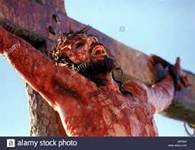
 #2: “Watson, you idiot, someone has stolen our tent:” Sherlock Holmes and his smart assistant Dr. Watson go on a camping trip, enjoy a heavy barbeque dinner with a bottle of whisky, set up their tent, and fall asleep. Some hours later, Holmes wakes his faithful friend. “Watson, look up at the sky and tell me what you see.” Watson replies, “I see millions of stars.” “What does that tell you?” Watson ponders for a minute. “Astronomically speaking, it tells me that there are millions of galaxies and potentially billions of planets. Astrologically, it tells me that Saturn is in Leo. Timewise, it appears to be approximately a quarter past three. Theologically, it’s evident the Lord is all powerful and we are small and insignificant. Meteorologically, it seems we will have a beautiful day tomorrow. What does it tell you?” Holmes is silent for a moment, then speaks. “Watson, you idiot, someone has stolen our tent!”– Watson had missed the most obvious observation. He was clever enough to notice the complexities of the stars, but he missed what was plain and simple. Today’s Gospel reading is about a whole lot of people who miss the point. In Jesus’ healing of a blind man, the Pharisees missed the most evident point that it was a real miracle by Divine intervention. (
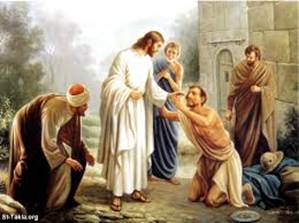
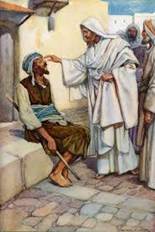
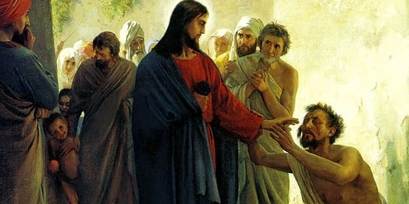
 “Scriptural Homilies” Cycle A (No. 21) by Fr. Tony: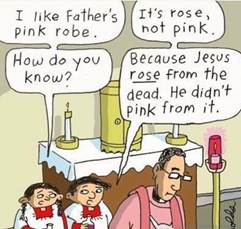

 # 1:
# 1:  Photeine, the Samaritan woman evangelist: Venerated as a saint among the Greek and Russian Orthodox and given the name Photeine (Greek) or Svetlana (Russian), which means radiant or shining (from the Greek noun phos or light), the woman at the well has been variously praised by Origen, John Chrysostom, Augustine, and Teresa of Avila as: (1) an “apostle,” (2) one who “left her water pot at the well in order to go off and preach the Gospel,” (3) “the first apostle to the Gentiles who invited her neighbors to ‘Come and see’.” (
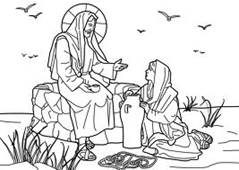
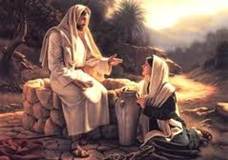
 “Scriptural Homilies” Cycle A (No. 20) by Fr. Tony:
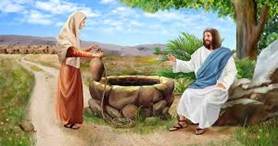

 Fr Tony's Homilies
You must be logged in to post a comment.